Shaun the Sheep the Movie (2015)Animals fare far better in silents than talkies. The absence of dialogue puts them on an equal footing with their human co-stars, and what’s more, they’re cuter. The only place left in these synchronised days where feathered and furred characters can expect top billing is in animated movies – digitally rendered and belting out showtunes. While we have become accustomed to talking animals in children’s animations, ever since Mickey Mouse started to squeak, Aardman’s Shaun the Sheep is a gent from the old school, having stubbornly refused to articulate anything more complicated than a bleat for 20 years.
And now Shaun the Sheep, who like the most illustrious slapstick comedians, is both black-and-white and silent, has been given his very own feature film. And no bankable Hollywood name has been roped in to voice his inner monologue. While the advance publicity has not been playing up the silent angle, this is a dialogue-free delight, a champion of visual gags, physical comedy and unutterable joy. Following on from the 2007 series of short animations made for CBBC, Shaun and his fellows dwell in an almost wordless world, baa-ing and snorting and belching their feelings, just like their harrumphing two-legged companions. As in the shorts, the written word often appears as an incomprehensible squiggle – perfect for young children who would be challenged or bored by too many letters.
Shaun the Sheep the Movie (2015)But Shaun the Sheep has an adult audience too, who appreciated his seven-minute TV escapades not just as kid-friendly fun, but as throwbacks to the silent comedy greats. Aardman’s previous films have cheekily plundered the classics for plots and sly in-jokes – restaging The Great Escape in a hen coop for its feature debut, Chicken Run (2000). Shaun the Sheep the Movie is no exception. There’s barely a frame, or a foley effect here that isn’t a wink to Jacques Tati. And amid nods to Inception, Taxi Driver and The Terminator, there is a Hannibal Lecter-impersonating cat who wins the movie-reference game hands down. C’mon, you’d feel cheated without a mention of The Silence of the Lambs, wouldn’t you? There’s a tip of the titfer to classic British animation too. Shaun’s longing for a break from the farm’s daily grind of tedium and indignity accidentally results in a barnyard mutiny and more than a shade of Animal Farm.
Elusive films, we are always told, can turn up anywhere. And if you’ve read the Primal Screen column in this month’s issue of Sight & Sound, you’ll know the truth of that. Oliver Gaycken, an early cinema scholar at the University of Maryland, stumbled across (most of) a missing Charles Urban film, Cheese Mites (1903) on YouTube. He describes it as “a landmark of early cinema, one of the first film ever made for general audiences about a scientific topic.”
The uploader, not knowing anything about the 35mm nitrate strip he had picked up from an antiques shop, had found an ingenious lo-fi method of digitising the film, and posted it on the video site under a name of his own devising. Gaycken was sent a link by chance and recognised it immediately. Anyway, you can buy the magazine to read the full story, or indeed pre-order Gaycken’s book Devices of Curiosity: Early Cinema and Popular Science, forthcoming from Oxford University Press.
You can see Cheese Mites, properly restored and digitised, on the BFIplayer, or indeed on the institute’s own YouTube page. One thing that will strike you, as you watch those microscopic critters wriggling under the professor’s magnifying glass, is that Cheese Mites is more than a little bit repulsive. The tweedy professor (F Martin Duncan), turns his magnifying glass from his newspaper to his lunch, and uncovers a microscopic crowd of wriggly creepy-crawlies. In the still missing last scene, he chucks his cheese away in horror. You won’t see your humble cheddar-and-pickle sarnie in the same way again. And so, to celebrate this unlikely discovery, here are 10 totally gross moments in silent cinema. Hold on to your stomachs … this is not for the squeamish.
Un Chien Andalou (1929)
The eye-slashing in Un Chien Andalou
Yes, I now that Bunuel and Dali cut to a calf’s eye for the breathtaking “out, vile jelly” opening to this surreal classic. But come on, weren’t you fooled the first time you saw it? And there’s nothing particularly wholesome about a dead calf wearing mascara anyway. See also: the rocket crash-landing in the man in the moon’s eye in George Méliès’ Voyage Dans La Lune (1902) – so much more gory in full colour.
The maggots in Battleship Potemkin
Similarly, the first time one watches Eisenstein’s bombastic Potemkin, one might expect the maggots in the Men and Maggots title card to be metaphorical rather than literal. And certainly one wouldn’t expect to see them in a gruesome close-up, squirming under the doctor’s glasses. “This meat could crawl overboard on its own!” Upsettingly, the resulting stew is only the second most disgusting casserole in this list.
Alice Guy-Blaché’s modern surgery
George Mélies made a version of this a few years later, often titled Une Indigestion, but Guy-Blaché’s earlier film Chirurgie Fin de Siecle (1900) is more widely available. And it’s not one to watch the night before an operation. In this clinic, a sign pleads “On est prie de ne pas crier/Please do not cry”, and the doctors set about the patient with saws, cheerily hacking off limbs, and then slopping them into a bucket, all the while arguing ferociously with each other. They then reattach arms and legs from a bucket of “exchange pieces” (using glue) before re-animating their victim, I mean patient, with bellows.
This is a guest post for Silent London by Isabel Stevens, production editor of Sight & Sound. The Silents by Numbers strand celebrates some very personal top 10s by silent film enthusiasts and experts.
This slideshow requires JavaScript.
Just as films in the nascent years of cinema were characterised by their visual innovation, so too were their posters. Designers enjoyed far more freedom than most of their successors working in the sound era, who toiled in large publicity departments and had to comply with strict restrictions on the size and prominence of stars’ images and their names.
Designs for silent movie posters were also created using many different techniques – from hand-painting unique posters for local theatres to mass-produced lithographs or linocuts. The Stenberg brothers, whose designs alone could fill a list of 10 ground-breaking silent movie posters, even invented a special projector that paused a film frame so faces could be traced, the resulting image appearing somewhere between a painting and a photograph.
The designs collected here are for both masterpieces and little-known films alike, but all preference mood and visual daring, never just relying on tantalising narrative tit-bits to sell a movie. Many of them contain echoes of art movements of the time – Cubism, Art Deco, Constructivism, the Bauhaus and Expressionism – and were created in the 1920s, that decade of wild avant-garde experimentation.
The Green Spider, Vladimir Egorov, 1916 (Credit: The Silent Film Poster: Russia 1910-1930)
The Green Spider, Vladimir Egorov, 1916
Here is the original spiderwoman, accessorised delightfully with eight-legged earrings. It’s a surreal vision that proves that Russian film poster design in the 1910s could be just as imaginative and strange as that of the Soviet era. Little is known about this tale of lust, apart from that it was considered a cult movie at the time of its release and played in theatres in seedy parts of St Petersburg. The poster is the work of Moscow theatre designer Vladimir Egorov, sketched one presumes under the influence of the many arachnoids that featured in the drawings of Symbolist artists such as Odilon Redon and Alfred Kubin.
Safety Last!, Curt Peters,1923
Safety Last!, Curt Peters, 1923
Swedish film poster design was particularly adventurous in the 1920s, as exemplified by this vibrant design featuring stunt-mad comedian Harold Lloyd swinging into the frame and promising vertiginous laughs and spectacle galore. With his clothes billowing in the wind, his hair standing on end and a smile on his lips, he’s enjoying the ride as much as you will.
London is the best city in the world for silent cinema. OK, so maybe I should admit to a little bias, but really, between the BFI Southbank, the Barbican, the London Film Festival, the Phoenix cinema in Finchley, and the capital’s many film societies, rep cinemas, arthouse cinemas, orchestras, concert halls and festivals (including the many visits of the British Silent Film Festival, the Fashion in Film Festival and the recently departed Birds Eye View Film Festival) we are sitting pretty for silents. Whether it’s a symptom or a cause I don’t know, but we also have many of the world’s best silent film accompanists based right here in the Big Smoke.
It’s in this context that in the summer of 2013, two of London’s fabulous silent film musicians, John Sweeney and Cyrus Gabrysch, set up a “silent speakeasy” called the Kennington Bioscope: “a silent cinematic event dedicated to the rediscovery of forgotten masterpieces”. Since then, they have been creating silent cinema magic in South London on a regular basis. The Bioscope is cinephilia at its best – if you’ve been, you’ll know what I mean. If you haven’t been, you are missing out, and I am about to make you jealous. I can’t let another Bioscope go by without telling you all how amazing it is.
The KB (as I have never yet heard one person call it) is held once every three weeks at the Cinema Museum – a volunteer-staffed Aladdin’s Cave of cinematic memorabilia and ephemera. There are more than a few reasons why you voted this place as your favourite silent film venue of 2014. It’s a wee bit like a time machine, whisking you back to a more sedate era of cinemagoing. There’s always an interval, ushers may well be wearing natty uniforms, someone will undoubtedly strike a gong to prompt patrons to take their seats, and the adverts before the screening will remind those assembled of the proper etiquette required. Tickets, which cost just £3, are made of cardboard and ripped off a reel. Most important of all, the projection booth is staffed by an expert projectionist, showing films of all shapes and sizes as often as possible.
This is a guest post for Silent London by Peter Baran. You can follow Peter on Twitter at @pb14.
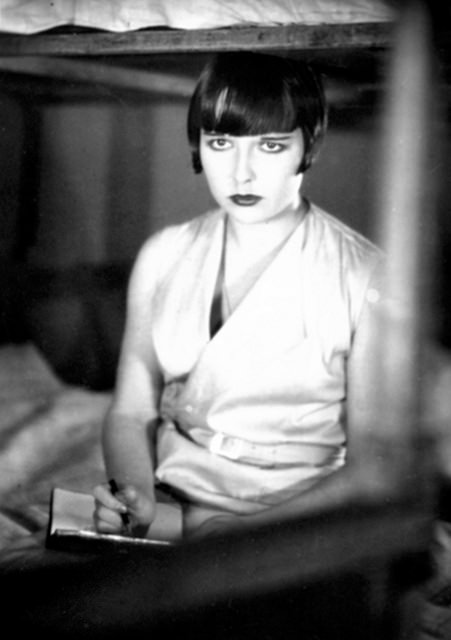
Louise Brooks and GW Pabst, an irresistible combination? Certainly Pandora’s Box (1929) caught lightning in a bottle, creating one of the most iconic female roles in all of silent cinema. In Pandora’s Box, Pabst and Brooks tease eroticism out of a certain ingenue naivety, whereas in her previous US films (A Girl In Every Port and Beggars of Life in particular) Brooks had offerede a slightly more world-weary sensuality. So it is no surprise that Pabst saw Brooks as the perfect person to play Thymian, the sheltered girl who will drop through the cracks of life via a workhouse for fallen women and prostitution.
This new Blu-Ray transfer of Diary of a Lost Girl (Tagebuch einer verlorenen, 1929) by Eureka’s Masters of Cinema label is a crisp and beautiful version of what is clearly an exploitation movie. As in Pandora’s Box, Pabst’s walks the tightrope of commenting on eroticism and sensuality; too often he falls off the tightrope into titillation. The film is set up for us to rue the difficult circumstances that lead to Thymian’s journey from a fine middle-class household down into poverty and eventually to selling her body. Except everything is still a bit clean. The reformatory is horrid, but only in comparison to her comfortable home – and its horridness is more due to a Miss Hanniganesque management rather than something inherent in the system. And there isn’t really too much criticism of Thymian’s shaming (AKA rape), and pregnancy. You get the sense that the original author (the film is based on a popular Margarete Böhme novel) and the film-makers are just following through the logical conclusion of these incidents. Instead, we end up with a somewhat warped fairytale, a slow-burn Snow White where the dwarves run a brothel full of happy hookers, or Cinderella with calisthenics.
Diary of a Lost Girl (1929)
There is a sensuality and rawness in Pandora’s Box, coming from Lulu’s naivity, which Thymian doesn’t share at all. At least by the time the film has put her through her paces as part of the reformatory’s physical education routine, she has no sense of wild abandon. It is a wholly more sinister erotic thrill, underlined (perhaps a bit too heavily) by the matron whipping her gong and clearly getting far too much pleasure out of the whole affair. This part of the film could be subtitled Reform School Girls do gym:






 Silent London