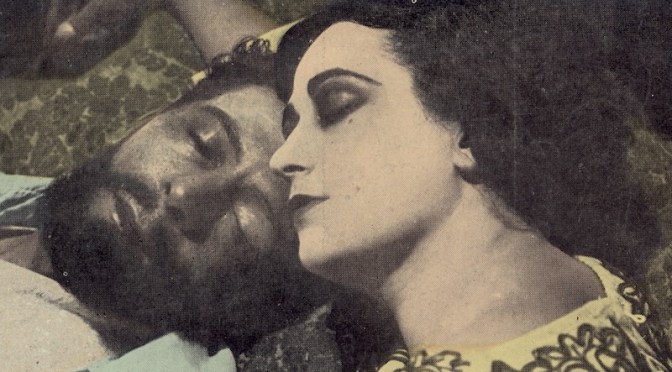
Monday finished with a zinger. I mean a Zingari. Italia Almirante Manzini wowed the Verdi as Wilejka, a heavy-lidded beauty with great hair, but in this case as a heavy-lidded beautiful Gypsy shepherdess with great hair. In Zingari (Mario Almirante, 1920) Wilejka falls in love with a man, Abaldo (Amleto Novelli, no less) that her father, the leader of the camp, forbids her to marry. There is many a consultation of the cards, a fireside dance, a storm, a threatening villain, a crushing pang of jealousy, an assassination and naturally, a barn on fire before this will all end happily ever after.
Maybe it sounds generic when I put it that way, but this film had life, it was brimming over with it. With action and passion and characterful faces on compelling characters. Manzini pulled her shawl tightly around her shoulders, drew herself up to her full height and commanded the camera. Her close-ups were sensuous and also, deeply expressive. This was the first of 10 films she made with her cousin Mario as director, and it’s a great partnership. The frame was so often crowded with movement, whether of crowds or animals or foliage, the landscape dotted with brightly costumed extras, even some scene-stealing sheep. I particularly liked the shepp. And even the hand-drawn Polish intertitles gave it a little something extra. But of course the real reason that this was such a triumphant climax to our day was the tremendous work of Gunter Buchwald, Elizabeth-Jane Baldry (on harp and vocals) and Frank Bockius on the spirited accompaniment, the perfect soundtrack to the adventures of a woman who wanders over hill and dale, in pursuit of her one true love, but audaciously, in four-inch heels.
Not that we hadn’t had plenty of drama already. We’re adding new rules to the silent film guidebook everyday. One more we need is don’t get on a boat with Hobart Bosworth. Many of us are still harrowed by Behind the Door (Irwin Willat, 1919). And this morning we went through the ringer again with a rediscovery, The Blood Ship (George B. Seitz, 1927). This was a terrific melodrama with Bosworth as the grizzled sea dog who eventually takes revenge on the tyrannous brute (Walter James) who stole his wife, then killed her many years before. Hunky Richard Arlen (really looking his very best here) plays a young sailor who joins the cursed voyage, purely due to the charms of Bosworth’s estranged daughter, played by Jacqueline Logan. I explained that plot backwards, but the film is best enjoyed forwards, leading up to its violent climax. There is a very nasty-looking whip. There should be another rule in the silent film guidebook about whips. Donald Sosin really leaned into this one, a fantastic accompaniment in a day of great music.
More melodramas in miniature this morning from Louis Feuillade, from Gaumont’s Films Esthetique series. I had an elsewhere to be so only saw too. The Vipers (1911), about the perils of vicious village gossip, and Le Nain (1912), about a poet with dwarfism and his love for his leading lady. Who in the end, really lets us all down, quite frankly. Like novels written on postcards, these, full of character and feeling and rich décor but just a reel or so long. And to add to the feeling of luxe, we had both Daan ven den Hurk and Elizabeth-Jane Baldry covering these films with love today.
After lunch, a real rediscovery, a June Mathis-scripted adaptation of God’s Half Acre, directed by Edwin Carewe in 1916. An ambitious ensemble plot here, but the gist was the young Blossom (Mabel Taliaferro, for whom Mathis wrote the film) works in a nursing home, visited by a married novelist looking for material (J.W. Johnston), but instead finding her, a “mite of wonderment”. Complications ensue, largely in the missing reel. But love, er, blossoms, leading to much awkwardness until, oh, the novelist’s wife absconds with a cad, apparently gay-coded but well there you go. And “Will you ask me that question you asked me once before on the stairs?”. Plus there is an exploding car. Wonderful. And thank you to John Sweeney for guiding us round those hairpin turns.
Hairpin turns of the conceptual rather than narrative bent abounded in the first programme from the Belgian avant-garde. How to summarise? Well let’s not. Let’s conjure the atmosphere: delight, confusion, horror… charm? Sur les bords de la camera (Henri Storck, 1932) was a very successful montage exercise based on found footage, which manages to depict seemingly a whole world of variety through matching and clashing edits of various kinds, with humour and playfulness and light and then suddenly something terrible emerges, as if it had been there all along, hidden in the violence of the edit. Histoire de Détective (Charles Dekeukeleire, 1929) was bursting with cards that could be intertitle of the day. It was disqualified form that contest for trying too hard. Through “documents psychologiques”, mostly still images, animated portraits and captions, this film compiles the dossier of evidence supposedly gathered by a private investigator on a Mr T, at the request of his wife. It both is and isn’t that, and it really could test your patience except it was very witty, and unexpectedly emotionally fraught. How Mauro Colombis felt accompanying this I have no idea but it was a terrific double-bill. Very excited for more from this strand.
Intertitle of the Day
“Please make me a young young lady again. I don’t want to be old!” You and me both, Blossom. That’s God’s Half-Acre.
Chatup line of the Day
“I wish to test the power of my kiss.” Abaldo to Wiljeka in Zingari. He meant it, too.
- Look, I drank too much coffee again. Let’s say no more about it.
- Sine Nomine. Can you help identify an unidentified silent film?
- You can read more about the festival, and all of the films, on the Giornate website.
- I am on Letterboxd – watch me struggle to keep up with all these films.
- Silent London will always be free to all readers. If you enjoy checking in with the site, including reports from silent film festivals, features and reviews, please consider shouting me a coffee on my Ko-Fi page.
 Silent London
One thought on “Le Giornate del Cinema Muto 2025: Pordenone Post No 3”