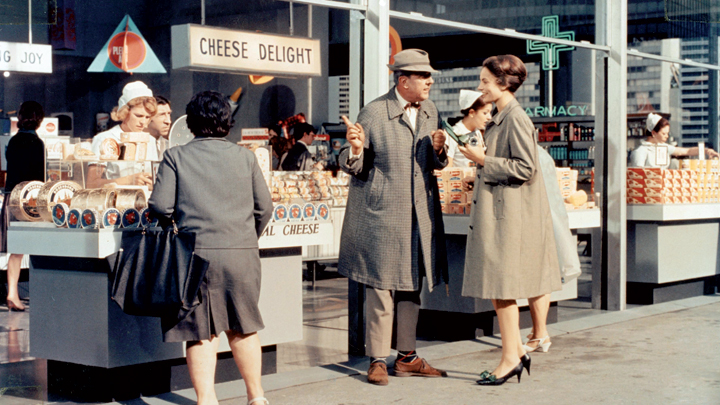
For Jacques Tati, diegetic sound is about as useful as headlights on a broom. He’d rather not illuminate anything with such a crude tool. Playtime, his masterpiece, is a work of brow-furrowing complexity in its design and structure, but a model of narrative clarity.
Amid the Babel of un-synched language spouted by its multiple characters, Tati tells us a story of a man, M Hulot, trying to negotiate a city, Paris, that doesn’t exist. Only Hulot (Tati, of course), and an American tourist, Barbara (Barbara Dennek) seem to notice that the steel and glass skyscrapers of the soaring sixties have hidden the real city, obscuring its landmarks and dividing its citizens. Tati goes to a business meeting, is diverted to a furniture show, meets an old friend who invites him home for a drink, attends the opening of a restaurant, meets a girl and loses her, all in the space of 24-odd hours.
Each twist in Hulot’s meander is a prompted by a mistake or misapprehension. His attempt to refuse to enter the restaurant shatters the door and he stumbles inside unwillingly. If I tried to explain to you why a German door salesman then ushers him further into the dining room I would expend many, many words to explain a labyrinthine incident earlier in the film that is played out in at least three languages, none of which needed subtitles at all.
Playtime (1967)
Trust me, it was a wonderful moment. I felt that door salesman’s anger, his hostility, his sarcasm, his deep shame and his ingratiating warmth so deeply, because they were so strongly expressed, not because I translated “Dumbkopf!” in my head. The only skills you need to understand this film are patience and observation, which transparently makes my German GCSE barely worth the paper it is written on.
Man with a Movie Camera, dir. Dziga Vertov (USSR 1929)
Man with a Movie Camera, dir. Dziga Vertov (USSR 1929)
Man with a Movie Camera, dir. Dziga Vertov (USSR 1929)
Man with a Movie Camera, dir. Dziga Vertov (USSR 1929)
Man with a Movie Camera, dir. Dziga Vertov (USSR 1929)
Man with a Movie Camera, dir. Dziga Vertov (USSR 1929)
Two years ago, Dziga Vertov’s landmark art film Man With a Movie Camera crashlanded into the top 10 of the Sight & Sound Greatest Films of All Time poll. Today, I can jubilantly announce that this year Movie Camera tops another Sight & Sound poll – the hunt for the Greatest Documentary of all time. There’s another silent in the top 10 too – the wondrous, beautiful, and controversial Nanook of the North (Robert Flaherty, 1922).
1. Man with a Movie Camera, dir. Dziga Vertov (USSR 1929)
2. Shoah, dir. Claude Lanzmann (France 1985)
3. Sans soleil, dir. Chris Marker (France 1982)
4. Night and Fog, dir. Alain Resnais (France 1955)
5. The Thin Blue Line, dir. Errol Morris (USA 1989)
6. Chronicle of a Summer, dir. Jean Rouch & Edgar Morin (France 1961)
7. Nanook of the North, dir. Robert Flaherty (USA 1922)
8. The Gleaners and I, dir. Agnès Varda (France 2000)
9. Dont Look Back, dir. D.A. Pennebaker (USA 1967)
10. Grey Gardens, dirs. Albert and David Maysles, Ellen Hovde and Muffie Meyer (USA 1975)
Both of these films deserve endless discussion and analysis, it’s true – as do the others in the list, from Shoah (Claude Lanzmann, 1985) to Don’t Look Back (DA Pennebaker, 1967), but I want to linger on Vertov’s film for now. I think it’s rather special – but I am intrigued by its success in this poll. For me Man With a Movie Camera is really an art film, not a documentary, because it foregrounds technique and display above truth-telling and information-imparting. Not that it doesn’t do that too, but in the world of documentary film-making, City Symphonies have every right to push form over content, and Man With a Movie Camera is the most invigorating of all City Symphonies. This is a movie about the sheer joy and madness of film-making – stopmotion, superimposition, freeze-frame, split-screens, rewinds, acute angles and all. It exalts in the possibilities of photography and motion. From the opening scene in which the cinema seats slam down one by one, onwards, we are sure that this will be a movie about the movies, and all the more enjoyable for that. It’s as addictive as popcorn, as edifying as high art.
Is it worthy of comment that Man With a Movie Camera is in the ascendancy at a time when there is little good news coming out of Ukraine? I’m not sure – for most viewers, I suspect this film is lumped in with the less-specific categories labelled “Soviet”, “Silent” and “Arthouse”. But it always does us good to remember that far-away parts of the world are synonymous with more than the bad news that hits the headlines. This poll result reminds us that Ukrainian cinema, as showcased at last year’s Pordenone Silent Film Festival, shines in our global film heritage. There are, you’ll note, no British films in the top 10.
Will this be something we consider to be a truly silent film? Who knows. But it’s dialogue-free, delightful and comes to us courtesy of our friends at Aardman Animations, whose support for the Slapstick Festival is legendary. Shaun the Sheep the Movie is scheduled for release in spring 2015. Not just for kiddywinks, we’re sure.
From Aardman, the creators of Wallace & Gromit and Chicken Run, comes the highly anticipated big screen debut of Shaun the Sheep. When Shaun decides to take the day off and have some fun, he gets a little more action than he baa-rgained for! Shaun’s mischief accidentally causes the Farmer to be taken away from the farm, so it’s up to Shaun and the flock to travel to the Big City to rescue him. Will Shaun find the Farmer in the strange and unfamiliar world of the City before he’s lost forever? Join Shaun and the flock on their hilarious, action-packed adventure in Shaun the Sheep the Movie – only in cinemas Spring 2015.
This is a guest post for Silent London by Sabina Stent. Sabina has a PhD in French studies from the University of Birmingham and is a regular contributor to Zero magazine. Her PhD thesis was on Women Surrealists: sexuality, fetish, femininity and female surrealism – and you can read it in full here. This article is an edited extract from her thesis, focusing on the early cinema of Luis Buñuel.
Sabina Stent
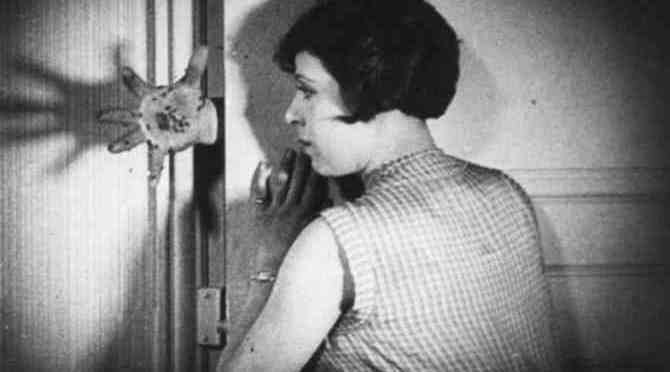
There are particular images that were central to the Surrealist movement. The human hand, for example, became a frequent Surrealist motif and can be seen in the movement’s films, paintings and photography. Why were these motifs so important to Surrealism and why do we continue to discuss them as part of the movement’s history? To understand why we must look to the Surrealist films of the 1920s, specifically Un chien andalou (Salvador Dalí and Luis Buñuel, 1928) and L’Age d’Or (Buñuel, 1930) and how key scenes emphasised the reoccurring themes that were so central to this movement.
The repetition of hands in Un chien andalou is, to put it simply, a symbol of fetish: what hands can do and how they can generate both intense pleasure and intolerable pain. Williams has commented that ‘the function of the fetish arises from the fear of castration’ and can only be preserved through making the object in question a symbol of fetish.[1] The repetition of wounded and severed hands in the film represents castration fear, and more specifically, a disembodied phallus. This is emphasised when we realise that all the hands, whether injured or exuding ants, are male. Continue reading Surrealism, symbols and sexuality in Un Chien Andalou (1929) and L’Age d’Or (1930)→
You hate bad dialogue, I hate bad dialogue. And clunky, needless expository dialogue is the worst: the most heinous crime in sound cinema. A good rule of thumb for screenwriters would be to look at each line they want their actors to spout and say: “Would this be an absolutely essential intertitle?” Without all those words, actors have to tell the story physically, by acting, rather than describing: they say a picture tells a thousand words after all. With 24 frames a second, who needs text, by that logic?
This is clearly a pet hate of mine – I rarely see a new movie without wanted to take a red pen to the script here and there. So thank heavens for All is Lost, the tremendous new film from JC Chandor (Margin Call), starring Robert Redford as a sailor lost in the middle of the Indian Ocean. Redford is the only actor in the film – it’s just him, the boat, the water and a series of catastrophes until the bitter end. And he’s fantastic in it – his nicely grizzled features reacting moment by moment to his impending doom. It’s a physical role for sure, as he tackles the high winds and rolling waves – but for the full Ancient Mariner angst, he needs to capture our sympathies too, and let us know what’s going on behind those famous blue eyes.
You’ll have guessed the twist: as Redford helms the movie solo, there’s no real dialogue at all. I don’t want to spoiler the film, but he speaks a few words; wouldn’t you curse a little, in his deck shoes? For most of the film’s 106-minute running time, however, all you’ll hear is the roar of the ocean, the clattering and cracking of his boat and a hell of a lot of weather. The score, by Alex Ebert, appears only sporadically, and there’s no intrusive internal monologue to break the tension either. So with all that space in which to act, and such a simple story, Redford is free to give an indelible, immense performance that’s a pleasure to watch. Or it would be, if one weren’t so terrified for him.
All is Lost wouldn’t qualify as a silent movie, I know that. In fact its stunning sound design is as Oscar-worthy as Redford’s star turn. But it is a rare sound film that has learned the extraordinary power of silents – and it’s really very special indeed.
Waiting for a festival screening to begin at Cinema Arlecchino in Bologna.
Completists, please avert your gaze. During the three days I spent at Il Cinema Ritrovato in Bologna I missed far more than I saw. With four screens, plus lectures, workshops, exhibitions, open-air screenings, and programmes for children all running at once, there is too much here for any one person to take in. It’s a festival that requires endurance, decisiveness and a philosophical approach to the ones that got away. But if you think you’re tough enough, start clearing your diary for summer 2014. And welcome to classic cinema bootcamp.
Ritrovato is all about rediscovery – the films on show here have all been found, restored or reclaimed. They are the work of film-makers whose work deserves a second look, or whose weighty reputation means that their films merit a little extra care and attention. To this end, the festival is woven from many strands – and even if one were to stay for the entire festival, it would require a certain single-mindedness to see one of them through from start to finish. On my flying visit, I didn’t have a hope. This is my way of excusing my scattergun approach to the festival – a programme of early shorts here, a classic Chaplin two-reeler projected in the Piazza Maggiore there, a lush new print of a silent Hitchcock here, a rustic Soviet melodrama there. And sound films too. Lots of them, actually, I cannot tell a lie.
According to my notes, the first film I saw at the festival was a four-minute snippet from 1913 called Hungarian Folklore, which detailed wedding traditions in the country. Good intentions and all that. This was followed by Baby Riazanskie, a chewy melodrama directed by Olga Preobrazenskaja and Ivan Pravov. I never saw another of their films – because I was distracted by other delights, and because I was slightly underwhelmed by this one. Another regret.
Zaza (1923)
My highlights included the Allan Dwan silents, especially Zaza and Manhandled starring the fantastic, feisty Gloria Swanson, and the action-packed East Side, West Side. I enjoyed many of his sound films too: witty sweet-hearted comedies from the 40s and 50s.
I was captivated by the beautiful if overlong city symphony Etudes Sur Paris – catch it for the underground canal sequences alone. I was moved by Victor Sjostrom’s social drama Ingeborg Holm (a 100-year-old Swedish Cathy Come Home) and tickled pink by Chaplin’s The Cure.
The Cure: Charlie Chaplin and Eric Campbell on the big screen in Piazza Maggiore, Bologna
Another highlight was a recently discovered collection of sweet colour films from 1906 screened using carbon light projector in the Piazzetta Pasolini late at night. I didn’t want that to end. The Farmer’s Wife, all gussied up by the BFI as part of the Hitchock 9 project, looked beautiful and its peculiarly English humour translated well to the Bologna audience.
When it comes to talkies, I was emotionally shredded and enthralled by Anna Magnani in Rossellini’s L’Amore – and again in Roma Citta Aperta. Plein Soleil, La Belle et La Bete, Chimes at Midnight … I don’t feel the least bit guilty about watching those.
The main thing I missed during my trip was Bologna itself. I strolled around the Piazza Maggiore one morning, and glimpsed the two tipsy towers, but I was far too distracted by the flickers to do any real sightseeing, or sunbathing in the 30-degree heat. Arrivederci, Bologna.
And if you’re thinking of visiting Il Cinema Ritrovato next year, here are my top five tips for festival newbies. If you’ve been to Ritrovato before, please share your tips below:
Get yourself a map of Bologna. And mark the festival venues on it. Do this before you arrive so you’re not wandering the streets panic-stricken, in search of a Gloria Swanson film, like a certain blogger of our mutual acquaintance.
Patience is a virtue. The screenings run late. And almost every film is prefaced with a long introduction, in at least two languages. Luckily the movies are worth the wait.
Health and safety. Strappy wedge sandals, cobbled streets and ten-minute gaps between screenings led me dangerously close to a few unscripted slapstick moments. There is a shuttle bus in operation between the cinemas, for those who really need assistance. For the rest of us – these strolls are the only exercise you are going to get all week. And drink lots of liquid: caffeine will get you through the schedule, but it’s hot out there, so drink plenty of water too.
See one film you’ve never heard of every day. The best festival experiences are the surprises – and the programme at Ritrovato has plenty of surprises up its sleeve.
Don’t be discouraged by the catalogue. The descriptions of films in the official catalogue are useful, and very detailed, but often a little cool. Trust your instincts – and the festival programmers.






 Silent London