Tag Archives: Kevin Brownlow

How to beat the Napoléon blues

Napoléon (Abel Gance, 1927)
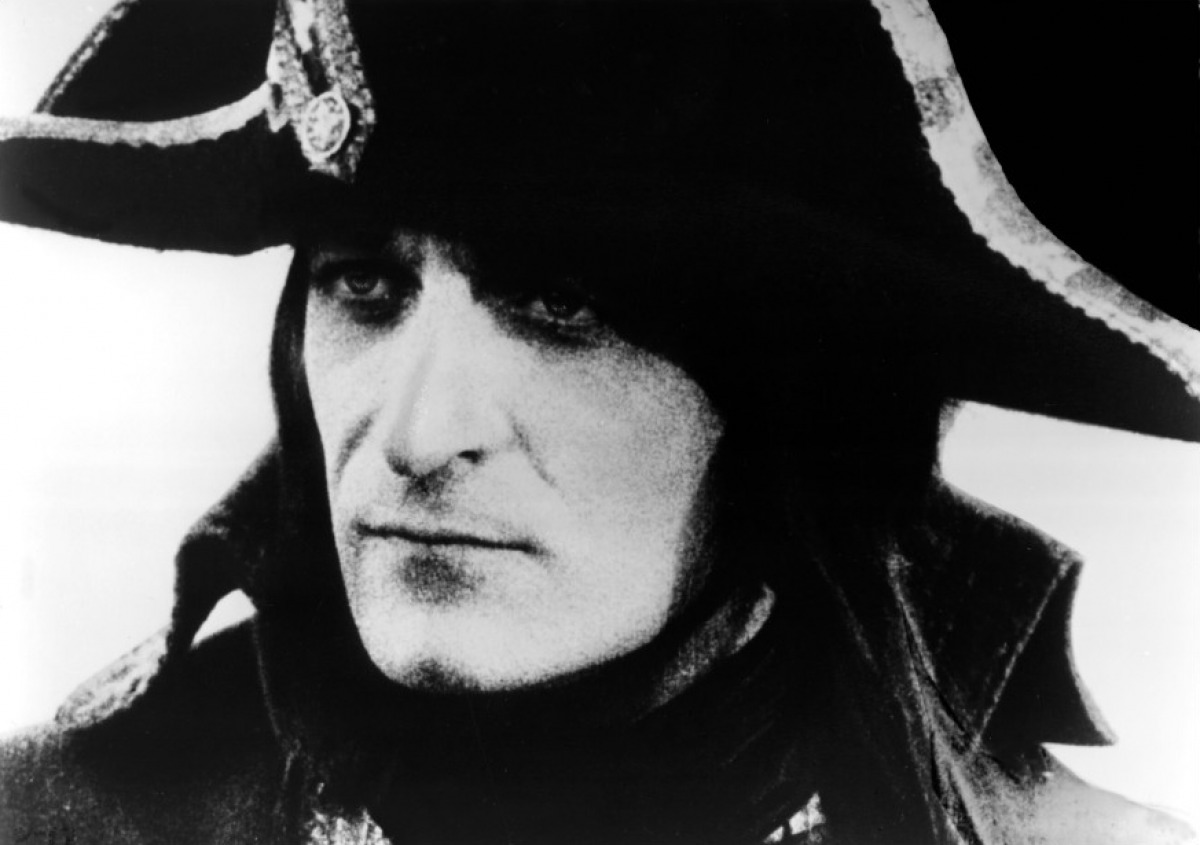
Albert Dieudonné in Napoléon (Abel Gance, 1927)

This weekend, something momentous is happing in California. Kevin Brownlow’s mammoth restoration of Abel Gance’s legendary epic film Napoléon is screening at the Paramount Theatre in Oakland, accompanied by the Oakland East Bay Symphony Orchestra playing the US premiere of Carl Davis’s wonderful score. Wow. That’s five-and-a-half hours of majestic, groundbreaking silent cinema with fantastic live music, and it’s not an opportunity that comes along very often. If you want to be there, you need to know that there will be two screenings this weekend, and two the next: tickets are available here, starting from around $50 and going up to $550 for a premium seat including a gourmet dinner and reception with Brownlow and Davis.

Unfortunately, it’s not a cheap proposition for us Silent Londoners if you throw in the cost of flights, hotels and taking leave from work. While a few friends of the blog are making the trip west for Napoléon, most of us will be sitting at home, trying not to let the jealousy get the better of us.

But there’s no need to succumb to the green-eyed monster. Napoléon last played in London in 2004 and although Brownlow is adding new footage all the time (the original film ran at around nine hours) so the California screenings will technically be an advance on those shows, it’s only a matter of time before Gance’s masterpiece makes its way back to us. What I’m hearing, from reputable sources, is November 2013, at the Royal Festival Hall.

However, if that still seems like a long way away, and you’re suffering from FOMO (otherwise known as the Fear Of Missing Out), here is a five-point guide to help you pass the time, and overcome the Napoléon blues.

1 Get your Photoplay fix

Napoléon isn’t the only film to have been restored by Brownlow and Co, nor is it the only one to benefit from a Carl Davis score. Tickets are already available for Ben Hur at the Royal Festival Hall this summer. And if you want to look even further ahead, the Philarmonia Orchestra will accompany The Thief of Baghdad at the same venue in June 2013.

2 Do your homework

The story of how Abel Gance struggled to make his masterpiece, how it was shredded and how Kevin Brownlow pieced Napoléon back together starting with the 9.5mm snippets he bought as a schoolboy is worthy of a film adaptation itself. You can read all about it in Brownlow’s book, which is available to buy here with a sampler CD of Davis’s score. Napoléon has been all over the American media recently too, in the runup to the Oakland shows, so there’s plenty more to devour. You can read Martin Scorsese in Vanity Fair, or this neat MUBI post, which tells the story of the film via its many posters. The Wall Street Journal and New York Times both printed heavyweight features about the film, Gance and Brownlow’s restoration. If your French is up to the task, the San Francisco Silent Film Festival blog has posted some original articles from the French press about the making of the movie. I also enjoyed this Smithsonian blog that pushes The Artist to one side to say that this restoration is the silent film event of the year. And who can argue with that?
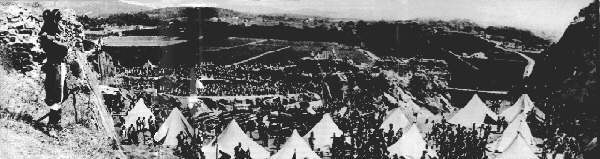
A Napoléon triptych
A Napoléon triptych
Polyvision
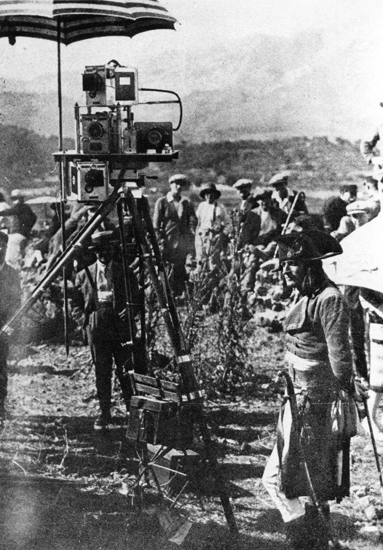
Three movie cameras stacked on top of each other on the set of Napoléon to film in ‘Polyvision’.

3 See the bigger picture

Of Gance’s many extraordinary technical and artisitic innovations in Napoléon, the most famous must surely be the film’s climactic triptychs: a way of creating an early form of widescreen that required three cameras on set and three projectors in the cinema. This Polyvision effect is also one of the reasons why the film is so rarely shown. Intrigued? On 29 April, more or less fresh from the Oakland screenings, Kevin Brownlow is speaking at the Widescreen Weekend festival in Bradford, and it’s a fair bet that he will mention Napoléon. The subject of his lecture is: ‘From Biograph to Fox Grandeur. Early Experiments in Large Format Presentations’. It strikes me that if you want to learn more about Polyvision from the man who knows more than most, that’s the place to be. If you’re lucky, he may even screen a clip or two.

4 Gen up on Gance

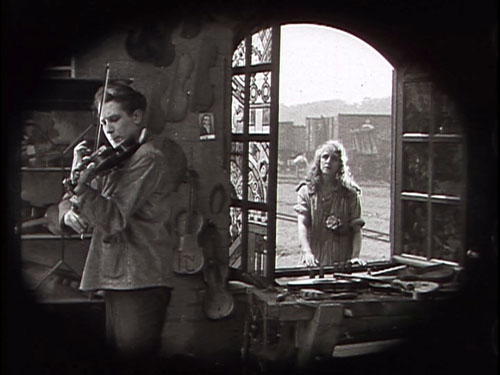
Of course, Napoléon wasn’t Gance’s only film. It wasn’t even his only great film. If you have the technology to play Region 1 discs, Gance’s anti-war film J’Accuse (1919) and his impressionistic railway melodrama La Roue (1923) are both available on very nice DVDs, courtesy of Flicker Alley. At around four-and-a-half hours long each, they are ambitious by any standard, although they can only hint at the scope of Napoléon, and they’re well worth devoting a clear afternoon and a coffee pot to. If you’re shopping around for import DVDs, you may well find the four-hour cut of Napoléon, with Carmine Coppola’s score. It’s not quite the real deal, of course, but still fascinating.
La Roue (1923)
La Roue (1923)

5 Clear out your attics

Brownlow’s restoration of Napoléon is magnificent, but it’s still not complete. Wouldn’t it be wonderful if there was more waiting to be discovered? And unearthing the final reels of a film this important is surely every silent cinema geek’s number one fantasy. Apart from the ones that involve a close encounter with Buster Keaton/Louise Brooks (delete as applicable), that is.
The Goose Woman: London Film Festival review

The Goose Woman (1925)

This review is a guest post for Silent London by Philip Concannon of the Phil on Film blog.

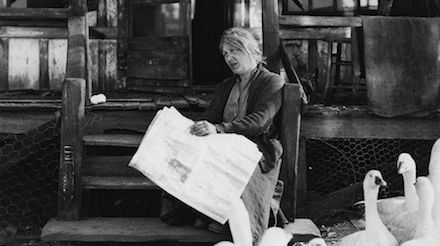
During his interesting (if incredibly long) introduction to The Goose Woman at its London Film Festival screening, Robert Gitt suggested that Louise Dresser would have won an Academy Award if the ceremony had existed in 1925. Having watched the film, few will disagree with his assessment. Dresser plays Mary Holmes – the eponymous goose woman – an alcoholic, embittered old crone living on a remote farm. Twenty years earlier, she was Marie de Nardi, a beautiful singer on the cusp of fame, but she gave up her career to have her son Gerald (Jack Pickford) and now she has nothing but her memories, her geese and a pile of broken booze bottles outside her window. Dresser’s performance as this unsympathetic protagonist is remarkable, expressing sadness, regret and bitterness through her subtle but forceful acting.

Clarence Brown’s film is adapted from a story by Rex Beach, which was itself based on the real-life “Pig Woman” case (heavily publicised by William Randolph Hearst’s press at the time). It’s the tale of a murder that Mary claims to have witnessed, milking the subsequent publicity and press attention for all it’s worth, and propelling herself back into the spotlight, but her fabricated account of what happened that night inadvertently frames her own son for the murder. This narrative is given an extra charge by the tensions that are already simmering between Mary and Gerald, with Mary blaming her son for her ruined career, and their relationship reaches its nadir when she hits him with a revelation about his parentage that’s so shocking the film can’t even articulate it. The Goose Woman is so coy about the nature of this secret that for some time I wasn’t sure what it was; all we see is Mary spitefully mouthing the truth as her son recoils in horror, and then he tearfully runs to his fiancée Hazel (Constance Bennett) who reacts with similar dismay.

Aside from that confusing plot niggle, The Goose Woman‘s story is handled with great skill and sophistication by Brown, who keeps the action down-to-earth and rooted in character, sustaining an impressive level of suspense (with welcome burst of humour) until the final scenes. He has a great eye for detail and there are some lovely, telling moments scattered throughout the movie, like the running gag involving Mary’s attempts to hide her whisky bottle, or her habit of judging every man she meets by rubbing his business card (if you don’t have embossed lettering, you’re not worth a damn, clearly). His visual style is simple but effective, and he puts together a terrific sequence during Gerald’s interrogation, cutting away to a dripping tap, nuts being cracked and coins jangling, as the suspect’s anxiety grows. This latter scene is also the kind of interlude that allows accompanist Stephen Horne to get creative on his piano and flute; as ever, his playing at this screening caught the tone and mood of the picture perfectly.

In the years following this film, Brown went on to direct a number of stars to some of their most celebrated performances (including Greta Garbo, who called him her favourite director) and it’s clear from The Goose Woman that he was very much an actors’ director. All of the performances here are a pleasure to watch, particularly the scene-stealing James O Barrows and Gustav von Seyffertitz as a detective and district attorney who have a competitive relationship in the movie’s background, and it’s nice to see Jack Pickford – so often in his sister’s shadow – given a rare chance to shine. However, The Goose Woman ultimately belongs to Louise Dresser, whose outstanding lead performance, like the film itself, deserves to be rediscovered and celebrated.

Philip Concannon

Pêcheur d’Islande at the Institut Français, 11 October 2011

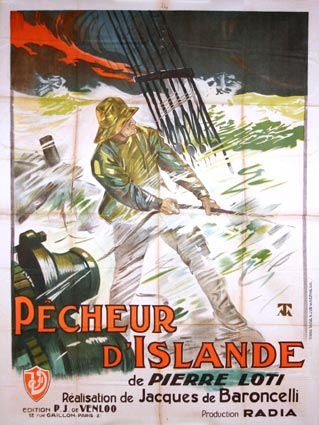
Pêcheur d'Islande (1927)

Pierre Loti’s novel Pêcheur d’Islande combines realism and impressionism as it explores the hard life of Breton fishermen who risk their lives to catch cod in Icelandic waters. The tragic air extends as far as the novel’s love story, a romance between a sailor, Yann and a young girl, Gaud, who meet at a party. Gaud is in love with Yann, but he is also in love with the sea …

In 1927 the novel was adapted for the screen and directed by the Jacques de Baroncelli, a Frenchman who had made many films in the silent era. Pêcheur d’Islande was shot on location in Brittany, and the landscapes both on land and at sea are magnificent. It’s a rarely seen film, and so you’ll be very happy to know that its forthcoming London screening will be introduced by – Kevin Brownlow. Not only that, but Neil Brand will provide piano accompaniment.

Pêcheur d’Islande screens at the Ciné Lumière at the Institut Français on Tuesday 11 October at 6.30pm. Tickets cost £10 or less for concessions and are available on the Institut Français website here.

Kevin Brownlow talks about Winstanley. Plus, tour the BFI National Archive

Inside the BFI National Archive (bbc.co.uk)

These two events caught my eye in the JuLy BFI brochure.  They’re not silent film screenings, and one of them isn’t even in London, but they are definitely worth a peek.

First up, your favourite silent film historian and mine, Kevin Brownlow, will be appearing at BFI Southbank to introduce a screening of his film Winstanley on 5 July. There’ll be time for a discussion after the film too, which is bound to include some talk of silent cinema. I’d bet my second-best cloche on it, in fact. This event is free for seniors, so if you’re over 60 this is a can’t-miss. The rest of us whippersnappers are invited too, but we’ll have to pay usual matinee ticket prices.

Winstanley screens at 2pm on Tuesday 5 July in NFT1. There are no details on the BFI website, so it might be worth ringing the box office on 020 7928 3232.

Second, there is an opportunity for BFI members to pay a visit to the National Archive in Berkhamsted. It’s a three-hour tour, including light refreshments, and you’ll have the chance to talk to some of the talented people who work there, and find out how films are restored. It seems like an apposite time to visit, with all the work currently being done on the Hitchcock 9 project, and the fact that the archive has recently been placed on the Unesco World Heritage register.

The cost of the archive visit is £25 or £20 for concessions, and the tour will take place on Tuesday 19 July. Log in to the BFI website to find out more or call 020 7928 3232 to book.

Those Surprising Silents with Kevin Brownlow, The Cinema Museum, 14 April

The Fire Brigade (1926)
The Fire Brigade (1926), from silentfilmstillarchive.com

Fresh from winning an Oscar last year, Kevin Brownlow will be in London in April to give an illustrated lecture at the Cinema Museum. The talk will use clips (all projected in 35mm) to explore the development of silent film technique, from one-shot shorts, to epic features. The clips will include newsreel footage as well as a sequence from The Fire Brigade (1926, hat-tip to mrbertiewooster on Nitrateville for that information), and will be accompanied on the piano by Stephen Horne.

Those Surprising Silents will begin at 7.30pm and should finish at 10pm, on 14 April. Full information can be found here at the Cinema Museum website.

The Blot, BFI Southbank, 28 March 2011

The Blot (1921)
The Blot (1921)

BFI Southbank has a busy schedule of silent films in March. All except this one are part of the Birds Eye View festival, and you can read about them here. The odd one out is also a film by a pioneering female film-maker, however, and is screened as part of the Passport to Cinema programme, introduced by Kevin Brownlow. It’s The Blot, directed in 1921 by Lois Weber:

The Blot is a realistic study of genteel poverty among the struggling middle-classes. An underpaid college professor scarcely has the means to support his wife and daughter, who in turn has three suitors, one an impoverished cleric, one the son of a nouveau riche neighbour, and one a playboy. The film is a subtle and compassionate study of the vagaries of society’s rewards.

An early example of “gritty” socially conscious film-making, The Blot was shot largely on location, often using natural lighting and with non-professional actors. The story highlights the plight of low-paid workers and the film’s mesage is sadly still relevant to modern audiences, so this should be a very interesting evening.

The screening of The Blot will be accompanied by the short animation The Country Mouse and the City Mouse as well as the talk by Kevin Brownlow. It will be shown at 6.10pm on Monday 28 March in NFT2. Tickets are available on the BFI website here.

The Birth of a Nation, BFI Southbank, 24 January – postponed

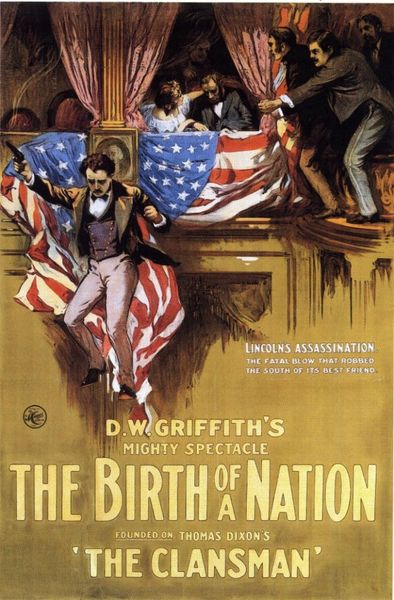
The Birth of a Nation (1915)

Due to technical difficulties, the screening of The Birth of a Nation (DW Griffith, 1915) at the BFI Southbank on 24 January has been cancelled, but it will be rescheduled for later in the year. Hopefully, the rearranged screening will also benefit from an introduction from Kevin Brownlow as originally planned. Of course, we’ll pass on the details as soon we know more.