When I am not on duty at Silent London, I write for less prestigious outfits. Speaking of which, I have a monthly column in Sight and Sound – have done for a year now. I use this column mostly to talk about the places where young cinema and old cinema meet. My last column was a little different. It’s about the most moving cinema experience I had all year: watching Mikhail Kaufman’s In Spring (1929) at the Tromsø Stumfilmdager with live music from Ukrainian musicians Roksana Smirnova on piano and Misha Kalinin on electric guitar.
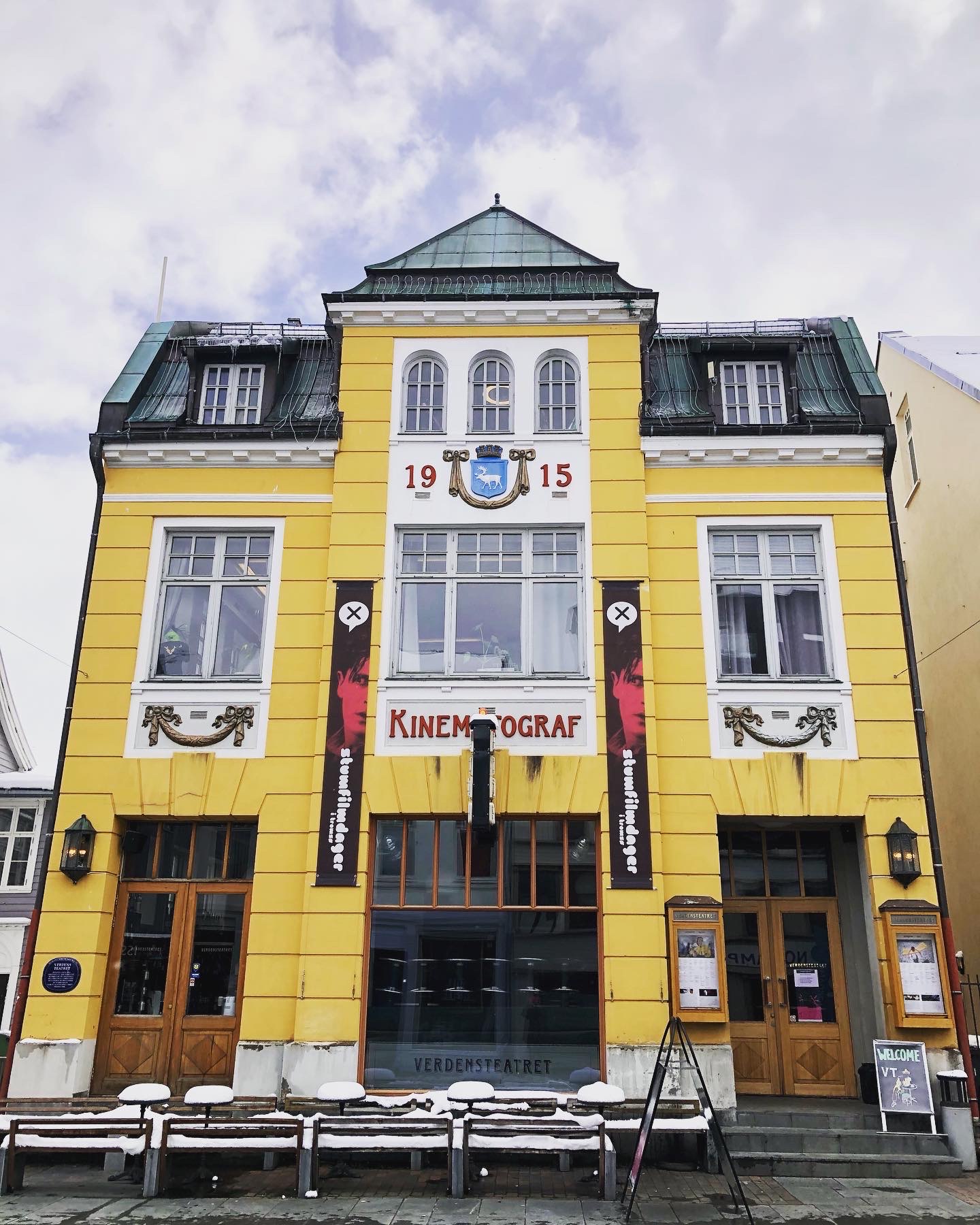
All silent film festivals are not the same. Tromsø Stumfilmdager in northern Norway is full of surprises. For one thing, it was the first time I have ever been offered, and gratefully accepted, earplugs before a silent movie screening.
But first of all, as we’re (mostly) Brits here, you’ll want to know about the weather. And boy was there are a lot of it. Tromsø is 69 degrees north, comfortably inside the Arctic Circle and yet in late April they often expect balmy temperatures of 5 Celsius or so, and clear skies. Not this year. As our pilot informed us en route, “winter has returned”, and we spent four days in the Arctic snow. A delightful Christmas-card novelty for us, but something of a drag for the locals who were looking forward to spring.
There was no escaping the weather on-screen either. The movies included the stories of a seasonal thaw, a woman driven insane by the desert winds, a serial killer operating under the cloak of city fog and a demon destroyed by sunlight. Ten points if you guess all of those titles correctly (although you could just check out the programme here).
The Man with a Movie Camera (1929)
As of next week, Man With a Movie Camera could be coming to a big screen, or a Blu-ray machine, near you. And there’s always a good reason to watch Man With a Movie Camera again. First, because it’s such a stunning film: exhilarating, avant-garde and witty. And second, because each time you do, you’ll grapple with the questions it throws at you again – and just possibly come up with different conclusions. This magnificent movie may be a film studies set text, but it defies attempts at explanation, and in fact, it has a unique way of wriggling out of any category you might try to impose on it. Recently crowned top documentary of all time, it is also an experimental art film. It appears to be a City Symphony but it is a fraudulent one – filmed in three cities and naming none of them. Its absurdities of composition and action make the audience think of comedy, even cartoons and its trick cuts and frame manipulation are closer to animation than conventional film-making.
If I could rechristen this film as its director did himself when he went from plain David Kaufman to the far more evocative Dziga Vertov, I would call it Woman with a Moviola. The new name would be in honour of Yelizaveta Svilova, who edited the film with Vertov, and whom we see stitching together frames midway through the film. The man of the title clambers, and tilts and gets where the action is, that’s for sure, as any camera operator should do. But the magic of this film is in its elaborate construction, its celebration of those arts that are purely cinematic – not offcuts from other media. As Roger Ebert said when he reviewed the film in 2009: “It’s what you do after you have your frames that makes it cinema.”
Man With a Movie Camera (1929)Svilova is also arguably the least well-known of the “council of three” comprising herself, her husband Vertov and his brother-cinematographer Mikhail Kaufman. And it seems appropriate to the film’s perversities to proclaim her the heroine: at this point, perhaps, the only way to look at Vertov’s film is sideways.




 Silent London