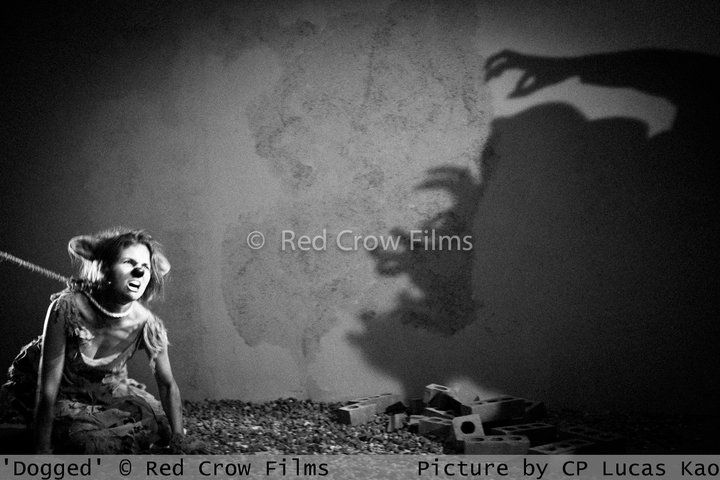
Modern silent films. They’re the hottest thing since 3D, but far more popular in this neck of the woods. One film we’ve had our eye on for a while is the fantasy short Dogged (2011), written and directed by Jo Shaw and starring Lucy Goldie in all nine roles. The sinister premise of the film is summarised thus on IMDB: “In a world where bogeymen roam freely, devouring people randomly and the only creatures they fear are dogs, old dog does her best to defend the family home.” I think this dog is a very different breed to Uggie.
Dogged was described as “intriguing and insightful” by the judges at the Aesthetica film festival in York, who awarded it the prize for Best Experimental Film (read more here), but now, happily, you have the chance to see it in London and make your own mind up. Dogged is playing as part of the Making Tracks night programmed by Whirlygig Cinema at the London Short Film Festival. This event is especially notable because all the soundtracks for the short films being screened will be played live, by The Cabinet of Living Cinema. It’s a treatment that should particularly suit Shaw’s spooky silent film.
Want to know more about Dogged? There’s a trailer, which you can see on the IMDB page here and a regularly updated Facebook page.
Making Tracks is at Rich Mix, Bethnal Green on 14 January at 7.30pm. Tickets are £8 on the door or book them in advance for £6 at the Rich Mix website.
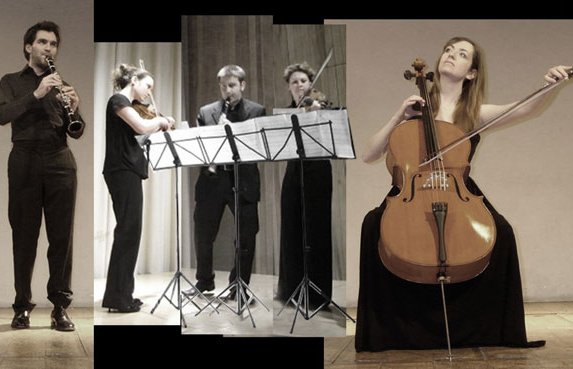
Ensemble Amorpha are a contemporary chamber music group that puts the emphasis on contemporary. Primarily, they play music by living composers, and in some of their upcoming shows they are championing the art of modern silent film-making as well.
Shorts Amorpha at the BFI Southbank is a programme of contemporary silent films, which will be shown not in a gallery, but on the big screen at NFT1. Ensemble Amorpha will play music by Dominic Murcott, Luke Styles, Christopher Mayo, Marc Yeats, Damon Lee, Alwyn Thomas Westbrooke, Philippe Kocher, Naomi Pinnock, Phil Vennables and Yoav Pasovsky to accompany films by Pavla Sceranková, Jan Pfeiffer, Sebastian Schmidt, Daniel Bisig, Gabriela Lang, Damon Lee, Nicolas Wiese and Zoe Payne. The music will be played on strings, woodwind, percussion and electronically too. This promises to be a fascinating and experimental evening – plenty here to inspire musicians and film-makers alike.
Shorts Amorpha screens at BFI Southbank on 1 December at 8.45pm. Tickets are available here, on the BFI website.
Later in the month, at Kings Place, the ensemble are putting on programme called Modern Silence. This will include scores for modern silent films by Alwyn Westbrooke and Damon Lee, as well as Luke Styles’s beautiful music for Rene Clair’s Entr’acte (1924). It’s great to see Kings Place continuing to support silent film, both here and with its Not So Silent Movies shows.
Modern Silence will be performed in Hall Two of Kings Place on 12 December at 8pm. Tickets start at £9.50 and are available here on the Kings Place website.
To find out more about Ensemble Amorpha and to listen to samples of their performances, visit their website.
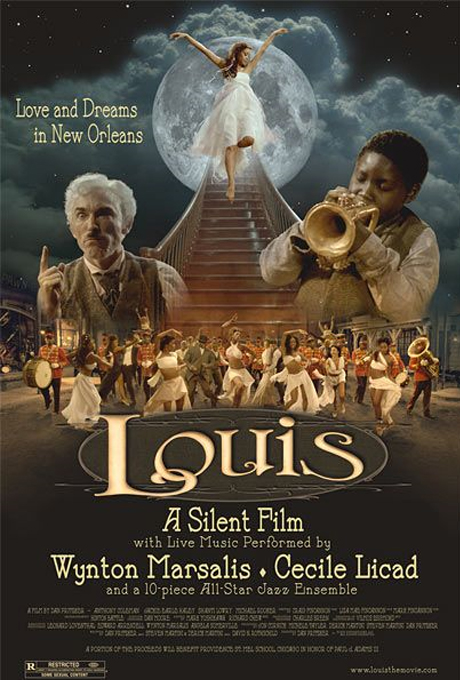
Louis (2010) is definitely helping to put modern silents on the map, but you won’t be seeing it in your local Odeon any time soon, because it is only to be shown with its live musical accompaniment, a score composed by Wynton Marsalis and performed by a hand-picked band of musicians. This is a film all about jazz in fact, set in New Orleans in 1907 – it’s a fictionalised account of the early years of Louis Armstrong, with a few nods to the cinema of the time.
Louis is a companion piece to a sound film, Bolden, which is coming out next year, about the ‘Cornet King’ Buddy Bolden. Both films have been directed and co-written by Dan Pritzker, a billionaire musician turned film-maker, who has certainly hired some big names to help realise his vision – not just Marsalis, but an Oscar-winning director of photography too.
Shot by Academy Award-winning cinematographer Vilmos Zsigmond as a modern re-imagining of early silent film, “Louis” is an homage to Louis Armstrong, Charlie Chaplin, beautiful women and the birth of American music. The grand Storyville bordellos, alleys and cemeteries of 1907 New Orleans provide a backdrop of lust, blood and magic for 6 year old Louis (Anthony Coleman) as he navigates the colourful intricacies of life in the city. Young Louis’s dreams of playing the trumpet are interrupted by a chance meeting with a beautiful and vulnerable girl named Grace (Lowry) and her baby, Jasmine. Haley, in a performance reminiscent of the great comic stars of the silent screen, plays the evil Judge Perry who is determined not to let Jasmine’s true heritage derail his candidacy for governor.
When Roger Ebert saw a preview of Louis in Chicago, he praised its “energy and wit,” saying: “It’s not a social documentary, and its recreation of New Orleans is certainly on the upbeat side, but then Louis Armstrong was on the upbeat side … What he’d especially approve of might be Marsalis – who took his performances as an inspiration – and the jazz band.”
I have taken a peek at the trailer, and at first glance Louis’s moody colour palette doesn’t look quite like any silent film I’ve seen before – but the Chaplinalike villain, speeded-up chase sequences and some neat physical comedy all recall the silent era. Some of the slick superimpositions and swooping camera movements feel comfortable, too, despite their 21st-century sheen. That said, the raunchy dancing in some scenes is more reminiscent of a Christina Aguilera video than anything I’ve seen in a silent film.
We will be able to judge properly soon, though, as Louis comes to London as part of the London Jazz Festival, with two screenings at the Barbican Arts Centre. This is an exciting opportunity to see a new silent film on the big screen and hear some leading jazz musicians play. Whether the music or the film will shine the brightest remains to be seen.
Louis screens at the Barbican on 13 November 2011 at 3pm and 8pm. Tickets cost between £10 and £25 and are available here. It’s worth pointing out that this film is not suitable for children – it was rated R in the US for sexual content and nudity.
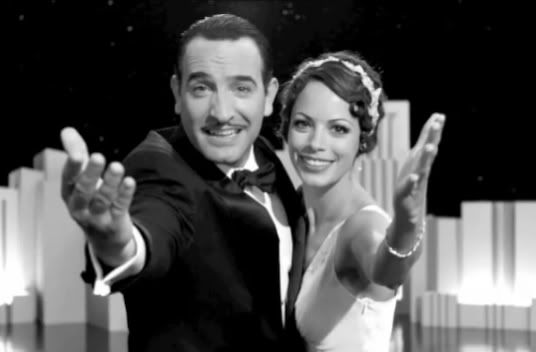
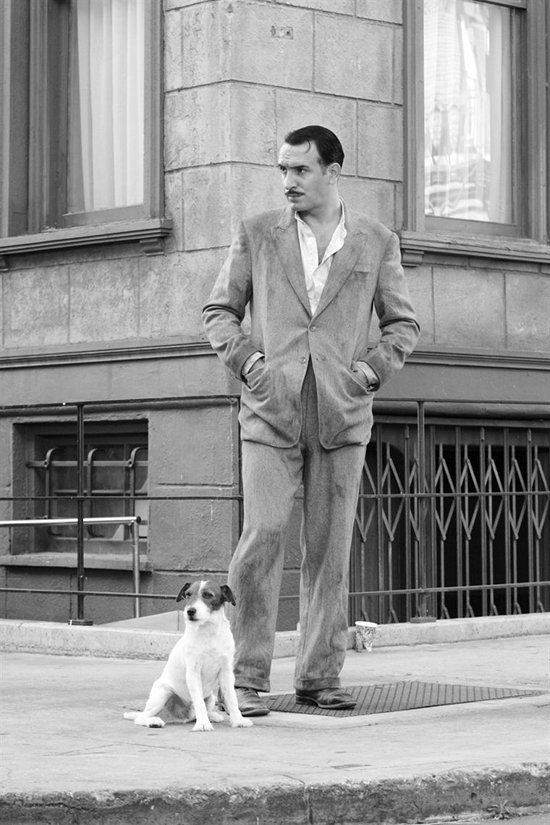
The American trailer for The Artist, Michel Hazanavicius’s love letter to silent cinema, is here. It’s beautiful, and almost note for note the same as the French trailer we saw in the spring. The only differences are that the US version doesn’t name any of the actors until the final card, and I swear they have beefed up the sound of tap shoes clicking across the floor in the dancing sequences. It’s not synched sound, and there’s definitely some of it in the French version, but there’s more now. It’s still utterly gorgeous though – I’m not sure what delights me more, Jean Dujardin’s Hollywood smile, Uggy the performing dog or Bérénice Bejo’s wardrobe.
The Artist is released in France on 12 October 2011 and in the US on 23 November 2011. No word on a UK release date yet.
As far as I know, The Artist (2011) is the first silent film ever to be placed in competition for the Palme d’Or. It’s been a long time coming, and it’s fair to say that silent film fans will take a keener interest than usual in the Cannes judging this year. There has been a lot of early buzz about The Artist, not least because it was swiftly snapped up and flaunted around town by the Weinstein Company. But then again, some of the other films in the competition have earned rave reviews already: notably Lynne Ramsay’s We Need to Talk About Kevin.
Winner or not, The Artist is the most high-profile modern silent in a long, long time and we’re all keen to see it, to find out whether it lives up to the hype, and whether it’s a sensitive tribute to an era of exquisite film-making, or a heavy-handed pastiche.
To this end, I’ve pulled together as many reviews from Cannes as I can find so in the long wait for The Artist to hit UK cinemas we can amuse ourselves by forming our own opinions. We can base this a little on what the critics say, and mostly, of course, on our own preconceptions springing from the extraordinarily beautiful trailer:
This is a turnup for the books. A new silent feature film by French director Michel Hazanavicius has been added to the competition lineup for this year’s Cannes Film Festival. The Artist (2011), starring John Goodman, is a silent, black-and-white, 1.33:1 film about the demise of a silent star’s career during the arrival of sound – and it will be competing with titles including Terence Malick’s The Tree of Life and Lars Von Trier’s Melancholia for the prestigious Palme d’Or prize.
There’s no confirmed UK release date for The Artist yet, but this news would suggest that we’ll see it sooner rather than later. Unfortunately, your correspondent is not a Cannes delegate, but I will be keeping track of the reviews coming back from the festival, and of course, hoping that this film does justice to the era we love. The 20 films in competition include work by Aki Kaurismaki, Pedro Almodovar, Lynne Ramsay and the Dardenne brothers. Still, wouldn’t it be something if a silent film won the Palme d’Or in 2011?
People who have seen Hazanavicius’s previous films – the retro OSS-117 spy capers – say he has a sure touch with period detail. His first film, La Classe Américaine, was actually a redubbed collage of extracts from the Warner Bros archive, so it’s reasonable to assume he knows his film history. The question is whether The Artist can avoid pastiche, and satisfy silent film fans as much as the wider audience – let alone the judges at Cannes. Goodman is joined in the cast by Hollywood veteran James Cromwell, and Penelope Ann Miller, who you might remember played Edna Purviance in Richard Attenborough’s Chaplin biopic.
The Artist (2011)
UPDATE:The Artist has been bought at Cannes by the Weinstein Company. The Weinsteins are saying “Oscar season release”, which we should perhaps take with a pinch of salt, not least because it means quite a long wait until we see the film in the UK. Talking about Oscars raises other questions, though. Would they be angling for a nomination for Best Picture or Best Picture in a Foreign Language? Will the intertitles be translated or subtitled outside France? Still, it’s definitely a vote of confidence in the film, and let’s not get ahead of ourselves.
You can watch some extracts here. Yes the interviews with the director and actors Jean Dujardin and Berenice Bejo are in French, but as you’ll see, the language barrier is no obstacle for the clips, which demonstrate a sophisticated visual approach to film-making. From the evidence here, The Artist definitely has more than a flavour of late 1920s Hollywood, using dance and humour rather than dialogue to tell its story. Bejo talks about: “un rapport tres sensuel entre le spectateur et l’histoire”, which seems to sum it up rather well.
The Artist screens at the Cannes Film Festival on Sunday 15 May.
Le Voyage Dans la Lune (1902)
And The Artist isn’t the only silent film screening at Cannes this year. Hugely excitingly, the festival will also host a screening of George Méliès’s La Voyage Dans la Lune (1902) – like you’ve never seen it before. A nitrate print of the elusive hand-painted colour version of the film was discovered in Barcelona in 1993 and has been salvaged, frame by frame, by Lobster Films, Groupama Gan Foundation for Cinema and Technicolor Foundation for Heritage Cinema. The beautiful film will be premiered at Cannes with a score by the dreamy French band Air. As soon as I hear about a chance to see this new version in London, you’ll be the very next people to know.


 Silent London