This week, I was lucky enough to attend the launch of Sound of Cinema, a new cross-channel season from the BBC exploring film music in all its variety. The centrepiece of the season, arriving in September, is a three-part documentary on BBC4 by silent film composer Neil Brand called The Big Score. I’ve had a sneak preview of the series and it’s seriously fascinating stuff, with Brand tracing the development of film music from the silent era onwards, explaining exactly how classic scores work their magic on the viewing public and interviewing movie composers and big-name directors. Vangelis discusses the creation of his classic score for the most famous slow-motion sequence of them all in Chariots of Fire; Martin Scorsese talks us through his use of Jumpin’ Jack Flash in Mean Streets. In the first episode, Brand talks to silent film accompanist Bernie Anderson at Loew’s Theatre in Jersey City – and has a go on the magnificent in-house organ there.
Other elements in the season include stars discussing their favourite film music moments on BBC Radio 6; a documentary about the relationship between hip-hop and cinema on BBC Radio 1; Bobby Friction exploring Bollywood music on the BBC Asian Network; and a BBC Radio 2 documentary made by Mark Kermode called Soundtrack of my Life, which promises to be very entertaining. There’s absolutely masses planned on BBC Radio 3, including Sound of Cinema downloads by Brand and a a week of programmes hosted by Matthew Sweet. You can read more here (PDF). Radio1 film critic Rhianna Dhillon talked to me about the intriguing possibility of getting some pop acts to have a stab at scoring a film – perhaps they will get a taste for it and we’ll find some new names added to the list of regular silent film composers!
Because, yes, this all sounds a bit “talkie” for Silent London, but I’m sharing this with you because this series promises “a deep understanding of what music does for film”. It’s a subject that silent cinema fans discuss animatedly after every screening – we’re in the now unusual position of watching the same film again and again with different scores, which can make a huge difference to the experience. Perhaps, after dipping into this season. we’ll have an insight into the influences, theories and ideas rushing through the film accompanist’s mind at the next screening we attend.
Underground, surely one of the greatest “Silent London” films, has been turning our heads for some time now: at festivals, at the Barbican with the BBC Symphony Orchestra in 2011, and this year selling out screenings on its theatrical outing. This home video release is Underground’s latest, glossiest incarnation, and by rights should bring the film to the widest possible audience.
If you don’t know it (why?), the first thing you need to know about Anthony Asquith’s film is that it is an exercise in contrasts. Underground spins high drama out of a love story in a humble setting, pivoting from flirtation to daggers-drawn aggression. A hybrid romcom-thriller sounds like commercial gold, the elusive “perfect date movie”. Well, I wouldn’t necessarily argue with that assessment, but Underground is no popcorn flick: it’s passionate, arty, and unafraid to trip up the audience with a sudden, disconcerting shift in tone.
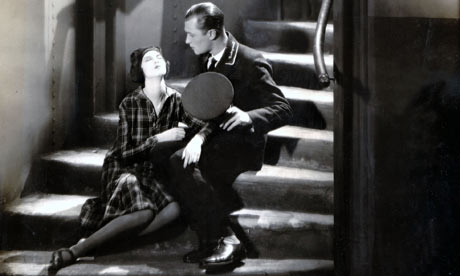
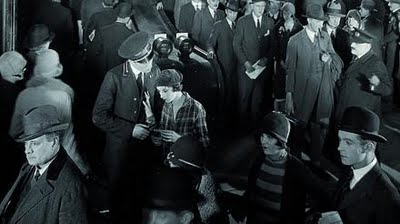
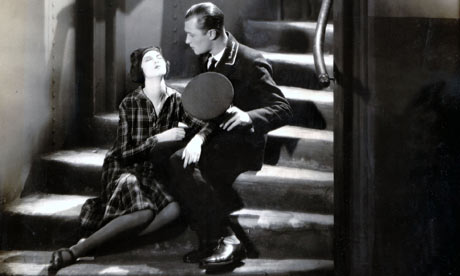
Getting down to brass tacks, this is a tale of love, jealousy, madness and missed connections. Pals Bill (Brian Aherne) and Bert (Cyril McLaglen) meet sweet Nell (Elissa Landi) on the tube one morning. Nell only has eyes for Bill, but nevertheless incurs the wrath of Kate (Norah Baring), a dangerously unhinged woman who carries a lonely torch for Bert. The narrative, and the tension, escalate as a chance meeting on the tube results in a violent confrontation at the now disused Lots Road power station. Asquith’s second film as director, the first he received a full credit for, is an astonishingly distinctive and inventive work. Everywhere there are bravura touches that mark him out as a great of British silent cinema: the shadows of tentative lovers embrace even while they pull awkwardly apart; a pub brawl is edited montage-style, a kaleidoscope of splintered violence.
So, the story of Underground may be simple, but its treatment is unexpectedly dark, stylised and violent – the good news is that this Blu-Ray does Asquith’s expressionist experiments proud. The slanting shadows of the tube tunnels and the boarding house are deep and black; the white-knuckle action of the final chase remains sharply defined.
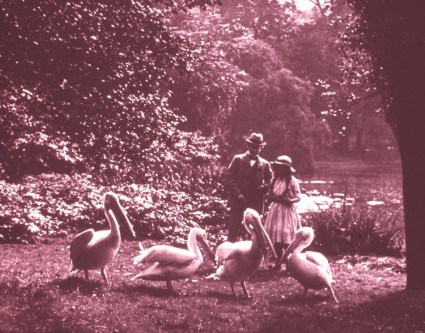
You’ll want to turn this disc up loud too. If you haven’t heard Neil Brand’s orchestral score for Underground yet, you’ve been missing out. This full-bodied, stirring music is a masterclass in silent film music. It’s lush and classic, certainly, but unafraid to cling to the twists and jolts on the track: alert to the film’s many mood swings. Try watching any sequence in Underground with and without Brand’s score (I recommend that furtive shadow-kiss, or Kate’s mad scene) and you’ll notice how the music inhabits every corner of the film, animating it without smothering it. Should you tire of the music, there is an alternative option, one I found fascinating but initially, at least, harder to warm to. Recordist Chris Watson has created a soundtrack for Underground that uses noises rather than music. That fantasy kiss is here accompanied by the sound of trains rushing through tunnels; the birds sing when Bill and Nell picnic in the park, although the young boy’s harmonica is eerily silent. It’s finely crafted, and as artful as any musical score could hope to be. However, shoot me, but I miss the romance of the symphony orchestra in full flow.
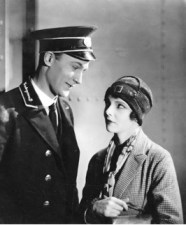
Underground (1928)
This is a dual-format release, with plenty of room for extras (though some of them you will only find on the DVD disc). There is a brief but illuminating featurette on the restoration of the film (the short answer is that it wasn’t easy and that a French print in a Belgian archive filled in many of the gaps in the decomposing British reels) and a generous booklet featuring essays from Brand, Bryony Dixon, Christian Wolmar, Simon Murphy and Michael Brooke as well as snippets from the archive. The archive film extras are the real treat though: including glimpses of Asquith as a young boy with his notable father in tow. I was particularly taken by Under Night Streets, a 1958 documentary about the Underground network’s night workers, with its jaunty cockney narration explaining the whys and wherefores of the work done by men “hard at it, down in the hole” while the city sleeps above them.
As a souvenir of 1920s London, this is hard to beat. And it’s a damn fine treatment for a great British film. But I am greedy. This release will sit neatly on my shelf next to the BFI’s DVD of Asquith’s final silent A Cottage on Dartmoor with Stephen Horne’s brilliant score. Two out of three ain’t bad, but how about Shooting Stars to complete the set?
Underground is released on a Dual-Format DVD/Blu-Ray set by the BFI, RRP £19.99 on 17 June 2013. To pre-order, click here.
This is a guest post for Silent London by Neil Brand.
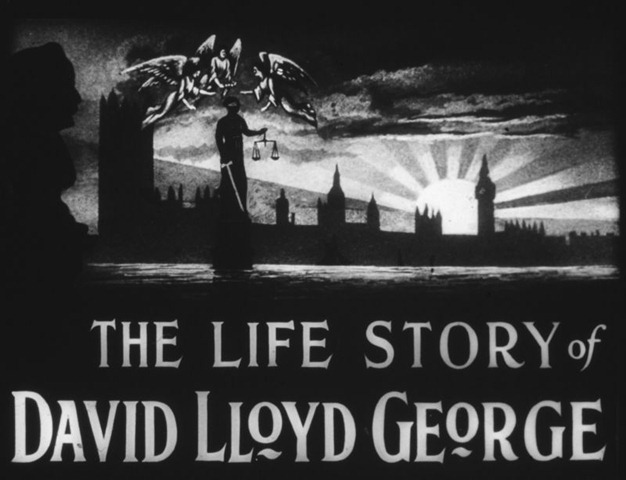
In late 1918 a film was in preparation that was to rewrite the history books – a British picture, running almost as long as Griffith’s The Birth of a Nation, bringing to life the political career of the country’s prime minister, the full ferocity of the war and the experience of ordinary people caught up in these momentous events. It was called The Life Story of David Lloyd George. Nothing as ambitious had been tried before and it was ready for launch immediately after Armistice Day. There was even a deal in place with Carl Laemmle to splash it across the American continent.
Then late one afternoon in January 1919, a lawyer arrived at the offices of Ideal Film Company, the film’s producers, handed over £20,000 in £1,000 notes and drove away with the only negative and positive copies of the film. It was never seen again by its makers, its writer, the respected historian Sir Sidney Low, or its director Maurice Elvey. No audience saw it at the time and the film became a lost treasure.
But you can see it at the Barbican on 17 February, 2013.
The Life Story of David Lloyd George (1918)
The story behind these extraordinary events is still murky, but what we do know is this. Towards the end of 1918, as the film was nearing completion, the owners of Ideal Film, the Rowson brothers, issued a writ for libel against John Bull magazine, edited by the virulent xenophobe Horatio Bottomley, which had accused them of being German sympathisers (largely on account of their original name, Rosenbaum). At the same time, word came down from Lloyd George himself that he was unhappy with the film going ahead, this despite the fact that the producers had secured his involvement before shooting began. These two events are almost certainly linked, but the outcome is still shocking to this day.
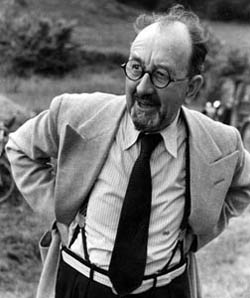
Maurice Elvey
The £20,000 paid to Ideal represented the out-of-pocket costs of the film not appearing – the greater costs, to Elvey, to lead actor Norman Page, whose Lloyd George is a phenomenal performance of nuance and understatement, even to the future of the British film industry, are incalculable. As Kevin Brownlow wrote on seeing the film in 1996, “… had the Life Story of David Lloyd George been released, Elvey might even have been hailed ‘The Griffith of Britain’ … certainly the film would have been placed beside the best work from America and the continent and it would not have been entirely overshadowed.”
So how did Brownlow come to see it? In 1994 the Welsh Film Archive in Aberystwyth took delivery of 16 cans of film found on the farm of Lord Tenby, grandson of Lloyd George. These turned out to contain 137 unedited rolls of nitrate film, which, after two years of painstaking restoration and reconstruction work, finally hit a screen before an audience in North Wales in April 1996 – I was the pianist on that occasion, unable to believe my luck.
For Lloyd George is a phenomenal film, a history that plays out like a biopic, a time-capsule that, at its best, still holds a modern audience with extraordinary power. Like the best biopics it hops nimbly between the big picture and the small, creating a fascinating portrait of Lloyd George within an entirely convincing political and domestic world. It has massive scenes, including a riot at Birmingham Town Hall with nearly a thousand extras; and quiet, contemplative scenes informed by Page’s charismatic dignity. Best of all, it still has the power to move, as much as it would have done with those audiences of 1919 who were destined never to see it. I urge you to see this “lost” masterpiece on its only London showing, and be prepared to have your preconceptions about British cinema, the first world war and silent cinema acting overturned.
Norman Page and Alma Reville in The Life Story of David Lloyd George (1918)
The National Library of Wales holds more information on this extraordinary film and its story, if not the solution to the mystery of the film’s disappearance. Here’s my take on it – the film turned up among Lloyd George’s own possessions and, as was common knowledge at the time, £20,000 was about the going rate for a baronetcy …
Excellent news for fans of British silent cinema (that’s you). Anthony Asquith’s Underground (1928) will be released in cinemas next year. It’s a romantic and thrilling film about a love triangle that sparks jealousy, madness and terrible violence. Asquith’s direction is confident – and richly expressive.
Underground (1928)
Underground is also a fascinating portrait of 1920s London, including a public transport system that has only subtly changed in the intervening 80-odd years. Indeed this theatrical release is intended to celebrate 150 years of the Tube. The film stars Brian Aherne, Elissa Landi, Cyril McLaglen, and Norah Baring in the roles the opening intertitle describes as “ordinary workaday people whose names are just Nell, Bill, Kate and Bert”. It’s no ordinary film though, Asquith uses subjective techniques inspired by European cinema to convey his character’s emotional turmoils and to make Underground both atmospheric and suspenseful. If you’ve seen his final silent film A Cottage on Dartmoor, you’ll know just what to expect.
What is particularly special about this release is that the film has been beautifully restored by the BFI and will be accompanied by a live orchestral recording of Neil Brand’s superb score – played by the BBC Symphony Orchestra. You can read more about the film here on the BFI website, or read Silent London’s interview with composer Neil Brand here. Ahead of last year’s Barbican screening of Underground, Brand wrote this fascinating piece for the Telegraph about “Silent cinema and the secrets of London”.
Underground is released on 11 January 2013, screening at the BFI Southbank and selected cinemas nationwide. A special preview screening at BFI Southbank on 10 January 2013 will be followed by a panel discussion hosted by Francine Stock, with Bryony Dixon, Ben Thompson, Simon Murphy and Neil Brand.
Cléo de Mérode dances Photograph: Cinémathèque française / Gaumont Pathé Archives, Paris
This is a guest post for Silent London by Neil Brand.
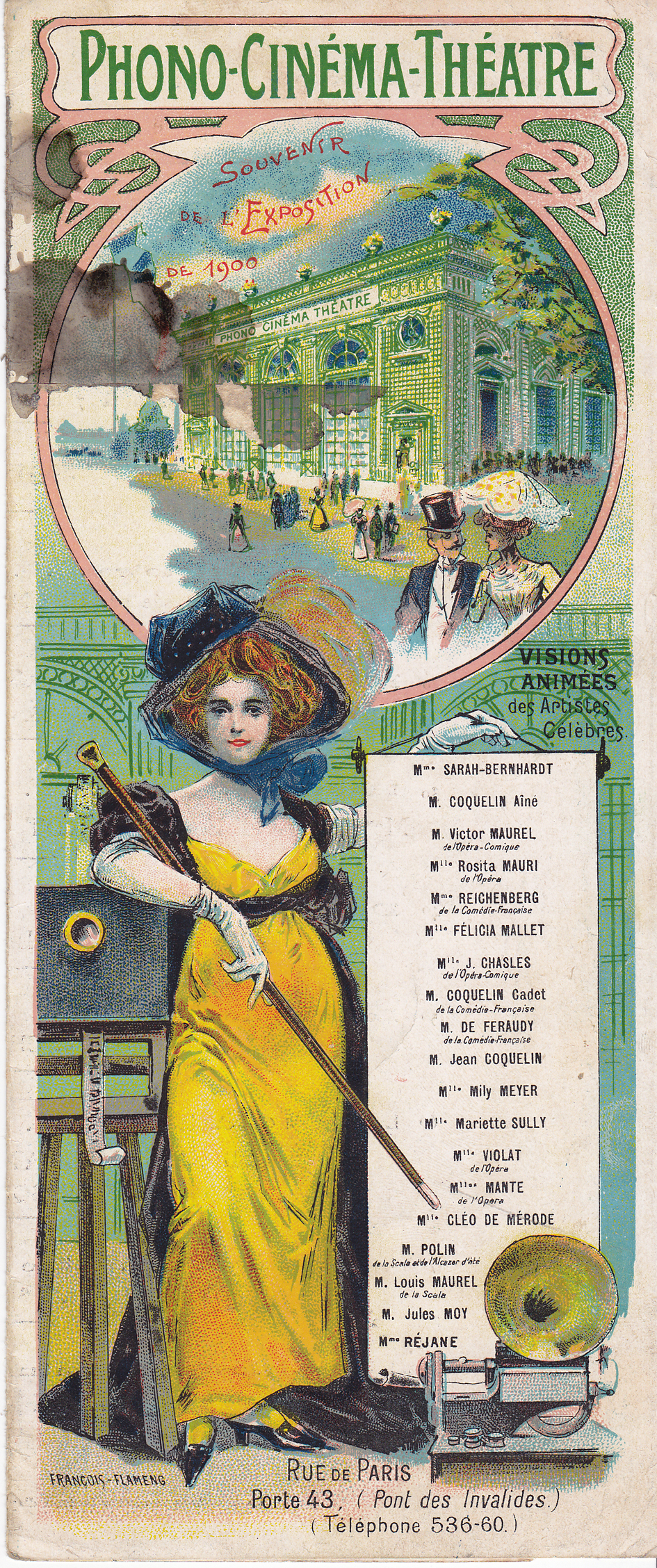
Among the gorgeously designed pavilions on the banks of the Seine at the Paris Exposition of 1900 was a small, ornate theatre called the Phono-Cinéma-Théatre, which contained a screen and a small musical ensemble. Across the screen moved the greatest actors, dancers, mimes and clowns of the day – they spoke, they sang, they moved to music provided by musicians playing live and they were often in exquisite, hand-tinted colour. Five years after the birth of cinema, film and recorded sound brought France’s finest theatrical artists to mechanical life for the lucky generation of fin-de-siècle Paris. It was ephemera among ephemera, Toulouse-Lautrec’s posters pulled aside to reveal the artists that inspired him, and, of course, not made to last – half a century of progress and war on an industrial scale would sweep away those films and the spirit of The Banquet Years, as well as millions of those lucky or wealthy enough to experience them, leaving the rest of us with just the books, the posters, a few photos … until last week.
Phono-Cinéma-Théatre poster. Photograph: David Robinson Collection
On Thursday last the Giornate del Cinema Muto in Pordenone, Italy, showed 23 surviving films of the 41 originally shot, most complete with their hand-colouring, many with their synchronised sound, almost all accompanied live by a small ensemble directed and arranged by John Sweeney. John had spent months finding as much of the original music to the dances and songs as possible, then rehearsed synchronising them to the pre-recorded singing and dancers’ steps, which were set in stone over a hundred years ago – the result was an astounding time-bridge that placed us all more viscerally in the Paris Exposition auditorium than any sound and image record could have done – the artists were now performing for us, their movements driven by John’s piano, their eyes returning our gaze and their efforts aimed at pleasing us.
It was all so relaxed – Little Tich missed a catch with his hat but just picked it up and carried on as if nothing had happened, the odd dance step was fumbled, but unlike the stiff subjects of so much still photography of the time, our performers did what they did for the camera just as they had done on stage for years (in some cases decades), blissfully uncaring of giving a “definitive” performance or of the legacy of our critical response from an unimaginable distance of posterity.
Sarah Bernhardt fought Hamlet’s duel beautifully, despite her 56 years, and with the addition of Frank Bockius’s uncannily precise sword clashes on triangle; Emilio Cossira sang Romeo’s aria from Gounod’s opera silently, his voice reproduced by Romano Todesco’s single notes on accordion, the intent of feeling vibrant in his features and his genial return for a second bow – Mariette Sully wrung genuine comedy out of singing and dancing “La Poupée” and Cléo de Mérode, La Grande Horizontale to many of the crowned heads of Europe, danced in the way that had turned those heads in the first place.
Sarah Bernhardt in Hamlet Photograph: Cinémathèque Française/Gaumont Pathé Archives, Paris
We found out what made 1900 audiences laugh, thanks to Jules Moy’s anarchic dancing master and Polin’s Troupier Pompette singing about, among other things, stroking a lady’s leg, wondering at the lack of resistance and, on raising her skirt, realising he is touching up the table leg. The entire 90-minute show was a triumph of 1900 and 2012 technology – I have worked with early film for 30 years, and never have I felt so privileged to see these wonders more clearly than any generation before, even the one for which they were intended.
Little Tich Photograph: Cinémathèque Française/Gaumont Pathé Archives, Paris
Above all, I now feel I understand turn-of-the-century Paris with a profundity that was impossible before last Thursday night – its potency, its sexuality, within which the highest arts of performance were also the most immediately sensual and arresting, its gaiety and love of sensation, the vibrancy and diversity of its entertainments. The combined efforts of the Cinémathèque Française, Gaumont, Lobster Films, Olivier Auboin-Vermorel and the historical and aesthetic energy of Pordenone director David Robinson have brought not just a corpse but a memory back to life – theatre as film as theatre, a heady concoction only available through the medium of “silent film” – in London, the equivalent would be seeing a complete night at the music hall from 1900, in full colour and with synchronised sound – for now, London must get to see this show, preferably in the perfect surroundings of Hackney Empire where the artists can emerge from the proscenium arch of a Matcham theatre – but maybe after Paris has seen its own long-lost child, this November at the Cinémathèque Française – and, of course, John Sweeney and his ensemble will be there to assist at the rebirth.
The union flag bunting has been hung, the coronation chicken sandwiches have been cut and the roads have mostly been closed. Like it or not, it will be hard to escape the Queen’s diamond jubilee celebrations this weekend. So why all the fuss? Well, monarchs rarely reach the 60-year mark, so this is probably the only diamond jubilee we’ll see – in person that is. It has happened before, when august Queen Victoria marked her 60-year anniversary in 1897. Luckily for us, the newsreel cameras were rolling that day and the BFI has released this fascinating clip of her elaborate jubilee procession. The Queen herself makes an appearance at 1:40, but my personal highlight is 1:23, when a rather wayward horse threatens, briefly, to derail the whole shebang.
This is by no means the only clip to survive, however, and if you want to see more, you can visit the Bedford Park festival in Chiswick, west London on 21 June 2012, for an audiovsual feast of material related to Queen Victoria’s diamond jubilee – presented by Luke McKernan and Neil Brand:
A 90-minute show combining archive film from the BFI, photographs, live commentary with actors, and piano accompaniment, recreating the London procession on 22 June 1897 to mark the 60th year of Queen Victoria’s reign. Presented by film historian Luke McKernan, with actors Neil Brand and Liz Fost reading eyewitness accounts of Mark Twain, Rudyard Kipling, and Queen Victoria herself.
Who do you watch silent movies with? Your friends? Your partner? Toute seule on the front row taking notes? The answer is that we all watch silent films in the company of the musician, who is not just accompanying the movie, but guiding the audience through it as well. Whether composing a score or improvising on the fly, silent cinema musicians are arguably closer to and more involved with the film then anyone else in the auditorium. Which is why it’s always fascinating to hear what they have to say about the movies.
Neil Brand does more to share his wisdom than most, with regular appearances on TV and radio discussing film history and film scores – as well as his work with the British Silent Film Festival too. But for the real skinny on silent cinema as he sees it, you need to catch him on stage, with a projector and a piano, holding forth. The good news is that Brand’s The Silent Pianist Speaks show is back in London on Saturday, at our beloved Cinema Museum.
From the earliest, earthiest comedies and thrillers, through a silent cine-verité classic scripted by a young Billy Wilder, to the glories of Hollywood glamour and the sublime Laurel and Hardy, Neil provides improvised accompaniment and laconic commentary on everything from deep focus to his own live cinema disasters. He investigates how music works with film by inviting the audience to score a love scene, and the show culminates with Neil accompanying a clip ‘sight unseen’ whilst simultaneously describing his reactions to it. The result is a hilarious, sharp and ultimately moving show about cinema and music which pays tribute to the musicians of the silent era through the observations of one the world’s greatest improvising accompanists.
You don’t want to miss this, do you?
The Silent Pianist Speaks is at the Cinema Museum on Saturday 19 May 2012 at 7.30pm. To read more about this particular event, and to buy tickets at the bargainous price of £8.50 or less for concessions, click through to the Cinema Museum website here. Read more about The Silent Pianist Speaks here. If you don’t live in the capital, you;ll be pleased to know that the Silent Pianist Also Speaks Elsewhere. Visit Neil Brand’s website for details of shows around the country (there’s one coming up in Ipswich on 27 May).
“This is for now. This is for audiences now” – Neil Brand, composer, Blackmail
Yesterday I was lucky enough to attend the press launch of the BFI’s Genius of Hitchcock season, where the summer’s blockbuster season of screenings was announced. Creative director Heather Stewart made a great case for Leytonstone’s favourite son, calling him a modernist to compare with Picasso and Le Corbusier, and a cornerstone of British culture, laying the adjective Hitchcockian alongside its counterparts Dickensian and Shakespearean. “The idea of popular cinema somehow being capable of being great art at the same time as being entertaining is still a problem for some people. Shakespeare is on the national curriculum, Hitchcock is not,” she says. Furthermore, she argued that Hitchcock’s work demands not just greater study, but wider audiences. The answer the BFI proposes is to show the films – all of them – in the most comprehensive Hitchcock retrospective ever staged – including his silent films.
“We would find it very strange if we could not see Shakespeare’s early plays performed, or read Dickens’s early novels. But we’ve been quite satisfied as a nation that Hitchcock’s early films have not been seen in good quality prints on the big screen.”
Showing the nine extant silents is of course more difficult than screening the later work. The prints require varying degrees of restoration work – and new scores. For me, the most interesting part of launch event was a panel discussion chaired by Nick James, editor of Sight & Sound magazine, which gave an insight into the process of writing new music for the films. Five composers were on stage, each of whom had been tasked with scoring a different Hitchcock silent. It was fascinating to hear about the different approaches they took, how much they felt that the project was a direct way of expressing their admiration for the director, and their readings of the different films.
Neil Brand, whose orchestral score for Blackmail will be arranged for a smaller ensemble and played at a gala screening in the forecourt of the British Museum, described the “party game” of following Hitchcock’s characters’ shifting motivations and vulnerability. His intention, he said, was “bring out the neurosis” in the film. And he was upfront about the fact that he took inspiration from some of Hitchcock’s later musical collaborators. We were shown a clip from the film that precedes the scene excerpted above. Brand wasn’t, he explained, trying to register the heroine’s desire for the artist, but for the frilly dress hanging in the studio. To that end, he “scored the dress”, with a sparkling theme every bit as frothy as the frock.
Hitchcock’s “switching empathies” were also part of the attraction and the complexity of scoring The Lodger for Nitin Sawhney. He started, he said, by working on the titles, those extravagantly designed, animated captions that decorate the film, and pulling the strands of the narrative apart. It must have been complex. Asked by James if the score was as foggy as the film’s vision of London, he replied no, but added self-deprecatingly that his brain was a little fogged during the composition process. Those who have heard Sawhney’s score for A Throw of Dice will doubtless be happy to learn that this new composition will also be performed by the London Symphony Orchestra at the Barbican in June.
Fog or no fog, young composer Daniel Patrick Cohen showed every enthusiasm for the task of soundtracking Hitchcock’s first film. As a long-term fan of the director he described The Pleasure Garden as “a blueprint for all the wonderful films that Alfred Hitchcock went on to make”. Happily for us, we saw a glimpse of the film with Cohen’s score. It was the opening scene in fact, which sets up so many of Hitchcock’s enduring fascinations: blondes, voyeurism and a ribald, but very British sense of humour. Cohen knows his audience will have been brought up on Hitchcock’s grisly thrillers, and that we know where all these fascinations can lead, and so the music was deliberately playful, but with a steely, sinister edge. When it came to the humour in the film, Cohen promised us “one amusing sound effect” in his score. Just one, and he wasn’t telling where it was to be found. Tease.
Can you imagine Betty Balfour as the pinup of the Occupy movement? Mira Calix can, perhaps. She offered an audacious reading of Champagne, which screens in September, as a critique of celebrity culture and a comment on the financial crisis. I see her point, but can’t quite imagine idle heiress de nos jours Paris Hilton with soot on her face, or indeed flying a plane. Still, Champagne is a film with a great deal of style and Calix quite rightly noted that while 1928 may seem to be the long-distant past, this is a film obsessed with modernity, in all its art-deco, cocktail-sipping, drop-waisted deliciousness. Calix aims to bridge the 84-year age gap with a score for Champagne that incorporates traditional instruments alongside the electronica she is renowned for. I think this will be most of the most distinctive scores in the season, and I am certainly intrigued.
Soweto Kinch didn’t just discuss his score for The Ring, he put his saxophone where his mouth was and accompanied a short clip from the film. His finished score will be played by a five-piece band at the Hackney Empire, but he performed solo in NFT1, his sax lines underscoring each small but significant gesture in one of The Ring’s quieter scenes – and drawing a fantastic response from the audience. Like Calix, he is keen to bring out the elements of the film that feel new. Watching The Ring, he said he was suprised to see such a racially hetereogenous vision of 1920s, pre-Windrush London, and impressed by the films’ treatment of sexuality and gender identity. “It reframed how I thought relationships were in the early 20th century,” he said, adding that he would look a little differently on his own grandparents’ courtship from now on! He was confident, that he would be able to “twin the old and the new” in the film, just as he combines jazz and hip-hop in his music. Hip-hop Hitchcock? Bring it on.
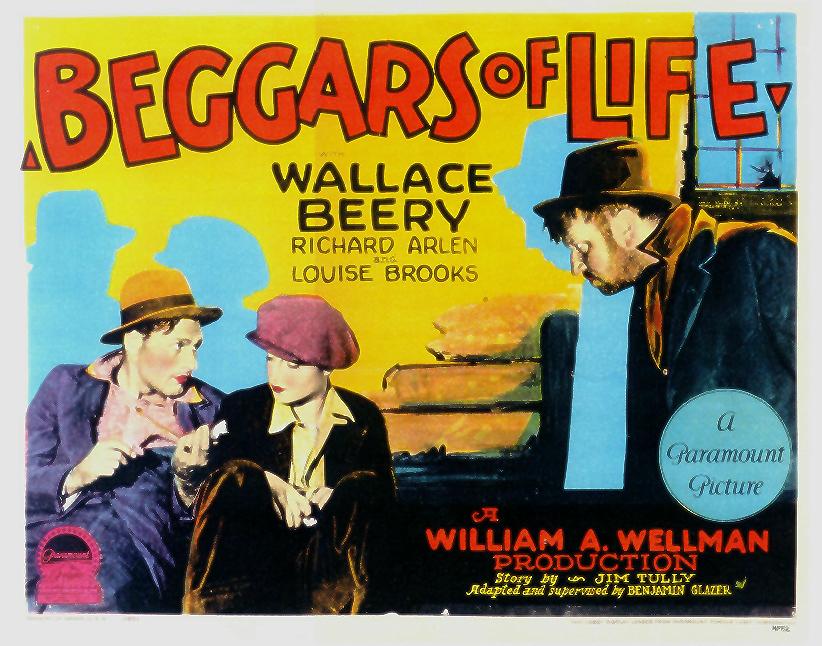
If you were at the British Silent Film Festival last year, you won’t need telling twice to book for Beggars of Life. The gorgeous Louise Brooks, leery Wallace Beery, a hulking great train, ‘Wild Bill’ Wellman at the helm and a soundtrack by the coolest skiffle band in town.
This show is a fine example of how invigorating the combination of a great silent movie and live music can be. The Dodge Brothers, an Americana-drenched quartet featuring none other than bequiffed film critic Mark Kermode on bass and harmonica, will accompany rail-riding rom-com Beggars of Life at the Barbican next month. And their numbers will be swelled by Neil Brand on the piano. Here’s a taster of one of the quieter moments from their score.
And here’s a review of their BSFF performance at the BFI Southbank last year, from the Ithankyou blog. Bryony Dixon herself says: “Never has a film and a band been more perfectly matched”. And if you want more Dodge Brothers action, don’t forget that they’re playing this year’s BSFF too, accompanying Abram Room’s The Ghost That Never Returns.
Beggars of Life screens at the Barbican on 29 April 2012 at 4pm. Tickets start from £7.50 and they’re available here. Please note this screening is rated 12A
This review is a guest post for Silent London by Ewan Munro of the Pubology blog.
Among the many wonderful restorations in the Treasures from the Archives strand at the London Film Festival this year was a programme of silent short films, nine- to 12-minute long travelogues from a series made in the early 1920s by film producer Harry B Parkinson, and entitled Wonderful London. The BFI National Archive chose six of these films to restore and present at what turned out to be a packed-out screening (attributed by silent film curator Bryony Dixon to a resurgence of interest in historic London).
The subject of these quirky little screen-fillers is, of course, London. And while there are certainly occasional shots of the tourist London we’re all familiar with, perhaps more interesting is the time spent looking around the corners, into the back streets and out into the suburbs of the working-class city. Street markets and grimy housing, docks, shops, scenes of daily life, and even a few pubs all show up in these films. The East, the North, the West End and the City all show up, though the South is represented by only a few shots of streets around the site of the Globe.
There’s Petticoat Lane market (still bustling today) and Club Row market (no longer), where live animals of all kinds are traded under the still-familiar railway arches down by Sclater Street (arches which now hold the lines leading to Shoreditch High Street station). There are grand West End theatres alongside street performers and Punch & Judy shows. There’s Ye Olde Cheshire Cheese pub, just off Fleet Street, one of the few views that hasn’t changed at all, even as we briefly spot the drays of long-defunct brewers such as Truman Hanbury Buxton and Mann Crossman’s. There are the flower sellers usually at work underneath Eros on Piccadilly Circus, but moved from this attractive spot due to London Underground construction works (little change there, though back then it was for the station’s grand booking hall). There are the canals around Mile End, Islington and Hackney (with a brief cutaway to show Broadway Market), mules working along their towpaths to pull the barges. This is just one example of perhaps the greatest change since these films were made: the extent to which the London shown is a city of industry and manufacturing, where the canals are still busy with freight and the docklands still bustling with ships.
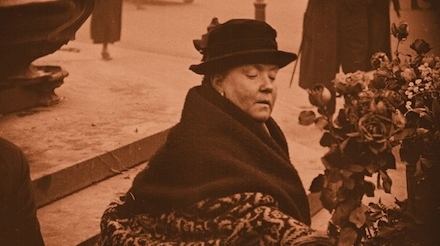
Flowers of London (1924)
This “unofficial” view of London is matched by the narration, with the intertitles frequently offering humorous asides and boundless sarcasm, especially in the Barging Through London film (any given intertitle card makes reference to dizzying speeds, as the film cuts to, say, a barge moving languorously under a bridge alongside Regent’s Park, while befrocked and behatted tourists on the way to London Zoo stop to watch). A personal favourite is the introduction of Southwark Bridge, newly constructed at a cost of £3 million and “sometimes it gets VERY busy”, cutting to show a few hackney carriages trundling across while a handful of people walk along the outside.
The titles remain fairly light-hearted, but this only exposes some of the period’s unpleasant attitudes, communicated with an at times disarming frankness, especially in the Cosmopolitan London short. In what must be a staged scene, the film’s “white trash” are swiftly kicked out of a “negro club” on Whitcomb Street, while the film is unsparing in its negative judgment on the poverty and unfriendliness of the Chinese population of Limehouse. When the film returns pointedly to scenes on Horse Guards Parade, it expresses greater relief at their comforting Englishness than perhaps the modern audience can muster. Nevertheless, the scenes of Limehouse provide interest when compared to similar ones staged for the roughly contemporaneous Piccadilly (1929).
Through it all, piano accompaniment is sensitively provided by Neil Brand, an accomplished master of the art. The tone is largely jaunty as befits the films, though he sensibly opts for a quieter register at key points towards the end of the Cosmopolitan London short, and a briefly uncomfortable silence within the auditorium at one point further brings into focus the discomfort engendered by the film itself (not to mention highlighting the very rarity of silence at screenings of silent films).
The restoration has been handled magnificently, and Scott Starck from the restoration team speaks before the film, rattling off a quick account of the process, along with dizzying statistics on the number of frames that needed repair. Colour tinting has been retained as per the original films, and this is used to good effect to depict the passing of the day in London’s Sunday, or the colours of the flowers in Flowers of London. One can only hope that the success of this screening leads to further such archival restorations and that the Wonderful London series may one day be available in its entirety.
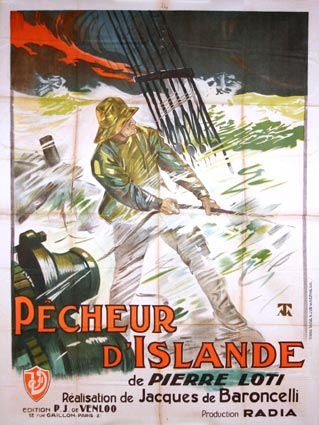
Pierre Loti’s novel Pêcheur d’Islande combines realism and impressionism as it explores the hard life of Breton fishermen who risk their lives to catch cod in Icelandic waters. The tragic air extends as far as the novel’s love story, a romance between a sailor, Yann and a young girl, Gaud, who meet at a party. Gaud is in love with Yann, but he is also in love with the sea …
In 1927 the novel was adapted for the screen and directed by the Jacques de Baroncelli, a Frenchman who had made many films in the silent era. Pêcheur d’Islande was shot on location in Brittany, and the landscapes both on land and at sea are magnificent. It’s a rarely seen film, and so you’ll be very happy to know that its forthcoming London screening will be introduced by – Kevin Brownlow. Not only that, but Neil Brand will provide piano accompaniment.
Pêcheur d’Islande screens at the Ciné Lumière at the Institut Français on Tuesday 11 October at 6.30pm. Tickets cost £10 or less for concessions and are available on the Institut Français website here.
There’s nothing like seeing a film with a live orchestra – it’s far more exciting than surround sound. That’s why at Silent London we’re so excited about the world premiere of Neil Brand’s score for Anthony Asquith’s Underground (1928), which will be performed by the BBC Symphony Orchestra on 5 October.
Undergound is set in London, among what Asquith called “everyday” people, but that doesn’t mean that this is an unsophisticated film. Far from it. The director’s appreciation of European and Russian cinema (he was a co-founder of the London Film Society) is betrayed by his use of Expressionist shadows, subjective camerawork and montage editing. This is 1920s London, but not like you may have seen before.
Underground tells the story of four young working people making their way in 1920s London. The parallels with life in the metropolis today are poignant and it is fascinating to see location footage of the Underground network, old London pubs, department stores and of course the climactic chase through the Lots Road Power Station in Chelsea … Asquith had a remarkable ability to portray the lighter and darker aspects of life through staging and cinematography. He was aided by the superb and unusually good-looking cast of Brian Aherne and Elissa Landi as the nice young couple, with Norah Baring and Cyril McLaglen as the unluckier, troubled duo.
The print of Underground that will be shown at the Barbican is the product of many hours of restoration work by the BFI, using new, cutting-edge techniques. The BBC Symphony Orchestra will be conducted by Timothy Brock.
To be in with a chance of winning a pair of tickets to watch Underground at the Barbican Concert Hall, just answer this simple question:
Cyril McLaglen, who plays Bert in Underground, had an older brother who was also a film actor. What was his name?
Email your answer to silentlondontickets@gmail.com by noon on Monday 26 September. The winner will be picked at random from the correct entries and emailed with the good news. Best of luck!
No festival worth its salt is without a silent film screening these days – which is a great way to introduce people to this world. Rock festivals increasingly offer cinema tents and film festivals are often involved in commissioning new scores for films, or simply offering musicians an opportunity to perform their soundtracks in front of a large audience. It’s well worth keeping an eye on what’s going at festivals, even if you’re not planning to attend: what debuts at a festival one year, may turn up in your city the next. Here’s a selection of interesting festival events coming up in the next month or so alone.
At the Green Man Festival in the Brecon Beacons (19-21 August), the rock band Minima are performing an improvised set to a selection of early science films in the Einstein Tent. Over in the Cinema Tent, Blue Roses will perform her piano score to Dr Jekyll and Mr Hyde (1920). You may remember that this score first appeared as part of the Birds Eye View Festival’s Sound & Silents strand back in March. Watch out for news of a forthcoming UK Sound & Silents tour on their website.
The following week, at the Edinburgh Fringe, Minima will perform their score to The Cabinet of Dr Caligari six nights in a row – kicking off at midnight.
Also in Edinburgh and courtesy of the Birds Eye View Film Festival Sounds & Silents strand, there will be a screening of Lotte Reiniger’s Hansel & Gretel with a live score by Micachu – that’s at the Edinburgh Art Festival.
The Cambridge Film Festival runs from 15-25 September and although it hasn’t announced its full lineup yet, I am pretty certain we’ll see some silent movies in the lineup. And before the festival even begins they are hosting a special screening of Douglas Fairbanks’s Robin Hood in Rendlesham Forest with a new score by Neil Brand – that’s on 29 August, bank holiday Monday.
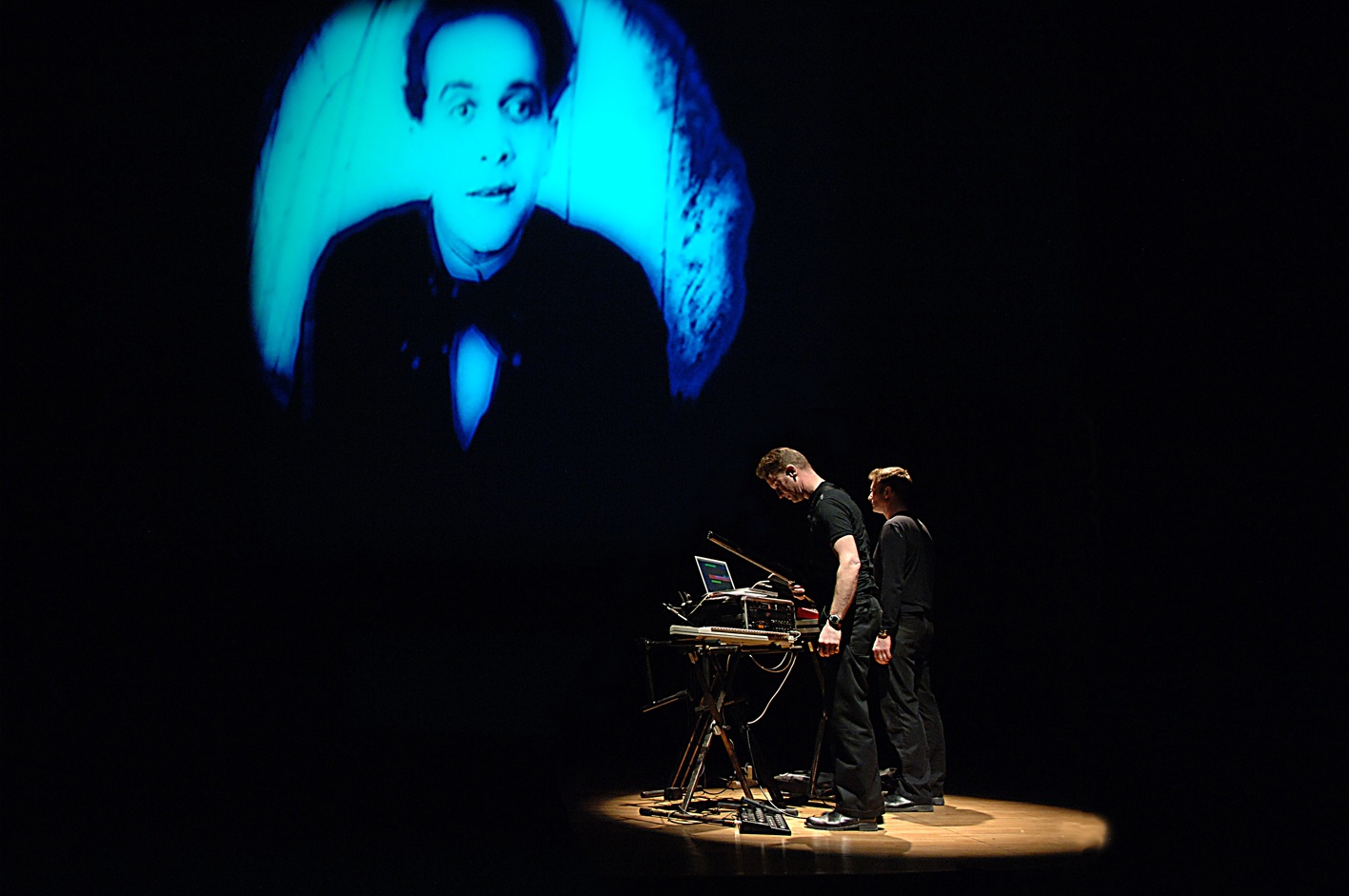
In the Nursery perform their soundtrack to The Cabinet of Dr Caligari
Also on the bank holiday Monday, Bath Film Festival is hosting a screening of Buster Keaton’s Steamboat Bill Jr and the short film One Week, with live music from James Harpham.
At the beginning of September, the Little White Lies cinedrome at the End of the Road festival in Dorset will be showing all kinds of good things, including The Great White Silence.
Back in London, on 17 September, gothic electronic duo In the Nursery will soundtrack The Cabinet of Dr Caligari in a pop-up cinema as part of the Portobello Film Festival. And as reported elsewhere, the Peckham Free Film Festival is screening Safety Last and Battleship Potemkin, on 16 and 18 September respectively. And entrance to all of those screenings can be had for the very reasonable price of zero pence exactly.
The New Forest Film Festival has a very exciting event planned for 18 September. The Dodge Brothers (featuring Mark Kermode) and Neil Brand are teaming up to score another movie. The Ghost That Never Returns is a Soviet film directed by Abram Room (Bed and Sofa) about a fugitive from jail being chased by an assassin in South America. What makes the screening even more exciting is that the cinema will be powered by bicycle – it’s a movie, a gig and a workout, all in one. The Dodge Brothers’ performances have been a highlight of recent British Silent Film Festivals, so let’s hope we see this one in London soon.
The Branchage Film Festival in Jersey commissions and hosts all sorts of fascination film/music combinations, and holds events in London throughout the year too. Its festival closer this year is a very beautiful thing. On Sunday 25 September, Simon Fisher Turner and the Elysian Quartet will play their intensely emotional score for The Great White Silence live at Jersey Opera House. Not to be missed.
In October, of course, it will be time for the 55th London Film Festival. Watch this space to find out silent film events await us there.
There is far more to British silent cinema than Hitchcock, whatever recent news reports might have you believe. From Yorkshireman Louis Le Prince’s claim to have invented motion-picture technology, through Cecil Hepworth’s pioneering days in Walton-on-Thames, to the directors who gathered at the London Film Society in the 1920s, our early cinema industry has much to offer. And it’s not just directors that we can praise, but actors, writers, producers and more besides.
That’s why I am so happy to report that, before Hitchcock’s work takes centre-stage next year, there are several screenings of silent films by other British film-makers coming up in London soon. This is a great opportunity to learn more about what we can loftily, but quite rightly, call our cinematic heritage – and to enjoy some rather good films. Continue reading British silent film screenings, autumn 2011→
Whether Paul Merton’s recent Birth of Hollywood documentaries piqued your interest in silent cinema, or you are already a fan of the era’s exquisitely hilarious comedians, this is a date for your diary. Merton, and silent film pianist Neil Brand, are reprising their Silent Clowns show, which toured throughout 2009, at the Cinema Museum this September.
According to my sources, we can expect some classic moments from Buster Keaton, Charlie Chaplin and Harold Lloyd as well as a complete Laurel and Hardy short, We Faw Down, their first film to be directed by Leo McCarey, which is sometimes known under the simpler title We Slip Up. Paul Merton will introduce the clips, and Neil Brand will provide musical accompaniment. You really can’t go wrong. Anyone who has read Merton’s Silent Comedy book or watched his recent TV programmes, will know that he is passionate about this subject, and if you only know him from the radio, you’ll know that he is exceedingly funny himself.
Silent Clowns is at the Cinema Museum in Kennington onSaturday 3 September at 7.30pm, but doors will open an hour earlier for you to look around the collections. Refreshments will be available too, and there should be some time for you to mingle and have a high old time. Tickets cost £6.50 or less for concessions. For more information, visit the Cinema Museum website, or to buy tickets, visit WeGotTickets.
This is a lovely thing to report: openair screenings of two silent film classics, with a local twist. And best of all, they are free.
In September, the Peckham Free Film Festival will be showing Harold Lloyd’s Safety Last on a giant inflatable screen on Peckham Rye near the cafe. The film will be accompanied by Neil Brand on the piano and by a package of local archive footage including newsreels, too. You’ll be able to buy refreshments from the cafe, which focuses on “free range, fair trade, organic, locally sourced, healthy” food, but I can’t be held responsible for the consequences of laughing with your mouth full.
Safety Last screens at Peckham Rye on Friday 16 September at 8pm. Entrance is free.
The festival will close in rousing style with another free silent film screening, on the roof of Peckham multi-storey car par. Eisenstein’s Battleship Potemkin will be screened near Franks Cafe and Campari Bar, also located on the roof, so you can grab a drink and something to eat while you watch. Live music will be provided by Super Best Friends club, who describe themselves this way:
Super Best Friends Club are a friendly beast from London. We wonder if it’s possible to transform this cutthroat universe to a loving frequency. And we wonder if its possible to do this through nudity and frantic dancing. I think its worth trying.
Battleship Potemkin screens on 18 September at 8pm. Entrance is free. For more information on the Peckham Free Film Festival, click here.
The beautiful regency town of Cheltenham is home to a very impressive film festival and this year’s lineup is particularly exciting for lovers of silent cinema. Across the festival weekend in November there are no fewer than six silent events – all with live music, and incorporating fiction and non-fiction films. Some of these special events have already been seen in London – but by no means all of them. Let’s go straight into a list:
• Update 19 September 2011: Cambridge Film Festival is screening Robin Hood again, tonight, with live music by Neil Brand in the grand surroundings of Trinity College. Sounds wonderful. Click here for details.
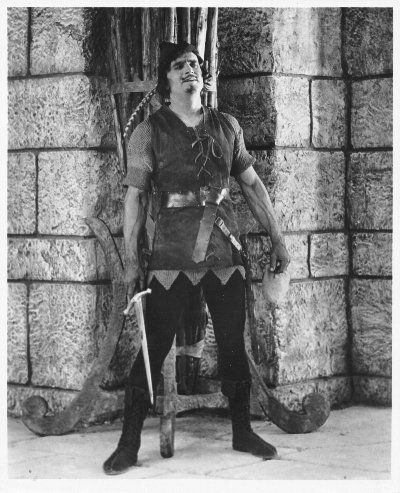
It’s going to be a good summer for outdoor screenings of silent films, both across London and at festivals around the country. And I expect this one will be one of the most atmospheric. Cambridge Film Festival On Location is presenting a special screening of Robin Hood (1922), the swashbuckling classic starring Douglas Fairbanks, along with the world premiere of a new score by Neil Brand.
This is an epic, but charming Robin Hood, shot on some of Hollywood’s largest and most lavish sets, with fantastic action sequences and a mischievous streak of humour. Fairbanks leaps tall turrets in a single bound as a spectacularly gymnastic Robin Hood, while Wallace Beery gives us an imposing King Richard. Allan Dwan directs with flair, making the most of the gigantic sets – getting a lot of mileage out of the drawbridge, in particular.
Robin Hood dazzled audiences back in the 1920s. Photoplay magazine (quoted on Kevin Brownlow’s The Parade’s Gone by) raved about it, while considering it the apotheosis of Hollywood excess:
More than anything else, Robin Hood is a show. It seems to be stretching the word photoplay to classify it under that name. In fact, it’s the last thing in spectacles. We doubt if the silversheet will go much further along this expensive road.
If only Ridley Scott had taken the hint. I love the word “silversheet”, too. Perhaps we should try to bring that one back.
Robin Hood screens at the theatre in Rendlesham Forest in Suffolk on Monday 29 August. Neil Brand’s merry band will include violinist Günter Buchwald and percussionist Jeff Davenport. For more details, click here.
What’s better than a silent film screening eh? A free silent film screening of course. The Barbican is camping out at Canary Wharf this August to stage three outdoor screenings of feature-length silent comedy classics and you won’t have to pay a penny to attend.
Neil Brand will be accompanying on the piano while the assembled crowds enjoy Monday night screenings of Buster Keaton’s The Navigator and The General and Harold Lloyd’s Safety Last. There’s nothing like watching silent comedy with a large, lively audience and Neil Brand is always on top form, so these shows should be inked in your diary already.
Monday 8 August
6.30pm – The General (U) (US 1926 Dir. Buster Keaton & Clyde Bruckman 89 min)
Set during the Civil War and based on a true incident, The General is considered to be the one of the greatest comedies of all time. Buster Keaton plays Johnnie Gray who loves his steam train The General. When Union soldiers penetrate Confederate lines and steal his locomotive, Johnnie sets off in hot pursuit – and seven of the film’s eight reels are devoted to the nail-biting chase.
Monday 15 August
6.30pm – Safety Last! (U) (US 1923 Dir. Fred Newmeyer & Sam Taylor 73 min)
In Safety Last!, Harold Lloyd’s most famous comedy, he plays a sales clerk in a department store who finds himself hanging off the hands of a collapsing clock on the side of a skyscraper high above the streets of downtown Los Angeles. Harold’s legendary building climb is breathtaking and hilariously funny at the same time. A sequence achieved without any special effects.
Monday 22 August
6.30pm – The Navigator (U) (US 1924 Dir. Donald Crisp, Buster Keaton 60 min)
Keaton’s biggest box-office success tells the story of inept millionaire Rollo Treadway and Betsy O’Brien (Kathryn McGuire), his rich, pampered girlfriend, who find themselves on a huge deserted liner adrift in the ocean. The Navigator is one of Buster Keaton’s finest films.
Hopefully some of the financiers of Canary Wharf will be tempted to leave their offices and join in the fun – it’s got to be more of a laugh than banking.
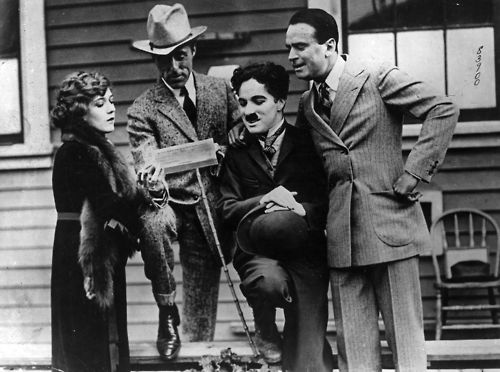
(l-r) Mary Pickford, DW Griffith, Charlie Chaplin and Douglas Fairbanks, founders of United Artists
Paul Merton is probably the most high-profile silent film fan in the country, with a book, a stage show and a series of documentaries on comedy under his belt. And now he’s back, on BBC 2 no less, with a three-part series of programmes about the early days of the American films industry – Paul Merton’s Birth of Hollywood.
The first programme will focus on DW Griffith, the beginnings of the star system and the relationship between music and silent film. There’s a very jolly introduction to the series on Paul Merton’s official website here, and some musings about making the documentaries on the BBC site here. You’ll be pleased to know that Neil Brand is involved too – he’s written the title music
Merton clearly has a great passion for the subject, and I couldn’t be more pleased to see documentaries on early cinema airing on one of the major channels. What would be great, of course, would be a screening of a silent film or two after the programme, but it looks like that is not to be. Better luck next time, chums.
Merton appeared on Danny Baker’s radio show on Saturday to promote the show and their 10-minute chat is well worth a listen on iPlayer, if only for the infectious enthusiasm the pair have for the subject. Follow the link here, and fast-forward to an hour and five minutes into the programme.
Paul Merton’s Birth of Hollywood begins on BBC 2 at 9.30pm on Friday 27 May 2011.





 Silent London