If we have our way, silent film is only going to get bigger in 2011. There are lots of great screenings coming up in London and elsewhere and it feels like there is a lot of enthusiasm out there for this fantastic art form.
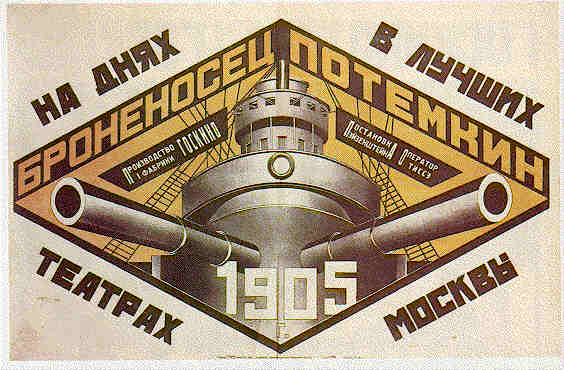
It doesn’t take a crystal ball to predict that Battleship Potemkin, in its new restored 35mm print, courtesy of Kino International, will be the big silent film hit of the year. I have watched this great film more times than I care to remember but I will inevitably be back in the cinema to watch it this year. If I’m honest, I prefer to go to one-off events with live music rather than to listen to a recorded soundtrack, but if this re-release gets more people watching Battleship Potemkin, and stimulates their interest in silent cinema, it’s all good with me. Continue reading Silent film in 2011 – a new vintage trend?→
There is an interesting article by the composer Carl Davis about Charlie Chaplinin the Guardian Review today. In the piece, he talks about how he came to piece together the original score for The Gold Rush, which he will conduct at the Royal Festival Hall on 3 January.
I was allowed into the vaults under the Alps near Geneva where all the materials of Chaplin’s working life are kept. There I examined the boxes containing the sketches and materials used for the 1942 revision. I found the sources of the pieces I could only guess at, as well as sketches for sequences that were in the 1925 version but cut in 1942.
Tickets for The Gold Rush are available here. Plus, for a limited time only, you can get a 20% discount if you call the box office (0844 847 9910) and quote ‘London Film Museum’.
It’s New Year’s Eve, so it’s time to get your dancing shoes on. Here’s a little cinematic inspiration for those of you anticipating a “foxtrot epidemic” tonight, courtesy of Ernst Lubitsch’s The Oyster Princess (1919). Happy New Year, everyone!
Walter Forde is on the right, directing Richard Cooper in Lord Richard in the Pantry (1930)
It’s all about the archives this February at BFI Southbank. The stand-out feature for us is What Next? (1928) directed by and starring Londoner Walter Forde. Encouragingly, this film was recently discovered as a result of the BFI’s Most Wanted project, which searches for lost films. Forde, born in Lambeth in 1898, started out in musical halls before becoming a popular film comedian, then gradually moved into directing. What Next? is described as a”cheerful farce” and features a “deranged archaeologist” chasing our hapless hero around a museum at night in pursuit of a valuable Egyptian candlestick. As a bonus feature there’s a short film, Walter the Sleuth (1927). Both films are, of course, accompanied by live piano.
What Next? is screened in NFT2 on Wednesday 2 February at 6.10pm and will be introduced by a curator of the BFI archive.
There are also archival treasures to be found in the Tales From the Shipyard season, which opens with a compilation launch event on 7 February. At that event, and on 17 February as part of the A Ship is Born in Belfast programme, you can see footage from 1910 of the SS Olympic, which was the Titanic’s sister ship.
The Tales from the Shipyard launch event is on Monday 7 February in NFT1 at 6.20pm
A Ship is Born in Belfast is on Thursday 17 February in NFT2 at 8.30pm.
The most intriguing item is a talk on 19 February called The Tragic Launch of HMS Albion. Film-maker Patrick Keillor will be joined by the BFI’s Bryony Dixon, John Graves from the National Maritime Museum and London historian Chris Ellmers to discuss the terrible events of 21 June 1898. On that day, the battleship HMS Albion was christened, but as it entered the Thames, a wave caused a platform bearing spectators to collapse, and 34 people were drowned. The ship’s launch and the subsequent disaster were being filmed – so the debate will cover the ethics of documentary film-making, as well as providing historical context.
The Tragic Launch of HMS Albion is on 19 February from 11am to 4pm in NFT3 and tickets are £5
The BFI’s Tales From the Shipyard DVD will be released on 14 February.
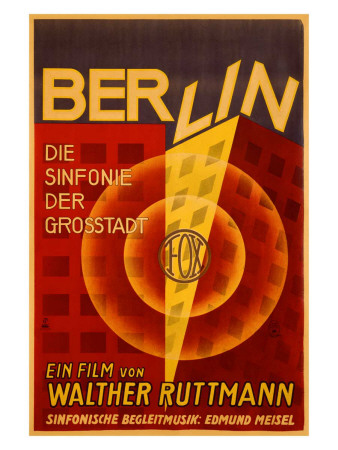
This tale of two cities is a very cool way to spend a Sunday afternoon. The classic Berlin: Symphony of a City (1927) montage documentary directed by Walter Ruttmann is paired with a film that partly inspired it: Manhatta (1921), based on Walt Whitman’s poem Mannahatta. Both films create portraits of cities rather than character-driven narratives. It’s an idea that’s radical even now, and both of these films are beautiful works of modernism. What better to watch in the sleek 60s architecture of an arts centre in the east end of London?
Accompaniment for the films comes from the saxophone and keyboards of German group Reflektor2. The duo, Jan Kopinski and Steve Iliffe, toured the UK last year with a live score for Der Golem (1920) and have written scores for many other silent films.
Berlin, Symphony of a City and Manhatta screen at 4pm on 6 February 2011. Tickets are £10.50 full price but £8.50 online and less for concessions. They’re available here.
There are a heck of a lot of end-of-year lists floating around at the moment. But most of them are dominated by talkies. To rectify this, allow me to present The Silent London End of Year Poll. I’m looking for the best silent film show of the year – anywhere in the world. And I’d like your help.
If you love going to watch silent films with live music then there have been ample opportunities to indulge your passion this year. The scene is thriving in London, not that we wouldn’t like to see more screenings. And my Twitter spies tell me that from New York to Paris to California to Sussex people are enjoying silent cinema shows of all kinds. So what has been your personal highlight of 2010? The show that introduced you to silent film or reinvigorated your appreciation of it? A new film or musician that blew you away – or a classic done just right?
Consider this a teaser trailer. The British Silent Film Festival returns to the Barbican in April – and some of the screenings have already been announced. The theme is Going to the Movies: Music, Sound and the British Silent Film – no great surprise, as the festival is presented in partnership with the Sounds of Early Cinema in Britain project. As well as lectures and clip shows, five standalone film screenings are listed:
Beau Geste (1926)
Hollywood director Herbert Brenon’s adaptation of the best-selling British adventure story about the Foreign Legion starring the quintessentially English Ronald Colman.
Twinkletoes (1926)
US director Charles Brabin’s take on the British music hall starring Hollywood’s favourite flapper Colleen Moore.
Lonesome (1928)
Paul Fejos’s brilliant part-talkie where dialogue was introduced as a novelty in this story of two lonely people trying to find love in New York. The film features a fantastic jazz-fuelled parade in Coney Island.
Morozko (1925)
Yu Zhelyabuzhsky’s rarely seen Soviet fantasy about a stepdaughter who is driven out to face the spirit of winter is here presented with its original music score rediscovered and reconstructed for orchestra. Presented in conjunction with Sounds of Early Cinema Conference.
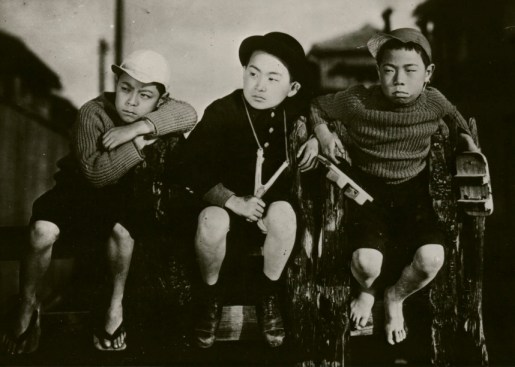
I Was Born But … (1932)
Ozu’s classic family comedy marks the very end of the silent period. As one of the greatest silent films ever made, it is screened here to celebrate the artistic excellence which the silent cinema had achieved.
So, clearly the festival is not limited to British films, and with several compilation programmes, including New Discoveries in British Silent Film – there is lots to look forward to. The promise of an orchestral score for Morozko is intriguing, as is the Ozu film, which will surely be very popular. As soon as we know more, such as accompanists and individual dates, we’ll post it here. Until then, read the Bisocope’s post about the festival here, and consider your appetite well and truly whetted.
The 14th British Silent Film Festival takes place from Thursday 7 April to Sunday 10 April at the Barbican Arts Centre, London.
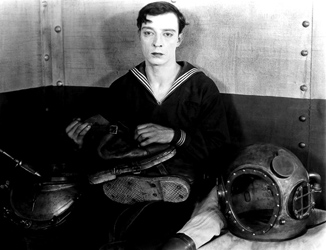
The Fashion in Film festival may have departed the Barbican for another year, but the Silent Film and Live Music series is still active. That said, there’s just one screening lined up for January, but it looks like a treat. It’s a Buster Keaton double-bill of sorts, comprising The Navigator (1924), and one of his earlier, short films, Cops (1922). Continue reading The Navigator at the Barbican, 9 January→
“I think that exhibition is an important part of film preservation and the audience participation is part of that as well. If you bring somebody whether it’s a date or kids, you’re helping to build the audience for these great films.”
Yes, this film is dated 2010. Silent film-making didn’t keel over and die when Al Jolson waved his jazz hands in 1927, though we admit modern silent films are rare beasts. The Tenement Ghost is unusual on two counts – it’s silent, and it is being distributed online.
The Prince Charles Cinema in the West End shows a silent film on the last Thursday of each month – except for December, it seems. So their next silent screening is in January, and it’s The Hunchback of Notre Dame, starring “Man of a Thousand Faces” Lon Chaney. Hunchback was Universal’s most successful silent production, and it was the definitive film adaptation of Hugo’s novel – until a certain Disney version came along.
Trivia: English actress Kate Lester, who plays Madame de Gondelaurier, died on the Universal lot a year after making this film, following an explosion in her dressing room.
The Hunchback of Notre Dame is screened at 8.45pm on Thursday 27th January. John Sweeney provides piano accompaniment.
SCHEDULE CLASH: Just like London buses, etc etc, The Hunchback of Notre Dame is showing at exactly the same time as Hamlet starring Asta Nielsen screens at the BFI. Just so you know.
Early Cinema Myth No 1 is surely that all silent films were black and white. It’s not true in the slightest, which is why we’re so keen to see this new exhibition in Brighton, which explores early attempts to achieve colour – from magic lanterns onwards.
We take the moving image in colour for granted, but the search for a way to capture the world in colour is a story of ingenious inventions, personal obsession, magic and illusion, scientific discovery, glamour, hard work and determination.
The Capturing Colour exhibition is at the Brighton Museum and Art Gallery until 20 March 2011 and admission is free.
Silent London is planning a field trip to take a look at the show later in the week – we’ll report back here.