Season’s greetings Silent Londoners. It’s that time of year when we like to look back at the year, and especially at all the great silent movies we watched.
2023 was a busy year. We had in-person and online film festivals, seasons, screenings and conferences, some fabulous new restorations, discs and some big anniversaries. We had new books and DVDs to enjoy. I was a little distracted, but the silent film scene was booming.
A major discovery screened Mostly Lost this year. Researcher James Fennell has identified a clip from some footage purchased on eBay as scenes from one of the most sought-after “lost films” of all time: Cleopatra (1917), starring iconic vamp Theda Bara. While the image of Theda Bara in her risqué pearl breastplate (now on display at the V&A as part of the Diva exhibition) is well known to all silent cinema fans, the film itself has long been missing.
“Why are your thoughts in America when you tell me your heart is in Italy?” Well, Theda Bara, since you ask, it’s because the Giornate showed a mid-period silent American classic on Friday night. A Fool There Was (1915), or as I prefer to call it, The Cabinet of Dr Libido, is a bizarre film, by turns prosaic and ethereal. The plot is slight, but the imagery is immense, with Bara as an especially vampirish vamp, her long dark hair framing a milk-white face in the most demonic way. She can bat away a revolver with a rose and drive a man to distraction with a glimpse of ankle or shoulder – these are superpowers, not seduction techniques. No wonder the image of Fox’s foxy lady endures even when so many of her films are lost, burned up in the heat of her own fiery screen presence. And as silents go, A Fool There Was has great words, not least in the recurring appearance of Kipling’s ‘The Vampire’, but in a few killer lines of dialogue, one of you which you already know is going to appear below. And speaking to the film as well as for it, tonight, we had a brilliant new score written by Philip Carli and played by a quintet, which kept pace with the film’s many twists and dramatic moments and also added some much-needed nuance, as in the heartbreaking scene in New York traffic when Schuyler ignores his own daughter’s pleas, so engrossed is he in his new paramour’s charms.
A FOOL THERE WAS (US 1915) Credit: The Museum of Modern Art, New York
After Theda Bara, Hollywood turned to Pola Negri for a more authentically exotic vamp, although a more romantic one too. So it was fitting that one of her early German films, Mania (1918) closed the evening’s viewing. I’ve written about that one before, a couple of times, so I skipped it tonight.
THORA VAN DEKEN (SE 1920) Credit: Svenska Filminstitutet, Stockholm
But it was a great day for strong leading women, from a selection of cheeky Nasty Women shorts (I loved Lea causing havoc in an office full of besotted men) and beyond. We had the rich, psychological drama Thora Van Dekan (John W Brunius, 1920), for example – a story of a woman trying to protect her daughter’s inheritance from her wayward ex-husband, in the face of opposition and judgment in her village. Pauline Brunius is hypnotic in the lead role as a spiky, often unlikeable, singleminded and clearly emotionally brutalised woman trying to do her best by her child. This was a sombre piece, all the more so with Maud Nelissen’s downbeat improvisation, and just the sort of thing that nestles into your brain cavities and makes itself at home for days.
This is a guest post for Silent London by David Cairns, a film-maker and lecturer based in Edinburgh who writes the fantastic Shadowplay blog. The Silents by Numbers strand celebrates some very personal top 10s by silent film enthusiasts and experts.
It’s impossible to tot up a list of “the greatest” or even “my favourite” lost films, since they are by definition lost and impossible to assess, at least without using supernatural powers or outright lying. These are just 10 that produce in me a particularly sharp pang of longing.
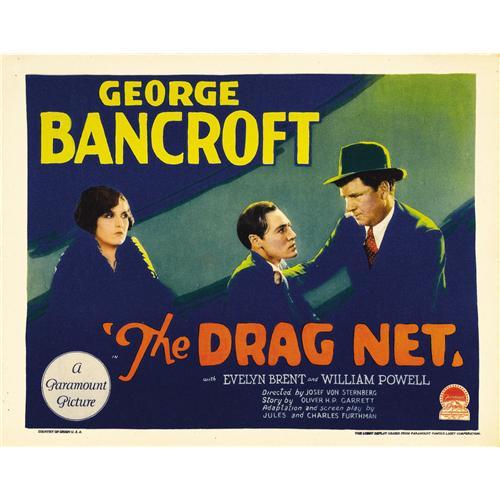
The Drag Net (1928)
1) The Drag Net(1928). Since Josef Von Sternberg’s Underworld reinvented the gangster movie as romantic tragedy, and still stands up as a rip-roaring urban fantasy comparable in its antisocial mayhem to a Grand Theft Auto game with love scenes, the fact that the second silent crime thriller he made, refining his take in the genre, is not known to survive anywhere, is heartbreaking.
Sternberg was particularly targeted by the vicissitudes of fate in his career. Weirdly, those of his films whose destruction was ordered, such asThe Blue Angel (by the Nazis), The Devil is a Woman (by Spain’s Guardia Civil) have survived, whereas The Case of Lena Smith exists only as a tantalising 10-minute fragment. A Woman of the Sea may have been destroyed on the orders of its producer, Charlie Chaplin, but a second print remains unaccounted for …
FW Murnau
2) Similarly, while the British courts ordered FW Murnau’s Nosferatu destroyed for copyright infringement, the unauthorised adaptation of Draculasurvived, but nearly all his earlier movies are lost, including Der Januskopf(The Janus-Face, 1920), an unauthorised adaptation of Dr Jekyll and Mr Hyde. Why this matters: the star was Conrad Veidt (seen looking angst-ridden in a few grainy stills), the screenplay was by Caligari scribe Hans Janowitz, and Bela Lugosi had a smaller role. Plus, you know, it’s Murnau. Doing a horror film.
Several of Murnau’s German silents are completely lost or survive only in tiny pieces. 4 Devils, his last Hollywood film, is also MIA.
The Patriot (1928)
3) Another German in Hollywood, Ernst Lubitsch, suffered a major loss when The Patriot(1928) vanished from the earth. This is particularly appalling since the film won best screenplay (Hans Kraly) at the 1930 Academy Awards. Also, the star of the film is Emil Jannings. The movie is far enough removed from Lubitsch’s usual brand of movies that it might be hard to know exactly what we’re missing, but the trailer for this one surivives and the vast, expressionistic sets haunted by Lubitsch’s restless camera make this look like one of the most impressive films of the silent era. Sob.
4) The Divine Woman(1928) is, of course, Greta Garbo. Her director is fellow Swede Victor Sjostrom (or Seastrom) and her co-star is Lars Hanson. And there are nine minutes of this in existence to make you yearn for the rest all the more desperately. What we can see in the clip (which turned up in Russia after Glasnost) suggests a rather more boisterous Garbo than we’re used to seeing, throwing herself at Hanson and yanking him about by the hair in an affectionate but rather rough fashion. Another 71 minutes of that, please.
Alfred Hitchcock and Alma Reville filming The Mountain Eagle
5) The Mountain Eagle(1926). Its own director thought this one was rubbish, but as he was Alfred Hitchcock I’d still like to see it. It was his second directorial effort. A recent restoration of his first, The Pleasure Garden, has revealed it to be a better film than we all thought. Who knows what a rediscovery of the followup might reveal?



 Silent London