The outdoor silent film screenings at the East End film festival are always a highlight of the year. Held in the centre of Spitalfields market, the screenings are accompanied by live music from Minima – guaranteed to send a shiver down the spine. But this year Minima, and the festival, have come up with something that promises to be extra-special.
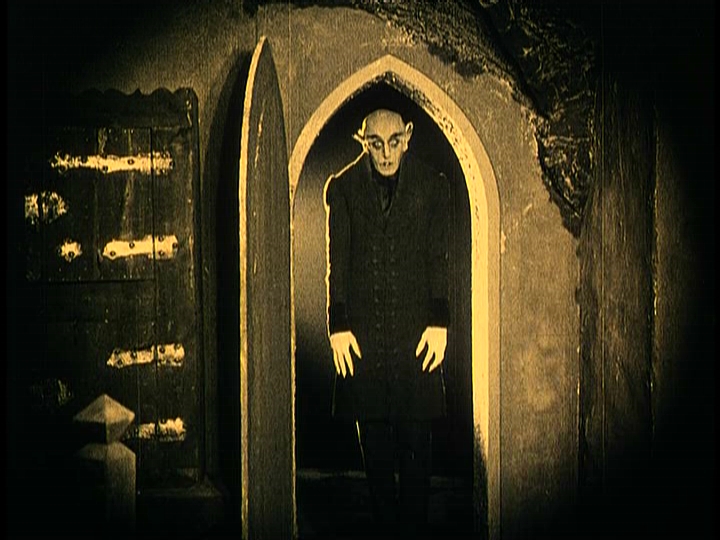
This summer’s screening is of Nosferatu, the landmark vampire horror by FW Murnau, which is 90 years old this year. It’s a movie Minima have accompanied many times before, but not like this:
East End Film Festival presents the World Premiere of A Symphony of Horror, a unique collaboration between soundscapers Minima, Paul Ayres’ Queldryk Choral Ensemble and Hackney-based spatial artist Lucy Jones to create a re-imagined film score and performance on the 90th anniversary of the classic 1922 film.
Enter the fully immersive eerie and unsettling world of Nosferatu where the very walls of Spitalfields Market will be alive with creeping shadows and silhouettes, and reverberating with the soaring tones of the Queldryk Choral Ensemble, featuring 60 choristers, accompanied by the festival’s favourite soundtrackers, Minima.
Silent film screenings with live music have always spearheaded the immersive, live cinema trend, but this event goes a step further, combining an atmospheric location with projections and a spooky soundtrack turned up to eleven.
Admission is free, and the film won’t start until the sun goes down, but you’ll want turn up early to get a good seat and bring your own cushions/blankets/cagoules. For more information, visit the East End film festival website.
For more on Nosferatu, check out Sight & Sound contributing editor Mark Sinker discussing the film on the first Silent London podcast.
File this one under Not Quite Silent Film – but that doesn’t mean it won’t be of interest to the esteemed readers of this blog. And if you scroll down, you’ll be able to get yourself a special deal on tickets too.
Pioneered by Whirlygig Cinema and film-score artists The Cabinet of Living Cinema, Making Tracks is an ongoing interactive event that provides a unique platform for new filmmakers to get their work seen. The premise is simple; Whirlygig seek out amazing films to showcase, strip them of their original soundtracks, and The Cabinet perform brand new live re-scores. It is a perfect way for filmmakers who have had problems with music copyright to get their work screened in public.
Put simply, Making Tracks is all about the magical combination of movies and live music, and even if the films themselves weren’t originally silent, they will be on the night. They can be, however, and you may remember that the award-winning short film Dogged featured at a Making Tracks night a few months back.
Here’s a lovely blog review of a Making Tracks night that puts it in context of the silent film revival and how lucky we are in London to have so many silent film and live music screenings.
With a live soundtrack you feel the vibrations, hear and see everything intensely, get a few shivers down your spine, and share your entrapment in the vision of the filmmaker with your fellow audience.
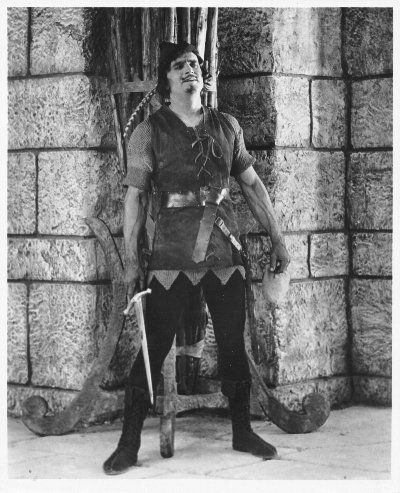
I can tell you right now – the 2012 summer blockbusters will have nothing to match Robin Hood (1922). The towering sets, the impossible stunts, the mischievous humour, the prancing Merrie Men and at the heart of it all, handsome lunatic Douglas Fairbanks springing from one perilous situation to the next. In tights. It’s ridiculous, sure, but it’s ridiculously good fun too. Not for nothing did Kevin Brownlow call it “unique in every respect … as legendary as the story which inspired it.”
This July, Robin Hood will be shown in the grand surroundings of Chelsea’s Cadogan Hall, with an equally grand accompaniment – the Royal Philharmonic Orchestra playing a new score composed by John Scott. If you want to introduce your children to silent cinema, I can think of few better ways to do it. This quote from Scott bodes well for a feisty soundtrack and a thrilling night.
The film calls for an action-packed score. There is romance, intrigue, terror, spectacle, suspense, and as the story progresses it demands more and more, culminating in the spectacle of a royal wedding.
Robin Hood screens at Cadogan Hall on 12 July 2012 at 7.30pm. Tickets start at £12.50 and you can buy them here on the Cadogan Hall website.
On 14 June, the Cinema Museum is showing a programme of little-seen British silent films, including a new print of the racy spy thriller A Woman Redeemed (Sinclair Hill, 1927), starring Brian Aherne and Joan Lockton, with musical accompaniment from Stephen Horne. I’ve seen A Woman Redeemed, and it’s a stylish, well-paced film from the latter end of the silent era that deserves a far more exciting title – and a wider audience. Here, to introduce the film more fully, is a guest post from Amy Sargeant, author of British Cinema: a Critical History (BFI, 2005).
'Hollywood taste' – A Woman Redeemed (1927)
Stoll’s 1927 release, A Woman Redeemed, was adapted by Mary Murillo from Frederick Britten Austin’s Strand magazine short story, ‘The Fining Pot is for Silver’. Both scenarios exploit a contemporary appetite for spy fiction – possibly best exemplified by John Buchan’s The Thirty-Nine Steps, Huntingtower and Greenmantle – and the audience for wartime memoirs published by former Secret Service personnel. Basil Thomson, appointed head of the Criminal Investigation Department in 1913, was twice charged with interviewing the alleged spy, Mata Hari. Self-servingly, he concluded:
No drama, no film story yet written has been so enthralling as our daily repertory on the dimly lighted stage set in a corner of the granite building in Westminster. In a century after we … are dead and gone, the Great War will be a quarry for tales of adventure, of high endeavour, and of splendid achievement: when that time comes even some of the humbler actors who play their part in these pages may be seen through a haze of romance.
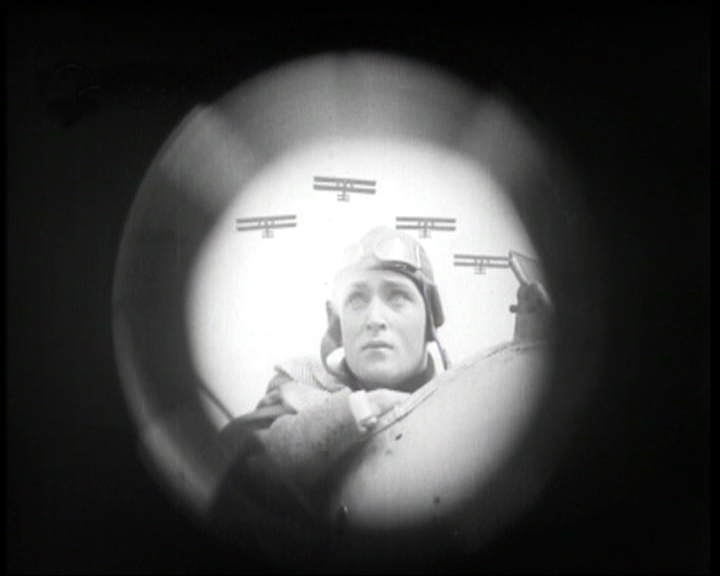
Both Britten Austin’s story and Sinclair Hill’s film feature an organisation of foreign agents, intent upon power and destruction. Geoffrey Wayneflete (Brian Aherne), an irreproachable young pilot distinguished for his service in the Great War, has designed a wireless controlled, pilotless aeroplane ‘that shall make Britain strong enough to keep peace in the world’. The agents conspire to steal his plans, pressing into service Felice Annaway (Joan Lockton), ordering her to use her ‘charm and beauty’ to seduce Geoffrey. Stella Arbenina, meanwhile, plays the darkly enigmatic and heartless Marta, threatening to expose Felice should she fail to comply with the instructions of a dastardly ‘Twisted Genius’. The Criminal Investigation Department is not to be outwitted and pursues the agents to France; a chase ensues, from Paris to London, the centre of a ‘Proud Empire’.
A foreign agent, 'intent upon power and destruction' – A Woman Redeemed (1927)
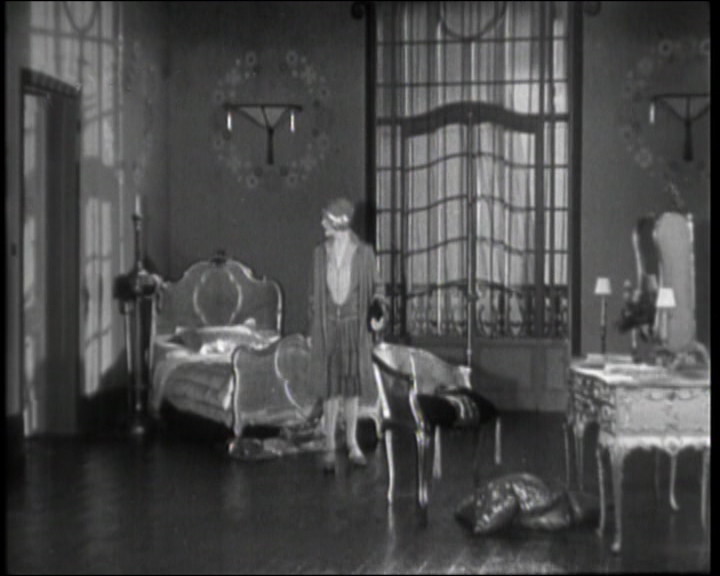
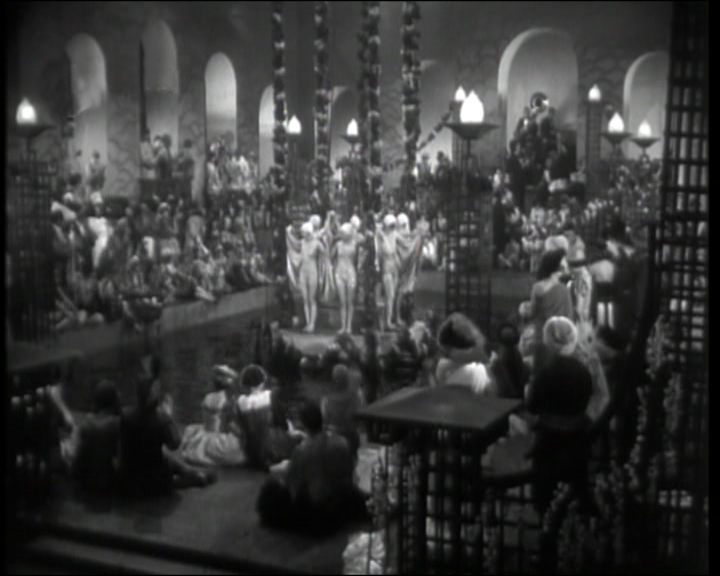
A masked ball afforded Walter Murton, Hill’s designer, the opportunity to produce the most spectacular set witnessed to date in British Cinema: spangled bathing belles dive into a pool from tiered platforms. A 1927 Bioscope reviewer commented wryly on the decors provided for Felice’s Paris hotel suite:
The bedrooms with gold and silver draperies seem rather to suggest Hollywood taste, but for anything we know that may be the taste that appeals to ladies in the pay of alien governments.
One guest at the ball has drawn inspiration from Douglas Fairbanks; Geoffrey comes dressed as Harlequin.
'Spangled bathing belles' – A Woman Redeemed (1927)
As an author, Britten Austin was something of a pasticheur, with a range spanning from popular farce to a modish fascination with the occult: Buried Treasure, combining parapsychology, adventure and costume drama, was filmed by Cosmopolitan in 1921 from a Britten Austin short story, as a vehicle for Marion Davies. However, as a prediction of future aerial warfare, A Woman Redeemed bears comparison with Maurice Elvey’s 1929 High Treason, likewise featuring a gang of alien, deracinated mercenaries and idealists.
A Woman Redeemed uses multinational aliases to designate suspect characters. It gestures towards a return to nationalism in Europe in the late 1920s and early 1930s as a guarantor of inner security and the potential incubator of external conflict.
A Woman Redeemed screens at the Cinema Museum in south London on 14 June 2012 at 6.30pm, with musical accompaniment by Stephen Horne. Tickets cost £8.50 or £6.50 for concessions and are available online here.
Images courtesy of the National Film and Television Archive.
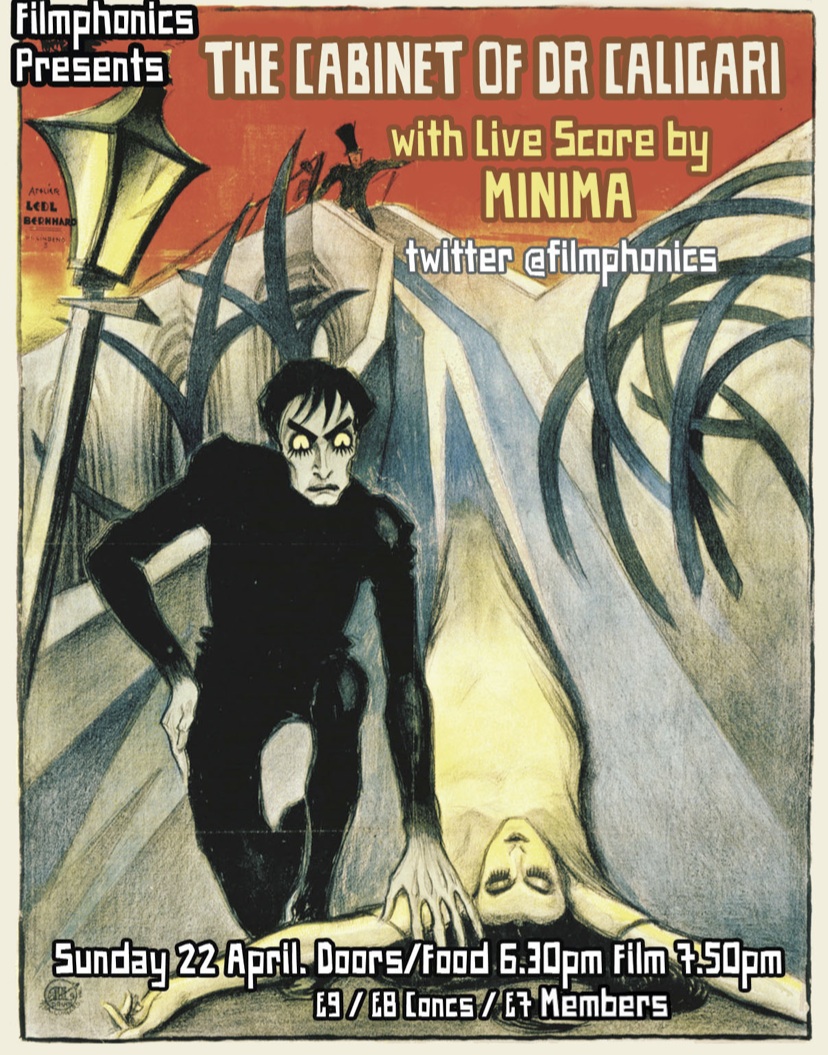
Glad tidings from east London. The capital’s newest cinema, the Hackney Picturehouse on Mare Street, also boasts the capital’s newest silent film screening venue. Hackney Attic hosts all kinds of live music and cinema events, scheduled by an outfit called Filmphonics. They have already dipped their toe into the silent waters with a sold-out screening of The Adventures of Prince Achmed, complete with belly dancers. Now Filmphonics are officially launching a series of monthly screenings with an event that is sure to be popular – a screening of the nightmarishly creepy The Cabinet of Dr Caligari, with live accompaniment from rock band Minima. if you’ve never seen Minima accompany a silent film, you’ve been missing out. They’re a rock band, albeit one with a cheeky cello, who specialise in the kind of spine-chilling soundscapes perfect for a film this creepy and strange.
The Cabinet of Dr Caligari screens at Hackney Attic on Sunday 22 April 2012. Doors open at 6.30p and the films begins at 7.50pm. Tickets for the screening cost £9, but less for concessions and members. Alternatively you can buy a dinner ticket, which includes the movie, a meal and a glass of wine for £20. That’s a pretty unbeatable night out, I’d say. Tickets are available online here.
Every so often a groovy film festival sweeps into town and shakes up the schedules a bit, introducing us to some silent movies that were hitherto a mystery to us. This month, the Argentine Film Festival arrives, complete with critical hits such as Las Acacias, but also with a programme of silents and live music at the Ritzy Cinema in Brixton.
I’ll admit, I’m not au fait with Argentine silent cinema. A little reading around tells me that only a handful of films made in the silent era in Argentina are still with us today, and that the films the Ritzy is showing have never been seen in the UK before. So this event should be a surprise to most of us.
These four short films, including the newsreel Film Revista Valle (1926), My Sorrel Horse (Mi alazán tostao -1923), The Return to the Bulin (La vuelta al bulín -1926) and Creole Mosaic (Mosaico criollo -1929) – one of the oldest preserved sound films – form part of the first collection of silent films to be recovered by the Pablo C. Ducrós Hicken Film Museum in Buenos Aires, and have never before been screened in the UK.
Together, they offer an intriguing vignette of life in 1920s Argentina, a country that was very much under Europe’s influence – as could be seen in the leisure pursuits of its upper classes – yet retained its own distinct character, not least through the tango.
The news reels featuring fox-hunts, visits from foreign dignitaries and elegant river cruises present a glamorous world which does much to explain how Buenos Aires acquired its title as the “Paris of South America”. At the same time the comic scenes from the tango underworld in The Return to the Bulin and the lawlessness in the country drama My Sorrel Horse are more reminiscent of North American genre films. Creole Mosaic sees one of the first attempts to include sound in films, using a synchronised gramophone record along with the actual screening. More of a musical review than a movie, it presented audiences with the voices and figures of popular radio artists.
It wasn’t easy to be a film-maker in Argentina in the 1920s. Money was tight, equipment was scarce and directors often found them selves multitasking, working on both sides of the camera, and editing films not on a Moviola but with a pair of scissors. Jose Ferreyra, who directed The Return to the Bulin, managed these challenges better than most. His films were made on the fly, often taking tango lyrics as the inspiration for the story. Sadly, Ferreyra’s films were not very well received, but those directed by one of his actors, Italian-born Nelo Cosimi, picked up better reviews. Cosimi didn’t restrict himself to tango themes, but looked farther afield for his subjects. My Sorrel Horse is one of his first films, and shows the influence of Hollywood cinema of the time.
The Argentine silent film programme screens at 5.05pm on Sunday 22 April 2012 in Screen 3 at the Ritzy Cinema, and will be followed by “a musical tour of Argentine tango history” in the bar afterwards. Tickets are available on this link.
UPDATE: I have just been informed that the screening of People on Sunday on 20 April 2012 will now have live piano accompaniment. That’s another reason to attend!
Just a year ago, Silent London was very pleased to report the news that a classic film club had been established in Ealing, west London – and they kicked off proceedings with two very fine silent films. The wonderful news is that the club is still going strong, and they are showing two more excellent silents this month. Up with this sort of thing.
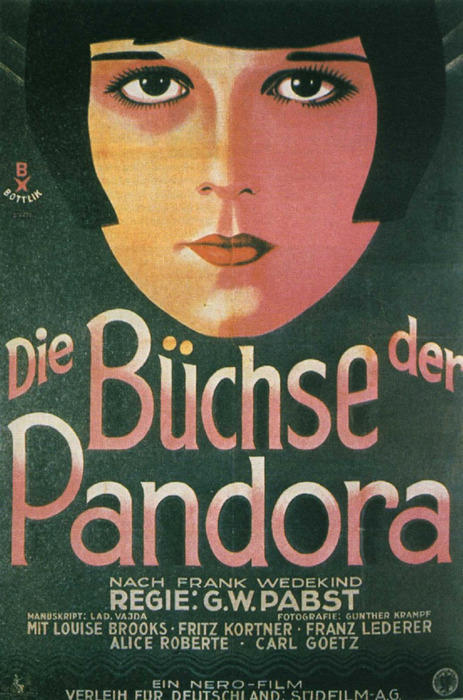
Pandora’s Box, (1929), directed by G. W. Pabst, on Friday 13th April at 7.30 pm
A masterpiece of German Expressionism, of cinematic eroticism which depicts the rise and inevitable fall of an amoral but naive young woman, who inspires lust and violence in those around her. The film remains as indelibly strange as ever, capable of reducing some critics to awed silence.
People on Sunday, (1930), directors Robert & Curt Siodmak, Edgar G. Ulmer, on Friday 20th April at 7.30 pm
This effervescent, sunlit silent, about a handful of city dwellers (a charming cast of non-professionals) enjoying a weekend outing, offers a rare glimpse of Weimar-era Berlin. People on Sunday was both an experiment and a mainstream hit that would influence generations of film artists around the world.
The Classic Film Club takes place at Ealing Town Hall, New Broadway, Ealing W5 2BY. The nearest rail and underground station is Ealing Broadway. Tickets £7 (concs £6) Membership £10 for 12 months. One day membership £1.
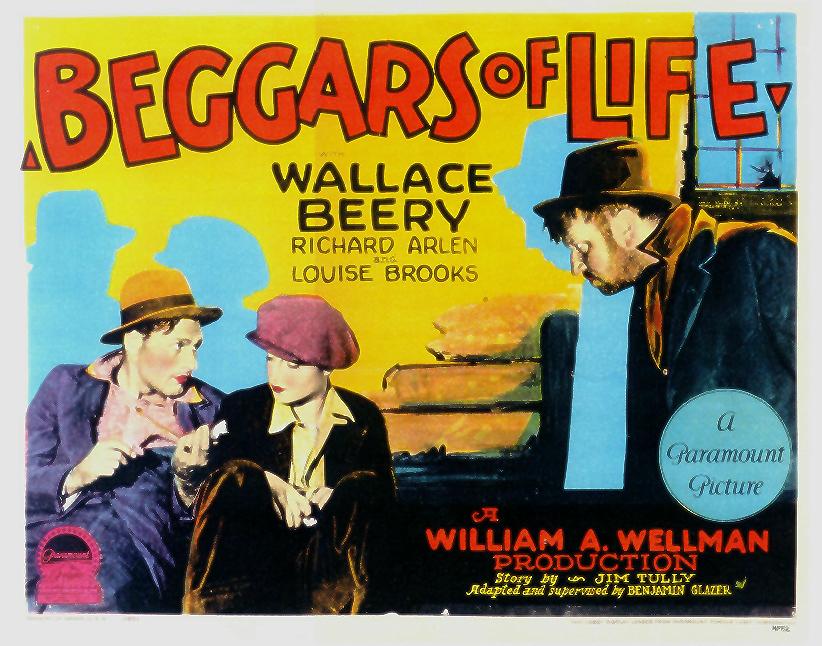
If you were at the British Silent Film Festival last year, you won’t need telling twice to book for Beggars of Life. The gorgeous Louise Brooks, leery Wallace Beery, a hulking great train, ‘Wild Bill’ Wellman at the helm and a soundtrack by the coolest skiffle band in town.
This show is a fine example of how invigorating the combination of a great silent movie and live music can be. The Dodge Brothers, an Americana-drenched quartet featuring none other than bequiffed film critic Mark Kermode on bass and harmonica, will accompany rail-riding rom-com Beggars of Life at the Barbican next month. And their numbers will be swelled by Neil Brand on the piano. Here’s a taster of one of the quieter moments from their score.
And here’s a review of their BSFF performance at the BFI Southbank last year, from the Ithankyou blog. Bryony Dixon herself says: “Never has a film and a band been more perfectly matched”. And if you want more Dodge Brothers action, don’t forget that they’re playing this year’s BSFF too, accompanying Abram Room’s The Ghost That Never Returns.
Beggars of Life screens at the Barbican on 29 April 2012 at 4pm. Tickets start from £7.50 and they’re available here. Please note this screening is rated 12A
You may have read somewhere or other that 2012 is the year of silent cinema. Well, wouldn’t that be nice? Far more certain to be an influence on your multiplex visits this year are a beautiful princess, a wicked stepmother and a poisoned apple. But silent cinema should still get a look-in.
The first of 2012’s adaptations of Snow White, with Julia Roberts as the vain queen and Lily Collins as her red-lipped, fair-skinned stepdaughter will be released in time for the Easter holidays on 2 April. Mirror Mirror is a family film, but it’s a modern twist on the fairytale, which gives Miss White a few more exciting tasks than whistling while she works. Judging by the trailer, she spends most of her time swordfighting with her bandit-dwarf chums and giving Prince Charming a spot of sass.
Released later in the summer, on 1 June, Snow White and the Huntsman is a darker, more violent version of the fairy tale, with Kristen Stewart as the heroine and Charlize Theron as the queen. There are buckets of CG effects in this one and the whole thing has a gritty Twilight-meets-Lord of the Rings vibe, although some of Theron’s scenes look uncannily like a certain perfume ad. This film tweaks the plot even further than Mirror Mirror, with Snow White as a chainmail-clad warrior on a mission to kill the queen. Chris “Thor” Hemsworth plays the hunky huntsman.
There’s even a TV Snow White in the States. Once Upon a Time is made by American broadcaster ABC and stars Ginnifer Goodwin as the long-lost daughter of Prince Charming and Snow White, trying to rescue a town of fairy-tale characters from a curse.
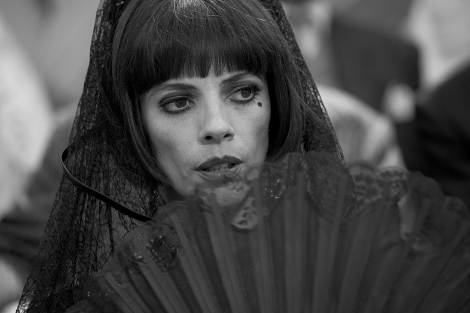
Maribel Verdú in Blancanieves
But enough of the talkies. The Snow White movie I’m really excited about this year hasn’t had a fraction of the publicity of those other flicks. In fact, it hasn’t got a UK release date yet, but it will debut on 28 September 2012 in its home country. Blancanieves is a Spanish film, directed by Pablo Berger, and it’s a Gothic horror-cum-melodrama, which retells the Snow White story in 1930s Madrid. From what I can gather, young Carmen has been tormented from childhood by her vile stepmother, so she escapes to the woods where she joins a troupe of dwarf bullfighters. Maribel Verdú plays the older woman, and Macarena García the younger. Did I forget to mention that it is a silent film? And black-and-white to boot. Splendid.
Berger’s previous feature film, which appeared nine years ago, Torremolinos 73, was a very different beast: a comedy about a man who wants to make arty films but gets into pornography instead. That at least proves he’s no stranger to taking a commercial risk. I really like the suitably Gothic approach he is taking to one of the Brothers Grimm’s nastiest tales, and this gallery of production stills on Facebook suggests that Blancanieves will be a truly gorgeous film. If you need another reason to get your hopes up, back in 2009 the Blancanieves script won a special award at Sundance to help fund the finished film.
There’s something else a little special about Blancanieves, though. The score for the movie is by Oscar-winning composer Alberto Iglesias, who has written for films including Tinker Tailor Soldier Spy and The Constant Gardener, as well as several of Almodóvar’s works. The wonderful news is that, according to the stories I have read, Blancanieves will complete a tour of cinemas with live orchestral accompaniment before its theatrical release. We’re still waiting for The Artist to do the same, though such a jaunt is in the works, we hear.
It’s facetious to draw comparisons at this stage with that other European monochrome silent, but I’m tickled pink to see this outsider muscling into what has been pitched as a battle between two blockbusters. There is always room for a silent film or two to cleanse our palates of all that too-familiar fare.
So which is the fairest of them all? Only time will tell, but I clearly already have a favourite – and a fairytale ending in mind. The other question is, how will Blancanieves compare to the whimsical 1916 Snow White, starring Marguerite Clark:
Read more about Blancanieves here. Thanks to the wonderful Nobody Knows Anybody blog for first alerting me to the film.
Walthamstow is at the very heart of the British film industry, or at least it used to be. Between 1910 and 1930, 400 movies were made in London’s E17 postcode at four studios, including a very grand establishment on Wood Street that was built by the Broad West Film Company in 1914. Nowadays, the suburb is more associated with a 90s boyband than film pioneers, but that doesn’t mean that the locals have turned their back on the area’s cinematic heritage. This summer, for example, the BFI will be showcasing the silent work of a little-known local film-maker called Alfred Hitchcock.
Check out this picture of the Wood Street Studio in the silent era. And do read this interview by Kevin Brownlow with Tilly Day, a woman who worked there as a Continuity Girl at the time. Her memories of a sharing a scene with Kenneth McLaglen, being frightened by the horses on location shoots in Epping Forest and watching Walter West directing silent films are all fascinating.
Broad West Film Company's Wood Street studio
The Wood Street Pop-up Picture Palace will celebrate the days when Walthamstow was in the movie business in grand style on Friday night, with a special event that includes live music and the chance to dress up like a vintage film star. There’ll also be a screening of a new silent film, which incorporates animation and live action, and was filmed with help from the children of Woodside Primary School. I haven’t seen the movie myself, but the artists involved in the project are Elizabeth Hobbs, who makes animated films, and Emily Tracy, who produces beautiful light sculptures and collaborative art projects.
The Picture Palace's home in Wood Street Indoor Market
I popped down to the project’s offices at the new Wood Street Indoor Market on the weekend, but sadly they were closed. However I did spot a few sketches of the old Wood Street Studio that certainly intrigued me. Do get along to the special event on Friday 30 March, if you can. It’s free and promises to be very interesting and a lot of fun.
To read more about the indoor market, and other cultural events in E17, visit the very hip and happening Walthamstow Scene website.
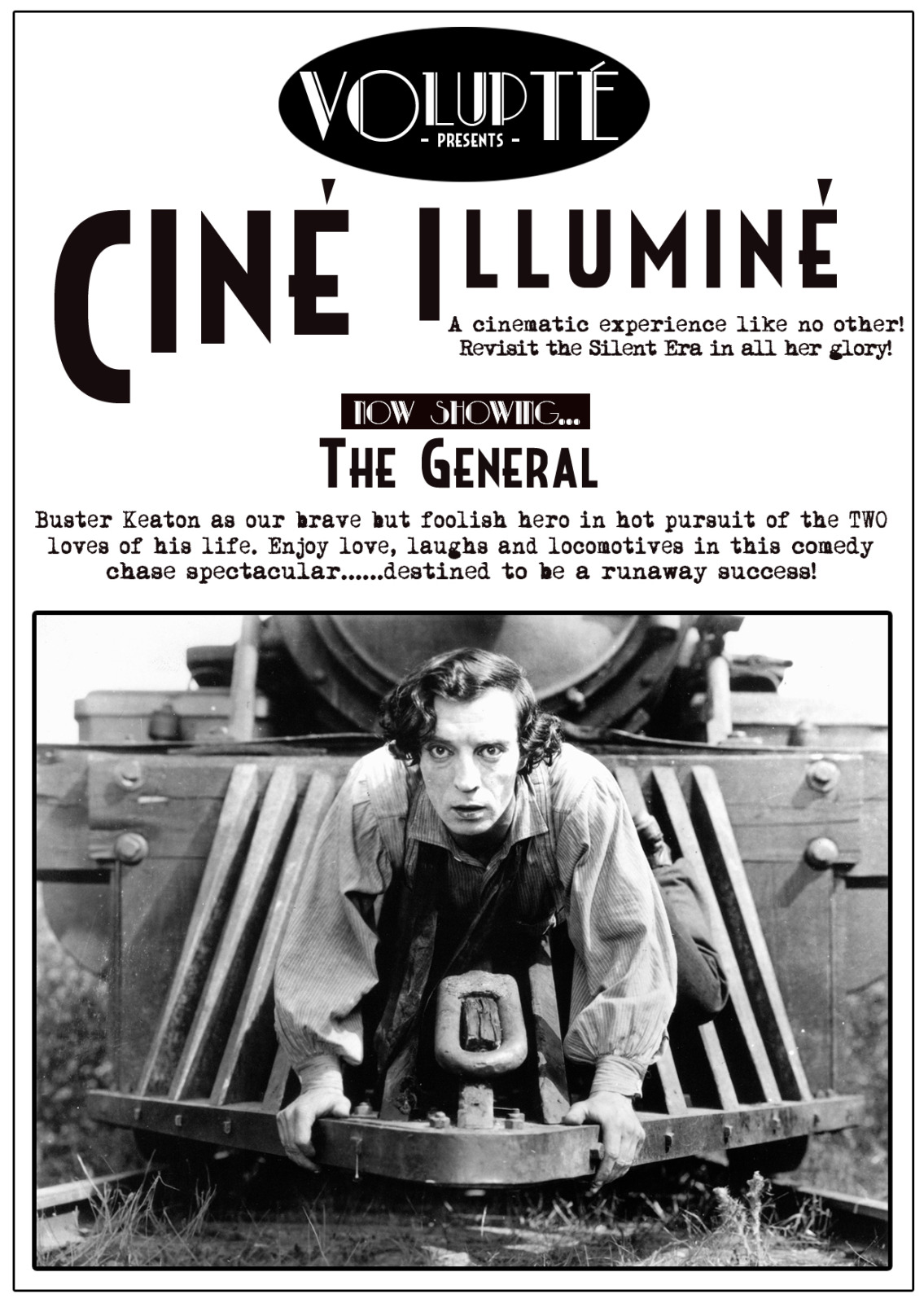
There’s nothing like a little prohibition-era pizzazz to to jazz up a silent movie screening. And the Volupté Lounge in central London is all about glamour. It’s a “burlesque cabaret bar” that calls itself the “the most decadent little supper club in town”, and if that doesn’t get you hot under the collar, check out its plans for silent cinema screenings. Phew!
On the first Sunday of every month, the club will show a silent movie in its underground cinema, the Ciné Illuminé, with live piano accompaniment from Luke Meredith. The series begins on Sunday 1 April 2012 with screening of the Buster Keaton’s must-see masterpiece The General. It sounds as if these shows will definitely be worth dressing up for too, promising usherettes, vintage cocktails and a “Bon Bon bar” for your sweet tooth.
Doors are at 6pm for a screening at 8pm. Tickets are £7 in advance or £9 on the door. You’ll find the Volupté Lounge at 9 Norwich Street, EC4A 1EJ. Call 0207 831 1622 or email reservations@volupte-lounge.com to book tickets. Don’t forget to check out the Facebook page for future screenings.
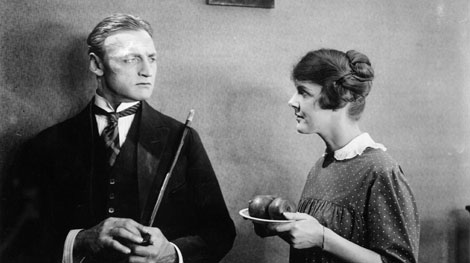
Miles Mander and Madeleine Carroll in The First Born (1928)
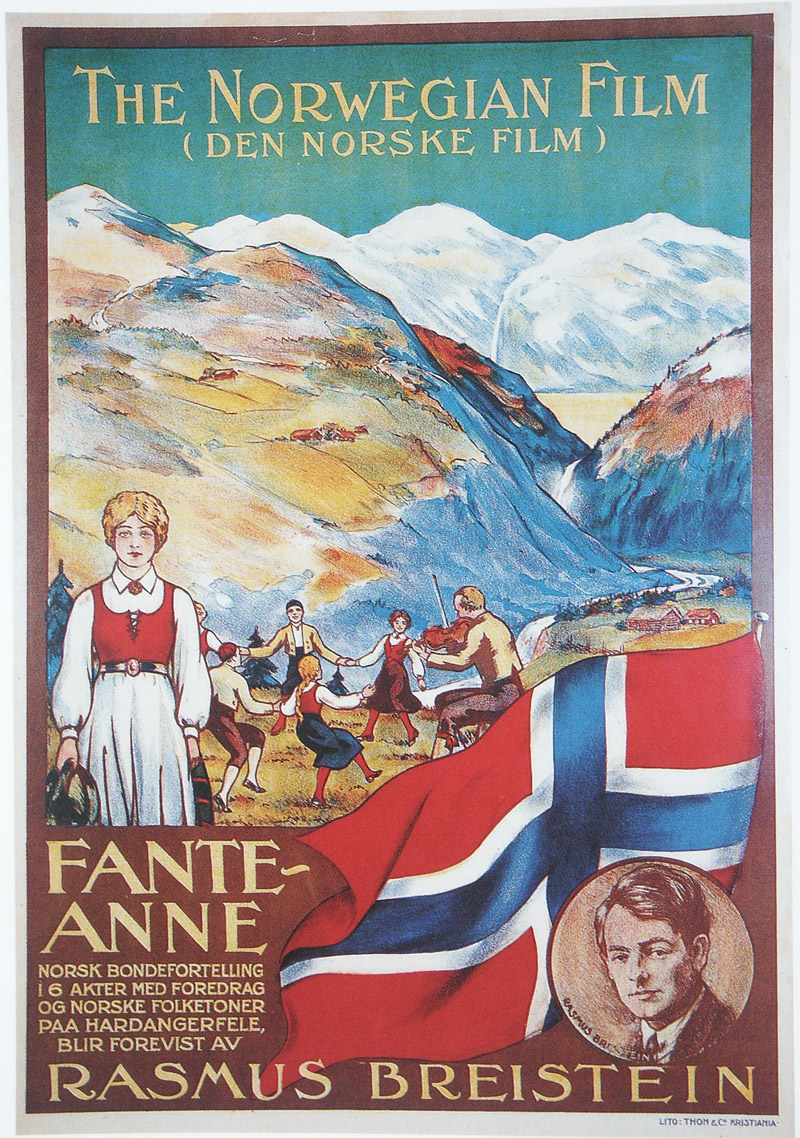
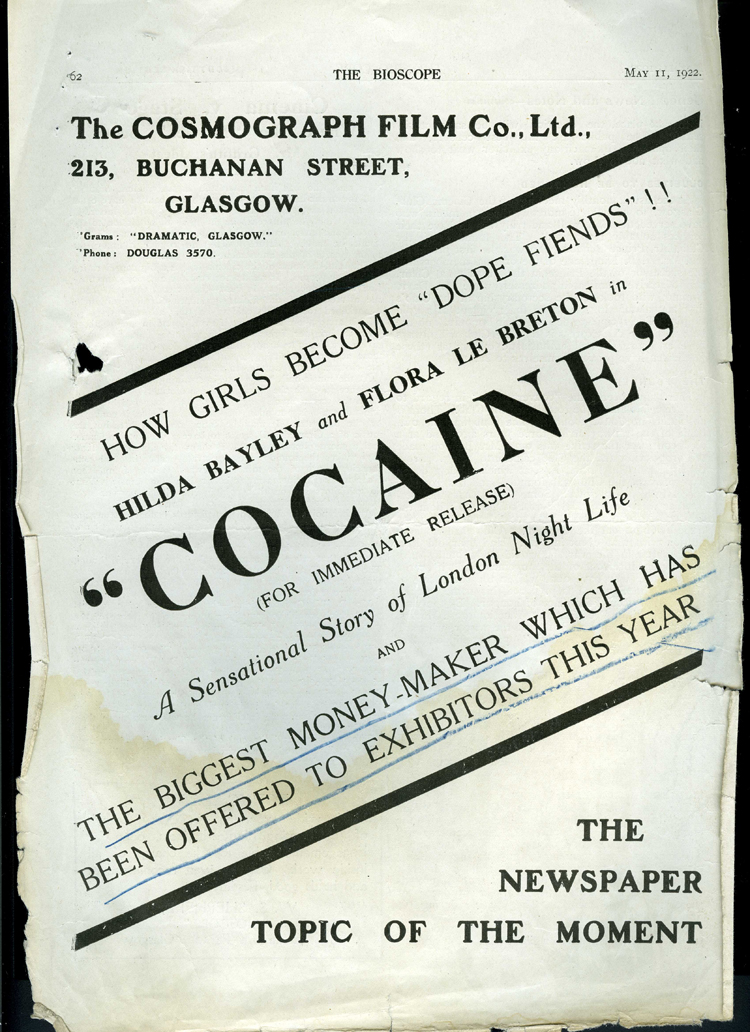
I’m very pleased to say that more details of the programme for next month’s British Silent Film Festival have just been released. The festival takes place in Cambridge this year, from 19-22 April. Delegate passes for the weekend are now available to buy here, and the full schedule is available to browse here. Screenings will include Graham Cutts’s Cocaine, to accompany the ‘What the Silent Censor Saw’ programme, The First Born, with Stephen Horne’s ensemble score, Norwegian drama Fante-Anne (Gipsy Anne) with a new score by Halldor Krogh, Soviet documentary Turksib with accompaniment from Bronnt Industries, folk films from the ‘Here’s a Health to the Barley Mow’ collection and new restorations from the Imperial War Museum. There will be some British silent cinema highlights from 15-year history of the festival, a Grand Guignol strand of macabre movies and Ian Christie will deliver the Rachael Low lecture.
All this plus the Dodge Brothers will be scoring The Ghost That Never Returns live, there’ll be an outdoor screening on the Sunday night, golfing tales from PG Wodehouse, some classic Cambridge comedies and a couple of WW Jacobs adaptations in the form of The Boatswain’s Mate and A Will and a Way. The full announcement is pasted below.
Fante-Anne (1920)
The British Silent Film Festival will be celebrating its 15th Anniversary in Cambridge at the Arts Picture House. The four-day programme will be packed with rarely-seen films from the BFI and other international archives featuring a wide range of fascinating subjects such as: P.G. Wodehouse’s golfing tales including The Long Holeand The Clicking of Cuthbert; rarities based on the charming coastal stories of W.W. Jacobs including The Boatswain’s Mate and A Will and a Way; a celebration of thecentenary of the British Board of Film Classification with a look at ‘What the Silent Censor Saw’ with the rarely screened and risqué film Cocaine. We’ll be tracing the origins of Cambridge’s brand of ‘university humour’ before the Footlights with a selection of burlesque films from the 1920s and featuring A Couple of Down and Outs, the ‘silent Warhorse’ made in 1923 which tells the tale of a WWI soldier who goes on the run with his warhorse to save it from the ‘knacker’s yard’. We are also delighted to be screening the 1920 classic Fante-Anne (Gipsy Anne), directed bythe greatNorwegian director Rasmus Breistein; accompanied by a new musical score by composer and music producer Halldor Krogh.
Trade ad for the scandalous Cocaine (Graham Cutts, 1922)
We’ll also be featuring some 15th anniversary highlights including the legendary Grand Guignol programme of macabre stories with a twist in the tale and we’ll be including a selection of the best of British silent feature films screened over the past fourteen years. The Imperial War Museum will be presenting their latest silent restorations from their fabulous collection and we are very pleased to announce that Ian Christie will deliver the Annual Rachael Low Lecture.
This year’s ‘hot tickets’ will be the wildly popular Dodge Brothers performing their distinctive brand of Americana to The Ghost That Never Returns at the West Road Concert Hall; Here’s a Health to the Barley Mow with live folk accompaniment to silent films of English folk traditions and the Bronnt Industries playing to the stunning Soviet film Turksib. Regular Festival collaborator Stephen Horne will be performing his fabulous new ensemble music score to The First Born, a dizzying tale of sex, death and British politics.
Screenings will take place at the Arts Picturehouse, Emmanuel College and the West Road Concert Hall. The Festival will draw to a close with an outdoor highlights screening on Magdalene Street in the evening of Sunday 22 April.
Today, Carl Theodor Dreyer is best known for one lost-and-found silent masterpiece, and five subsequent sound films shot many years apart – but the little-mentioned fact is that the 1920s were his most productive decade. The BFI’s forthcoming retrospective, The Passion of Carl Dreyer, offers a chance to to shift the balance. In March, you’ll be able to see all nine of the Danish director’s silent features on the big screen, from 1919’s daring The President to the timeless The Passion of Joan of Arc (1928). A closer look at Dreyer’s silents is always rewarding, both for their continuity with the themes of religion and female suffering found in his later films such as Ordet and Day of Wrath, and for the revelation that this serious Scandinavian was also a master of comedy.
Dreyer had been working as a journalist when he was first hired by the Nordisk company in 1913 to write intertitles and to edit and write screenplays. This was a boomtime for Danish cinema: in the teens, Nordisk was not just making hundreds of films a year but exporting them widely too. From writing intertitles, he discovered the strength of distilled, almost elliptical speech – he later talked about how he whittled down the dialogue in Vampyr (1930) until it was almost a silent film, and it was all the more powerful, all the more eerie, for his labours. Dreyer worked on the screenplays of several literary adaptations at this time, which also cemented his opinion that great films should have literary sources – and all his features did.
It was as he grew more confident in his work at the studio, and was working as an editor, that Dreyer developed his signature film-making style too – before he had even stepped on set as a director. As David Bordwell has written, Nordisk’s films at this time were predominantly shot in the “tableau” style, with the actors blocked in sophisticated patterns on a deep stage. When Dreyer got behind a camera he ditched that approach in favour of an edit-heavy style more popular with American film-makers such as DW Griffith. This distinctive, modern, method is apparent in his very first feature, just as it is in the barrage of close-ups that comprise his final silent film, The Passion of Joan of Arc.
The purpose of this post is to offer a quick introduction to Dreyer’s silents, which are for the most part much less widely seen than his sound films – and really do draw a different picture of the director. I assume that most of you are familiar with The Passion of Joan of Arc – if you haven’t seen it, you must take this opportunity to do so – but I also highly recommend many of the others, especially The Parson’s Widow and The Master of the House.
Spring 2012 marks a couple of grisly, yet hugely significant centenaries. The Titanic sank on 15 April 1912 (more of which in forthcoming posts) and on 29 March 1912 or thereabouts, Robert Falcon Scott succumbed to cold and starvation and died a few miles from the South Pole.
The story of Scott and his crew’s tragic expedition has been told many times, but nowhere more movingly than in The Great White Silence (1924), Herbert Ponting’s silent documentary that was rereleased theatrically last year.
To commemorate the centenary, the BFI has scheduled three special screenings of documentary material relation to Antarctic exploration, each pegged to an individual explorer. You’ll probably be familiar with The Great White Silence by now, but if you haven’t seen it yet (or bought it on DVD/Blu-Ray), this is a fantastic opportunity to see it on the big screen. The Ernest Shackleton film South is a marvellous companion to The Great White Silence, with fantastic photography from Frank Hurley. It was also recently restored by the BFI and released on DVD. The footage of Roald Amundsen’s rather more successful voyage is less widely seen and promises to be fascinating.
Race to the South Pole: Amundsen and the Others
Our first programme focuses on Roald Amundsen and the little-seen film Roald Amundsens Sydpolsferd (1910-12), restored by the Norwegian Film Institute and here playing in context with a selection of surviving fragments from films of the expeditions of William Speirs Bruce in 1902-4 (The Scottish Antarctic Expedition), Shackleton in 1908-9 (Departure of the British Antarctic Expedition from Lyttelton, NZ 1st Jan 1908), the Japanese Shirase in 1911 (Nihon Nankyoku Tanken), and a work in progress to recreate cinematographer Frank Hurley’s original lecture on the Mawson Australian Antarctic Expedition 1910-12.
With introduction by Bryony Dixon and live piano accompaniment.
Memorial Service at St. Paul’s Cathedral to the Antarctic Heroes (Pathé Animated Gazette, UK 1913, 1min) + Captain Scott and Dr Wilson with ‘Nobby’ the Pony (Gaumont Graphic, UK 1912, 1min) + Cardiff: The Ship ‘Terra Nova’ Leaving Harbour Towards the South Pole (Pathé Animated Gazette, UK 1912, 1min) + The Great White Silence (UK 1924, dir Herbert Ponting, 106min. Digital)
To commemorate the centenary of the death of Scott and his companions we present Herbert Ponting’s moving tribute The Great White Silence (1924), together with newsreels of the time showing how contemporary audiences followed the momentous news from the planet’s last unexplored continent.
South – Sir Ernest Shackleton’s Glorious Epic of the Antarctic (UK 1919, dir Frank Hurley, 72min) + El Homenaje del Uruguay a los Restos de Sir Ernest Shackleton (Uruguay 1922, dir Henry Maurice, 10min, Spanish intertitles) + Southward on the ‘Quest’ (UK 1922, extract, c5min).
Of all the heroic age Antarctic explorers, Shackleton seems to have the most enduring popular appeal. Almost nothing of the film from the Nimrod expedition which inspired Scott and Amundsen seems to survive, but we do have Frank Hurley’s extraordinary document South (1919) which we will be showing with rare footage of Shackleton’s last expedition and the huge crowds gathered for his lying in state in Montevideo, Uruguay.
Introduced by Bryony Dixon. Live piano accompaniment.
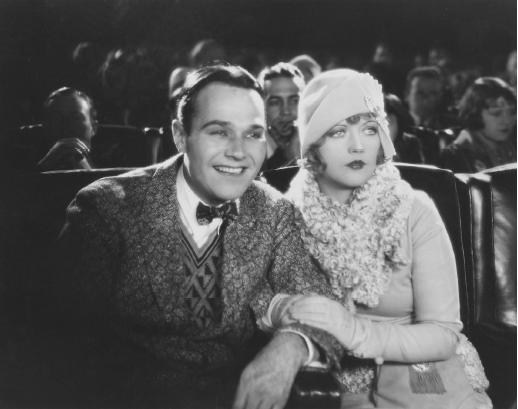
William Haines and Marion Davies in Show People (1928)
The Hippodrome in Bo’ness is Scotland’s oldest purpose-built picture palace – and it’s a real beauty. This year, the cinema is celebrating its 100th birthday in grand style, with the return of the Hippodrome Festival of Silent Cinema.
The centenary event builds on the success of last year’s festival, and tips its boater to a certain modern silent hit too. The opening night gala will be a screening of Show People, starring Marion Davies as a Hollywood wannabe whose dream comes true – shades of Peppy Miller, of course. It’s a real treat of a film, and it’s packed with cameos from silent Hollywood stars too: you’ll be able to spot Charlie Chaplin, Douglas Fairbanks, John Gilbert, William S Hart and Mae Murray, among many others. William Haines is Davies’s co-star and King Vidor directs. Neil Brand will be playing the piano. If you’re attending the gala, don’t forget the dress code: the theme is Hollywood film star, the more glamorous the better.
Other events at the festival include:
The fantastic new restoration of British drama The First Born, starring and directed by Miles Mander, with a brand new score by Stephen Horne, performed by Horne and his band.
A Jeely Jar Special family screening of Harold Lloyd’s Safety Last! Bring along a clean jam jar (and matching lid) for a 2-for-1 ticket deal on the Saturday morning. Piano accompaniment by Neil Brand.
Two comedy shows: Another Fine Mess with Laurel and Hardy and The Keystone Connection, curated by David Wyatt, with Stephen Horne on the piano. You knew, of course, that Keystone Studios was founded in 1912, the same year that the Hippodrome was built.
The Lost Art of the Film Explainer will revive the live film narrator tradition with renowned storyteller Andy Cannon and cellist Wendy Weatherby.
Ozu’s poignant comedy I Was Born, But … with musical accompaniment by Forrester Pyke.
Flashback thriller A Cottage on Dartmoor, directed by Anthony Asquith.
Music and stunt workshops.
The closing night gala will be the two-strip Technicolor restoration of The Black Pirate, featuring a swashbuckling lead performance by Douglas Fairbanks, with musical accompaniment by pianist Jane Gardner and percussionist Hazel Morrison.
Tickets are available from the Steeple Box Office, High Street, Falkirk FK1 1NW, the Hippodrome Box Office, by phone on 01324 506850, and online at www.falkirkcommunitytrust.org/silentcinemafest, where you can also read the full schedule for the festival.
One of the great strengths, at least as far as this blog is concerned, of the BFI’s ongoing Dickens on Screen programme, is that the silent films on offer have been spread out across the season, rather than all lumped into the first month. Witness: the impressive range of silents screening in January and February.
More silents appear in March, including another programme of pre-1914 shorts and a rare sighting of a Danish film, AW Sandberg’s Our Mutual Friend (1921). The Nordisk films is one of four Dickens adaptations by Sandberg, which were all well received in Denmark at least. Our Mutual Friend, or Vor Faelles Ven, is the least seen of the quartet, and indeed the restoration work on this print has been going on for quite some time. Now, 90 years after it was released, we can see it as it should be seen. Our Mutual Friend screens at NFT3, BFI Southbank at 6.20pm on 6 March 2012 and at 8.45pm on 9 March 2012 with live piano accompaniment. Buy tickets here.
Seymour Hicks as Ebenezer in Scrooge (1913)
The shorts programme kicks off with Thomas Bentley, who went on to direct several Dickens films, in front of the camera taking on a number of roles in Leaves from the Books of Charles Dickens (1912). American comedian John Bunny starred in three films based on The Pickwick Papers – but the two shown here are the only ones to survive. Two versions of A Christmas Carol finish the programme, with Seymour Hicks playing the miser in 1913 version and Charles Rock being visited by spectres in 1914. Pre-1914 Short Films (Programme two) screens at 9.30pm on 9 March at NFT3, BFI Southbank (with introduction by Michael Eaton) and at 6.20pm on 23 March 2012 in NFT2, BFI Southbank. Both screenings will feature live piano accompaniment. Buy tickets here.
Decasia, Bill Morrison’s haunting 2002 tribute to film and its fragility, screens at the BFI Southbank in March, in an expertly matched double-bill with the terrifying, elusive The Fall of the House of Usher (Jean Epstein, 1928). Don’t miss.
The double-bill screens at 8.30pm on Sunday 4 March 2012 and at 6.10pm on Tuesday 6 March. Both screenings are in NFT2. The Fall of the House of Usher will have live piano accompaniment. The Tuesday screening will be introduced by Dominic Power, the head of screen arts at the National Film and Television School. Tickets will be available here.
Mary Pickford is one of the most fascinating figures in Hollywood history. She was “America’s sweetheart” with long blonde curls and a fairytale marriage to handsome Douglas Fairbanks. But she was also the co-founder of United Artists and producer, star and director in all but name on some of her most successful pictures. More than just a pretty face indeed. Pickford knew exactly how the movies worked, and having grown up in terrible poverty as a child in Toronto, she knew what life was all about too, which you can see clearly in her finest screen performances.
Therefore, it’s a pleasure to learn that this year’s Birds Eye View Sound and Silents commissions will celebrate Mary Pickford with a triple-bill of her films at the Purcell Room in the Southbank Centre. The New York Hat (1912), The Female of the Species (1912) and Amarilly of Clothes-Line Alley (1918) will be screened, accompanied by new scores by three very different musical talents:
Bouncing off Pickford’s on-screen radiance are three contemporary female artists. Anna Meredith is an in-demand composer/performer of acoustic and electronia, Welsh-born Roshi absorbs Iranian influences in her experimental folk. And multi-instrumentalist Tanya Auclair merges British, Rwandan and Canadian roots.
The New York Hat and The Female of the Species are both short films directed by DW Griffith, featuring Pickford in wildly different roles; the first of them was written by a young Anita Loos. Another legendary Hollywood screenwriter, Frances Marion, wrote the scenario for Amarilly, which is closer to feature-length and features Pickford as a young woman from a poor family who meets an upper-class sculptor but falls foul of his snobbish and cruel aunt.
The Mary Pickford Revived event is part of the Women of the World Festival and takes place at 8pm on 9 March 2012 at the Purcell Room in the Southbank Centre. Tickets cost £15 and are available here.
Also as part of the Sound and Silents programme, the magnificently gothic and strangely comic Sparrows (1926), one of Pickford’s greatest films, will be shown at Hackney Picturehouse on 11 March, with a live score by Aristazabal Hawkes from the Guillemots. You may remember that the score was commissioned by BEV last year and was due to be performed at the BFI Southbank, but the performance was cancelled. Sounds like a must-see to me. You can buy tickets here.
To find out more about the Birds Eye View Film Festival, which returns next year, visit the website.
UPDATE: I updated this post on 2 April 2013, because The Scaffold has just been made available on YouTube. Enjoy!
What a joy to return from a weekend of visual comedy at the Slapstick Festival (more of which anon) to hear about a modern silent comedy, “inspired by and dedicated to the grand masters of slapstick”, screening in London later this week. The Scaffold, directed by Peter Hübelbauer, is showing at the Student Film Festival on Friday 3 February 2012. It’s a knockabout, retro treat, very much in the vein of Laurel and Hardy. The three characters are painters and decorators, working on a rickety scaffold – expect planks, pratfalls and precarious pots of glue. The Scaffold is screening in Competition Block 2: Eclectic Mix, at 12:15 on Friday 3 February 2012. The venue is the London College of Communication. Buy tickets here. The film-maker will be there, so hopefully you’ll be able to hear about his inspiration for the film, and how he recreated the noble art of slapstick movie-making in the 21st century. To find out more about the Student Film Festival, visit the website.
The Farnborough Symphony Orchestra begins its 90th anniversary year by performing the live accompaniment to two screenings of the 1927 comedy classic silent film The General at Farnham Maltings on Saturday 17 March. The General, directed by and starring Buster Keaton, was recently listed in The Independent as one of the 10 best silent films, and features some of the most dangerous (and explosive) stunts with steam trains ever filmed. Carl Davis’ score includes every famous civil war song, as well as a tender folk song the composer’s grandmother used to sing him when he used to sit on her knee. The General was described by Orson Welles as “the greatest comedy ever made, the greatest Civil War film ever made, and perhaps the greatest film ever made” and this unique performance, conducted by the FSO’s charismatic musical director Mark Fitz-Gerald, will delight young and old alike.
The General screens on Saturday 17 March at at 3pm & 7.45pm. Tickets are priced at £10 for adults or £5 for children or students in full-time education and are available from the FSO Ticket Secretary on 07775 789477, Farnham Maltings Box Office on 01252 745444 or online at www.farnboroughsymphony.org.uk








 Silent London