Tag Archives: Ben Carré

Le Giornate del Cinema Muto 2024: Pordenone Post No 8

A confession. I was conspiring over breakfast, and reader, this was a two-cappuccino problem. The upshot? I was a little late in getting started with the screenings today. But I certainly knew that I was going to be up late, with the gala… and the end-of-festival celebrations!

My sunny morning stroll to Cinemazero was rewarded with a simply terrific film from Uzbekistan. In Her Right (Grigorii Cherniak, 1930), a group of workers from the collective farm are sent to the factory to boost the workforce there, and to learn those valuable Soviet methods. One woman from the village defies her husband and sheds her burqa to join them. It’s a life-changing experience and not only does she gain independence through work, but she inspires others to do the same, through a filmed speech, that the workers clamour to watch, even after he enraged husband slashes the screen. Even with her “throat” cut, in a silent film, she continues to speak her truth.  So you have noted already that this is once again pro-Soviet, anti-Islam propaganda in intent, but this is also a remarkable film in style and action. Our Hollywood friends would applaud the excellent, and indeed poignant, action sequence in which our heroine runs to jump on the train to the factory, is repeatedly shoved away by male guards and then, when it seems she has finally found a helping female hand, her husband leaps – for a second we think he has dragged her form the moving train, but no, he only has her coat in his hands. Nail-biting stuff. And the scene in which they watch the film is also very strong. Günter Buchwald at the keys for this one, keeping the energy at exactly the right pace.

Continue reading Le Giornate del Cinema Muto 2024: Pordenone Post No 8


Le Giornate del Cinema Muto 2024: Pordenone Post No 7

Blood, sweat and tears on the screen today. And to cap it all off, prizes! That’s Friday in Pordenone, folks. Read all about it.  

Your scribe is a little squeamish, I must confess, so this morning I had to resort to an old trick, and pop my glasses off during some of Arabi (Nadezhda Zubova, 1933), a drama about sheep farmers organising to form a collective and defeat the feudal powers that exploit their labour under the old system. That doesn’t make me squeamish, I’m all for it – it was the killing and skinning of lambs that turned my stomach. Still, I thought this was terrific, with some very sharp editing, especially in the opening sequence, and lovely low camerawork of the herd out in the field.

Continue reading Le Giornate del Cinema Muto 2024: Pordenone Post No 7

Le Giornate del Cinema Muto 2024: Pordenone Post No 6

Wouldn’t you like to go Behind the Scenes with DW Griffith and Florence Lawrence? I sure would, that’s why I was bright and early at the Verdi this morning for the 1980 Biograph package. Behind the Scenes, per the catalogue is the “happy exception” among the 1908 output. Well it certainly had punch. A distraught mother must tear herself from her daughter’s sickbed to kick her heels and shake her hips on the vaudeville stage to earn a crust. But as the crowd roars out for an encore, her baby girl is slipping away from this life; Grandma rushes to the stage door… If “too late!” is the essence of the melodramatic narrative then this was a textbook case. We stayed to see Lawrence reappear as the titular character in The Red Girl, in which a collection of ethnic stereotypes conspire to rob a “girl miner” but Lawrence defies racist convention to lend a hand instead. Impressive to see Lawrence Harry Houdini her way free after being tied up and dangled over a precipice above the rushing river. Extra exciting with John Sweeney at the keys, of course.

Continue reading Le Giornate del Cinema Muto 2024: Pordenone Post No 6

Le Giornate del Cinema Muto 2024: Pordenone Post No 5

Sometimes the old songs are the best, right? Familiarity can breed contentment. And nowhere will you find more consensus on that than here in Pordenone. So today I was happy to rewatch a couple of silent films I love, spend a little time with one of my all-time favourite silent stars. And then see something entirely new to me!

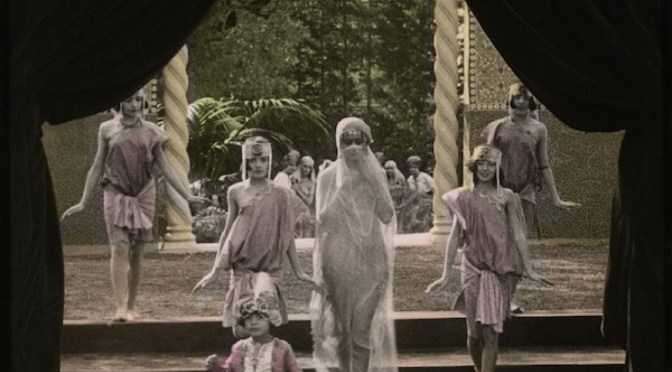
First, the old friends. This morning, we ventured back into the imaginations of Maurice Tourneur, and Ben Carré, with the 1918 adaptation of Maurice Maeterlinck’s The Blue Bird. Such a strange and beautiful, terrifying and wholesome journey into the shadow world of dreams, where bread and sugar and water have souls, the dogs and cats can talk, lost grandparents always have the table set for supper and babies wait impatiently to be born. If you have not seen this, you possibly can’t imagine quite how weirdly pretty it is. Variety’s critic wrote: “It is quite safe to assert that nothing quite like Director Tourneur’s work has ever been shown on the screen.” So hats off to Tourneur and Carré, and doubly so to Neil Brand and Elizabeth-Jane Baldry, who transported us to an enchanted realm with their music. I wrote about the film in more detail here, should you be interested.

Continue reading Le Giornate del Cinema Muto 2024: Pordenone Post No 5

Le Giornate del Cinema Muto 2024: Pordenone Post No 4

And verily, on Tuesday, the fourth day of Le Giornate del Cinema Muto, the rains came down upon us. And things got quite soggy inside the theatre too, what with Mary Pickford nearly drowning in the hold of her own houseboat in Pride of the Clan, a parcel of wonderful underwater films in the early afternoon, and a wild ride to Neptune’s kingdom to close the day.

Before the rain began, I spent a couple of rapt hours in the Canon Revisited strand this morning. Carl Th Dreyer’s Leaves From Satan’s Book (1920) travels through the centuries with God’s Fallen Angel, who is doing his evil work among humans who prove reliably weak in the face of temptation. Surrendering one’s soul to sin is not to be advised, but surrendering oneself to cinematic greatness – that is a balm for the ills of the modern age. This is a film of deceptive subtlety, and slow-burning excitement. The camera stays still so long that when it moves, the moral universe tilts. The austerity of the first, biblical sequence gives way by degrees to a faster editing rhythm, and cutaways to sympathetic details, a flock of geese, a cat toying with a mouse, a baby in her crib. Soon we’re in action thriller territory as we finally wash up in Finland in 1918, via the Spanish Inquisition and the French Revolution. Dreyer, being Dreyer, the faces, not least of Helge Nissen as the shape-shifting Satanas, carry boundless weight. It’s a masterpiece, an early one, from a man who made much better films, even, but still. And yes I am smug about having watched it with John Sweeney’s soul-stirring accompaniment, which likewise knew when to hold back and when to rush forward through the ages.

Continue reading Le Giornate del Cinema Muto 2024: Pordenone Post No 4