Tag Archives: Charlie Chaplin

Charlie’s London: music hall memories

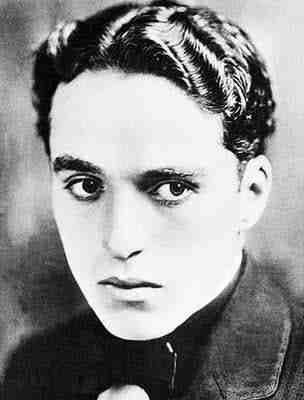
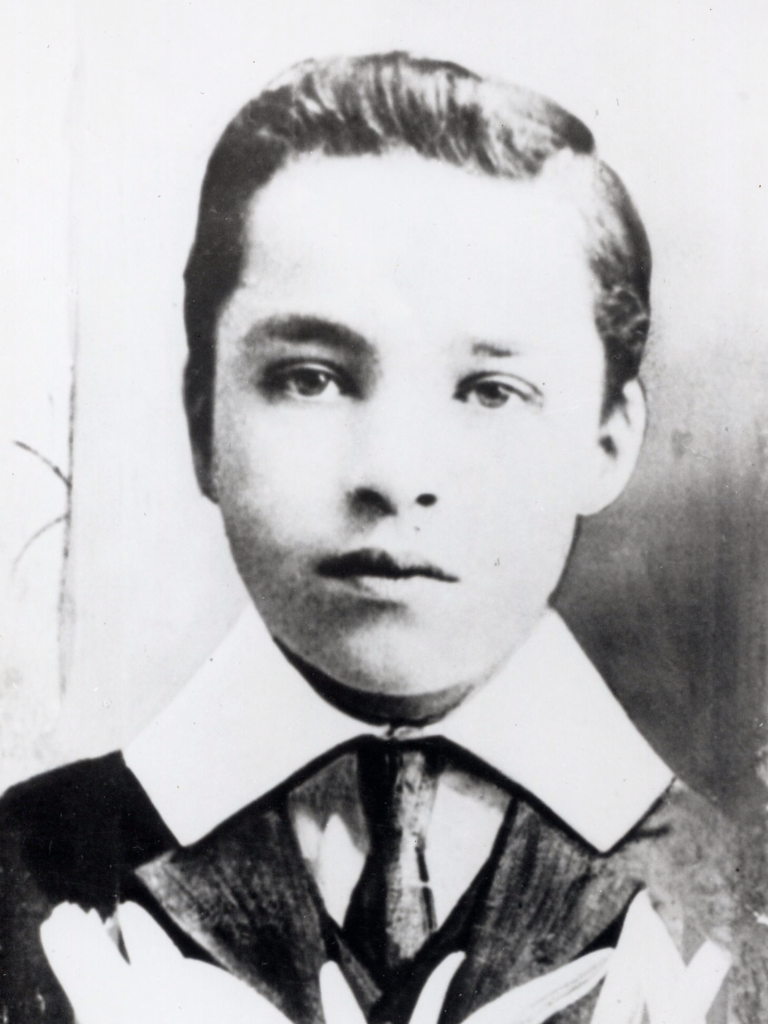
A young Charlie Chaplin, photograph from the archives of Roy Export Company Establishment

This is a guest post for Silent London by Ayşe Behçet.

Thanks for returning for part three of Charlie’s London; this edition will look at the tradition of the English music hall, the same stages that would form the backdrop to Charlie’s early years. Unfortunately, these such wonderful places do not really exist any more, except for seasonal events or moments of fleeting fashionable curiosity. Happily, those of us who love silent cinema have a greater appreciation for them.

Last week, I looked at the Walworth Road, Charlie’s supposed birthplace. This week looks at the music hall tradition, where both of Chaplin’s parents worked. And I’ll be throwing some family stories into the mix that will hopefully make you all chuckle along the way.

Charles Spencer Chaplin Senior was a butcher’s son who found his niche on the music hall stage with a certain degree of success and credibility. His specialist skills were as a vocalist and actor, talents that no doubt his famous son would inherit. However, Charlie Junior appears to credit his mother Hannah Chaplin as a larger theatrical and musical influence over his life. Hannah Harriet Pedlingham Hill was a smaller star who went by the stage name Lilly Harley. In the late 19th century, the Lambeth and Kennington area was a hotbed for music hall entertainers, including fresh-faced talents looking for their first taste of the stage, just like Hannah and Charles.

Music hall was already a tradition rooted in the working class history of London. Initially established in back rooms of public houses they provided entertainment from songs and plays to recitals and dance troupes. In a future instalment I will be talking about the Coal Hole public house in the Strand as a future place of work for Sydney Chaplin – that pub too had a back room known as a song and supper room. Offering light entertainment and a meal for a set price, song and supper rooms offered a bargain night out for most.
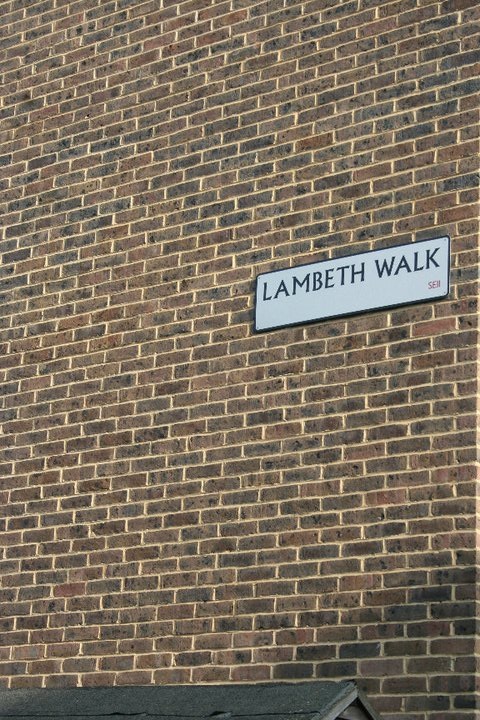
Doing the Lambeth Walk ...
Doing the Lambeth Walk …

In fact, the very first musical hall was established in little old Lambeth. 143 Westminster Bridge road in fact! The theatre was called the Canterbury and designed and built by Charles Morton in 1852. Charlies seem to feature a lot in this little walk around don’t they? Other, large-scale theatres followed, including the South London Music Hall in 1860, and the London Pavilion, which appeared in 1859 and then gave its name to a grander west end establishment in 1885.

Chaplin’s parents separated when he was just three years old, yet throughout his young life he did occasionally have contact with his father who had turned to drink many years before. In his autobiography Charlie blames the music hall culture for his father’s aggressive alcoholism, which would cut his life short at the age of just 37. Drink and song were always hand-in-hand partners in the music halls. My great grandmother used to enjoy both, and the stories live on in family tales to this day.

My Nanny Harris as we called her was, as my grandmother would say, “a blinking nightmare”. She was born in a workhouse, and had two of her children in one, but she was without a doubt the comic of our family. My grandmother would die every Sunday at the sight of her climbing the steps to her Peabody flat in Southwark Street looking like a scene from Chaplin’s film One AM. My grandmother was an amazingly proud person who took care of her home and who looked after her two girls with all the love in the world and never drank. However, my Nanny Harris would sit at the dinner table slightly inebriated and slyly place her false teeth into the gravy boat, waiting for some poor unsuspecting Sunday guest to tip them innocently on to their food. These scenes almost sound like something out of one of Chaplin’s early Keystone comedies, with a poor woman who is really a man in drag unfortunately being the brunt of all the jokes.

Anyone who has seen the Richard Attenborough film Chaplin or more importantly read David Robinson’s definitive biography will know the sad yet almost heroic story of his mother’s ill-fated performance on an Aldershot stage. She lost her nerve and her voice, and her small son Charlie took fearlessly to the stage in an attempt to calm the crowd. After much cheering and coins being thrown in support (Charlie paused and apologised to the crowd while he picked up the coins, leading to further cheers) he felt the rush of performing, admitting he felt completely at home on stage.

Music seems to be a very big part of the working-class community, it definitely can be found in my mother, grandmother’s and my childhood. Four generations of my family play the piano by ear, me included. I remember sitting with my nan, her on the piano and me sat next to her singing The Band Played On. The conversation would turn to Chaplin more times than not as she sat there, her fingers hitting away at the keys. We’d usually end up singing Champagne Charlie in his honour. Looking back on it now it’s hard to believe it was such a long time ago, life always seemed simpler sat on her knee on a cold winter’s afternoon. We’d watch a Chaplin film, usually followed by a bit of Laurel and Hardy, but we always returned to our favourite, good old Charlie! As Nanny would say: “The London boy done good”.

Thanks for reading, everyone! See you all next time, on 16 April.

Ayşe Behçet

Charlie’s London: the Walworth Road

Charlie Chaplin
Photograph of Charlie Chaplin from the archives of Roy Export Company Establishment.

This is a guest post for Silent London by Ayşe Behçet.

Hello again everyone! First, thank you for coming back for part two of my personal guide to Charlie Chaplin’s London. The journey is hopefully going to be interesting and fun with many unknown treasures along the way.
When I was thinking about the best way to write this blog I pondered the structure for quite a while. Should I group places together by theme? Should I piece them together by their visual representations within Chaplin’s films? Finally I realised the best way was the start at the very beginning. Ironically this was never how Chaplin made his movies; he would often think of a scenario and work on the beginning and end at a later time. Yet Chaplin’s background in London helped to set the scene for some of his best visual work.

Charlie Chaplin's blue plaque
The plaque marks the spot?

Charles Spencer Chaplin was born in Lambeth, South London on 16 April 1889, supposedly in Walworth, an area not far from East Street Market. Walworth and Lambeth officially lie within the borough of Southwark. The Walworth Road is a rather long stretch: all the way from Westminster to just beyond Camberwell. Charlie often described open-top tram journeys towards Westminster and even though he referred to his home as Walworth and Lambeth its position just beyond the north of Lambeth was also close to Waterloo. I was born at one end of the Walworth Road, the end closest to London Bridge, but I’m still from Southwark/Lambeth.
Are you confused? I don’t blame you! I believe this is why Charlie always referred to Lambeth as his birthplace – it’s easier! Phonetically, us Londoners are a very strange bunch, immigration had helped create a shift in the dialect over the years and certain words do not spell as they sound, and we also speak rather fast. For instance, if Charlie had commented that he was born in Southwark no doubt a journalist somewhere would have heard “Suffolk”, can you imagine where the myths would have ended up then?

East Street Market
East Street Market has been officially open since 1880, but there has been trading in this part of London since the 16th century.

Today the East Street Market still stands on the same site and at the entrance a blue plaque is posted on a wall above a clothes shop to mark the suppose birthplace of Charles Chaplin. In fact, no one really knows if this is true. There has been a lot of speculation about his origins, especially with the recent release of the MI5 file stating no birth certificate exists. Well apart from the fact that this was common in Victorian England. I would like to throw something else into the mix. Has anyone here actually dealt with Southwark Town Hall? I rest my case!

East Street AKA East Lane

Now, in the most recent edition of his book My Autobiography Chaplin states that he was born in East Lane, Lambeth at 8 o’clock in the evening. Here is another sign his origins show through even when he may not have meant them to! In his introduction, the eminent Chaplin historian and biographer David Robinson says that only south Londoners refer to East Street as East Lane, and I for one can vouch for that. My grandmother always called it this and people living in the area still do to this day.
As a child I frequently visited the Walworth Road, the treat was pie and mash in Arments and Sarsaparilla in Baldwins. In winter the Sarsaparilla was warmed with slices of orange and apple and served from barrels. When Charlie was a boy, Arments was located on the Walworth road itself, but it was relocated in 1914 to its current position just behind it. Baldwins has always been in the same spot; maybe as a child Charlie too drank warm Sarsaparilla there? Not far from where Arments was originally situated is a fishmonger’s, which has been there since the Victorian era. My mother would always buy fish there on a Friday and remembered always buying my grandmother bloaters that she would proceed to smoke. Charlie also fondly recollects his mother buying penny bloaters on a Friday while they lived at 3 Pownall Terrace, Lambeth, most probably at the same shop.

Along this journey I aim to find out as much as I can about not only my film hero but also about myself and my heritage. I have always been a proud South Londoner and knowing I walk in Charlie’s footsteps is an immense honour!

Thank you so much for reading. The next instalment will appear on 2 April.

Ayşe Behçet


Competition: Listen to long-lost silent film music – and make an animated film

Some of the scores discovered in Birmingham in 2011

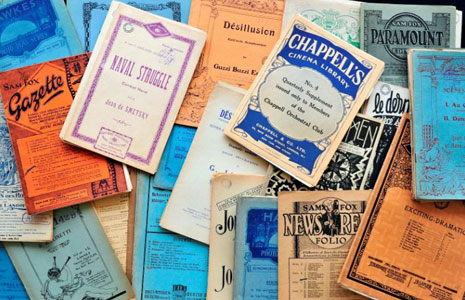
You remember, I’m sure, the exciting haul of silent film music that was discovered in Birmingham last year: the stash contained stock pieces to suit different moods, genres and locations as well as one very specific tune, a Charlie Chaplin theme. There were around 500 manuscripts in total, including compositions for small orchestras as well as solo pianists. The music had been ignored for decades and almost certainly not played in 80 years.

Neil Brand was quoted in the Guardian, explaining the significance of the find:

“This collection gives us our first proper overview of the music of the silent cinema in the UK from 1914 to the coming of sound. Its enormous size not only gives us insights into what the bands sounded like and how they worked with film [but also] the working methods of musical directors. Above all, it gives the lie to the long-cherished belief that silent films were accompanied on solo piano by little old ladies who only knew one tune. When they are played we will hear the authentic sound the audiences of the time would have heard.”

Read more, from the Bioscope, here.

The good news is that this spring, the City of Birmingham Symphony Orchestra will be playing some of the music as part of a special Charlie Chaplin night on Friday 20 April (they’re screening One AM and City Lights). The even better news is that you can hear some of the music on Soundcloud now. I’m quite fond of Dramatic Love Scene:

And how about The Great Ice Floe?

Or The Smugglers?

You’ll find nine tracks on the Orchestra’s Soundcloud page here. The reason that the tracks have been recorded and uploaded is that the Orchestra is holding a competition, and if you’re a whizz with animation you really should think about entering. The deal is that you have to make an animation to accompany one of the tracks, which includes the word “Birmingham” or an iconic image of the city. The winner will see their work on the big screen at the Charlie Chaplin night in April and receive a placement at the Charactershop animation studio and an Introduction to Final Cut Pro X course.

There are more details on the Orchestra’s website here.

Introducing … Charlie’s London

Charlie Chaplin
Maybe it’s because he’s a Londoner … Charlie Chaplin

Introducing a new series of guest posts by Chaplin expert and south Londoner Ayşe Behçet: a personal journey through Charlie Chaplin’s London.

Firstly, I want to say thank you for taking the time to read my first blog and what I hope will be an interesting journey through some unknown gems connected with one of the geniuses of early cinema, Charlie Chaplin.

Ayse
Ayşe

My fascination with Chaplin started at a very young age. My grandmother and I would watch his films on a Saturday afternoon and thinking back on it now it was always raining. It was always about three in the afternoon too! With so many other comedians and great silent films circulating, at first I didn’t understand why we mostly watched Chaplin, but soon it all became clear.

My grandmother, my mother and myself were all born just off the Walworth road, so was Charlie. We had meandered around the back streets of Southwark, Camberwell, Lambeth, East Street Market and Kennington, so had Charlie. We had all seen the beautiful buildings and yet the depravity and roughness of the streets, and of course, so had Charlie. Sitting with Nan one day I found all this out, and suddenly I learned more about her through him than I had ever known before. From an early age I felt this immense pride that this hero, icon and pioneer had started life in the same humble beginnings as so many members of my family and he proved that anything was possible.

The images most people associate with Chaplin are the Little Tramp and his glamorous and often debauched escapades in in Hollywood – but I want to look at something more. I want to look at the real Chaplin. The houses, streets and community he knew are all gone, but the signs of his times still linger on in small near-forgotten landmarks scattered across the city. The Three Stags pub where he last saw his father, The Coal Hole Public House, a first steady job for Syd, East Lane and of course 287 Kennington Road, his home while he lived with his father are all still very much there. These buildings still tell tales, as do many other spots in London, and this blog aims to show you all of them, proving that Charlie was always  a London boy – despite the glitz of Hollywood.

Hope you enjoy the instalments, the first blog spot will be Monday 19 March and will run fortnightly from that point on. Keep in touch.

Happy walking round London with me!

Ayşe Behçet

Slapstick Festival, Bristol, 26-29 January 2012

I hate to admit it, but there are good reasons to leave London sometimes. Bristol, for example, can lay a good claim to being the capital of silent cinema in this country, thanks mostly to the year-round efforts of the marvellous people at Bristol Silents. Indeed, come January there is nowhere finer for the discerning silent comedy fan to be. The annual Slapstick Festival is a four-day, multi-venue extravaganza of comedy, mostly of the silent era, presented by comedians and experts – and accompanied by live music.

The 2012 Slapstick Festival will take place from 26-29 January 2012, and the full lineup has just been announced. Yes, there will be some more recent comedy courtesy of gala screenings featuring Dad’s Army, Monty Python and the French film-maker Pierre Étaix. But Slapstick Festival is noted for its passionate endorsement of silent comedy, and it’s here in spades.

Buster Keaton in The General (1926)

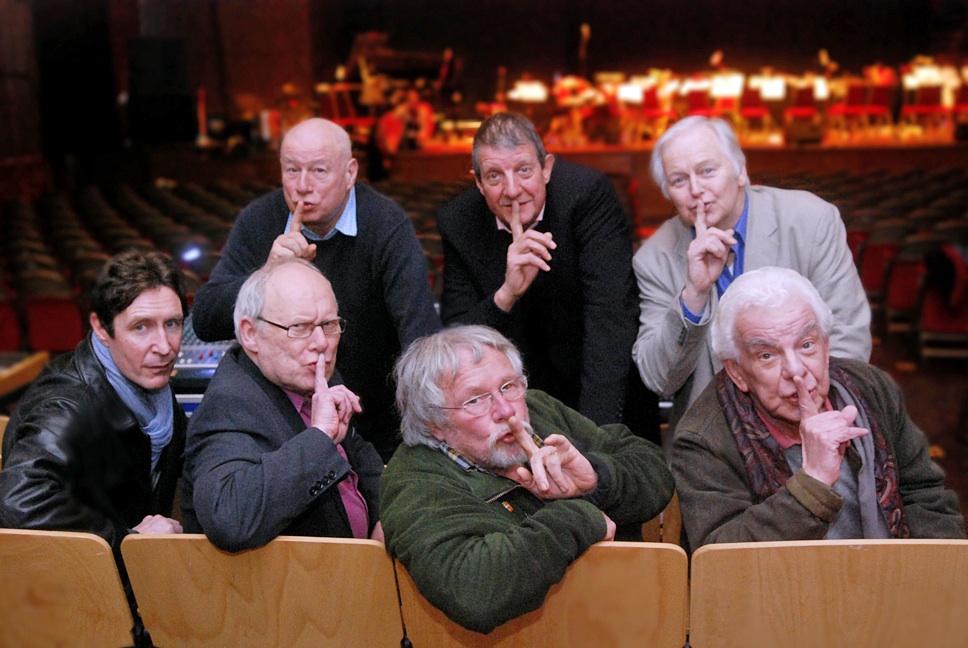
Kevin Brownlow will be talking about Buster Keaton and showing footage from his documentary A Hard Act to Follow, while Griff Rhys-Jones will introduce a night of silent comedy including a screening of The General at Colston Hall with music from Günter Buchwald and performed by The European Silent Screen Virtuosi and Bristol Ensemble. On the last day of the festival, Bill Oddie, Tim Brooke-Taylor, Ian Lavender and Barry Cryer will also introduce their favourite Buster Keaton shorts.

The Slapstick Festival team
The Slapstick Festival team: Neil Innes, Chris Serle and Ian Lavender (back row); Paul McGann, Graeme Garden, Bill Oddie and Barry Cryer

Historian David Robinson will give an illustrated lecture, with clips, on Charlie Chaplin and also discuss his work with fan and comedian Sanjeev Bhaskar; Barry Cryer will present a Harold Lloyd double-bill and Graeme Garden will make a case for the debonair Charley Chase. David Wyatt will give two presentations: one talking about lesser-known silent comics such as Max Davidson and Larry Semon and the other on the spoofs and parodies rife in silent-era comedy.

Slapstick Festival events will take place in Colston Hall, the Watershed Cinema and the Arnolfini Arts Centre, Bristol from 26-29 January 2012. See the Slapstick Festival website for more details and to book tickets.

  • And don’t forget, the Slapstick Festival has its own real ale, brewed locally, especially for the event. The launch of the Slapstick Beer takes place at the Victoria Pub, Clifton on Friday 9 December at 7.30pm. Details on Facebook.

Louis (2010): review

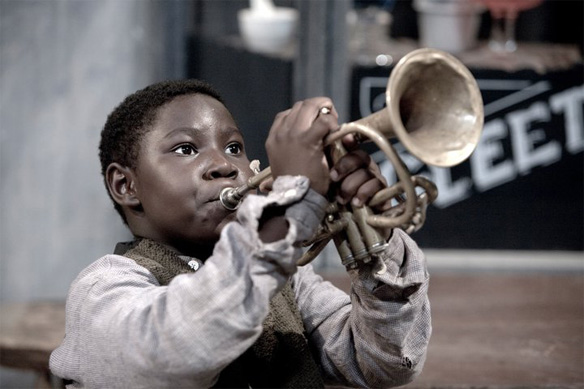
Anthony Coleman in Louis (2010)

The difference between homage and pastiche is largely a question of respect. It perfectly possible to pastiche something you don’t care for very much, or don’t understand, whereas a homage aims to be a worthy tribute to the art that inspires it. Louis (2010) is a pastiche. It’s a glossy, fast-paced film, with a charming lead performance from the young actor who takes the title role – and it’s occasionally funny, too – but I didn’t feel the love.

Louis, a “modern re-imagining” of a silent movie, is ostensibly both a tribute to Louis Armstrong, whose early life is mythologised here, and to the films of Charlie Chaplin. These two aims get so terribly bungled that the film shifts its attention away from the young Louis and towards what should be a sub-plot, featuring a villain who looks, and moves, in imitation of Chaplin. The idea of having an actor (Jackie Earle Haley, who is really very good in the role) mimic the Tramp while playing such an unpleasant character is bizarre: he’s a corrupt local judge who is guilty of murder and extortion. We see him attempting to pay off the prostitute who has given birth to his child, and when that fails, trying to suffocate the newborn in question. Adorable.

Louis may be ludicrous, but it very nearly gets away with it. There’s an undeniable pleasure in clocking all the Chaplin references, Vilmos Zsigmond’s back-and-white photography is crisp and the speeded-up chase sequences are a hoot. Yes, the film is set in a deprived quarter of early 20th-century New Orleans, but Louis is designed as a retro fantasy and if it stuck to its comedy guns, it could have been a family-friendly caper. Sadly, however, Louis loses its way very early on.

What might have been a charming film about a young boy’s love for music gets lost when it wanders on to adult territory, specifically the brothel. The scenes inside the bordello are both sanitised and horribly puerile at the same time – the women perform raunchy, anachronistic dance routines in perfectly laundered white petticoats. It’s more like a pop video than a movie in these sequences, but they are enough to give the film its US ‘R’ rating. More problematically, the storyline involving a prostitute going back to work after having an illegitimate baby raises issues that Louis is not sophisticated enough to deal with.

And then there’s the music. The score, written by Wynton Marsalis and featuring many pieces by Armstrong himself and Louis Moreau Gottschalk, is played by a 10-piece band at a volume that goes way beyond “accompaniment” – meaning, at least, you can barely concentrate on the plot holes. There’s rich, squelchy brass in almost every scene, and the tempo rarely takes a breath. You do wonder whether the music was meant to accompany the film or vice versa.

Louis is filmed in widescreen, with looping, extended Steadicam sequences and crane shots – it’s not a perfect replica of a silent film, but it will remind you of one. I don’t mind that it’s “inauthentic” in the slightest. Modern silents should come in all forms, and the idea of a silent biopic of a musician with a live score is an inspired one. The problem with Louis is that it gets distracted from what it does best, and a Chaplin pastiche is no substitute for the real thing.

Read more about Louis.

Chaplin in 3D. Wait, don’t run away

Charlie Chaplin in Easy Street (1917)

The reviews are already in for German film-maker Uwe Boll’s latest venture, and it isn’t even ready to view yet. “Worst idea ever,” said Anne Thompson on Indiewire. Wretched and doomed,” tweeted Roger Ebert. Thompson’s Indiewire blogpost reports that a representative of the German distributor Kinostar has approached a “major studio” with a pitch for “one 90 minute 3D movie titled Chaplin 3D – Little Tramp’s Adventure.” The plan involves the conversion of several Chaplin films into 3D, which will then be compiled into one feature-length movie. Retro-fitted 3D is rarely a happy experience, so even if the idea of Chaplin drunkenly tumbling down steps and into your lap, or skating wobbily past your nose, appeals, this doesn’t bode well. When you consider Boll’s critical reputation, which is somewhere between “joke” and ”criminal” this project is beginning to look disastrous. Led, perhaps, by Ebert, the reaction to the story on Twitter yesterday was of near-universal revulsion.

The truth is, there is more to this Chaplin in 3D story than meets the eye. Or both eyes. Clarification and elaboration arrives courtesy of a revelatory post by film preservationist David Shepard on the Nitrateville forum:

Serge Bromberg and I are among the people involved in this project. The principals, a film company in Istanbul which has been operating successfully for more than 70 years, is run by people of integrity; their proprietary 3-D conversion process is far superior to any other I have seen. Even the folks at Association Chaplin were impressed.

L’Immagine Ritrovata in Bologna or Technicolor scanned our earliest generation nitrate negatives to 2K and have done the highest quality of frame-by-frame image restoration of which they are capable for THE IMMIGRANT, THE RINK and EASY STREET. The films will be presented in b&w, at 20 fps, with new large-orchestra scores by Robert Israel, but in 3-D.

Obviously, Chaplin’s films are about performance; they are not highly pictorial films like, for example, those of Maurice Tourneur; we think they will look and sound wonderful and that the 3-D conversion does them no violence. We hope they will be rolled out first as family concerts with live orchestral performance, moving later on to other platforms with the recorded scores.

Obviously the intended audience is not the readers of Nitrateville, although you will not be excluded from attending the shows to see them for yourselves. If this project is successful it will be expanded to other silent films that can also deliver excellent experiences to 21st century audiences. We hope it will promote some awareness of silent films to many people who now do not have them even on their radar. Think of it as a solution for one of the performance arts (along with opera and classical music) for which the present audience is rapidly aging out, and for which something innovative must be done to insure their survival.

So, the precious films are in the hands of the experts, not a multiple Razzie-winner, and we can be fairly certain that they will look and sound great, due to the restoration and rescoring work. Those who share Mark Kermode’s aversion to 3D in all its forms will still have qualms, of course, but Martin Scorsese’s forthcoming Hugo (2011) may well be about to charm cinephiles into a newfound love of stereoscopy. Chaplin himself shot 3D test footage for The Circus (1928), though the fact that he dropped the idea may tell us as much as the fact that he attempted it. He was also known, of course, to retrospectively rework his films, such as when he added a voiceover and music to The Gold Rush in the 1940s.

It is a little saddening to think that the way to “promote some awareness of silent films to many people who now do not have them even on their radar” is to change them so radically. However, the recent re-release of Giorgio’s Moroder’s Metropolis has reminded us of the unusual paths many people take towards an appreciation of silent cinema. Could a three-dimensional rendering of Chaplin movies create a new generation of silent film fans, just as his colourised, intertitle-free Metropolis did in the 1980s?

As for Uwe Boll’s involvement? A red herring, or perhaps it’s something to do with the fact that he has worked with Geraldine Chaplin in the past (on 2005’s BloodRayne). Remember that Suzanne Lloyd has endorsed the 3D conversion of her grandfather Harold’s most famous scene from Safety Last.

I don’t need to tell you that the proof of the pudding is in the eating, and doubtless we all have opinions on whether this project is likely to succeed in pleasing either existing or potential silent film fans. The Tramp is not quite in the perilous position we feared, and for now I recommend keeping an open mind.

Beautiful and Damned by Pam Glew at Blackall Studios, Shoreditch 25-29 May 2011

From Beautiful and Damned by Pam Glew

For the vintage-lovers among you, this exhibition should be a real treat. Pam Glew’s Beautiful and Damned exhibition at Blackall Studios in east London uses vintage fabrics and techniques to create poignant but gorgeous images of silent movie stars. It’s only on for a few days, so catch it while you can:

‘Beautiful and Damned’, the shows title, is of course taken from F. Scott Fitzgerald’s 1922 novel, which explores the listless lives of moneyed society during the Jazz Age. This captivating era, drenched in glamour yet tinged with tragedy is the decadent setting for this extraordinary series of work. The exquisitely beautiful movie starlets, society icons and characters on display capture the spirit of the age all who are caught in the unforgiving glare of the limelight and some sadly burn out before their time. As Pam states, “the tragedy amongst the beauty is what has inspired this show, the sharp contrast between a blessed life and one that ends in scandal, hedonism or destitution”.

Beautiful and Damned runs from 25-29 May at Blackall Studios, 73 Leonard Street, Shoreditch, London EC2A 4QS. For more information, check out Pam Glew’s website here.

City Lights and Metropolis at Ealing’s Classic Cinema Club, May 2011

City Lights (1931)
City Lights (1931)

There’s a new film club in west London – Ealing’s Classic Cinema Club, which plans to show great movies from around the world every Friday night. They’re launching themselves in fine style, with a brace of silent films: Chaplin’s City Lights and Fritz Lang’s Metropolis.

From sentiment to science-fiction, that’s two very different silents, and this will be a great to watch some wonderful movies as well as an opportunity to meet fellow film fans in an area rich with its own cinematic heritage. First, the world-famous Ealing Studios are just down the road; second, I took Film Studies A-level at the local sixth-form college. OK, maybe I didn’t think that one through properly.

The following week, on 27 May, the club will show Eisenstein’s Ivan the Terrible (1944), which should be a fine accompaniment to the Soviet silents being screened at the BFI this month.

As ever, if your local film society is planning any silent screenings – do let me know.

City Lights screens on 13 May and Metropolis will be shown on 20 May, both at Ealing Town Hall. All screenings start at 7pm sharp and will be followed by a short discussion. Tickets cost £7.50 or £6 for concessions.  Tickets may be reserved (but not bought) in advance by writing to classiccinemaclub@hotmail.co.uk or phoning 020 8579 4925. Membership is also available at £5. More details about the club can be found here.

With thanks to @ianburge on Twitter for telling me about these screenings.

Charlie Chaplin Google doodle video

The Charlie Chaplin Google doodle is more ambitious than most. It links to this cute Chaplin-esque video. It hasn’t appeared here in the UK quite yet, but look out for it tomorrow, 16 April, which is the 122nd anniversary of the actor/director’s birth. Very nice of Google to mark the occasion, but this video does make you miss the real thing. Those of you who are Chaplin fans all year round and not just on his birthday might enjoy this article from the Spectator. It’s a preview of the forthcoming Chaplin museum in Switzerland and an interview with the film-maker’s son, Michael. Definitely worth a read.

The Hippodrome Festival of Silent Cinema, Bo’ness Hippodrome, 18-20 March 2011

Clara Bow in It (1927)

The Hippodrome Cinema in Bo’ness, Falkirk, beautifully restored to match its 1920 heyday, will host Scotland’s first silent film festival – and it promises to be an event with a real ‘vintage’ feel. The programme incorporates some enduringly popular silents, from a rare chance to see It (1927), starring Clara Bow, to FW Murnau’s influential vampire film Nosferatu (1922) and Charlie Chaplin’s The Kid (1921), plus a handful of comedies from Buster Keaton, Laurel and Hardy and Harold Lloyd.

Neil Brand will provide musical accompaniment to several of the films, and he will also perform his acclaimed one-man show The Silent Pianist Speaks. David Allison of The Island Tapes will reprise his score for Nosferatu at the festival’s closing night gala, and another of the films will benefit from a specially commissioned soundtrack performed by local schoolchildren.

There will be a Slapstick Workshop for over-12s by Scottish theatre company Plutôt La Vie, and a new, specially commissioned soundtrack for one of the films performed by local schoolchildren. Another retro treat for younger viewers is the “jeely jar special” – a revival of a 1920s practice whereby film fans can get a two-for-one deal on tickets for The Kid if they bring along a clean jam jar (with lid). Bargain.

And for a touch more glamour, the Opening Gala screening of It has a 1920s dress code. Dropped waists, long strings of beads and cloches – it’s the perfect opportunity to indulge your inner flapper and give Clara Bow a run for her money. Perhaps you can find some sartorial inspiration here. Festival director Allison Strauss says:

The whole event is designed to celebrate the magic, glamour and pure entertainment of films from the silent era.  Our programme and the supporting events include something for all ages and we’ve made sure that the wide appeal will involve a broad range of tastes, from cinephiles to anyone discovering early film for the first time.

For full details and to download a brochure, visit the website here.

Carl Davis on Charlie Chaplin

The Gold Rush (1925)

There is an interesting article by the composer Carl Davis about Charlie Chaplin in the Guardian Review today. In the piece, he talks about how he came to piece together the original score for The Gold Rush, which he will conduct at the Royal Festival Hall on 3 January.

I was ­allowed into the vaults under the Alps near Geneva where all the materials of Chaplin’s working life are kept. There I examined the boxes containing the sketches and materials used for the 1942 revision. I found the sources of the pieces I could only guess at, as well as sketches for sequences that were in the 1925 version but cut in 1942.

Tickets for The Gold Rush are available here. Plus, for a limited time only, you can get a 20% discount if you call the box office (0844 847 9910) and quote ‘London Film Museum’.