Tag Archives: Paul Wegener

Le Giornate del Cinema Muto 2024: Pordenone Post No 5

Sometimes the old songs are the best, right? Familiarity can breed contentment. And nowhere will you find more consensus on that than here in Pordenone. So today I was happy to rewatch a couple of silent films I love, spend a little time with one of my all-time favourite silent stars. And then see something entirely new to me!

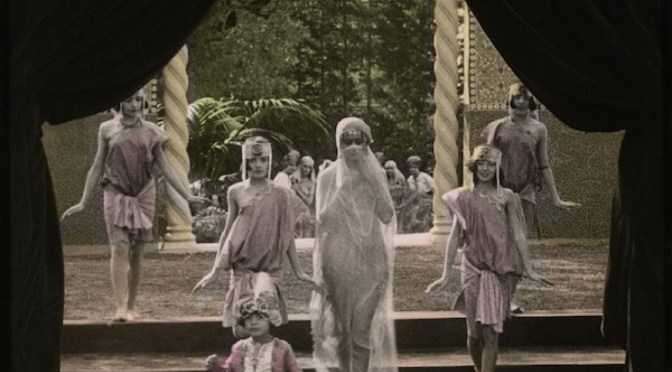
First, the old friends. This morning, we ventured back into the imaginations of Maurice Tourneur, and Ben Carré, with the 1918 adaptation of Maurice Maeterlinck’s The Blue Bird. Such a strange and beautiful, terrifying and wholesome journey into the shadow world of dreams, where bread and sugar and water have souls, the dogs and cats can talk, lost grandparents always have the table set for supper and babies wait impatiently to be born. If you have not seen this, you possibly can’t imagine quite how weirdly pretty it is. Variety’s critic wrote: “It is quite safe to assert that nothing quite like Director Tourneur’s work has ever been shown on the screen.” So hats off to Tourneur and Carré, and doubly so to Neil Brand and Elizabeth-Jane Baldry, who transported us to an enchanted realm with their music. I wrote about the film in more detail here, should you be interested.

Continue reading Le Giornate del Cinema Muto 2024: Pordenone Post No 5

The Magician (1926): Rex Ingram, Michael Powell and the French Riviera

Michael Powell made films in the south of France. Before that one. His first job in the film industry was working at the Victorine studios of Rex Ingram, just outside Nice, in the mid-1920s. He was 19 and he took on pretty much any job he could on set, trying to learn the business from the ground up. It worked, didn’t it? He even appeared in front of the camera a few times, often playing a sappy creation called Cicero Simp in the Riviera Revels comic shorts.

Continue reading The Magician (1926): Rex Ingram, Michael Powell and the French Riviera

Brigitte Helm: the perils of hedonism

There is no face more closely associated with the grandeur of Weimar Cinema than that of Brigitte Helm. Her first appearance on film was in the iconic dual-role of the teacher and the robot in Fritz Lang’s Metropolis (1927). As the villainous clone, her frenzied dancing and her kohl-rimmed eyes in winking close-ups incarnated a particularly timely force of evil: the giddy whirl of decadent 1920s Berlin. This was a time, according to German politician Gustav Stresemann, in which the people of Germany, intoxicated by the possibilities of the post-war world, were dancing on a volcano. Danger was afoot. In Metropolis, Helm’s crooked finger lured the hapless citizens to the brink. And audiences followed.

Brigitte Helm in Metropolis (Fritz Lang, 1927)
Continue reading Brigitte Helm: the perils of hedonism