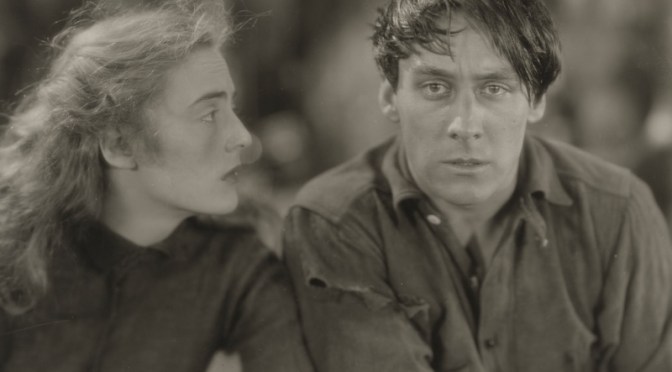
I have been a little slow to start up some mornings. But one thing you can guarantee that I will get out of bed for is Victor Sjöström. Victor Sjöström’s 1912 debut film no less, banned outright in Sweden, but available for us lucky degenerates on the capacious Verdi screen, with a truly wonderful accompaniment by Stephen Horne. Variously known as The Cruelty of the World, The Gardener or The Broken Spring Rose, this is a really special film and I do think the first title is the best one.
Continue reading Le Giornate del Cinema Muto 2025: Pordenone Post No 7Tag Archives: reviews
Le Giornate del Cinema Muto 2025: Pordenone Post No 3
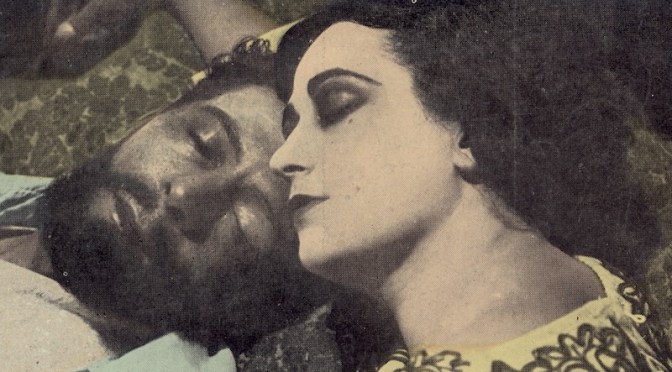
Monday finished with a zinger. I mean a Zingari. Italia Almirante Manzini wowed the Verdi as Wilejka, a heavy-lidded beauty with great hair, but in this case as a heavy-lidded beautiful Gypsy shepherdess with great hair. In Zingari (Mario Almirante, 1920) Wilejka falls in love with a man, Abaldo (Amleto Novelli, no less) that her father, the leader of the camp, forbids her to marry. There is many a consultation of the cards, a fireside dance, a storm, a threatening villain, a crushing pang of jealousy, an assassination and naturally, a barn on fire before this will all end happily ever after.
Continue reading Le Giornate del Cinema Muto 2025: Pordenone Post No 3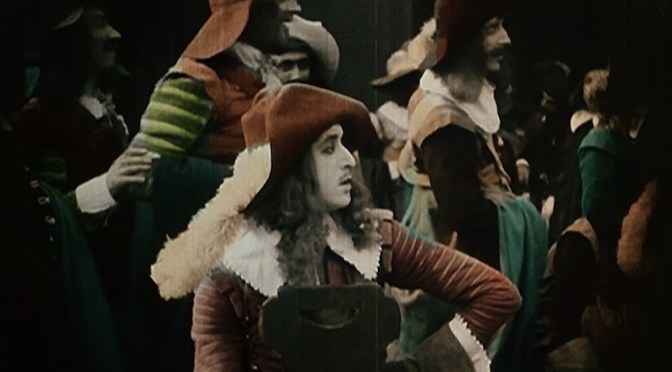
Le Giornate del Cinema Muto 2025: Pordenone Post No 1
The Giornate dawned with grey skies but good times, a respite from Storm Amy and all the rest of the week’s turbulence, a day of pretty views and outbreaks of mild escapism. Many of us were just grateful to be get here, let alone arrive on time, after the transport situation was especially complex this year. It was an especially mellow start to the festival for me. Blame it on the 3am alarm call, the cold medication or just the pleasurable daze of seeing so many familiar faces all at once. Will I sneeze or snooze my way through the first day of films? Who knows? And will my ears ever “unpop” from the plane? Join me now to find out.
Continue reading Le Giornate del Cinema Muto 2025: Pordenone Post No 1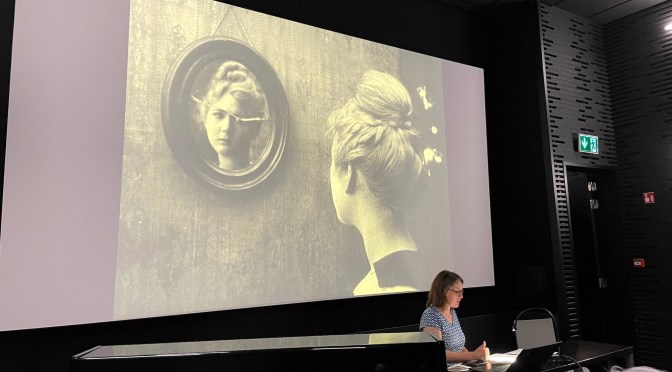
Catching trains, raising riots and trashing the kitchen: travels in feminist cinema
“Is this really what you want to learn from the past?”
– Breaking Plates (Karen Pearlman, 2025)
Let the train take the strain they say, and so I did, curating my own idiosyncratic, mostly silent, tour of female film history this week – and all by rail. Please rest assured that no leading ladies were lashed to the tracks in the making of this movie. Nor is this post sponsored by Eurostar. I should be so lucky.
This cute preamble has simply delayed me telling you that I took the choo-choo to Brussels, birthplace of such 20th-century film icons as Audrey Hepburn, Agnès Varda (foreshadowing) and Chantal Akerman. So my first stop, naturally, was a pilgrimage to one of the most famous addresses in cinema history, 23 Quai de Commerce, 1080 Bruxelles, to pay homage to Akerman, Delphine Seyrig, and Jeanne Dielman herself by posing outside the door of the heroine’s apartment building wielding a potato peeler. Important feminist film praxis, and in the estimable company of Maggie Hennefeld to boot. All joking aside, there is a frisson to be felt standing on this spot, where Akerman filmed the exteriors for her 1975 masterpiece, and it is in a very pleasant corner of the city. Do visit, with or without kitchen implements. Don’t miss the Marguerite Duras quotes that pave the nearby park, and the gorgeous, watercolour-style mural of Dielman at her kitchen table by Spanish muralist Alba Fabre Sacristan. I recommend checking out her portfolio on Instagram: the subject matter of the majority of her work throws a different light on this apparently demure picture of a middle-aged woman in her housecoat.
Continue reading Catching trains, raising riots and trashing the kitchen: travels in feminist cinema
Le Giornate del Cinema Muto 2024: Pordenone Post No 6
Wouldn’t you like to go Behind the Scenes with DW Griffith and Florence Lawrence? I sure would, that’s why I was bright and early at the Verdi this morning for the 1980 Biograph package. Behind the Scenes, per the catalogue is the “happy exception” among the 1908 output. Well it certainly had punch. A distraught mother must tear herself from her daughter’s sickbed to kick her heels and shake her hips on the vaudeville stage to earn a crust. But as the crowd roars out for an encore, her baby girl is slipping away from this life; Grandma rushes to the stage door… If “too late!” is the essence of the melodramatic narrative then this was a textbook case. We stayed to see Lawrence reappear as the titular character in The Red Girl, in which a collection of ethnic stereotypes conspire to rob a “girl miner” but Lawrence defies racist convention to lend a hand instead. Impressive to see Lawrence Harry Houdini her way free after being tied up and dangled over a precipice above the rushing river. Extra exciting with John Sweeney at the keys, of course.
Continue reading Le Giornate del Cinema Muto 2024: Pordenone Post No 6
Le Giornate del Cinema Muto 2024: Pordenone Post No 3
I promise you, I really am in Pordenone, not in Paris. But honestly, the geography is becoming a little subjective. We seem unable to escape the Rive Gauche for long. This morning, a really quite exceptionally taut melodrama from Louiis Feuillade, with sets,of course, by Ben Carré, illustrated how the Latin Quarter exerts its own gravitational pull, morally, if not physically. In La Tare (1911), part of Feuillade’s “La Vie telle qu’elle est” (Life as It Is) series, Renée Carl gave a really beautiful performance as Anna, who works in the dance halls of the Latin Quarter, but given the chance, moves to the South of France and devotes herself to a new career caring for patients young and old in a nursing home. Ah, but cruel fate intervenes and a medical student who used to tap her for cash in the Paris days, takes it upon himself to inform the medical board that their “secular saint” is really a “girl of easy virtue”, sooner than you can say “Madonna-whore complex”. And so we are left with a tragic, yet ambiguous ending, following a rather harrowing scene in the unemployment office with a crowd of women, all of whom had remarkable faces (no, not Léontine, I don’t think, but maybe this is the kind of place where she might be found). A very special film, enhanced, naturally, by John Sweeney’s sensitive accompaniment.
Continue reading Le Giornate del Cinema Muto 2024: Pordenone Post No 3 Silent London