This is a guest blog for Silent London by Maria Wyke, professor of Latin at University College London.
Worn out from watching Paul Mescal battle with CGI baboons, rhinos and sharks in the Roman arena? Or trying to avoid the Marvel-style struggle for the future of the Roman empire playing out in a cinema near you? Then you might be interested in these two screenings coming up at the end of November of very different antiquity films from 100 years ago or more. Gladiator II explicitly presents itself as a sequel to Gladiator (2000). That hugely successful film drew on the Hollywood blockbusters of the Cold War era and they in turn built on the global success of antiquity films already established at the start of the 20th century. Those early films, however, often reconstructed the ancient world in ways never taken up by later cinema. These upcoming screenings bring back to us that otherwise lost innovation, vibrantly supported by the live accompaniment of professional musicians.

Entering the Ancient World through Silent Cinema
Saturday 30 November 2024, 16:45-17:45 at the Morecambe Winter Gardens
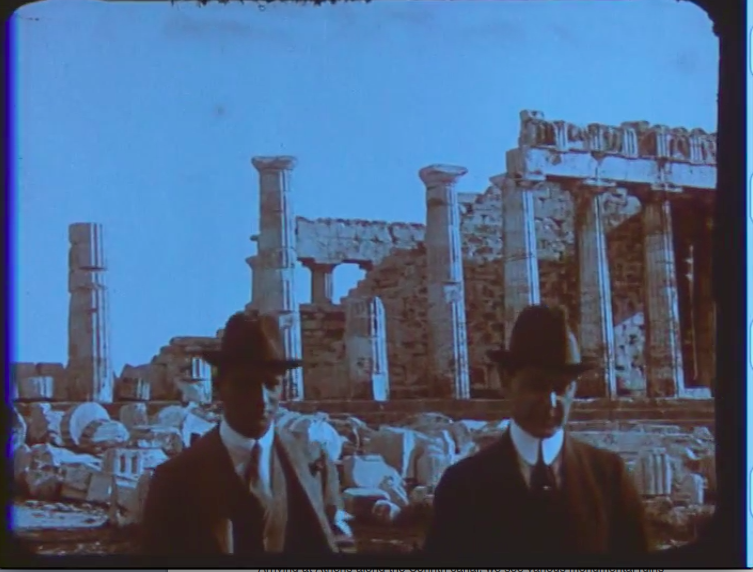
As part of a Northern Silents event, this variety programme begins with a British travelogue, Visit to Pompeii (1901, dirs. George A. Smith and Charles Urban), that takes elegant tourists on a journey around the excavated city and up to the crater of Vesuvius. An Italian historical drama, Nero, or the Burning of Rome (1909, dirs. Luigi Maggi and Arturo Ambrosio)shows the emperor repudiating his wife and driving her to suicide at the command of his beautiful mistress. The people rebel, Rome burns, the emperor plays his lyre. Through cinematic superimposition, a terrified Nero sees a nightmare vision of the Christians suffering for his crimes. His own suicide soon follows.
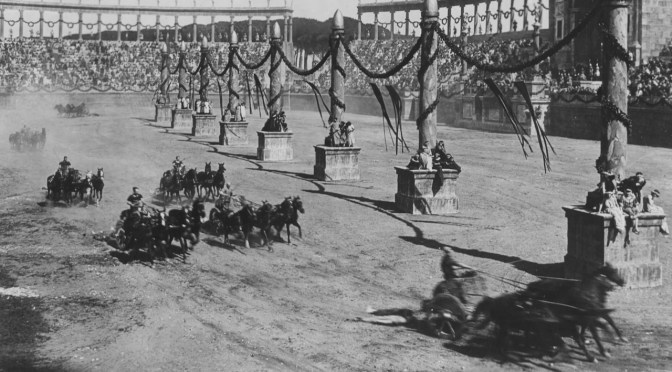
Similarly, The Odyssey (1911, dirs. F. Bertolini, A. Padovan and Giuseppe de Liguoro) uses special effects imaginatively to present the daring escape of Odysseus and his crew from a monstrous giant, the apparition to him of his protective goddess, and his miraculous transformations to hide his true self from the suitors who hound his wife back at home. The climactic finale is an American animation, A Roman Scandal (1926, dirs. Charles R. Bowers and Bud Fisher), based on the newspaper comic strip adventures of Mutt and Jeff. Magically transported back to ancient Rome, little Jeff finds himself racing a chariot before the beady eyes of emperor Mutt. In a parody of the great race sequence in Fred Niblo’s Ben-Hur (1925), cunning is the winner.

Quo vadis? (1924, dirs. Gabriellino D’Annunzio and George Jacoby)
Sunday 1 December 2024, 14:15 at BFI Southbank NFT1, London
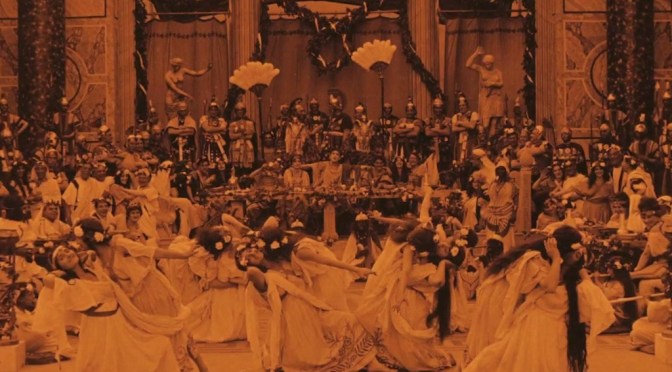
Magnificent and disturbing, this epic film revels in the debauchery often associated with ancient Rome. The emperor Nero is played as a satanic grotesque by the star Emil Jannings. At the opening of the film, we see him lie resplendent on a couch in the grounds of his ornate palace. He peers with sadistic amusement at a series of female victims being thrown into the fountain to fatten his fish.
The Latin title of the film or ‘Where are you going?’ refers to the question that the apostle Peter was supposed to have asked when he saw Christ coming to save the Christians in Rome. It also refers to a celebrated nineteenth-century novel that told the story of a fictional girl, Lygia, who turns the Roman soldier Vinicius toward God despite Nero’s attempts to stop her. The first half of the film ends with the camera focussing in on a hand gripping a cross. It is a sign that the soldier’s conversion is underway.
The second half of the film puts that story in the broader context of the burning of the city and the subsequent persecution of the Christian community. Here red tinting marks out the danger for Rome and the excitement for viewers. A cast of thousands charges the imperial palace. Christians are arrested and Christ himself makes two appearances. Eventually Nero commits suicide, and the Cross is declared victorious. But not before we are offered a range of extraordinary spectacles: extravagant banquets; beatings and murder; thwarted rapes; a city on fire; a strongman wrestling a bull, lurid martyrdoms and soldiers from the provinces riding to the rescue.
Both screenings are being run in association with the AHRC-funded research project Museum of Dream Worlds based at University College London and led by myself, Maria Wyke. The project (drawing on the surviving films in the BFI National Archive) asks how did early cinema design its Greek and Roman dreamworlds? What did cinema gain from recreating the distant past? What did that past gain from being recreated in moving images? The project also considers how these films were once used as instruments of education and what educative potential they might have today.
By Maria Wyke
- Further information about the project and its activities are available here.
- You can follow Museum of Dreamworlds on Instagram.
- You can also contact the project team at museumofdreamworlds@ucl.ac.uk
- Ivo Blom is offering a free download of his recent book Quo vadis?, Cabiria and the ‘Archaeologists’: Early Italian Cinema’s Appropriation of Art and Archaeology (Kaplan, 2023) over on his site, as well as the link to buy a paper copy.
- Silent London moved over to Bluesky a month or so ago. Come join us there!
 Silent London