A confession. I was conspiring over breakfast, and reader, this was a two-cappuccino problem. The upshot? I was a little late in getting started with the screenings today. But I certainly knew that I was going to be up late, with the gala… and the end-of-festival celebrations!
My sunny morning stroll to Cinemazero was rewarded with a simply terrific film from Uzbekistan. In Her Right (Grigorii Cherniak, 1930), a group of workers from the collective farm are sent to the factory to boost the workforce there, and to learn those valuable Soviet methods. One woman from the village defies her husband and sheds her burqa to join them. It’s a life-changing experience and not only does she gain independence through work, but she inspires others to do the same, through a filmed speech, that the workers clamour to watch, even after he enraged husband slashes the screen. Even with her “throat” cut, in a silent film, she continues to speak her truth. So you have noted already that this is once again pro-Soviet, anti-Islam propaganda in intent, but this is also a remarkable film in style and action. Our Hollywood friends would applaud the excellent, and indeed poignant, action sequence in which our heroine runs to jump on the train to the factory, is repeatedly shoved away by male guards and then, when it seems she has finally found a helping female hand, her husband leaps – for a second we think he has dragged her form the moving train, but no, he only has her coat in his hands. Nail-biting stuff. And the scene in which they watch the film is also very strong. Günter Buchwald at the keys for this one, keeping the energy at exactly the right pace.
The fashionable set is always the first to name a trend. So if you know you know, but if you don’t know you need to know that 2024 is the year of Coquette Core, a prettified aesthetic that can be boiled down to: put a bow on it. That’s technically a beribboned bow with a lower-case b, not a Clara Capital-B-Bow, but the difference is only nominal. At this year’s Hippodrome Silent Film Festival we celebrated the age of the flapper, with all things frilly, feminine and flirtatious.
If you wanted to keep up with the new womenswear trends in the 1920s and 1930s, the cinemagazine Eve’s Film Review would have been your bible, and one of my favourite events at this year’s Hippfest was Jenny Hammerton’s presentation on these witty and inventive female-interest dispatches. Here, every cinemagoer could truly learn how to be “a modern”, and more specifically, how to save your stockings from mud-spatters, advice that all of us in Bo’ness could truly use.
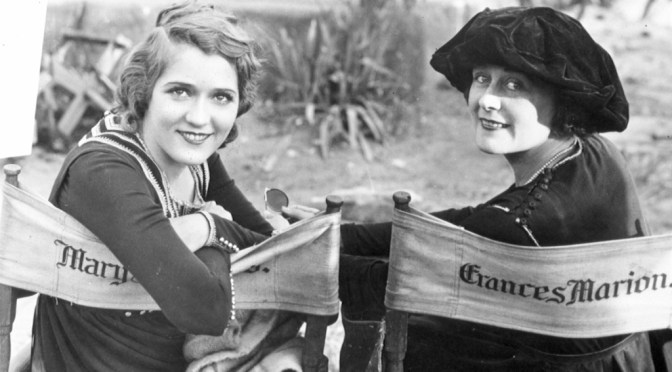
Next Friday evening, 26 January, I will be delivering a lecture called Frances Marion: Hollywood’s Favourite Storyteller, with clips accompanied by the brilliant Mike Nolan. Find out more about the Oscar-winning genius who wrote the best films for stars such as Mary Pickford, Lillian Gish, Marie Dressler and more.You can book your ticket here (it’s free or just £3 if you can spare the change).
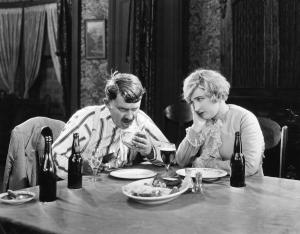
This is an expanded version of an essay I wrote for Sight and Sound in 2020. The First Year (Frank Borzage, 1926) screens this week at MoMA on the opening night of the After Alice, Beyond Lois programme, curated by Kate Saccone and Dave Kehr to commemorate 10 years of the Women Film Pioneers Project.
Frank Borzage was one of the greatest Hollywood directors of young love. When we remember his silent work in particular, a very distinctive kind of romantic melodrama come to the fore: a passionate tale in which two youthful lovers confront unbearable adversity and yet are finally saved by the redemptive, mystical power of true love. Most famously, this path from darkness into light was trod by Janet Gaynor and Charles Farrell in a trio of celebrated Borzage films from the end of the silent era: 7th Heaven (1927), Street Angel (1928) and Lucky Star (1929).
Some news is too good not to share, even if the Atlantic Ocean makes this a little inconvenient for me, personally. If you can be in New York later this month and next, I urge you to attend a particularly excellent birthday party.
The Women Film Pioneers Project, an impeccable resource for early and silent film history, has reached its 10th birthday. The brainchild of Jane Gaines, and managed by Kate Saccone, the WFPP has been doing the good work of balancing the gender books of film history for 10 years now, and this calls for a celebration. One that takes the form of a film season, curated by Saccone with Dave Kehr at the Museum of Modern Art in New York.
Day Seven of the festival and the mood on campus is very much “Thank God it’s Friday”. Not because anyone is glad the Giornate is nearly over (perhaps apart from the festival team perhaps who have worked tirelessly to ensure everything has run beautifully, as usual), but because today’s lineup is especially toothsome. More Norma! A Frances Marion-directed feature! And Ivan Mosjoukine and Brigitte Helm smouldering opposite each other! That’s before we even get to tonight’s Ruritanian romp – the 1924 adaptation of the silent era touchstone that is Elinor Glyn’s Three Weeks. Hold on to your string of pearls, we are going all-in.
First, an especially timely effort from Team Talmadge. In Within the Law (Frank Lloyd, 1923), Norma plays a shop girl who fights back. Exploited under capitalism, and imprisoned for a crime she didn’t commit, young Mary finds “going straight is a tough proposition”. Instead she teams up with a pretty blonde cellmate to take revenge on the moneyed male establishment with a breach-of-promise scheme that exploits men, cashes the big and stays strictly “within the law”.
Here I am again, talking about one of my very favourite subjects: women in silent cinema.
In fact, let’s get right into it – on Monday 30 May I am delivering an online lecture on the very subject. It is called “The Women Who Built Hollywood: A Feminist History of Early Cinema” and I would love you to join me. Here’s the official blurb from the website.
Today it looks like Hollywood is run by men, but it was built by women. In fact, there were more women working in Hollywood in its first two decades than there are now, or have been at any time since. If Hollywood is ever to achieve gender parity in its studios and boardrooms, it should look back to its beginnings.
I said something a little flippant in a Q&A once. OK, more than once, but let’s just talk about this one time. The occasion was a screening of A Page of Madness (1926) as part of the Japanese Avant-Garde and Experimental Film Festival, and I was responding to a comment about experimental silent film, and whether there was anything out there in the same vein as the movie we had just seen. According to the notes of Dr Lawrence Napper, I said “when you’re talking about silent cinema, you’re talking about the first four decades of film history, so in a way it’s all experimental, you can show almost anything”.
So much, so overstated. But there’s a truth there, to my credit.
Yes, being a movie pioneer means experimenting – and the history of cinema is the history of innovations and new ideas, from close-ups to Cinerama, montage editing to the Marvel Cinematic Universe. When these innovations still seem new, or when they didn’t last, we can call them experiments. Continue reading Toute la Mémoire du Monde: the experiment of silent cinema→
Who can resist a good film book? Not me. Sometimes I have to close my eyes when I pass a bookshop, just to save my bank balance..
Recently, I’ve been lucky enough to dip into several new silent movie-related books – some of which have been sent to me to review. In fact I have spent so much time reading them that there aren’t enough hours left in the day to report on them all. Here instead, are some rapid-fire reviews of books worthy of your consideration.
Every one of them would repay the decision to spend a leisurely afternoon browsing in the library of your choice – some you may even want to splash out on as a gift or a treat to yourself. I am sure you deserve it.
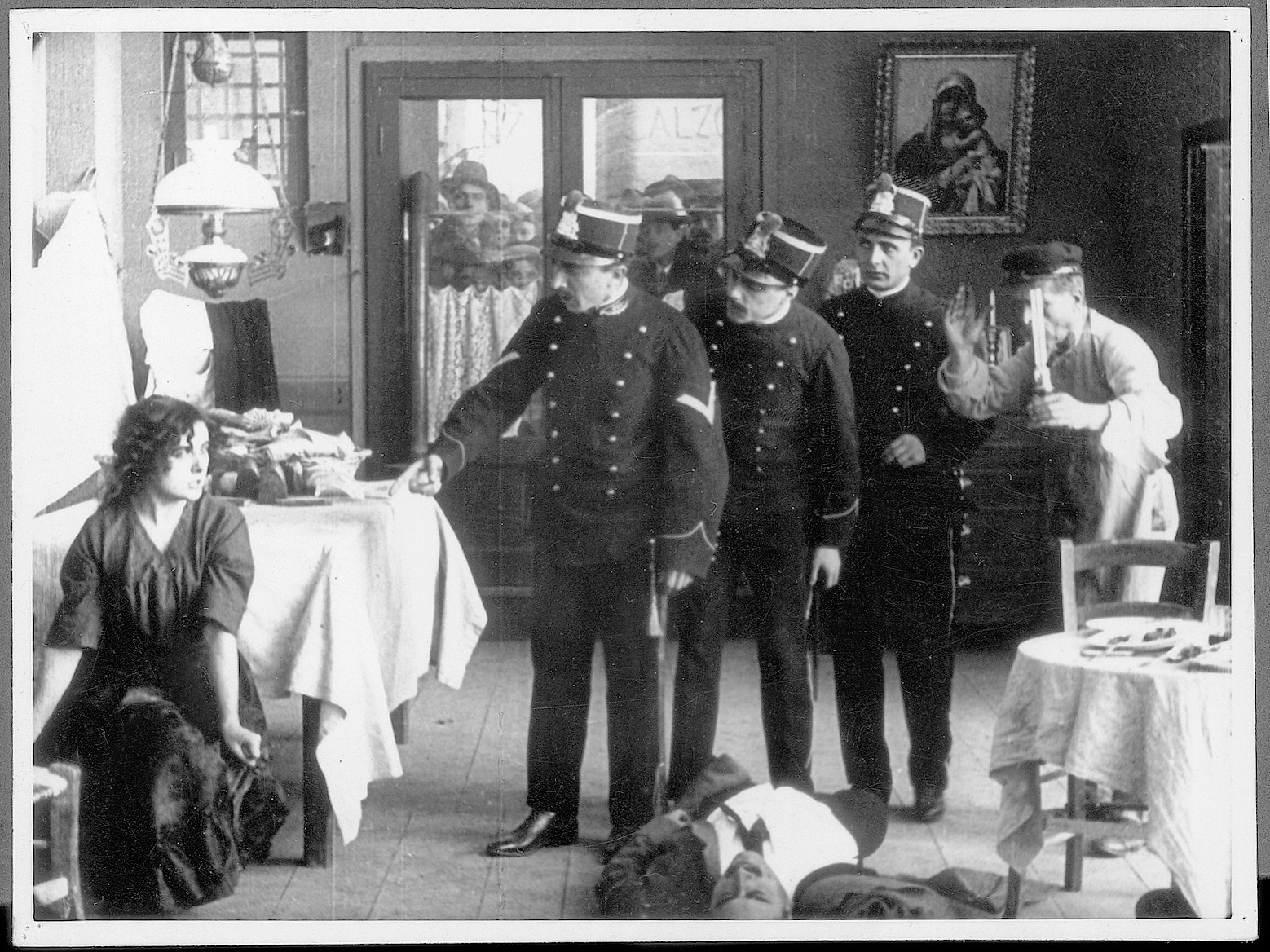
Assunta Spina (1915)
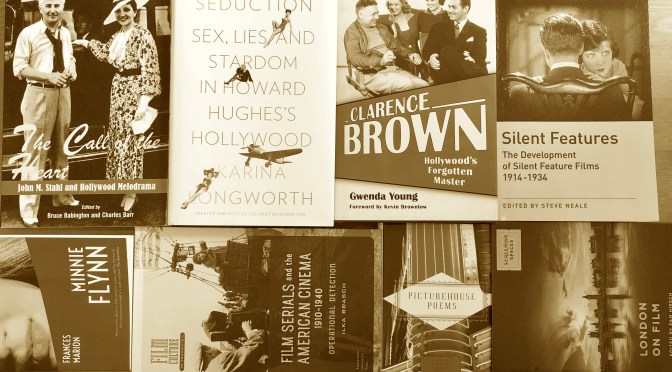
Silent Features: The Development of Silent Feature Films 1914-1934
Edited by Steve Neale (University of Exeter Press)
A great idea for a book, and one that is bound to be popular with students and scholars alike. The idea is to track the development of the feature film as a form, via a series of meticulous case studies. Each essay here functions as a mini-monograph on one feature film, covering its sources, production and critical reception in admirable depth.
This book has 17 chapters and almost as many contributors. It roams across films from Europe, Russia, America, China and Japan, and many of the choices are far from the usual suspects. There are some much-feted classics here, Assunta Spina, Wings, I Was Born, But …, The Phantom Carriage, but also The Strong Man, Lazybones, Miss Mend and The Wishing Ring. With each leap to different place and time, it’s hard not to wish for a second or third volume to fill in all the gaps.
Two British silents are covered, while Steve Neale’s essay on Lubitsch’s Lady Windermere’s Fan notes the similarities of that film with the 1916 adaptation from the Ideal studio. Piccadilly is the subject of a rich analysis by Jon Burrows which is both a pleasurable read and consistently illuminating. Another great silent London film, Maurice Elvey’s Palais de Dance (1928), is discussed in detail by Martin Shingler. Hopefully, his excellent essay may pique more interest in this overlooked film.
John M Stahl (centre), directing Husbands and Lovers (1924)
The Call of the Heart: John M Stahl and Hollywood Melodrama
Edited by Bruce Babington and Charles Barr (John Libbey)
You can’t have failed to notice the spread of Stahlmania by now, and not before time. Babington and Barr have been on a mission to put John M. Stahl back where he belongs in the annals of great American film directors. Perhaps it’s because he made “women’s films”, because melodrama is an unfashionable word, or because some of his best films were remade by Douglas Sirk (and it’s not long since he was fished out of the “forgotten” category), but Stahl hasn’t had his due for a while. That was before screenings of his best silent and sound films became some of the most popular programmes at Pordenone and Bologna last year. And before this impressive book.
This volume, with contributions from writers around the globe, represents a truly exhaustive study of a single director. There are essays on each of his films, even the lost ones, and biographical pieces by Babington to fill in some of the mystery surrounding this undersung director. Many people will be familiar with Stahl’s sound films, such as Leave Her to Heaven (1945) and the 1930s melodramas Back Street, Only Yesterday and Imitation of Life. Showcased at last year’s Giornate, however, the silent films are a revelation, and in their command of emotional complexity, freewheeling narrative and telling human detail cast a fresh light of the triumphs of the best sound films.
Richard Koszarski kicks off the silent section with a meticulous study of Stahl’s first substantial screen work, The Lincoln Cycle of short films on the beloved US president. Watching these shorts, Stahl’s ambition and talent is obvious from the outset. It’s clear now, that Stahl’s silent work alone deserves re-evaluation and a series of brilliant essays in this book by Lea Jacobs, Charles Barr and Imogen Sara Smith explore his first features with insight and clarity. Many of these films are very rarely shown, but this book should encourage more screenings.
Those of us who have been working on Stahl as part of this project expressed just one regret when we gathered at Pordenone. It was that we had been able to see all the other films before writing our individual pieces, because they are all connected, in such fascinating ways. The lurid plotting of Leave Her to Heaven has its roots in Stahl’s silent era melodramas, the immense sensitivity of his 1930s “women’s pictures” is trailed in the emotional delicacy of the later silent features. Thorough as this work is, and definitive as it feels right now, it may well be the start of something bigger.
Film Serials and the American Cinema 1910-1940: Operational Detection
By Ilka Brasch (Amsterdam University Press)
The film serial was once a staple of cinema programming, until TV came along and spoiled the fun. In this thoroughgoing study of the form, scholar Ilka Brasch gets to grips with what exactly made the serial such a compelling format. It’s goes beyond the thrill of the cliffhanger. Brasch has plenty to say on the appeal of the weekly thriller, but also drills into the “operational aesthetic” that informs our love of technological wizardry on screen and the particular pleasures of the police procedural drama.
And although the film serials may no longer grace our cinema screens, as Brasch points out, the rise of home video and digital streaming has allowed many of us to become 21st-century serial fans all over again. I couldn’t help but think of how popular daily serial screenings have become at Pordenone and Bologna. Maybe the serial has legs after all. How’s that for a last-minute twist?
I wrote a little more on this book for the April 2019 issue of Sight & Sound, which is on sale next week.
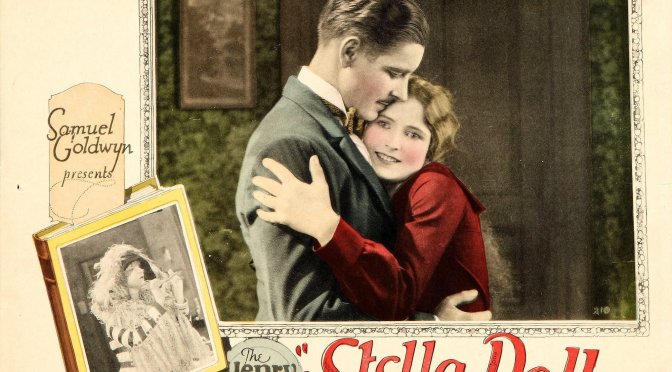
Olive Higgins Prouty’s 1923 novel Stella Dallas was destined to become a great movie. In fact, it has been adapted for the screen three times: in 1937 with Barbara Stanwyck in the lead role and in 1990 with Bette Midler, but before both of those in 1925 starring Belle Bennett as the unforgettable Stella.
Prouty’s novel is very cine-literate. It describes exactly the pleasure of a trip to the movies, but also the way that we can look at our real life as if it were a film. Sometimes we feel like an actor who is part of the spectacle, but at other times an onlooker, observing the action but not truly involved. Teenage Laurel, who is used to “standing on the outside” understands true love in real life because she has seen it in the movies: “Laurel had seen too many close-ups of faces not to recognize that look!”
The genius of this filmed Stella Dallas (Henry King, 1925) is that it captures the poignancy of watching life from the dark of the auditorium, but its emotional reach draws us in, even from the back of the balcony. The final scene of the film, in which Stella watches her daughter’s wedding through a lit window on the dark and rain-drenched street, is the perfect visual incarnation of Laurel’s horrified realisation, voiced early in the novel, that she had “become a part of the picture on the screen, while her mother was still in the audience, out there in the dark, looking on”.
Stella Dallas (1925)
On its release, the Manchester Guardian’s film critic CA Lejeune described the “painful beauty” of Stella Dallas, saying: “We are stirred into sympathy with all these people because we cannot help identifying ourselves with them … the whole picture is full of the half-tones of which ordinary life is composed.” In the New York Times, Mordaunt Hall praised one of the romantic scenes in the strongest terms: “It is all so natural, so sweet and genuine, so true to life, so fervent and sincere, so tender.”
Stella Dallas was made by Samuel Goldwyn in 1925, and the mogul was determined that it would be his masterpiece. He would end up spending $700,000 on the film – which was twice his line of credit.
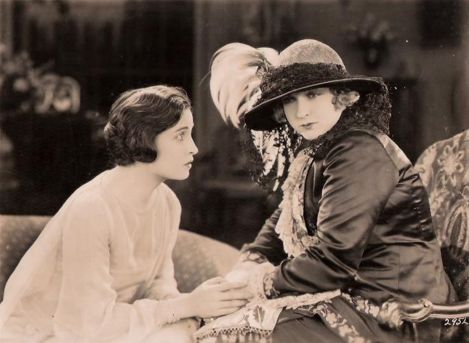
Stella Dallas (1925)
Key to the success of Stella Dallas is Frances Marion, the woman who wrote its sophisticated screenplay. Marion takes the events of the novel, which are jumbled by flashbacks to create the drama of suspense and revelation, and straightens them out into a flowing narrative that begins in a garden in spring and ends on a city street in the cold. She also takes a few discreet liberties, rearranging scenes and editing them slightly to emphasise the agonies that plague Stella and Laurel. Her screenplay for this silent adaptation became the basis for the subsequent sound film starring Stanwyck – making that film a true remake rather than a second adaptation. And the film is beautifully directed by Henry King, who tells the story visually, exploring the novel’s concern for appearances both contrived and mistaken, but who also coaxes excellent performances from his cast.
This is a guest post for Silent London by Ben Smith.
When Kevin Brownlow was in LA in the 1960s, interviewing cinema veterans for his unrivalled history of the Hollywood silent era, The Parade’s Gone By, there was one important figure who declined to be interviewed, Frances Marion. Brownlow admits he would have pursued her much more vigorously if he had only known then what he does now. At that time Marion was writing her memoir, Off With Their Heads!
Marion wrote some of the silent era’s biggest hits, among them screenplays for Mary Pickford and Douglas Fairbanks. Early on she established an extremely successful working relationship with Irving Thalberg, and became MGM’s premier screenwriter. She found love with a former Presbyterian Minister, Fred Thomson, and helped build his career as an actor who starred in 24 westerns. Thomson’s fame in 1927 was second only that of Tom Mix, but his stardom was cut short by a contract wrangle with the banker and film financier Joseph Kennedy (JFK’s father and a man who both simultaneously swindled and reformed the studios).
Fred Thomson’s death in 1928 – variously recorded as the result of tetanus, gallstone surgery and tuberculous – left Frances Marion a bereft widow and the single parent of two children. Marion, was more than stoic in her refusal to be held back by tragedy and continued to stay at the front of her craft, being the first woman to get a solo screenwriting academy award for The Big House (1930) and another for The Champ (1931).
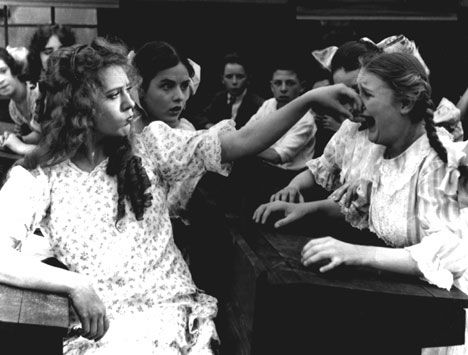
Mary Pickford in Rebecca of Sunnybrook Farm (1917), which was written by Frances Marion
In 1925, the year that F. Scott Fitzgerald published The Great Gatsby, Marion published her debut novel Minnie Flynn, the story of an uneducated working class girl who gets a break in the New York movie world before finding fame and fortune in Hollywood. Like Gatsby it was a story about new money, unfettered morals and collapsing class boundaries. Unlike Gatsby it wore its debt to melodrama on its sleeve. This unusual book, unique among the quietly burgeoning genre of the Hollywood novel for depicting the New York/New Jersey film industry, has been forgotten by history.
This is a guest post for Silent London by Kelly Robinson. If you haven’t seen The Wind, be warned that this article discusses the ending of the film.
Ethereal, delicate, poetic, otherworldly are just some of the somewhat elusive adjectives used to describe Lillian Gish since the early years of her stardom. Effusive admirer Vachel Lindsay said “Lillian Gish could be given wings and a wand if she only had directors and scenario writers who believed in fairies.” However, in reality Gish had her feet firmly on the ground. She had a career spanning eight decades, was a spokeswoman for cinema’s history with high artistic ambitions for herself and for the medium. King Vidor, who directed her in La Boheme (1926) commented: “The movies have never known a more dedicated artist than Lillian Gish.”
In his autobiography A Tree is a Tree Vidor said that Gish was incredibly assertive and had her own thoughts about the filmmaking process. Indeed, she knew a great deal about cinematography and in particular lighting. She had learned her trade during the more collaborative process of the silent era, where she had received extensive tutelage from DW Griffith in a production context where actors frequently worked without scripts and where they were encouraged to collaborate on characterisation and staging. She may only have had had a small acting role in Griffith’s Intolerance (1916), however she designed and furnished sets, helped with lighting and cutting, wrote intertitles and advertising copy.







 Silent London