The long hot summer of 2026 continues here at Pordenone. The first day of festivities for the 45th Pordenone Silent Film Festival dawned with a blaze of sunshine, a bustling market and an abundance of good vibes in northern Italy. And we closed with the glow of the Spanish sun. Now, to my mind, it is never truly autumn until Le Giornate del Cinema Muto has shut up shop for the year, but bonfire night edged a little closer with the new fizzing and sparkling festival logo that greeted us at the gala tonight.
The Giornate started not with a bang but with a bunch of Biographs. One-two-three-four-five miniature dramas directed by DW Griffith in 1908 and 1909, now beautifully restored from paper prints by the Film Preservation Society, and accompanied with élan by Philip Carli. I really enjoyed the very first of this, Money Mad (1908), a murky morality tale on the evils of Mammon, in which Griffith expressed in a single reel the very theme that Erich von Stroheim explored across an alleged 10 hours in Greed (1924). to see two theives attempting to sleep next to their stash with a gun or a knife respectively pointed at each other… The Christmas Burglars (1908) saw a hard-hearted pawnbroker warming to a starving child’s plea and sending his criminal friends to provide festive goodies for a single-parent household on the brink of eviction. A timely tale… There were more laughs in The Valet’s Wife (1908) in which a city chap lives large on the bounty of a beneficent uncle under the pretence that he is supporting a wife and infant. When Uncle Ebenezer comes to visit his bachelor pad, the dependents must be on display. Quelle horreur, all they can rustle up for a blushing bride is the brassy working-class wife of his manservant, and the bébé, half-inched from the local orphanage, is Black. Well the shock will probably do old Ebenezer good…
The second programme of the day was in many ways typical of the festival as whole: one film I knew, one that was didn’t and one that nobody knows – yet. Let’s start with the latter, a French police-thief-chase film, of the canine variety, from the Sine Nomine strand. I am so excited for the annual guessing game/super-sleuthing to begin. The second piece was a picturesque fragment of an Italian melodrama made in Turin, Ironie della Vita (Mario Roncoroni, 1917), starring the returning star of last year’s Giornate, Italia Almirante Manzini.
Manzini was the heroine, although not quite the focal point, of Augusto Genina’s adultery dramedy La Maschera e il Volte (1919), which is a slow-burn winner. It begins a very dry comedy of manners, introducing us to a social set riddled with infidelity, before taking a darker, and then a comical turn. Paolo (Vittorio Rossi Pianelli) insists that if he ever suspected his wife Savina (Manzini) of cheating, he would make like Othello in an instant. When the worst happens, however, he simply sends the missus away and merely pretends to have wrung her neck. Accused of murder, he hires Luciano (Ettore Piergiovanni) as his lawyer, who gets him off by damning the faithless wife in court. But who was the man who “led Savina to sin”? Lucky Luciano of course. And Paolo can’t bear people talking trash about his wife. It gets funnier and funnier, even when a corpse is duly produced – and buried. Nicely underplayed, with glamorous interiors and gorgeous Lake Como location shooting. Mauro Colombis played beautifully for this one.
The gala began with Stephen Horne at the piano, for two rediscovered gems: a Georges Méliès trick film with a Pierrot automaton gone rogue from 1897 and a British cartoon, Jerry the Troublesome Tyke – Curing a Cold, by Sid Griffiths and Bert Bilby from 1925. In this, the titular doggo took a trip Egypt to kick the sniffles.
These were followed by the first stop in a route that will loop, at a well-regulated speed, throughout the Giornate programme. Barcelona by Tram (Ramón de Baños Martínez, Ricardo de Baños Martínez, 1909), is the first of a series of urban phantom rides programmed by Lawrence Napper. Will he make tramspotters of us all, or will we merely be along for the, er, ride? This one was very precious, my favourite film of the day, starting out on the “golden mile” and travelling north-east, so that the city transforms in front of our faces. The joyous sight of men and boys running ahead of the tram, fascinated by the camera and the thrill of of outsprinting a moving vehicle, is just something very charming to be behold. Apparently, a picture such as this would originally have been shown in a city-centre cinema decked out like a train carriage. Calling Joan Fontaine and Louis Jourdan… Don’t forget to tap in and tap out.
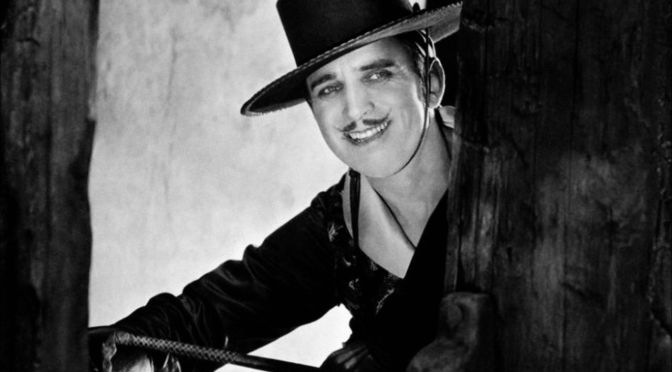
We remained in Spain for tonight’s main event, with the supreme swashbuckler of them all, Douglas Fairbanks, in Don Q, Son of Zorro (Donald Crisp, 1925) shown with Andrej Goričar’s new score, commissioned by the Slovenska kinoteka and performed by the RTV Slovenia Symphony Orchestra. The catalogue note by Tracey Goessel calls this “Fairbanks’ forgotten blockbuster”, and it really should be better known, which may soon come to pass, thanks to this gleaming new restoration from the Danish Film Institute, and Goričar’s sprightly Spanish-infused music.
After all, what is better than Douglas Fairbanks performing thrilling stunts in a mega-budget costume actioner? Two Douglas Fairbankses performing the you-know-what in a you-know-what. We are 30 years on from The Mark of Zorro, and the hero’s son is getting in touch with his roots, and practising his whipcraft in Spain. What’s that? Evil Don Sebastian (Don Crisp himself) is his rival for the hand of fair maiden Dolores (Mary Astor)? and he will go so far as to frame Don Q for murder to get the upper hand? Believe me – snake-hips Fairbanks, twisting around like Tony Manero in high-waisted flares, can handle himself. But it wouldn’t hurt for his grey-haired pappy to bounce over from California to help…
This is vivacious, ridiculous and gorgeous to look at. Handsome set-building, fluid fight choreography and enjoyable character work (Jean Hersholt!) put a pep in each and every step. What a delightful way to close Day One. Now light me a cigarette, Don Q-style – with a flick of a six-foot whip!
Benvenuto a casa. A domani!
Intertitle of the Day
“Wretched woman! Don’t you know your corpse is lying in one of the rooms in this house?” – La Maschera e il Volte
Animal of the Day
Inanimate maybe, but the stuffed kitty who face planted in front of the tree in The Christmas Burglars and then summarily vanished by morning was one mysterious moggy.
- Sine Nomine. Can you help identify an unidentified silent film?
- You can read more about the festival, and all of the films, on the Giornate website.
- Silent London will always be free to all readers. If you enjoy checking in with the site, including reports from silent film festivals, features and reviews, please consider shouting me a coffee on my Ko-Fi page.
- I am on Letterboxd – watch me struggle to keep up with all these films.


What a lovely surprise – you’re back in Pordenone! Less lovely surprise – I’m not!
Very much enjoyed the first report. The DW Griffith shorts from 1908 were a big highlight from my last visit. So glad to hear there’s more quality from whence they came. The bloke could tell a story with wit & economy!
Happily, I think the Barcelona tram jaunt is on the at home menu later today Australia time. Ding ding!
Intertitle of the day is a rollicking start – hard to see it being beaten. But we love surprises.
Bon continuation.