Even the most beautiful tram ride eventually comes to a halt. Even the transcontinental railroad has a beginning and an end. It is also true that after eight days of divas, detours, detectives and decadence, the Giornate del Cinema Muto closes its doors for another year. I had a wonderful festival with great films and better friends. I am overwhelmed by the strength and creativity of this silent film community. As Catherine Cormon said when she accepted her Jean Mitry award, the goal is for this festival to keep going and going, so we continue to deepen our relationship with our silent film heritage. Film won’t save itself.
I began my day as I had ended the previous one: drinking a glass of prosecco in a pavement café. Sorry, no, I mean watching a Gloria Swanson picture. Addressing the morning gang in Cinemazero, Donald Sosin dedicated his performance to Dennis Doros and Amy Heller, newly retired founders of the Milestone feast, and restorers of this Paris, Hollywood confection. Together with Romano Tedesco on accordion, Sosin (on paino and tambourine) provided suitably energetic and gallic accompaniment for The Humming Bird (Sidney Olcott, 1924). In this film, Swanson plays Toinette, a cheeky Parisian gamine and thief, who likes to commit her crimes in disguise as a boy, “the Humming Bird”. Swanson is so much fun in this, so enthusiastically “French”, savouring each saucy swagger across the sawdust-strewn floor of Montmartre dive Le Caveau and looking divine in stripes, and photographed by Harry Fischbeck. I mean, there is a romantic plot involving a reporter (Edward Burns), the outbreak of war, her time in prison, a miracle… and a medal but this is mostly a must-see for the joy of seeing Swanson roll with a theme.
After lunch, we were back in the Verdi for the final feature in the Marshall Neilan section. Spy thriller Diplomacy was – how can I be diplomatic? – not very thrilling. Blanche Sweet was sweet, Gustav von Seyffertitz was an unusually a low-key villain, Neil Hamilton played Neil Hamilton and there was lots of going in and out of rooms and opening envelopes. All very pretty but dare I say it, dull? Others agreed – other decidedly did not. Howsoever – masterclass student Lulu Chen did a sterling job with the accompaniment. And the tram film that preceded it was a very attractive one, footage from 1915 of a tram gliding gracefully along the banks of Dutch waterways, windmills in the background, etc. Honestly very soothing.
The next programme was one of my favourites of the festival, for its novelty and charm. Magnus Rosborn of the Swedish Film Institute, accompanied by Stephen Horne on piano, presented what remains of the directorial output of theatre legend Pauline Brunius: situation comedies about married couple the Vinners. This added up to fragments of three films, ingeniously presented alongside stills and intertitles to give a sense of the whole story, and then the one remaining two-reeler, Liv Livet Leende (1921), in which Mr Vinner, much to everyone’s annoyance, takes inspiration from Douglas Fairbanks’s book Laugh and Live. Such a smart and appealing way to share access to what is otherwise lost.
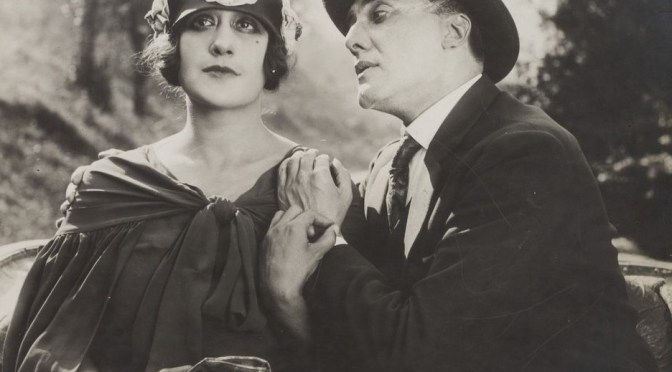
And now the end is near, but it is not over until the diva swoons. My final film of the festival was another hot and heavy date with Italian Almirante Manzini, in La Grande Passione (Mario Almirante, 1922). This was really lovely, with astonishing views of Lake Como, which is where Maria (Manzini) retreats with Patrizio (André Habay)after he overhears her rowing with her lover in a hotel room. There they are greeted by a curious old gent, who is shocked they are not sharing a room while their romance begins to bloom. That the film cross-cuts to an elderly couple as they cruise across the lake,and then vignettes pointedly on to the bed when they arrive, gives a suggestion of the film’s slightly quirky tone, its intense foreshadowing and editorialization. The romance is sumptuous, and Manzini magnificent – however, death, distress and heartbreak await our young lovers. This film initially moved slowly, hampered by excessively verbose intertitles, but still, it really began to engross… I think Gabriel Thibaudeau really helped, with his restrained accompaniment. I may have had to cut my festival short but I ended on a high.
Intertitle of the Day
“I am a woman – let me cry.” Ah, Blanche Sweet in Diplomacy, I fear you are too delicate for the cutthroat world of international espionage.
- Good news – Paul Cuff has started blogging the remote festival.
- READ HERE: An open letter from The Cinema Museum to everyone at Pordenone. Can you donate to help save the museum? Find out more here.
- Sine Nomine. Can you help identify an unidentified silent film?
- You can read more about the festival, and all of the films, on the Giornate website.
- Silent London will always be free to all readers. If you enjoy checking in with the site, including reports from silent film festivals, features and reviews, please consider shouting me a coffee on my Ko-Fi page.
- I am on Letterboxd – watch me struggle to keep up with all these films.

