If you are anything like me, then you may well consider the two-hour flight to Italy for the Pordenone Silent Film Festival at least partially justified by the chance to see four minutes of a lost FW Murnau film. Right or wrong, it’s how we’re made. And yes today I did get to see two separate fragments of Murnau’s Satanas (1920). Well, they say the devil has all the best films.
It was a wild Weimar morning of sorts, starting off with – blessed words – a Pola Negri double-bill. We saw La Negri vamping it up as a woman out for revenge against the architect of her forced marriage in the remnants of Die Marchesa D’Arminiani (Alfred Halm, 1920). This was truly glamorous, and she made a wonderful cold-hearted tormentor of men. But especially when superimposed, in miniature, on her victim’s piano. This was followed by one of her best Polish films, Bestia/The Polish Dancer (Aleksander Hertz, 1919), in which she plays a wild young teenager betrayed by a boyfriend and forced to make her own way in the city, only to discover, too late, that her wealthy lover is married. The wife dies of a broken heart, the boyfriend kills Pola in revenge – what a mess! Still, Negri is fabulous in this, so vibrant and passionate. The character is named Pola, she becomes famous dancing as Mlle Elena – yet her elegant boudoir is decorated with sashes that read… “Pola Negri”. The very definition of a star vehicle, for the 23-year-old Negri. Dancer films such as these always shimmy their best when accompanied by John Sweeney.
Weightier material in the second stage of the morning, with the first shows from the much-anticipated Weimar Uncensored strand, curated by Anton Kaes and Michael Cowan. First, four mind-boggling minutes of Satanas, with an Egyptian Fritz Kortner writhing in passion with a seductive missy, and then a frigid Conrad Veidt wearing a peroxide bobbed wig and making the very darkest of threats: “Nouri’s scream will not pierce seven doors.”
The feature, also missing a reel, was Die Teufelskirche (Hans Mierendorff, 1919), which was truly a nightmare scenario. A young married farmer (Otto Werther) falls asleep and dreams the devil (a muscular Paul Rehkopf) is coming for his wife (a fabulous Agnes Straub, in a very low-cut dress), his land, and his church, led by the heretofore upright pastor (Mierendorff). Perhaps a blunt instrument, but so sp effective, as Satan preys upon each person’s weakness to lead the congregation into sin and thus into his thrall. And pause to consider the wife, who “longs for a child”… or perhaps the means of production, shall we say? Am sure there is a certain satirical critique of church and civic politics in the behaviour of the village landowners and this is a lively tale adapted from a play by a rather bohemian writer, apparently, so maybe we are meant to cheer for the devil? Or at least not pretend we are so very pure as we claim… Anyway, this just gets better the more I think about it and the striking accompaniment from Gunther Buchwald and Frank Bockius really helped it fly.
The afternoon’s main attraction was the Female Madness shorts programme, which was a very mixed bag, from actuality to distressing medical footage to melodrama to comedy. I enjoyed the snatches of Germaine Dulac’s Ames de fous (1918), which has more plot than the rest of the selection run together, but especially enjoyed my own dear Asta Nielsen at her most energetically comedic in Das Versuchskaninchen/The Guinea Pig (Edmund Edel, 1917). Poor Asta, I mean Jesta, is a madcap young woman, accidentally sent to an experiment (putting it kindly) mental hospital. She spends an awful long time trying to hang herself, but thankfully fails and fails again, before making her way home with the help of her boyfriend. It is far more fun than it sounds, and if you don’t know Asta’s funny bone, you are missing out. How Daan van den Hurk kept up with these changes of pace and tone I will never know but he did.
We caught two trams today, you will be pleased to know. First, we soared through the skies on Wuppertal’s famous flying tram in Schwebebahn (1902). If you think you have seen this one before – well there is more footage in this version. It really is spectacular on the big screen. I do like, with these tram rides, the moment you pass another tram and it is suddenly like looking in a mirror – you see the shape of the vehicle that you are riding in. In this one, that is especially exciting, as you suddenly realised you are suspended from a rail, an upside-down tram, in topsy-turvy land.
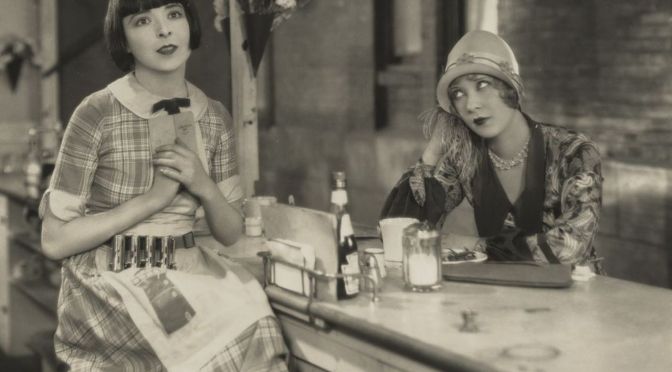
More familiar scenes were to be glimpsed from the window of the evening tram, an 1899 ride from New York to Brooklyn over the Brooklyn Bridge. Watch out for the cut in these one – the ride was longer than a reel. It set us up nicely for a film all about the niceties of the local geography, and the social strata of the city: Her Wild Oat from 1927, starring the charisma queen Colleen Moore and playing the strand devoted to its director, Marshall Neilan. So, fellas, it’s this way: Mary Lou is a sweet girl who runs an inner0city lunchwagon, just putting by her pennies for a rainy day. But one dark night she meets a swell gent, who is temporarily embarrassed for cash, and clothes (Larry Kent). Well, she lets him slip through her fingers, but she does fancy a taste of the high life so before you know it, she puts a pause on the sandwich-slinging and hightails to Plymouth Beach in entirely the wrong kind of clothes, where she is laughed at by the snobs. But due to… reasons, she re-enters society masquerading as a duchess. Will she meet her dream man again? Well yes, but it’s a bit awkward that he thinks she is his new stepmother…
Look Colleen Moore can sell this kind of thing by the cartload. And she did tonight, ably accompanied by Donald Sosin with a very nice score, which even included a couple of hymns – Mary Lou does her bit for the Sally Army. It may be the second-most charming mistaken identity farce to have been filmed in its key location: the Coronado Hotel in San Diego where Billy Wilder shot Some Like it Hot.
Intertitle Innuendo of the Day
“Let your kettle boil over.” The Devil to Ane in Die Teufelskirche. I guess we know what he means, Ane.
Intertitle Is-It-Innuendo of the Day
“When a duchesse sees a banana, she ignores it.” Tips on how to pass in high society, from Her Wild Oat.
Animal Friendship of the Day
Anyone else expect the dogs at the end of Her Wild Oat to pour some martinis and launch into “Well, Did You Evah”?
- Daily coffee count: stuck on a steady three…
- Sine Nomine. Can you help identify a silent film?
- You can read more about the festival, and all of the films, on the Giornate website.
- Silent London will always be free to all readers. If you enjoy checking in with the site, including reports from silent film festivals, features and reviews, please consider shouting me a coffee on my Ko-Fi page.
- I am on Letterboxd – watch me struggle to keep up with all these films.


Aha! We cross paths briefly – we also had Die Teufelskirche on our menu at home – and it was indeed fab. One that would have been so much better on big screen/live score etc. But the core energy and creepiness of the film could not be denied. So many people have epiphanies, pass the smelling salts.