Pordenone is basically a very long tram ride, and although the views at every stop are very diverting, I have no intention of disembarking any time soon.
The first route of the day took me to Scandinavia, where after a short voyage through Copenhagen, we arrived in northern Sweden, 1918, playing 18th-century Iceland, to see Victor Sjöström’s harrowing masterpiece The Outlaw and his Wife. Sjöström plays the outlaw, a fugitive ever since he stole a sheep in desperation to feed his starving brothers and sisters, and Finnish actor Edith Erastoff plays the wife. At first she is a local landowner who hires him to work her land. But when she sees his mettle, they fall in love and are married “in the eyes of God”. Undaunted, she takes to the hills with her beloved, ready to face life’s adventures together, on the run, off the grid. Just a quick note: apparently Erastoff, who was married to someone else, was pregnant with Sjöström’s baby during the shoot. They were married five years later, when her divorce came through, and stayed married until she died.
This is a wonderful film, as you probably know, which after a romantic start turns terribly tragic. There are spectacular scenes out in nature, many of them filled with peril. The through-line from here to The Wind (1928), is very clear despite all the many differences, not least of technology and budget. Honestly, it was a real privilege to see this on a Monday morning with sumptuous, and beautifully responsive, accompaniment from Neil Brand on piano and Gunther Buchwald on violin. Sometimes Pordenone offers the best of the best, and this was just that.
The only way to follow such heights is with a complete change of tone, and another tram. So to the first screening in the sitcom strand with a collection of Mr and Mrs Sidney Drew Vitagraph comedies. Buckle up for the mother-in-law jokes. These are not quite my cup of tea but they are really very well done. Sidney Drew’s face is just so elastic! It is just a coincidence – I promise – that my favourite was Boobley’s Baby (Mrs Sidney Drew, 1915), in which lazy Sidney, stick of standing for parents of newborns takes to carrying a doll on his morning commute to guarantee a seat… such sneakiness gets him into trouble but does indeed result in him getting the girl, AKA his wife Lucille McVey, AKA the director. To find out more about Drew and McVey, you could read the new book Presenting Mr and Mrs Sidney Drew (Split Reel), by Rob Farr, or listen to him on the NitrateVille Radio Podcast, or come to his book talk on Wednesday, which will also be livestreamed on YouTube*. Or all three. but definitely get the book.
Fancy another swift change of direction? Let’s return to Weimar Germany, the perils thereof, and a drama best served cold, Heddas Rache (Jaap Speyer, 1919) where “Rache” means revenge. Our Hedda (Mia Pankau) swears she will avenge the wrongs done to her dying mother, whom she has belatedly learned has been running a brothel while she is away at boarding school, but she will do so “in a dignified way”. Mother was seduced and abandoned by a married man as a young woman, and when she was left with a baby to feed, turned to the oldest profession to make ends meet. And to be honest, from there she rose through the ranks, and fallen woman or not, she was something of a career girl. But ma’s trade has put an end to her own hopes of marriage (to Reinhold Schünzel) so she is out to give the man who ruined her mother a dose of his own medicine. It’s a lurid story and apparently the reaction at the time was suitably outraged, but as a drama it was rather pedestrian. Thankfully Meg Morley was at the keys to add a little sparkle.
Come the evening, we were accompanied with great charm and ingenuity by the trio of Stephen Horne, Elizabeth-Jane Baldry and Frank Bockius, we hopped on another tram, for a scenic tour through the centre of Vienna, circa 1906, and from thence we drifted to Venice, just down the road from Pordenone. Stellina, Pescatrice di Venezia from Film D’Arte Italiana in 1912 was a picturesque half-hour romantic tragedy, adorned with vivid (I mean, really vivid) stencil colour and more than a few luscious travelogue indulgences. Not that we minded a single one. The city looked its beauteous self, as did our fisher girl heroine, played by French star Madeleine Céliat, who is one day bitten by a snake and taken to the home of a seductive count to recover… it was truly a delight and a a smart restoration, even if most of its pleasures were surface level.
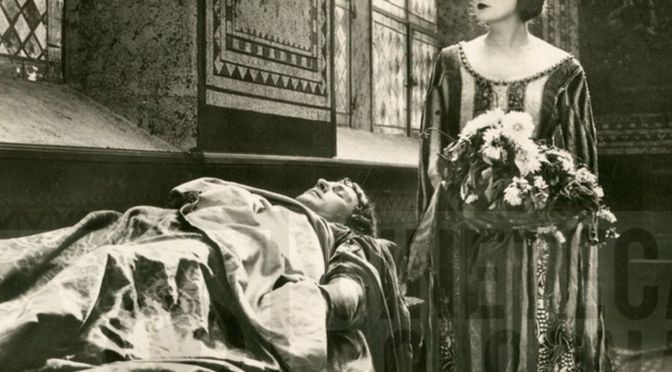
But Monday night was truly diva night, as we were also in the presence of the one-and-only Italia Almirante Manzini. I did mention once or twice on these pages how distracting brilliant she can be. Arzigogolo (directed by her cousin Mario Almirante, 1924), was officially a “superfilm”: a prestige production of a medieval romance in which Manzini plays Violante, a haughty princess who rejects every suitor, in particular the besotted Count Giano (Alberto Collo). When she is forced to choose someone, she accepts the first that comes along, a rich and grasping buffoon called Floridoro (Oreste Bilancia), on the condition that the marriage is not consummated and she will continue to look for her true love. Which may be the count’s jester (Annibale Betrone)… ? This was as sumptuously decorated and dressed as you might expect, and yet also filled with bizarre touches: a swarm of mice on a banquet table, a man’s head superimposed on a sheep (very Poor Things), and horizontal splitscreen. It was compelling, dramatic, and enjoyably odd. I was not able to see to the end, which hurts me more than it does you, believe me. This was huge fun. I will do what I can to see the rest…
Intertitle of the Day
“I have no wish to weep – weeping is ridiculous.”
So says Edith Erastoff in The Outlaw and his Wife. An hour later, the audience would beg to differ.
*Why yes you may also see me there!
- Paul Joyce is doing some excellent blogging.
- Sine Nomine. Can you help identify an unidentified silent film?
- You can read more about the festival, and all of the films, on the Giornate website.
- Silent London will always be free to all readers. If you enjoy checking in with the site, including reports from silent film festivals, features and reviews, please consider shouting me a coffee on my Ko-Fi page.
- I am on Letterboxd – watch me struggle to keep up with all these films.


Can anyone tell me what film the above picture comes from?
Hello, the picture is from Arzigogolo (Mario Almirante, 1924). See also: https://www.giornatedelcinemamuto.it/wp-content/uploads/2026/09/ARZIGOGOLO.jpg