I have spent a lot of words on Le Giornate del Cinema Muto so maybe I need some new ones. Conveniently enough, day six of the festival proved a fruitful day for neologisms – right from the start.
A couple of minutes past nine in the morning, in fact when I was merrily enjoying the views of the Bute coast in Promenading Rothesay (1906-9). Here the camera is affixed to a car on the Rothesay and Ettrick Bay Light Railway, tilted towards the sea, showing us the spectacle of gardens, shorelines and parading Edwardian tourists, “promenading” with parasols and formal hats. It is, as Lawrence Napper notes in the catalogue, very similar to the Mitchell and Kenyon film, Panoramic View of the Morecombe Sea Front (1901). So is this a phantom ride or a panorama? Or could it be a tramorama? Later, in the afternoon, we all caught collective vertigo riding to the very top of a hill and down again in A Ride on the Peak Tramway, Hong Kong (1900) – a more dramatic effect, but somehow less picturesque. Heights, camera, action!
Frances Marion coined several phrases and words in the backwoods comedy drama M’Liss (1918), a merry Mary Pickford vehicle directed by Marshall Neilan. Pickford is M’Liss, or Melissa, raised in a shack by her boozy old pops “Bummer” Smith, and despite her simple life of doin’ what comes natur’lly, as Doris Day might put it, she is destined to fall in love with the rather hunky new schoolteacher played by Thomas Meighan. There was an excess of plot (shenanigans involving an estranged brother and a will), and a multitude of colourful characters (Tully Marshall as the local, hapless, judge was particularly good value) and plenty of dialect dialogue. At one point, a title announced “a solemncholy moment”. Ah, but don’t worry – the funeral was only for poor M’Liss’s baby doll – she had accidentally blasted its face off with a catapult. Gorgeously restored and with live music from John Sweeney, this was heaps of fun, although the lynching made the otherwise happy ending a little “solemncholy”.
Solemncholia of course abounded the rest of the day’s fare. Not least in Kenji Mizoguchi’s beautiful, heartrending The Water Magician (1933), accompanied by benshi Ōmori Kumiko as well as beautiful if necessarily understated music from Matsumura Makia on piano, Katada Kisayo (percussion) and Kiyomoto Nobuakira (shamisen). The feature was proceeded by two animated shorts: I especially liked the new restoration of fragment The Dull Sword (1917), a cut-out and silhouette animation in which a daft young ronin has to get to grips with his weapon, but it is probably best no one tells him its name. The feature itself, is a classic for a reason, with the mesmerising Takako Irie as the young illusionist who gives up everything for the young man whom she loves (Tokihiko Okada), but who does not prove worthy of her sacrifice. Not to be too flippant, but it really felt like yesterday’s The Girl At Home was a trial run for this screening … similar themes and very different treatment.
“Let us proceed with the ‘drammer’,” as M’Liss put it. Yevgeni Bauer’s Zhizn za Zhizn (A Life for a Life, 1916), was another exceptional film. The daughter (with a hefty dowry) and stepdaughter (absolutely not) of a wealthy woman (Olga Rakhmanova), fall for the same Prince, a “waster and a rake”, played by Vitold Polonsky. There is a genuine attraction between the Prince and the stepdaughter but guess who he marries instead? Oh dear. When the police come after him for fraud and Mater sees that he has truly broken her daughter’s heart she wants his guts for the garters. To day the least. This was beautifully done, with astonishingly elaborate décor and camera movements that provoked almost as much dizziness as the Hong Kong tram earlier… And this, with its wonderfully dramatic ending, prompted a good old “cheernate” – when the Pordenone crowd respond with entirely 21st-century enthusiasm to a film made in another era. This came when the furious mother-in-law, having failed to persuade the Prince to “be a man, for once,” forcing the revolver into his hand, picked it up herself and took some long overdue action…
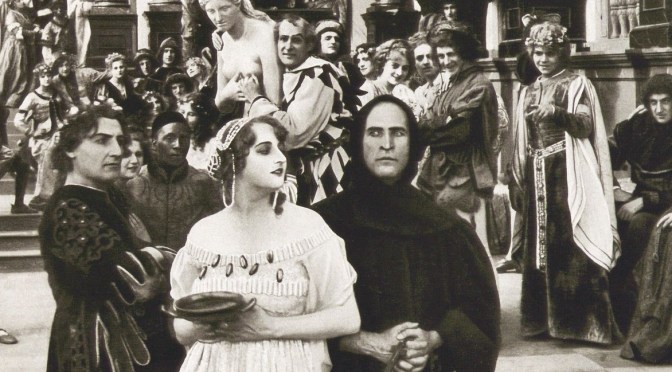
“Divided into 7 chapters, the film charts a relentless descent into chaos and ruin.” Some people would read that in the catalogue note and run a mile. But not me, Weimar Uncensored strand curators Michael Cowan and Anton Kaes, not me… Pest in Florenz (Otto Rippert, 1919) was a movie and a half, scripted by a battle-traumatised Fritz Lang and produced at great expense by Erich Pommer. While it had plenty of solemncholy, it had much of the opposite too – joyphoria? The setting is renaissance Florence, but the subject of the film is so clearly war-ravaged, influenza-stricken Germany. Julia (Marga Kierska) is a free-spirited, free-loving courtesan who kicks off a new age of hedonism within the walls of Florence. The city’s tyrannical ruler, and his son both fall under her spell, but the real love story here is between Julia and Medardus (Theodor Becker), a hermit monk with an aspect of Savonarola. Decadent? Decadon’t.
If, whisper it, there are moments when it doesn’t look that expensive compared to later silents, you could always see where the money had gone. The frames were bulging with detail, and excess. Cavorting pleasure-seekers, canoodling couples, jesters walking on their hands, peacocks by the dozen, a man riding a pig, another jester doing unseemly things to a sheep’s tail, a corpse-lined catacomb, a vision of Jesus – or of Hell, a broken cross resurrected. And then… all of a sudden, the skeletal spectre of plague, playing the violin and stalking the streets to rain down retribution on the decadent Florentines. This was so much of a spectacle that I was kind of enthralled, and never bored, though not as emotionally engaged as I would love to be… but I won’t forget it in a hurry. This could have been a horror with a redemptive ending, or a risqué carnival, but instead it is something much darker, a deadfooted march down the primrose path to hell. Thanks to the Blsck Forest’s finest, Gunter Buchwald and Frank Bockius, for keeping time with every painful step. Could it be… an allegorical blockbuster? A behemyth?
Intertitle of the Day 1
“Swayed by love, a woman can forgive anything.” – Zhizn za Zhizn. Can she? Maybe we can work on that.
Intertitle of the Day 2
“And Florence entered an age of unbridled pleasure.” Did she now? Sorry, it’s late. You can guess that one was from Pest in Florenz..
- Sine Nomine. Can you help identify an unidentified silent film?
- You can read more about the festival, and all of the films, on the Giornate website.
- Silent London will always be free to all readers. If you enjoy checking in with the site, including reports from silent film festivals, features and reviews, please consider shouting me a coffee on my Ko-Fi page.
- I am on Letterboxd – watch me struggle to keep up with all these films.

