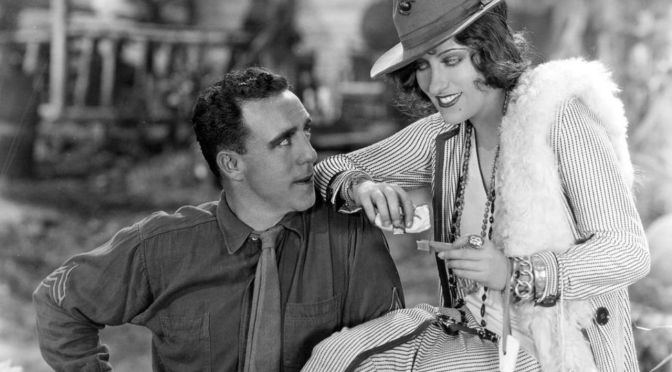
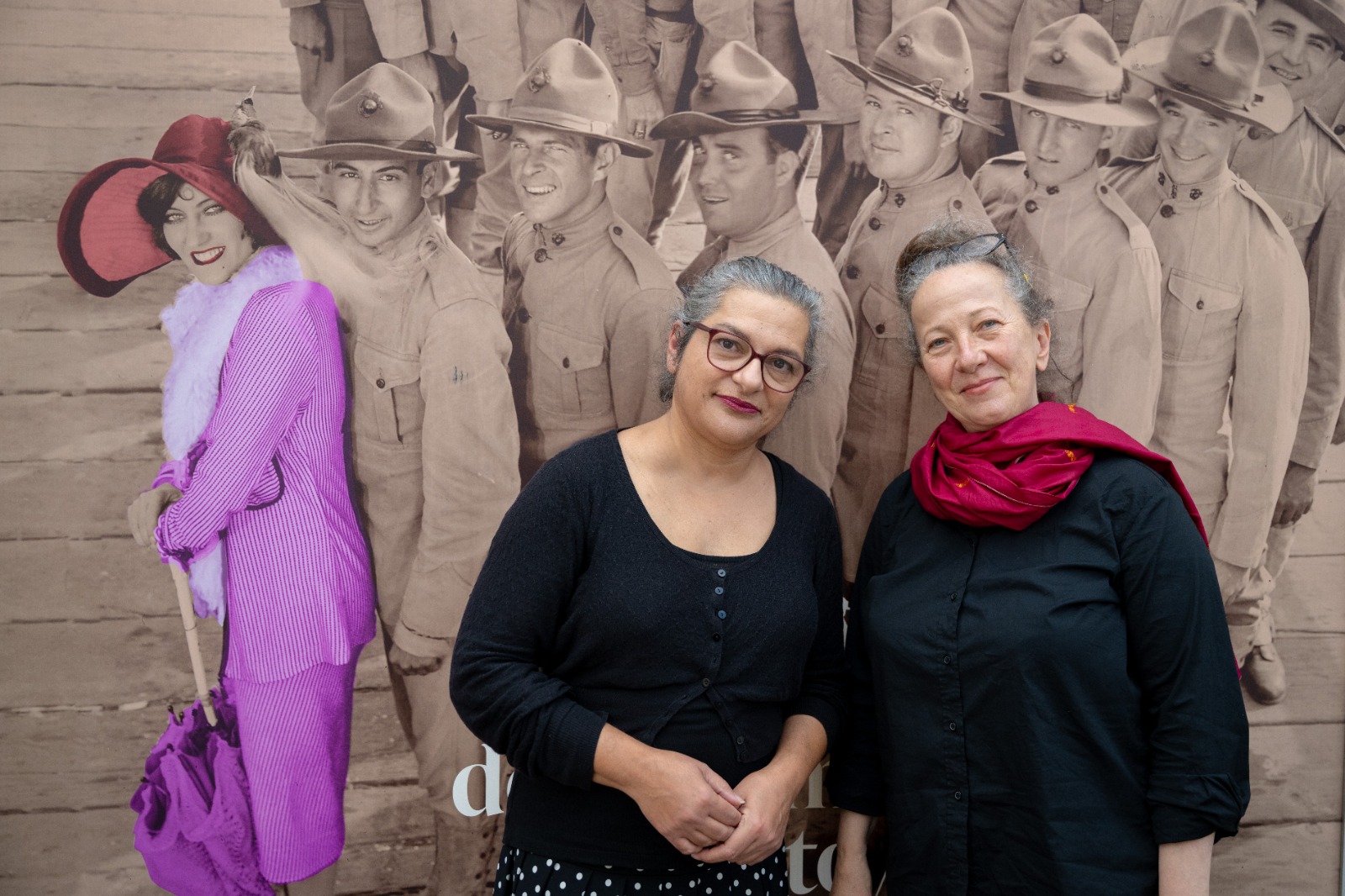
Let’s begin in the logical place, at the very end of the day. Tonight was a gala night in Pordenone, a celebration of some of my favourite women. For sure we had Pola Negri and Gloria Swanson on the big screen, but if you want a really iconic duo, check out our Jean Mitry prize-winners, Elif Rongen-Kaynakçi and Catherine Corman from Eye Filmmuseum in Amsterdam. I don’t pretend to know everyone in the film archiving world but I know enough to know that these two were very worthy winners. And Elif’s speech in which she talked about expanding the canon, refusing to accept that films were lost, and “acts of resistance against the establishment” made my heart sing.
To follow this, we had Negri in full wicked gothic glamour in the remaining (so far!) fragment of Das Martyrium (Paul L. Stein, 1920), playing a widow, controlled from beyond the grave by the outrageous rules in her husband’s will, and the officious secretary executor bent on enforcing them – who happens to be her old flame. Those rules? She can never remarry and must sleep each night in the room her husband died in, which will be painted grey and decorated with his portrait on every wall. Negri is astonishing in this. I love her and always will.
And that would be awkward, if the stories about her feud with Gloria Swanson were true, as she has my heart also. I spent a lot of time with her recently. And tonight we saw one of her best silents, newly restored by Milestone, the Hays-baiting Somerset Maugham adaptation Sadie Thompson (Raoul Walsh, 1928). Swanson got her first Oscar nomination for this, playing the sex worker stuck on a pacific island, falling in love and reluctantly seeking redemption and you can see why. She is terrific: funny, and, sexy and tortured, and especially enjoyable when she is righteously angry. She looks gorgeous too. Lionel Barrymore is terrific as the reformer trying to reform her and Walsh is hunky and charming in his final acting role (before losing his eye), as her love interest, ‘Handsome’ O’Hara. Meg Morley played superbly for this very long, and late programme, so extra congratulations to her.
But there was a full day of goodness beforehand. This was a very strong day at the Giornate indeed. The first feature of the day was a creepy Vertigo-esque doppelganger drama with Italia Almirante Manzini playing Mary, a young working-class woman who falls in love with a count (Lido Manetti), but dies of shock when hid old flame tries to cause trouble. And then also, Naomi a Ballet Russe dancer who looks just like her. At first the brokenhearted count attempts to mould Naomi in Mary’s image, keeping her locked away in a secluded villa, choosing her gowns and making short, intense visits to her… but love, real love, breaks through and they find a way – we hope – to be themselves, together, in love. This was La Statua di Carne (Mario Almirante, 1921), and it was rather good. A nice chewy role for Manzini – passionate but also more complex than the standard diva fare. And I really loved the subplot romance between the count and Mary’s friend (Bianca Renieri). There is some fine comedy to begin with when the chaps are slumming, pretending to be broke in front of the women who work in an artificial flower workshop. But when Mary’s friend discovers her beau is actually loaded she is (somehow sweetly) thrilled, and proposes on the spot. As the film continues we see her happily living the high life. A fairy tale indeed. Though of course she does lose her best friend so y’know it’s not all chocolate boxes and silk dresses. Daan van den Hurk was with us all the way through and honestly this one was a joy, despite the clear potential to be otherwise.
Now I do have one quibble with the Pordenone programming: Genuine (Robert Wiene, 1920) should have played much earlier in the festival – just so we could have spent more time talking about it, and fashioning our own copycat outfits. Imagine Caligari, but even more eccentrically designed, more feminine and much more funny. Plus, it is looking incredible in a nifty new restoration from Filmmuseum München, which restores it to its full length, or near enough. The design is what you might call Expressionist-Maximalist, with brush strokes and steep gradients and monochrome geometry as far as the eye can see. This must be what Tim Burton sees when he goes to sleep at night. As the titular succubus, Fern Andra is truly vicious, but also stunning, like a voluptuous Siouxsie Sioux. On any other day, Negri in Das Martytrium would win the crown for gothiest sex goddess. Not today. Silent cinema can be so punk rock.
Do we need a plot? Well, OK, artist Percy falls asleep and his painting of Genuine comes to life and so does a convoluted story of her enthralling and killing a series of increasingly emo men so she can drink their blood. Does it have to make sense when it looks this good and this ghoulish? I cannot begin to tell you how much fun Mauro Colombis and Elizabeth-Jane Baldry added with their musical accompaniment, here.
Less fun was had in the afternoon and yet this triple-bill contained one of my favourite films of the festival. The first two work as a good pair, so let’s give due credit to the Imperial War Museum’s impressive reconstruction of sound film Peace on the Western Front (1930), missing a couple of reels of sound, but here performed as live with toby Haggith and Clare Watson providing voices and Stephen Horne providing music. Simple setup: a little boy is playing soldiers, and his father, a Great War veteran decides to tell him what war is really like, aided with some Belgian battlefield footage, a waring against future carnage. Beautifully done, and it would be haunting, of course, even if we didn’t know what happened next…
Lest We Forget , indeed. Which was in fact the title of a war blockbuster directed by Leonce Perret in 1918 no less, playing in the rediscoveries strand thanks to another impressive new restoartion. Neil Brand had death, disaster, murder, a firing squad, espionage, romance and nothing less than the sinking of the Lusitania to contend with here and of course he did an impeccable job. Rita Jolivet, who herself survived said sinking of the Lusitania, stars as a French opera singer in love with and American and caught up in the war in a series of highly dramatic events. It all ends with blatant propaganda about French-American cooperation but don’t let that blind you to what is a terrifically effective female-led war film, packed with action and spectacle and some genuine horrors.
But next, what may be my film of the festival, a Japanese feature from 1915, which was accompanied by three benshi (Kataoka Ichirō, Ōmori Kumiko, Yamauchi Nanako) in one of the most remarkable such performances I have ever witnessed. This film, A Tale of the Filial Devotion of Goro Masamune (YJiro Yoshino), was entirely new to me and it was really as harrowing as promised. It is the story of a little lad born out of wedlock but later reunited with his father, a master swordmaker, and his wife, who resents his presence and becomes increasingly violent and abusive to him. Shot in theatrical style, with the actors often fairly distant from the camera, in short vignettes led by leading intertitles, but no, somehow this was incredibly moving, pure Dickens. In silent film, it can be best described as akin to Julien Duvivier’s Carrot-Top (1925) for portraying the trauma and suicidal ideation of an abused child. And then it finished with a swordfight with a scary lady monster-ghost. Astonishing material this. When suddenly the poor boy (Kunimaru Sawamura) does approach the camera the impact is tremendous. Pianist Matusmara Makia accompanied alongside musicians Katada Kisayo and Kiyomoto Nobuakira, playing music authentic to the kabuki theatre tradition. It was spellbinding. Really unlike any other benshi screening I have ever attended.
Intertitle of the Day
“You have the power to hang me. But I have the power to say – HANG ME AND BE DAMNED!” – You get him, Sadie Thompson.
Overheard
“Misery and trams – that’s basically all I ever want to play for.” – An esteemed silent film accompanist who shall remain nameless.
- READ HERE: An open letter from The Cinema Museum to everyone at Pordenone. Can you donate to help save the museum? Find out more here.
- Sine Nomine. Can you help identify an unidentified silent film?
- You can read more about the festival, and all of the films, on the Giornate website.
- Silent London will always be free to all readers. If you enjoy checking in with the site, including reports from silent film festivals, features and reviews, please consider shouting me a coffee on my Ko-Fi page.
- I am on Letterboxd – watch me struggle to keep up with all these films.

