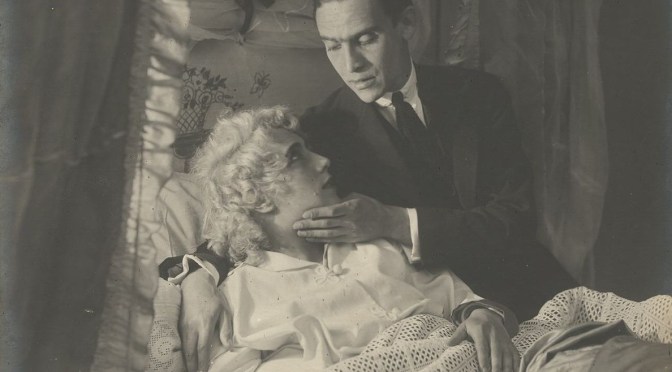
Even here at Pordenone, not every film you watch can be a masterpiece. So rest assured that tonight’s gala screening of A Page of Madness (Teinosuke Kinugasa, 1926), with live benshi narration from Kataoka Ichirō, more than fulfilled the festival’s chef d’oeuvre quotient for the day. It screened in the evening, with more shorts, all accompanied by benshi narrators and live music from Matsumura Makia, Katada Kisayo and Kiyomoto Nobuakira. Five stars all round. And there is another benshi programme tomorrow morning, featuring another canonical Japanese silent, one I may perhaps even prefer, so we are truly blessed.
The rest of the day abounded in interest, if not instant classics. Shall we tick off the trams first? Because I hate to miss a single one. Mid-morning we were in Karlskrona, Sweden in 1910 to witness the inauguration of the new electric tram system. These trams had ribbons on them, and the crowds were visible excited. In Karlskrona, I mean. But also in the Verdi.
We took this phantom ride before the morning’s sitcom screening: Gyurkovicsarna (1920) was a whimsical (if morbid) comedy starring Gösta Ekman as Geza, a cheeky young miiltary cadet, directed by John W Brunius and co-written by Ekman and the director’s wife Pauline Brunius. They were something of a power trio in Swedish theatre at the time and this was really a breeze and a pleasure. Not least Pauline Brunius’s key role as a haughty artisto who “elopes” with our cocky young hero. The director had his own cameo, playing cards on a card table, in the sea. I told you it was whimsical. Did I let the plot pass me by as I enjoyed Ekman’s charm and the film’s joyful silliness? Yes. Was I also taken by Nils Asther as Geza’s twin brother Bandi, who got the house and the girl? Yes. Did Stephen Horne add yet more gaiety with his witty, multi-instrumental accompaniment? Also yes.
But was I having also as much fun during the morning’s Weimar misery-fest? Well, I must confess, yes. Blondes Gift (Hubert Moest, 1919) was a potboiler and a half, with an abundance of narrative detail, most of it revolving around human cruelty and degradation. It was refreshingly explicit, and also impressively keen to find psychological causes for each blow inflicted on the human soul. But yes a lot of things happened and most of them were awful. As my neighbour joked afterwards: “What did the baby die of? Plot!”
But that is getting ahead of ourselves. Hedda Vernon plays Loni, who appears to be a blonde floozie, no better than she ought to be (horrific childhood with sex-worker mother, played by Vernon in flashback, and violent father who took an axe to the mother), and Ernst Deutsch is Rolf, her childhood pal, now wealthy but somewhat weakminded (distant grandfather, abusive governess). Loni has recently been released from the grip of her one true love, also a violent abuser, because he has been sent, quite rightly, to prison, so she strings Rolf along for the villa he buys her, but is off romping with the chauffeur… then she falls pregnant, so Rolf marries her, but then, aha, the first love reappears. This was deeply intense, although a little blunt-edged. That said I was engrossed, and horrified at every turn. Vernon may not have been a great actress, but she is perfect here: a blonde moppet with dangerous charm, a greedy streak and dark, dark nature.
A long evening of talking, sometimes about talkies, awaited me, so I squeezed in just one more full programme today. Following a reel of an action-packed French drama, we were treated to an early Marshall Neilan feature, The Girl at Home (1917). Here Neilan directs his drinking buddy Jack Pickford in the story of a callow young lad called Jimmy who romps off to university and is duly distracted by wine, women and song, in particular, a champagne-quaffing vamp singer called Diana, played by the statuesque Olga Grey. But little does he know that the money he is frittering away on this madam comes not from his parents, but from his faithful, ringletted sweetheart Jean (Vivian Martin) who is waiting patiently for him “at home”. Well Jimmy gets in a pickle and then suddenly this too is rectified for him: leaving him reunited with the girl, his dog, his cash and even gifted a slap-up breakfast. He’ll go back to college too, “when I can pay my way”. Yeah, right. Sweet and lively this was fore sure and Pickford seems to have no trouble acting a convincing hangover – wonder why? Thanks to Neil Brand for making this one even more fun.
I capped off the day with a 1929 motor voyage across the middle east in a car I can honestly tell you I have never heard of before: the Graham Paige. The film itself is fairly mysterious, albeit clearly on the hard sell and dated to 1929. All that I can really tell you or sure is that “Egypt’s foremost feminist” drives a Graham-Paige and that is good enough for me.
Intertitle of the Day
“The Hall of Earnest Evening Study” – sounds innocent enough, but this is from The Girl at Home, and if you know Neilan and Pickford you’ll rightly suspect that the venue revealed in the next scene was a campus bar full of students drinking frothing beers and peering at dancing girls over the books. It was ever, more or less, thus.
- Dog of the day: Almost impossible to choose, really, as it has proved a very canine festival, but I will plump for Spike from The Girl at Home. I swear young Jimmy missed the dog more than the girl…
- Talking: at Pordenone, about Queen Kelly.
- Talking: on Radio 4 about early talkies and Eva Marie Saint.
- Intertitle of the Day makes it to the Criterion website.
- Sine Nomine. Can you help identify an unidentified silent film?
- You can read more about the festival, and all of the films, on the Giornate website.
- Silent London will always be free to all readers. If you enjoy checking in with the site, including reports from silent film festivals, features and reviews, please consider shouting me a coffee on my Ko-Fi page.
- I am on Letterboxd – watch me struggle to keep up with all these films.

