In the interview, Chandler asks Stephen about how he started out playing for silent films, and Stephen reveals that The Passion of Joan of Arc was the intimidating first film he ever accompanied. They also discuss the differences between composition and improvisation, and in more detail, the music that Stephen has played and written for Stella Dallas, The Manxman, Prix de Beauté and The First Born. Thanks to Chandler and Stephen for allowing me to post this fascinating conversation here on Silent London.
Jonathan Croall would like to introduce you to his father, his father’s friends and their neglected, but fascinating, glory days. Readers of this blog will recognise Croall’s father as John Stuart, the dashing star of many a British silent movie, including The Pleasure Garden, Roses of Picardy and Hindle Wakes, plus many more talkies besides. Stuart worked right until the late 70s. His last big-screen role was as a Kryptonian elder in 1978’s Superman.
This lovingly written and hugely informative book, Forgotten Stars: My Father and the British Silent Film World, is concerned with Stuart’s heyday, however, and his cohorts in Britain’s silent movie industry. As Croall tells his father’s story, he loops in the tales of the actors, writers, producers and directors he worked with: there’s Maurice Elvey and Alfred Hitchcock; Lillian Hall-Davis and Estelle Brody; the Film Society and the coming of sound. It’s a distinctive methodology – a chapter on a wider topic will suddenly focus on anecdotes from Stuart’s career alone, and then usher in two more dramatis personae. Under the chapter heading Fans and Fan Clubs, say, one reads several paragraphs on the publicity industry surrounding silent movie stars. Beneath the subheading A Star Under Siege we encounter a story about Stuart being mobbed by fans at the Film Artists’ Fair, which leads to a discussion of his fans, his fan club, his gruelling schedule of personal appearances and the speeches he made. (These sections that dwell solely on Stuart’s career are flagged with his smiling portrait.) This is then followed by two profiles of British silent cinema’s two biggest stars: Betty Balfour and Ivor Novello.
Back by popular demand, Hitchcock’s silent movies take over the BFI Southbank for a second summer in a row: all of them freshly restored by the BFI experts and all either with live musical accompaniment or a range of very classy recorded scores. You can read more about each film on Silent London here. These are the first feature films Hitchcock ever made, and from the expressionist thriller The Lodger to the rustic comedy of The Farmer’s Wife they are clearly the work of an extremely talented and versatile director. In fact, they were recently inducted into the Unesco Memory of the World register.
All of which Hitchcock fandom is a preamble to saying that I have three pairs of tickets, to a silent Hitchcock screening of your choice, to give away. Hurry, because the season has already started, and I will be choosing the winner on Monday morning. Email the correct answer to this question to silentlondontickets@gmail.com with “Hitchcock” in the subject line by midnight on Sunday 11 August 2013 for your chance to win.
Alfred Hitchcock and Alma Reville filming The Mountain Eagle
Alfred Hitchcock and Alma Reville are back in the cinemas this weekend, courtesy of Sacha Gervasi’s controversial Hitchcock, which imagines what may have gone into the making of the notorious Psycho.
Who leered at who during the filming of the shower scene is not the biggest mystery in Hitchcock’s career, however. For anyone who enjoyed this summer’s programme of silent Hitchcock films, the big question is: where is The Mountain Eagle (1926)?
Though The Mountain Eagle was only Hitch’s second film, the reviews were unenthusiastic and he described it himself as “a very bad movie”, he made it just before he directed The Lodger, so there really is a chance that it’s not half bad. It starred Malcolm Keen with American vamp Nita Naldi and the plot focused on a school teacher and a hermit in rural Kentucky:
Pettigrew, a shop-keeper in a mountain town of Kentucky, falls in love with the teacher, Beatrice. The girl doesn’t consider him as a lover, so he gets angry and accuses her of molesting his son Edward who has a mental illness. The girl marries the hermit, Fear O’God Fulton in order to calm the people’s anger and day by day she falls in love with her husband and a child is born. Pettigrew hides Edward and charges the hermit with his son’s murder. Fear O’God is imprisoned but he escapes and takes refuge in the mountain with his wife and son. (From Hitchcock Wiki)
Shades of The Birds maybe? Perhaps that’s just me.
By Hitch’s own account, he did not get along with Naldi at all well:
First we quarrelled about her nails. They came down from half an inch beyond the finger to a quarter. We had another discussion. They came down to an eighth. Another discussion and they were all right. The heels came down layer by layer. The makeup was altered shade by shade. The hair was changed curl by curl.
A few weeks later, when Alma and I were married, we went to Paris for our honeymoon and spent the first day of it with Nita. But that is another story — and one I’m not going to tell.
Anyway, the reason I bring this up is that no, I have not stumbled across The Mountain Eagle, but I did discover this rather chilling but elegant silent short on Vimeo. It’s called The Projectionist, it was written and directed by film student Jamie Thraves last year and it features a piano score by Costas Fotopoulos – plus it is loosely inspired by the mystery of The Mountain Eagle.
Enjoy – and keep your eyes peeled.
Visit The Space for a collection of videos on Hitchock’s silent years, including featurettes on The Pleasure Garden and Matthew Sweet and Henry K Miller talking about “Hitchcock at the Picture Palace”
A folk romance that stumbles into melodrama, an adaptation of a blockbusting novel that is now all-but forgotten, The Manxman may seem to be far more of its time than ours. But the London film festival’s archive gala screening of this neglected Hitchcock film was having none of that. The red carpet was rolled out in Leicester Square and the crowds in the Empire cinema foyer were stocking up on nachos and popcorn before taking their seat. OK, so some of assembled throng were clutching tickets for Dredd or Madagascar 3, but Screen One was devoted to a lush, heartbreaking night of silent cinema.
And the venue was oddly appropriate. Back in its music-hall days, the Empire was the first London venue to run a paid-for programme of films. It’s a long journey from the Lumiéres’ actualities to the gorgeousness of The Manxman – arguably they have more in common with the 3D thrills on offer in the neighbouring screens – but it’s a happy connection to make.
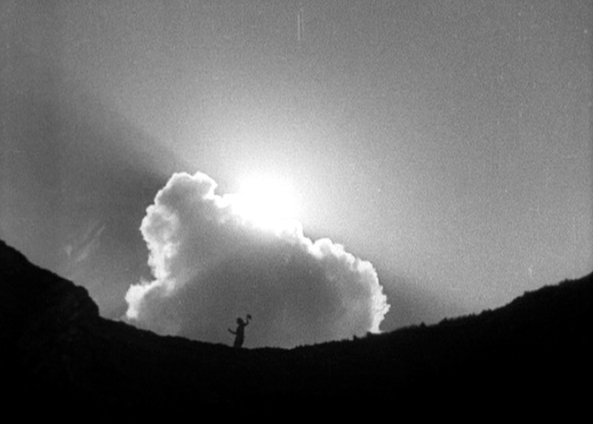
The Manxman was Hitchcock’s final “pure” silent – he was to shoot his next film Blackmail in both silent and sound versions – and the romance of the film’s story is augmented by the thought that the director was leaving his beloved silent cinema days behind him. Perhaps that is why the film is so unashamedly picturesque. The Cornish coast that doubles for the story’s Manx setting is imposing, but gorgeous. Hungarian star Anny Ondra is filmed as a tiny silhouette in front of sun-punctured cloud, skipping down vertiginous cliffs or strolling with her lover in dappled woods – and the film begins and ends with a view of fishing boats in the harbour. These images, like the film itself, combine prettiness with an air of intangible, elemental danger, and it’s this that makes The Manxman such a gripping watch.
Because this movie can be tough too: when a crisis arrives, a disconcerting cut from a body falling into water to a pen plunging into an inkwell is as violent as Hitchcock at his familiarly cold-hearted best. On this screen, and with the benefit of the BFI’s new gleaming restoration, it looked spectacular.
The Manxman (1929)
Ondra plays Kate, the daughter of the local pub landlord (a brilliantly grim-faced turn by Randle Ayrton). Best pals daft-but-dishy Pete, a fisherman (Carl Brisson), and Philip, an ambitious lawyer (Malcolm Keen), are each in love with Kate, but the latter is playing his cards close to his chest. In an excruciatingly twisted balcony scene, Pete coaxes Kate into an engagement, a promise to wait for him while he goes overseas to make his fortune. At first Kate doesn’t take him seriously, and it’s not clear which of the men – the one proposing or the faithful chum who is (literally) supporting him – is causing her to simper and pout. However it was extracted, it’s a rash promise to make, and as we’ll see, it will have terrible implications. Needless to say, while the cat is away, Kate strays, but what happens next is horrific, and not so easy to predict.
We have heard a few silent film scores recently (in this Hitchcock season no less) that have seemed to smooth out, or trample over the nuances of each scene. Not so here. Stephen Horne‘s rich score for The Manxman is alert to each turn of conversation, each double-meaning, furtive glance or blush. It’s a piece that is always a pleasure to listen to, but unafraid to sacrifice its melody to the drama when needed. This is crucial for The Manxman, where the plot hinges on whispered revelations, changes of heart and emotionally gruesome details – Kate’s face when her fiancé appoints his friend best man at their wedding, or she cuts her hand on their cake. The tempo slackens forebodingly when mid-speech, Phil is distracted by the sight of Pete and Kate together and the music follows the lead of Hitchcock’s stormy lighting effects, colouring each scene with shades of what is yet to happen. While the strings and piano offer folk melodies, there’s often a rumbling bass drum warning of impending disaster and even, at one crucial point, a very assertive oboe. The flute solo when Pete visits Phil towards the end of the film is particularly poignant; the ensemble together replicating the texture of nagging voices in the final scene especially cruel.
No one will argue that The Manxman is Hitchcock’s finest hour, the acting from the two male leads is often very weak, and the storyline offers only emotional trauma rather than his familiar bloody shocks. Despite those reservations, it is a sharply beautiful film and Anny Ondra’s sleepy-eyed romantic fool gives us a great Hitchcock Blonde before icy Grace Kelly was even born. The joy for us now is that Horne’s score gives The Manxman its best possible chance to shine, not just following but enhancing our pleasure in watching Hitchcock toy with this doomed love triangle.
Stephen Horne’s score for The Manxman was performed by Stephen Horne (piano/accordion/flute), Jennifer Bennett (fiddle/viola), Joby Burgess (percussion), Janey Miller (oboe/oboe d’Amore) and Ruth Wall (lever harp/wire harp).
There are plenty of changes afoot at the BFI London film festival, with a new artistic director, more venues being used around the capital and a rejigged set of thematic categories across the programme. The Treasures strand has been beefed up, and that can only mean good news for silent film enthusiasts. So, without further preamble, here’s what you can look forward to this year:
The Manxman
This is the big one, the archive gala presentation. Hitchcock’s tragic coastal romance is one of his most beautiful films, and an accomplished, fascinating silent. Anny Ondra, Carl Brisson and Malcolm Keen take their places at the corners of an Isle of Man love triangle, and Hitchcock milks their doom-laden situation for every drop of suspense. This will of course be a presentation of the BFI’s new restoration of the film, and as he did last year with The First Born, Stephen Horne will be writing and performing a brand new score.
Rather dishearteningly described as ‘Tim Burton meets The Artist’, Pablo Berger’s modern silent plays three times during the festival, in the Cult strand. It’s a Gothic adaptation of Snow White, set in the world of bullfighting in 1920s Spain and it looks very intriguing. You can read more here and we’ll have a better idea what to expect when the reviews come in from its screenings at the San Sebastian and Toronto festivals later this month.
UPDATE: Unfortunately I have just learned that Guy Maddin will no longer be able to attend the Keyhole premiere. The competition is still running, however.
No film director in the world takes more inspiration from early and silent cinema than Guy Maddin does. From his silent short The Heart of the World, to the dreamy textures of his features, such as The Saddest Music in the World and Brand Upon the Brain!, through to his hugely ambitious “lost films” project Spiritismes, Maddin has demonstrated a career-long passion for early cinema. His newest film Keyhole is also heavily influenced by classic Hollywood. AO Scott in the New York Times described it as “a dusty attic full of battered, evocative cultural references … a perfect gateway into the bizarre and fertile world of a unique film artist.”
Canadian director Guy Maddin (My Winnipeg, The Saddest Music in the World) is renowned for his exploration of surreal worlds and ghosts, which most recently has manifested itself in his ongoing Spiritismes project, launched at the Pompidou this March. His latest feature Keyhole, featuring deliciously unhinged performances from Isabella Rossellini, Jason Patric and Udo Kier, is a fabulous and bizarre personal-odyssey-cum-supernatural-thriller that exposes the hidden desires of the Pick family, their phantoms and the gang of thugs who inhabit the shadows of their crumbling home.
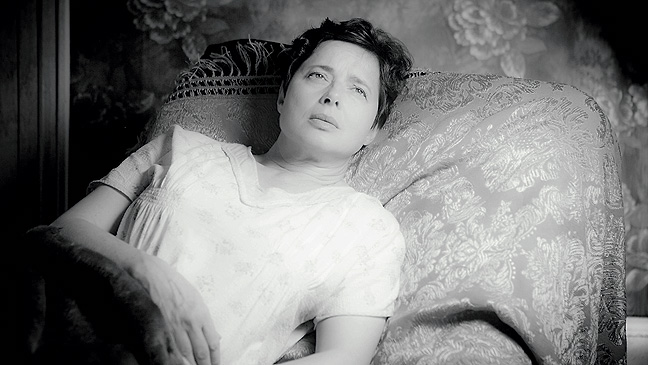
Isabella Rossellini in Guy Maddin’s Keyhole
Keyhole will premiere at the BFI Southbank on Monday 13th August, at a special screening that will be followed by a Q&A with the director in which he will talk not just about the new film, but about his latest silent project – one that is of particular interest to readers of Silent London.
Guy Maddin’s current project Spiritismes is a unique, live production/online project that brings back to life ‘unrealised, half-finished, lost or abandoned films’ by the great masters of the cinema: Cocteau, Vigo, Murnau … BFI’s special UK Premiere Fundraiser of Keyhole is being presented, courtesy of Soda Pictures, to enable Guy Maddin to ‘channel’ Hitchcock’s lost film The Mountain Eagle. All proceeds from the screening will be donated to the production and Maddin will be in attendance to talk about Keyhole, Hitchcock and Spiritismes.
So, buy a ticket for Monday’s event and you will be helping this acclaimed and distinctive director to recreate the lost Hitchcock film The Mountain Eagle.
To win a pair of tickets to the premiere of Keyhole at BFI Southbank, simply email the answer to this simple question to silentlondontickets@gmail.com with Keyhole in the subject header by noon on Friday 10 August 2012.
Name Guy Maddin’s hometown in Canada, referred to in the title of one of his most famous films.
Don’t forget that the BFI’s Genius of Hitchcock retrospective begins in earnest this month. In fact, you can kick off the celebration with a Blackmail silent-and-sound double-bill tonight. For the other silents in the season, check the Silent London Calendar.
First off you won’t want to miss the theatrical release of The Lodger on 10 August – there’s a special screening at BFI Southbank featuring a Q&A with composer Nitin Sawhney too.
Next month, you’ll want to note some other Hitchcock dates in your diary to see the new restorations of his silent films. There’s a second chance to see The Pleasure Garden with Daniel Patrick Cohen’s marvellous score on 13 September. Downhill will screen with a live score from beatboxer Shlomo on 20 September and there’s a screening of Champagne with “boldly classical” music from Mira Calix on 27 September. There’s the restoration premiere of Easy Virtue on 28 September, too.
To win a pair of tickets to the any silent screening at the BFI this month, simply email the answer to this simple question to silentlondontickets@gmail.com with August in the subject header by noon on Friday 3 August 2012.
What is the name of Hitchcock’s lost silent feature film, starring Nita Naldi?
The Genius of Hitchcock season runs until October and showcases a complete retrospective of his films, from his early British silents, to his later Hollywood classics. Also included in the season is a dedicated microsite, The 39 Steps to Hitchcock, which is a step-by-step guide through one man’s genius, featuring exclusive film extracts, interviews with close collaborators (Kim Novak, Tippi Hedren and more) and a journey through his life and career through galleries curated by Hitchcock experts.
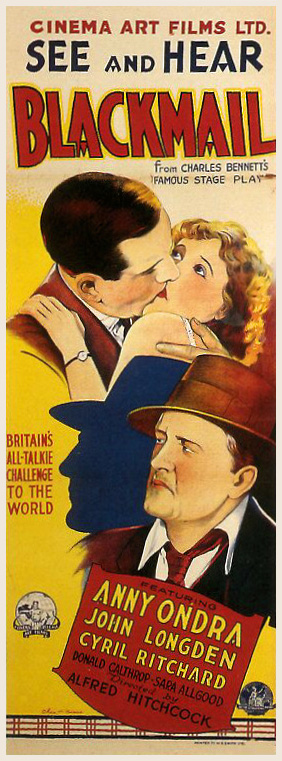
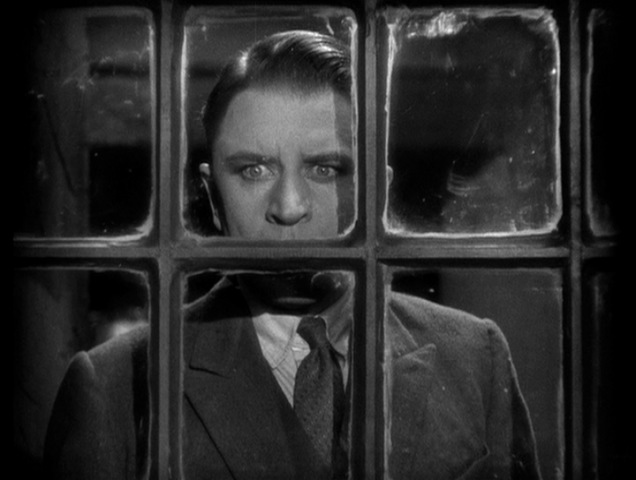
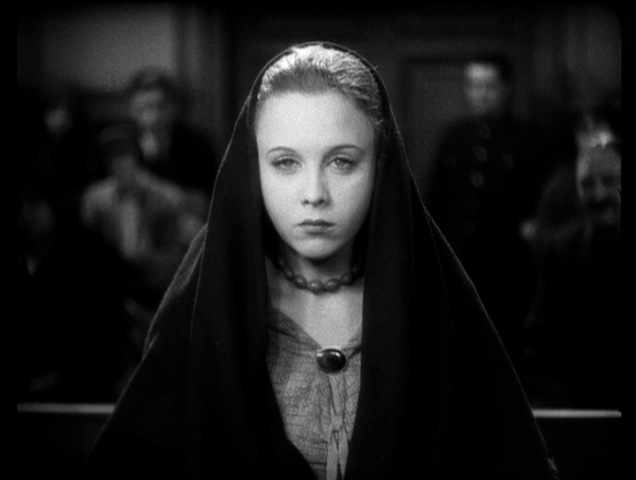
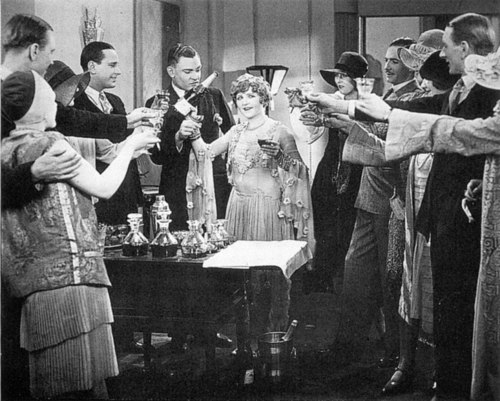
Blackmail, perhaps the greatest British silent film, was the work of a young director firing on all cylinders. As well as this masterful silent movie, Hitchcock made an acclaimed and pioneering talkie version, Britain’s first. It’s the silent Blackmail that concerns us, though, and it’s a fitting finale to Hitch’s silent years.
Blackmail (1929)
Anny Ondra is back, as Alice White, a young woman who rows with her dull policeman boyfriend in a Lyon’s Cornerhouse and wanders off with a dashing artist instead. When the dauber tries to take advantage of her in his studio, Alice defends herself, lethally, with a breadknife …
Here, as in The Lodger, Hitchcock’s London is superbly seedy. The opening scene of Blackmail shows the arrest of a shifty crim, holed up in bed in a tenement flat, and from the gossip who torments our heroine in her parents’s shop, to the blackmailer himself, everyone in the city seems to take an unnaturally keen interest in murder.
The way that Blackmail muddies a police procedural thriller with sex, moral compromise and guilt (and splashes of earthy humour) is a classic Hitchcock manoeuvre. Alfred was definitely hitting his stride here. However, one reason that Blackmail feels so much like the Hitchcock thrillers we know and love is that Charles Bennett, who wrote the play it is based on, went on to collaborate with Hitchcock on films from The 39 Steps to The Man Who Knew Too Much. Together, they created much that we think of as classic Hitchcock.
The question is, with a celebrated sound version available, why bother with the silent Blackmail? Of course, you don’t need to choose – they both have moments to recommend them. The finale at the British Museum (future shades of North by Northwest) is one of those great Hitchcock sequences that was conceived, and succeeds, visually. Sound adds nothing. Elsewhere, Hitchcock uses the freedom of a microphone-free set to set up some more experimental camera shots, where the sound film is a little more constrained. You won’t want to miss the famous “knife” sequence in the talkie Blackmail, but the silent version is unsettlingly creepy in its own way. I’d also like to champion Anny Ondra’s silent performance here – Joan Barry’s dubbed RP accent is just bizarre.
Synopsis:
Grocer’s daughter Alice White kills a man in self-defence when he tries to sexually assault her. Her policeman boyfriend covers up for her, but she has been spotted leaving the scene by a petty criminal who tries to blackmail her. (BFI Screenonline)
Hitchcock moment: Here’s the pivotal, and supremely Hitchcockian, murder scene. With Neil Brand’s score to boot.
Watch out for: That gruesome painting of a jester.
Blackmail (both versions) screens this summer as part of the BFI’s Genius of Hitchcock season. More information here. There’s also a gala performance featuring Neil Brand’s live score at the British Museum on 6 July.
Often referred to as Hitchcock’s final silent, because Blackmail was also shot as a sound film, The Manxman seems to be growing steadily in popularity, and with good reason. It’s a romance, yes, another Stannard adaptation of a hit novel by Hall Caine in fact, and I’m far fonder of it than Hitchcock professed himself to be. “It was a very banal picture,” he told Truffaut. “It was not a Hitchcock movie.”
Well, that’s his opinion. The Manxman lays out a love triangle, with Anny Ondra (Kate), Carl Brisson (Pete) and Malcolm Keen (Philip) at each corner. Poor Brisson gets the fuzzy end of the lollipop again, when his best friend takes care of his girl while he is away at sea. The setting is a fishing village on the Isle of Man. Pete is a fisherman, but Philip, who wants to become a judge like his father and his father’s father, may have more to lose by the liaison than his friend does.
Anny Ondra in The Manxman (1929)
Anny Ondra is fantastic here: mesmerising and sensual. One moment a flirtatious femme fatale; the next a confused young woman. It’s a wonderful rehearsal for the performance she gives in Hitchcock’s next film, Blackmail. She’s gorgeous too, but perhaps not as gorgeous as the stunning coastal scenery. The landscape towers over, and frames the lovers, as if to say they’re trapped by their destiny, and by the place they come from, both. It’s not really the Isle of Man, by the way, but Cornwall.
While this isn’t Hitchcock’s final silent film, it’s worth taking a moment to enjoy, and appreciate his virtuoso work here. The Manxman remains a testament to Hitchcock’s achievements in silent film-making, and it’s no wonder that decades later he would still refer disdainfully to “photographs of people talking”.
Synopsis:
In a small Isle of Man fishing community, two men, friends since childhood, find themselves in love with the same woman. Rejected by the girl’s father, Pete leaves to find his fortune in Africa, and Philip sees his chance with Kate. (BFI Screenonline)
Hitchcock moment: Sometimes good news feels like bad news, especially when there’s a dark blot on the horizon.
Watch out for: Windows. And how much they can hide.
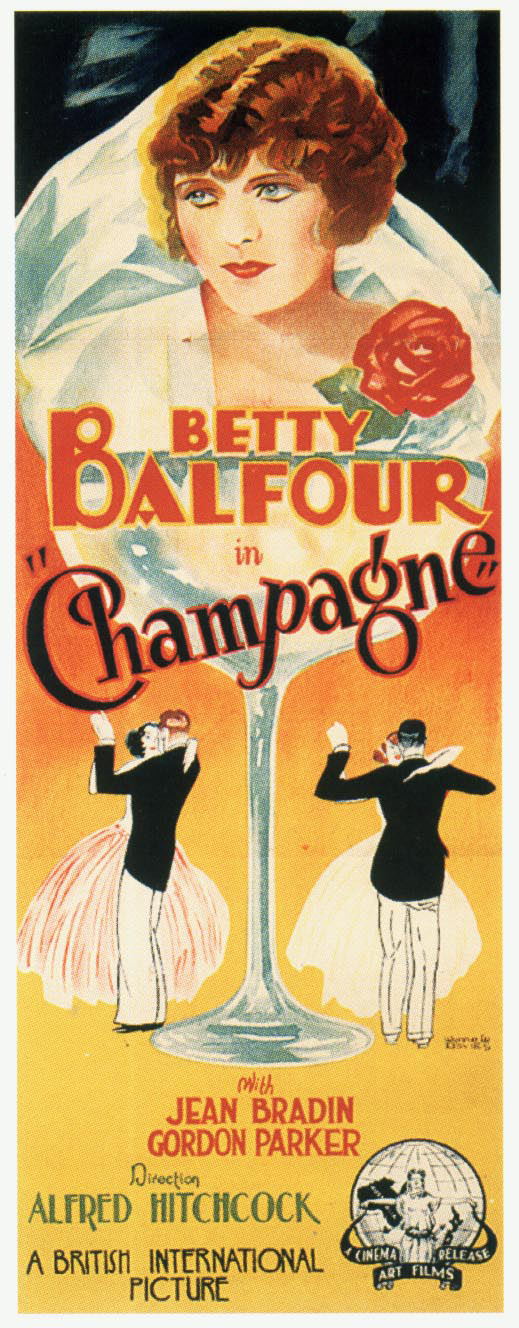
With The Farmer’s WifeHitchcock proved that he could excel at comedy, but Champagne (1928) unhappily revealed that froth was far from safe territory for the director. The critics were hardly impressed, with Close-Up crowing about: “champagne that had been left out in the rain all night”. Looking back, Hitchcock tended to agree, saying: “That was probably the lowest ebb of my output.”
Champagne (1928)
Hitchcock wasn’t happy at the time either, no fan of the source novel and uncertain how to proceed. What Champagne does have is a promising cast: Betty Balfour (the “British Mary Pickford”) takes the lead role and one of Hitchcock’s favourite character actors, Gordon Harker, plays her millionaire father. Balfour, who had made her name playing cockney sweetheart Squibs, does her best, but her likable screen persona fares much better in the second half of the film, when her character (The Girl) develops a touch more vulnerability and sweetness.
In the earlier stages of the film, The Girl is a spoiled, grandstanding heiress, but a combination of Balfour’s hard-to-repress charm and Hitchcock’s steely gaze means she’s very hard to hate. She invokes her father’s displeasure by commandeering a plane to catch up with her boyfriend’s cruise liner. For this, he wants to teach her a lesson. But Hitchcock gets in first, shooting Balfour triumphant in a ballgown after her dramatic entrance, but with her face covered in soot from the flight. I was rooting for her from that moment on. Further humiliations are in store, but it’s a blessed relief when she reaches the point of redemption.
That said, there are some hugely enjoyable glimpses of Hitchcock on top form here: including a cynical street robbery (shades of a similar scene in The Pleasure Garden, maybe even a nod to Graham Cutts), and some bold subjective camerawork.
Champagne is also of considerable interest as film that is utterly of its own time – a cocktail-swigging flapper, her father with his fortunes balanced precariously on Wall Street, her straitlaced fiance with his old-fashioned views – and a reflection of our own. Mira Calix, who will be scoring the film for its gala screening later this year, points out that Champagne attacks a continuing 21st-century obsesssion with celebrities who, just like The Girl, behave atrociously and are famous off the back of their parents’ success. It also, she hopes, will chime with supporters of the Occupy movement: a front-row seat to watch the 1%ers behaving badly and meeting their icky comeuppance.
A minor work, but not without its charms, Champagne maybe largely a waste of Balfour’s talents, but it’s a showcase for the director’s style and his mean streak both.
Synopsis:
Disapproving of her love affair, a millionaire sets out to teach his irresponsible daughter a lesson by pretending to lose all his money. (BFI Screenonline)
Hitchcock moment: Our heroine is attacked by a creep (7:25). Pure Hitchcock. But not entirely what it seems.
Watch out for: Those alarmingly close subjective shots, most notably some tricksy ones through the bottom of a champagne glass.
It is a truth universally acknowledged, that a single man in possession of a good fortune must be in want of a wife. And every schoolchild knows that statement is never more true than when the gent in question is a farmer.
Jameson Thomas, whom you you may not recognise under his bristly facial hair as the dashing lead in Piccadilly, plays Samuel Sweetland, a widowed farmer whose thoughts turn to matrimony. Samuel surveys the village women and sets about wooing potential Mrs Sweetlands, with hilariously disastrous results. Disastrous, but not in the usual vein of Hitchcock calamity. Samuel isn’t a perverted sex killer bumping women off in the dead of night. The Farmer’s Wife is a comedy, a broad one too, and the only injuries sustained are bruised egos and spoiled dinners.
LIllian Hall-Davis and Jameson Thomas in The Farmer’s Wife
Comedies are meant to have happy endings of course, and when I tell you Samuel is assisted in his quest for a new spouse by his sweet-faced and good-hearted housekeeper Araminta (Lillian Hall-Davis) perhaps you’ll be reassured that all will end well.
So how well does Hitchcock, acclaimed for his urban thrillers, succeed in staging a rural comedy? With flying colours. It’s not all down to the director, of course, this is an Eliot Stannard adaptation of a very popular play, but Hitchcock shoots The Farmer’s Wife as if it were a thriller, which somehow emphasises the poignancy of all these lonely people and their missed connections. His brisk economic style also ensure that the horseplay mostly doesn’t outstay its welcome.
Not exactly what you may expect from Hitchcock, but the silents rarely are, and there’s a huge amount to enjoy here.
Synopsis:
A middle-aged widowed landowner decides to marry again. With the aid of his faithful housekeeper he draws up a list of all the eligible women in the neighbourhood, each of whom in turn rejects him. (BFI Screenonline)
Hitchcock moment: Never mind the jelly and ice-cream, nor the awkward trouser situation. This proposal looks like one of Hitchcock’s murder scenes and features a very bizarre intertitle
Watch out for: The empty chair by the fireside. And what Hitchcock does with it.
Welcome back to our silent Hitchcock series. This week we’re looking at Downwhill (1927), hardly one of the director’s most acclaimed films, but one that offers rich, if distasteful, rewards for any Hitchcock aficionado. Dreamy Ivor Novello stars as Roddy, a sixth-former at a private school and thoroughly decent chap who takes the blame for a friend’s misbehaviour and suffers a degrading decline in his fortunes.
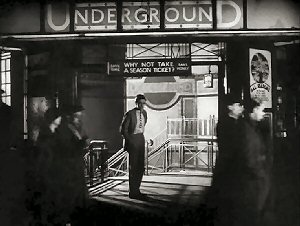
Going underground … Downhill (1927)
Downhill is clunky in places, and the thirtysomething Novello is one of cinema’s least convincing schoolboys, but the film’s strength lies in its brutal, single-minded nastiness. Cynical, misogynistic and determined to reveal the seediness beneath polite society, Downhill expresses the darkest of Hitchcock’s dark side – all without a single murder. It also gives us an insight into Novello’s psyche too; he co-wrote the play the film was based on, and one can only speculate whether he based it on any of his own experiences.
If you thought The Ring took a graphical idea and ran wild with it, then get a load of Downhill. Roddy’s progress through society, after his expulsion from school, is only going one way and that’s, er, down. You’ll find a lengthy shot of Novello slinking underground on Tube escalator – it’s widely mocked as the clumsiest example of Hitchcock warming to his theme.
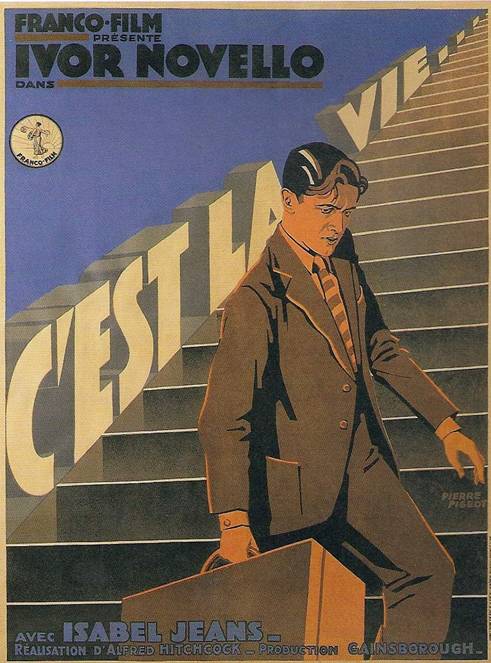
C’est la vie … Downhill’s French title
There’s another, more interesting, pattern running through Downhill, though: the reveal. The most celebrated example is introduced by the intertitle “The world of make-believe”: a series of slowly retreating camera placements reframe a shot of Roddy in contradictory ways, forcing the audience to continually shift their interpretation. At first we think he’s a smartly dressed gent. Then a waiter. Then a thief. Finally, the camera pans right to uncover the true extent of Roddy’s social degradation – he’s on stage, an extra in a cheesy musical, bobbing like a chump.
Poor Roddy: such a noble young man, and so unfortunate to meet, and be mistreated by, some of the most grotesquely venal women ever committed to film. Hitchcock’s misogyny is often discussed in relation to his sound films and some possibly apocryphal pranks and fallings-out on set, but Downhill suggests the rot set in a lot earlier than that – in fact, it makes the likes of Vertigo seem positively sensitive. The Farmer’s Wife gets laughs out of silly and unattractive spinsters, but the women of Downhill are almost entirely self-interested monsters. There’s even a spot of casual transphobia (see the clip below).
Ultimately, these crudely drawn villainesses are not just a cause of politically correct 21st-century complaint: they contribute to the structural failure of the film. Downhill is all Roddy, all the time, and virtually everyone else on screen is a mere cipher, which is unsatisfactory all round.
Synopsis: A boy takes the blame for his best friend’s misdeed and is expelled from school. From that point on, his life proceeds on a downward spiral into poverty and degradation. (BFI Screenonline)
Hitchcock moment: Another painful reveal: here’s why sunlight and early-hours drinking dens don’t mix.
Watch out for: A foretaste of Vertigo. No, not that shot, but a splash of sickly green tinting.
One of our very finest film directors tackles a drama by one of our very finest playwrights, and the result is … mixed. Easy Virtue is a very free adaptation of a Noel Coward play, with a script by Eliot Stannard. While it’s not an entirely successful movie, there is plenty of space here for the young Hitchcock to show us what he’s made of, with some rightly acclaimed sequences that are both smart and witty.
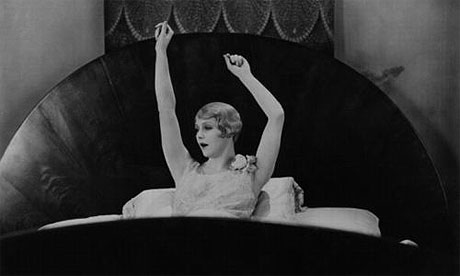
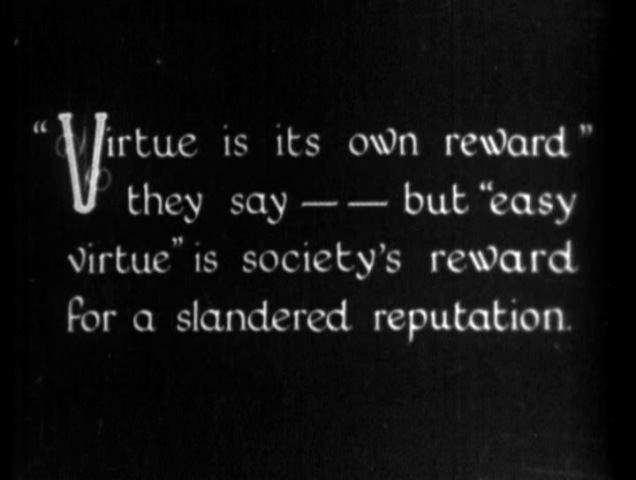
Indeed, at first glance Easy Virtue seems to be solid Hitchcock territory. Both the narrative setup and the moral message of the film both are concerned with the transferral of guilt, after all. The judge in our heroine Larita’s divorce case maligns her by convicting her of “misconduct” – and the world believes him. There’s some nice point-of-view business with the judge’s monocle (more circles!) to emphasise the flaw in his judicial vision, and a flashback to show us the truth of the matter, as opposed to the spectacle staged in the courtroom. Larita (Isabel Jeans) flees to the Mediterranean to escape the press attention and the slur on her virtue, but when she falls in love with a nice young Englishman and they return to stay with her new-in-laws, the divorce ruling becomes a classic Hitchcock bomb-under-the-table. Sooner or later, it’s going to blow up in her face …
Easy Virtue (1927)
Trouble is, this adaptation removes many of the shades of grey that Coward used to paint the stage Larita with. Hitchcock’s heroine is as sweet and innocent as the day is long, which makes her far less interesting and some of her more dramatic moments unconvincing. By and large the most successful section of the film is the first half, which deals with Larita’s trial and her romance with John (Robin Irvine), and all of which is new material for the film, not present in Coward’s play.
There’s wit, and a touch of glamour here, but little passion, and too much timidity. Had Hitchcock and his team not been held back by fear of the censor, or social acceptability, you feel they could have made much of the messy, complicated, terribly British problems that Larita faces. Her eventual gestures of defiance would have more power and this would be a far more exciting film. It’s all about sex, lies and suspicion, after all.
Easy Virtue (1927)
That said, Easy Virtue is more than worth a viewing. There’s a Hitchcock cameo here, lots of twists on his trademark business with voyeurism and an unexpectedly brutal meet-cute on the tennis court. My favourite thing here is how the length of the lovers’ journey back from France is measured by a dog. It’ll make sense when you see it, believe me.
Synopsis: Despite her totally innocent role in the events that led to it, divorce turns Larita Filton into a social outcast – and despite the love and support of her new husband she is constantly threatened by malicious gossip. (BFI Screenonline)
Hitchcock moment: John gets an answer from Larita, off-screen – but the telephone operator is listening in.
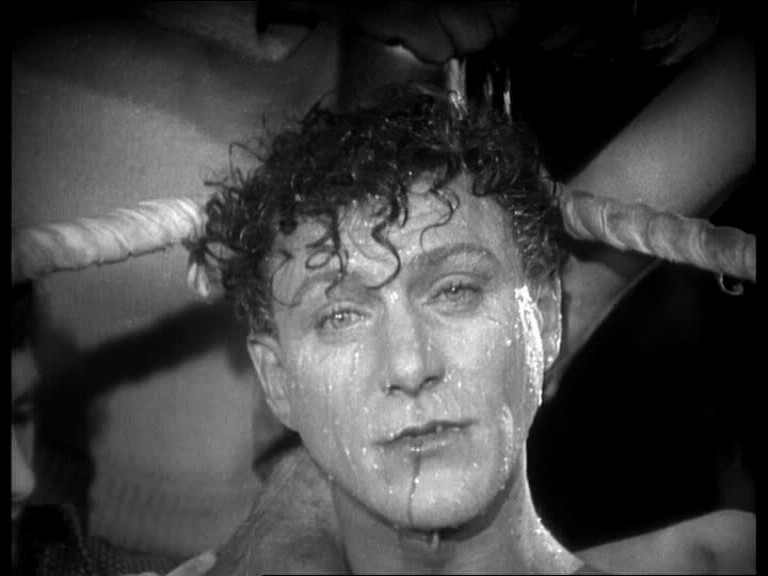
The only one of Hitchcock’s silents not to be a literary adaptation and his first to be made at British International Pictures, The Ring is a boxing movie, with a love triangle plot neatly expressed by the film’s central symbol. The ring is where Jack “One Round” Sander and his rival Bob compete, but it’s also a nod to the wedding band that Jack’s wife Mabel (Lillian Hall-Davis) wears, and her bracelet, which was given to her by … Bob.
With flashy editing that betrays a Soviet influence and some neat typological tricks too, The Ring is a visual triumph. The subject matter may not be what we expect from the master of suspense, but Hitchcock was very proud of it:
“You might say that after The Lodger, The Ring was the next Hitchcock picture. There were all kinds of innovations in it, and I remember that at the premiere an elaborate montage got a round of applause. It was the first time that had ever happened to me.”
The Bioscope was just as fond of it as it was of The Lodger, heralding it as “the most magnificent British film ever made”.
The Ring (1927)
That said, The Ring is not so popular today. The plot lacks the fireworks of a Hitchcock thriller and the stars here are not so well remembered as Novello, say. There’s also the matter of some outdated and offensive language. The Ring is set in multiracial 1920s London, and yes, some people use that word. They did then. It’s not pleasant, but it’s not a reason to avoid the film.
The Ring is one of Hitchcock’s most successful silents, and its tight dramatic structure as well as its obsession with circles is a precursor to the pleasing graphical neatness of many of his better-loved later films: the grids of glass in Rear Window and the “criss-cross” of train tracks in Strangers on a Train. Indeed, from Kim Novak’s chignon to Janet Leigh’s iris, spirals and circles continued to fascinate Hitchcock throughout his career (the explanation for this may be slightly distasteful).
It’s also worth remembering that this is the work of Hitchcock’s A-team – he collaborated on the script with Eliot Stannard and, of course, Alma Reville. Those visual effects are enhanced by the work of painter W Percy Day, too.
This summer’s gala screening of the BFI’s restoration of The Ring promises to reinvigorate the film. A film with this much style and swagger will shine when it has been been fully restored and it’s going to be shown at the Hackney Empire with a score by Soweto Kinch, known for his socially aware fusion of hip-hop and jazz. Indeed, the premiere screening of the new print at this year’s Cannes apparently received a standing ovation.
Synopsis: Love triangle melodrama set in the world of boxing. When Jack ‘One Round’ Sander is discovered by promoter James Ware, his career takes off. But rival Bob Corby, heavyweight champion takes an interest in his girlfriend. (BFI Screenonline)
Hitchcock moment: Eight minutes in: a discovery, a proposal, and a whole lot of circles within circles.
The Ring screens at the Hackney Empire on 13 July 2012, with a new score by Soweto Kinch. The screening will also be livestreamed on The Space. More information here.
Don’t forget that you can still donate to the For the Love of Film Blogathon, to get The White Shadow streamed online with a new score, if you can, please spare some cash for this good cause.
Each week, as you know, we’ll be looking at a different silent Hitchcock – and this week we have arrived at The Lodger, a bona fide Hitchcock thriller, yet only the third feature he directed. The film he made before this and after The Pleasure Garden, The Mountain Eagle, is sadly a lost film.
The Lodger is a wonderfully atmospheric “is-he-or-isn’t-he?” intrigue starring Ivor Novello as a man suspected of being a serial killer – a ripper who calls himself the Avenger and targets pretty blonde women. Heralded as an early classic and praised for its Expressionist flourishes now, The Lodger was almost never released following a damning assessment by a distributor at an industry screening. Michael Balcon and Film Society member Ivor Montagu both went to bat for the film and after the addition of some elaborate intertitles, The Lodger was finally released, pleasing critics and audiences alike. The Bioscope praised it, saying: “It is possible that this film is the finest British production ever made”.
The Lodger: A Story of the London Fog (1927)
The film bears the evocative subtitle “A Story of the London Fog”, but the peasouper here is really a miasma of suspicion, temptation and guilt. To varying extents, the lodger’s landlord and lady (the Buntings) suspect him of being the killer, as do their daughter Daisy and her steady policeman boyfriend, but still they welcome him into their home. When Daisy first kisses the lodger, she does so with open, watchful eyes. When Mrs Bunting sees some cash on his mantelpiece, her mind immediately turns to theft. Does she not even trust herself?
It’s a grimy, nasty film in so many ways, but there’s humour here of course, most notably in the gallows mode from the wearily pragmatic dancing girls who crowd round the paper to read about the latest murder then go out with brunette ringlets tucked in their hats as a precaution.
Hitchcock has said that he was forced to drop his preferred ending for the film and The Lodger‘s final moments are from convincing. It’s not as audacious as Murnau’s tacked-on happy ending for The Last Laugh (1924), but knowing that Hitchcock saw that film goes a long way to explaining the tone of the final scene.
Synopsis: London is being terrorised by a Jack the Ripper-style murderer, the Avenger, who targets young blond-haired women. A mysterious new lodger arrives at the home of Mr and Mrs Bunting, whose daughter Daisy is courted by a policeman on the case. When the lodger begins behaving strangely, he attracts suspicion, particularly when he shows an interest in Daisy. (BFI Screenonline)
Hitchcock moment: Three minutes in, Joe initiates a very ghoulish conversation over tea, but is interrupted by something apparently terrible happening upstairs.
Watch out for: Hitchcock’s first cameo, as a newspaper editor.
The Lodger screens at the Barbican on 21 July 2012, with the London Symphony Orchestra performing a new score by Nitin Sawhney. The film will then be theatrically released on 10 August 2012. More information here.
Don’t forget that you can still donate to the For the Love of Film Blogathon, to get The White Shadow streamed online with a new score, if you can, please spare some cash for this good cause.
The podcast returns – we love the talkies don’t we? This time around, I’m lucky enough to be joined by Matthew Turner from viewlondon.co.uk and podcaster extraordinaire Pete Baran. We’ll be hearing what you thought of the recent British Silent Film Festival, anticipating the forthcoming silent Hitchcock screenings in London and Matthew will be talking about his favourite silent film. If you haven’t seen Greed (1924), be warned: here be spoilers. There is plenty of suspense, however, in discovering whether we fail The Artist Challenge – and if we do, who the culprit will be.
Hitchcock, Hitchcock, Hitchcock, these days it’s all I ever blinking think about. Specifically silent Hitchcock, ahead of the feast that awaits us this summer. So today I’m kicking off a short introduction to the silent Hitchcocks, taking one film a week, so you’ll be fully up to speed by the time the screenings start in the summer.
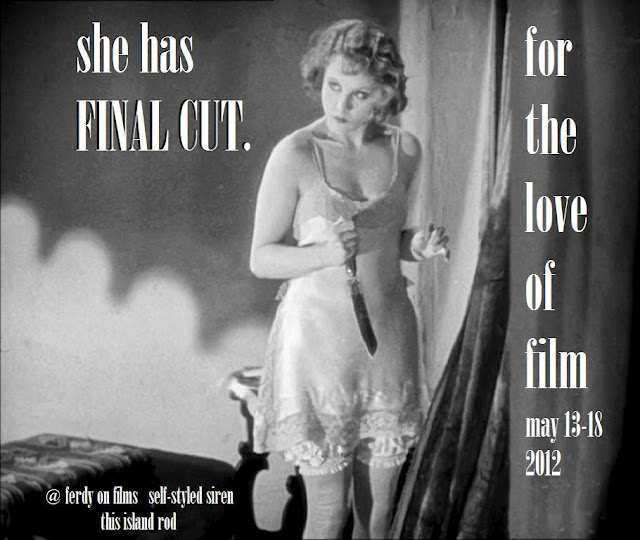
As we’re starting on Friday 18 May, there’s just enough time for us to squeeze this first post into the marvellous For The Love of Film blogathon, a noble endeavour to raise funds to get the remaining reels of The White Shadow online, with a freshly composed score, streaming to cinephiles around the world. Here’s a little more explanation from the Self-Styled Siren:
This year, we are raising funds for the National Film Preservation Foundation’s project, The White Shadow, directed by Graham Cutts and written, assistant-directed, and just generally meddled with in a number of different ways by the one and only Alfred Hitchcock. The goal is to raise $15,000 to stream this once-lost, now-found, three-reel fragment online, free to all, and to record the score by Michael Mortilla. Marilyn Ferdinand, Rod Heath and the Siren are pleased to announce that we now have more than 100 bloggers signed up for this hoedown.
Now, to business. Each week we’ll be looking at a different silent Hitchcock – there’ll be a short introduction here, a juicy clip, and some carefully selected links. We’re starting with Hitch’s directorial debut, The Pleasure Garden.
The Pleasure Garden (1925)
This tale of backstage romance and farflung misdeeds may have been Hitchcock’s directorial debut, but he was so proud of it that he put his signature in the credits. “Actors come and actors go,” he told the Film Society, “but the name of the director should stay clearly in the mind of the audiences.” As for the “cattle”, American star Virginia Valli plays the heroine, Patsy, and Miles Mander the brute she is unfortunate enough to fall for. Another US star, Carmelita Geraghty, plays Patsy’s friend and ambitious fellow dancer, and her love interest arrives in the form of popular Scottish actor John Stuart.
The Pleasure Garden was filmed in Germany, but it has a very British feel, from the leery music-hall audiences to our leading ladies’ aspidistra-and-doily lodgings. It may not be a suspense thriller, but The Pleasure Garden opens in fine Hitchcockian style with pretty blonde showgirls (and their legs) being ogled on stage. It’s good old innocent fun to start with, of course, but unless it really is 1925 and this is the first Hitchcock film you’ve ever seen, you’ll sense a sinister frisson in such ardent voyeurism. And you’d be right to.
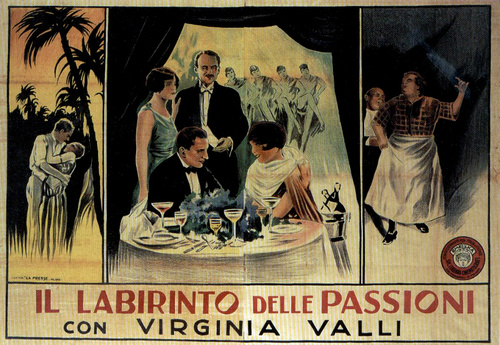
Poster for The Pleasure Garden (from Hitchcockwiki)
Like so many of Hitchcock’s silents, The Pleasure Garden was adapted for the screen by Eliot Stannard, a towering, if often unsung, figure in British silent cinema. While Hitchcock’s silents are undoubtedly less consistently surefooted than his blockbuster sound films (yer Psychos, yer Vertigos), they are all polished, sophisticated productions, deftly made by a team of film professionals. His debut benefits from the work of Stannard, Hitch’s wife Alma Reville, and producers Michael Balcon and Erich Pommer, nopt to mention its stars, including Valli, whom you may have seen elsewhere in King Vidor’s Wild Oranges (1924) and Mander whom you’ll surely know from his tour de force The First Born. But it’s Hitchcock’s show nonetheless: indeed, when the Spectator’s Iris Barry saw Hitchcock’s bravura debut, she sniffed out “new blood” for the British film industry immediately. This juvenilia is not so juvenile.
It must be said, however, that all reviews were not so enthusiastic. In the States, Variety spluttered: “A sappy chorus picture, probably intended for the sappy sticks where they still fall for this sort of a chorus girl story.” Fair comment, but Jill and Patsy themselves are hardly sappy, chorus girls or no.
Synopsis: “The diverging lives of two dancers from The Pleasure Garden nightspot. Jill rises to the heights and leaves her humble friend Patsy, and her fiancé, behind. Meanwhile, the good-natured Patsy stumbles into marriage with the selfish, dangerous Levet.” (From BFI Screenonline)
Hitchcock moment: Three minutes, 50 seconds into this clip, Jill gets her pocket picked by a couple of no-good hoods.
Watch out for: Patsy’s dog. There’s wisdom in those woofs.
Last year, a silent film wowed the Cannes film festival, and look where that ended up? This year, the BFI’s new restoration of Hitchcock’s 1927 film The Ring will be premiered at the festival – so the delegates at the film industry’s most glamorous get-together will be the first to see its full splendour.
When the film screens at the Hackney Empire in July, it will have a newly commissioned live score by Soweto Kinch. That screening will also be streamed online so people around the country can join in the sense of occasion. The Cannes crowd are in for a treat too, though: the festival screening will be a gala in itself, taking the form of a ciné-concert with London’s own Stephen Horne providing the music.
Obviously one is rather tired of annual trip to the Croisette, but this year we may make an exception, if only to see what the world’s cinema press make of a work that was heralded on its initial release as: “the most magnificent British film ever made”.
Our major campaign to restore all nine of Hitchcock’s surviving silent films.
Celebrating Cinema’s Master of Suspense
Gala screenings of newly restored British silent films with live scores
Starting with the London 2012 Festival, the BFI is exploring Alfred Hitchcock’s complete works with a celebration which includes gala screenings of the silent classics and a full retrospective at BFI Southbank.
Blackmail
One of the best British films of the 1920s, Hitchcock’s ‘Blackmail’ is a true masterpiece of the silent era. A young girl engaged to a stuffy policeman is enticed up to an artist’s studio, laying herself open to the blackmail of the title. Presented outdoors at the British Museum – the location of the film’s thrilling chase sequence – with a specially arranged score by composer Neil Brand, this is a once-in-a-lifetime film experience. Book now
The Ring
When boxer Bob Corby hires Jack Sander to be his sparring partner, he has no idea that he will become smitten with Mabel, Jack’s beautiful wife. A love triangle emerges in which the bouts in the ring become more than gamely sparring, leading up to the championship fight (famously set in the Albert Hall) between the two men for the love of Mabel. Features a brand new score by Soweto Kinch, multi-award winning British jazz alto saxophonist, hip hop artist, rapper and MC. Book now
The Lodger
A strange lodger may be a serial killer in Alfred Hitchcock’s first suspense thriller. With a new score by Nitin Sawhney, performed live with the London Symphony Orchestra at Barbican Hall. Nitin Sawhney’s score for The Lodger is commissioned by independent film distributor Network Releasing in partnership with the BFI. Book now




 Silent London