Happy holiday Silent Londoners! They say that if you remember 2025, then you weren’t watching enough silent movies. How much do you recall?
For myself I sure watched a lot of silent films, clocking up several festivals and individual screenings. Pordenone and Bologna, Zurich, Hippfest, Slapstick, Cinema Rediscovered, Women and the Silent Screen in Belgium, plus The Gold Rush centenary, Anna May Wong, Gosta Berlings Saga, Stella Dallas, Lillian Gish, Lois Weber, Film on Film and more at the Southbank. Did you catch Bonn, San Franciscso, the non-stop action at the Kennington Bioscope, or any of the many, many silent screenings all around the world? How about Sherlock Holmes?
In case there could be anyone reading this site who doesn’t know, Luke McKernan is a media historian, formerly Lead Curator, News and Moving Image at the British Library. Also a formidably erudite and trailblazing blogger on moving image culture, especially silent cinema, but not exclusively. This collection of essays from across his many sites, gives a rich flavour of his expertise in analysis, archival curation and nostalgia.
In this book, Luke McKernan comments on the moving image in all its multiple forms. Let Me Dream Again – beautiful title – is crammed with insights into history, technology, and humanity. Because these essays, on a staggering variety of topics, began their lives as blogposts, they have the freshness of a live response to a moment in time – whether McKernan is reading 21st-century online comments on a silent film from 1903, or channel-hopping during the 2016 Olympics. He proves an excellent guide to the many ways that the storytelling impulse survives, and adapts to each new medium, from magic lantern slides to Artificial Intelligence.
On Sunday I had the very great pleasure of introducing a double-bill of Anna May Wong silents: the UK premieres of new restorations of Song (Richard Eichberg, 1928, restored by Filmmuseum Düsseldorf) and Pavement Butterfly (Richard Eichberg, 1929, restored by DFF) at Cinema Rediscovered in Bristol. Beautiful films, a beautiful audience and simply gorgeous musical accompaniment by Stephen Horne. Wish you could have been there – maybe you were?
Thank you for bearing wth me during a few several technical glitches related to this year’s poll. Relax, enjoy your glass of wine-flavoured carbonated beverage, and welcome to our glittering award ceremony. I have counted the votes, and I am ready to announce the winners of the Silent London Poll of 2024!
Congratulations to all the people mentioned below – as ever, these categories were bursting at the seams with excellent, worthy nominations and a great reminder of how exciting the global silent film scene is. Thank you for all your votes, and your comments, especially.
Without further ado, let me open this giant stack of golden envelopes. Here are your winners.
1. Best orchestral silent film screening of 2024
Your winner: The Winning of Barbara Worth (Henry King, 1926), with a score composed by Neil Brand, arranged by George Morton, conducted by Ben Palmer, performed live by the Orchestra da Camera di Pordneone, at Giornate del Cinema Muto, Pordenone
I said:“t’s a big, big movie, with the youthful star trio of Ronald Colman (on $1,750 a week), Vilma Banky (on $1,000 a week) and Gary Cooper (on $50 a week!) in a desert love triangle, and a tremendously terrifying climax, as the townsfolk run for their lives when the river bursts its manmade bounds. Plus we were to enjoy the world premiere of a wondrous new score composed by Neil Brand, arranged by George Morton, conducted by Ben Palmer, and performed live tonight by the Orchestra da Camera di Pordenone. If you know the film you will know that it is celebrated for its scale, but also that this is a Frances Marion script, with a touch of melodrama (Vilma overhearing Ronald’s confession that he won’t propose to her, but not the reason why), her pet subject of adopted children, and her love of a grand theme – here the pioneers’ battle for mastery over the elements, and capitalism’s battle for mastery over the populace. You’ll also know that between the big action scenes there are several more sedate moments, discussions of policy and payroll. As, quite frankly, we have come to expect, Brand’s score was buoyant and nimble, keeping the film on its toes, teasing out the romance and flooding (yes, I went there) the auditorium with sound during those blockbuster setpieces, starting with a sandstorm in the first reel and the deluge in the last. Timed to a T, so that image and sound met in perfect harmony, and just a joy to listen to – for what it’s worth, I think it’s a winner. Geddit?”
Lillian Gish in The Wind (1928)
2. Best silent film screening with a solo musician or small ensemble of 2024
Season’s greetings Silent Londoners. It has been a whirlwind of a year. How much do you remember?
Personally, I watched silent movies on three different continents this year, so I have some great cinema memories from 2024. Pordenone and Bologna, San Francisco, Istanbul, Locarno… and back home, Hippfest, Bristol, Sherlock Holmes at Alexandra Palace, Dorothy Arzner and more at the Southbank, non-stop action at the Kennington Bioscope. We celebrated some major anniversaries. Plus there was a lot of love for Anna May Wong, and Sessue Hayakawa.
Blood, sweat and tears on the screen today. And to cap it all off, prizes! That’s Friday in Pordenone, folks. Read all about it.
Your scribe is a little squeamish, I must confess, so this morning I had to resort to an old trick, and pop my glasses off during some of Arabi (Nadezhda Zubova, 1933), a drama about sheep farmers organising to form a collective and defeat the feudal powers that exploit their labour under the old system. That doesn’t make me squeamish, I’m all for it – it was the killing and skinning of lambs that turned my stomach. Still, I thought this was terrific, with some very sharp editing, especially in the opening sequence, and lovely low camerawork of the herd out in the field.
Sometimes the old songs are the best, right? Familiarity can breed contentment. And nowhere will you find more consensus on that than here in Pordenone. So today I was happy to rewatch a couple of silent films I love, spend a little time with one of my all-time favourite silent stars. And then see something entirely new to me!
First, the old friends. This morning, we ventured back into the imaginations of Maurice Tourneur, and Ben Carré, with the 1918 adaptation of Maurice Maeterlinck’s The Blue Bird. Such a strange and beautiful, terrifying and wholesome journey into the shadow world of dreams, where bread and sugar and water have souls, the dogs and cats can talk, lost grandparents always have the table set for supper and babies wait impatiently to be born. If you have not seen this, you possibly can’t imagine quite how weirdly pretty it is. Variety’s critic wrote: “It is quite safe to assert that nothing quite like Director Tourneur’s work has ever been shown on the screen.” So hats off to Tourneur and Carré, and doubly so to Neil Brand and Elizabeth-Jane Baldry, who transported us to an enchanted realm with their music. I wrote about the film in more detail here, should you be interested.
I promise you, I really am in Pordenone, not in Paris. But honestly, the geography is becoming a little subjective. We seem unable to escape the Rive Gauche for long. This morning, a really quite exceptionally taut melodrama from Louiis Feuillade, with sets,of course, by Ben Carré, illustrated how the Latin Quarter exerts its own gravitational pull, morally, if not physically. In La Tare (1911), part of Feuillade’s “La Vie telle qu’elle est” (Life as It Is) series, Renée Carl gave a really beautiful performance as Anna, who works in the dance halls of the Latin Quarter, but given the chance, moves to the South of France and devotes herself to a new career caring for patients young and old in a nursing home. Ah, but cruel fate intervenes and a medical student who used to tap her for cash in the Paris days, takes it upon himself to inform the medical board that their “secular saint” is really a “girl of easy virtue”, sooner than you can say “Madonna-whore complex”. And so we are left with a tragic, yet ambiguous ending, following a rather harrowing scene in the unemployment office with a crowd of women, all of whom had remarkable faces (no, not Léontine, I don’t think, but maybe this is the kind of place where she might be found). A very special film, enhanced, naturally, by John Sweeney’s sensitive accompaniment.
“They’re eating the dogs. They’re eating the cats.” Proof, if proof were needed, that the American people saw through such anti-immigrant propaganda more than 100 years ago, comes in Dee-Dubya’s 1908 New York comedy Deceived Slumming Party – our first film of Sunday morning. Fraudulent tour guides promise show rich tourists the gritty realness of Chinatown and the Bowery, but the trick is, it’s all staged. Everyone in the opium den was upright and chatty before the tour group arrived, in fact, the barroom fights in the Bowery are choreographed by the bartender (DW Griffith himself) and the “meat grinder” in the Chinese restaurant kitchen, the one that the staff are “feeding” with cats and dogs and rats, is nothing but a sham.
Rich kids slumming it in Chinatown, you say? Hold that thought while we segue from comedy to melodrama, in the shape of Driven from Home (James Young, 1927), which yanked and yanked and yanked at the heartstrings with poor Virginia Lee Corbin disowned by her wealthy father after she married for love, although her devoted mother (Margaret Seddon) was on her deathbed and calling out to see her baby once more. Add to this a subway excavation accident, a scheming vamp housekeeper (Virginia Pearson), and you might not think there was room for an excursion to the Chinatown underworld but you would be wrong, as this film was playing in the Anna May Wong strand. So indeed here we witnessed a scant five minutes of Anna May Wong, as a Chinese restauranteur’s “legal wife and illegal accomplice” radiating more star power than the rest of the rest of the (perfectly good) cast could ever dream of. We understand this is a racist trope, yet it is quite nifty to think that on the evidence of this year’s Giornate, in any given situation, Anna May Wong can locate a secret door in seconds.
Grey skies clung to the Verdi this afternoon but you can’t put a dampener on a homecoming like this one. I’ve been to several festivals this year, but nothing really compares to the Giornate. And our hearts were warmed by festival director Jay Weissberg’s words of welcome, in which we pointed out how vital it is, these days more than ever, to cherish these events that bring people together in a shared endeavour.
Today was a day of varying shades and two colour schemes. We had a couple of stonking great classics. And also a slate of fragments, curios, oddities and ends – several of which had their merits, albeit in their own unconventional way. In fact, a certain aura of strangeness hung over the whole day, which you might attribute to the unseasonal weather, but I am partially putting down to the after-effects of watching Megalopolis last weekend.
I may be a humble blogger typing at my desk, but just imagine I am a glamorous celebrity cracking first-rate jokes while wearing a designer ballgown. I have counted the votes, and I am ready to announce the winners of the Silent London Poll of 2023!
Congratulations to all the people mentioned below – as ever, these categories were bursting with great nominations. Thank you for all your votes, and your comments, which remind us all of the passion for silent film out there.
Without further ado, let me open this giant stack of golden envelopes. Here are your winners.
1. Best orchestral silent film screening of 2023
Your winner: Stella Dallas (Henry King, 1925), with a score composed by Stephen Horne, orchestrated by Ben Palmer and performed by Orchestra del Teatro Comunale directed by Timothy Brock, in the Piazza Maggiore Bologna, as part of Il Cinema Ritrovato
I said: “Before Monday night’s screening of the original 1925 adaptation of Olive Higgins Prouty’s weepie, some people in Bologna were still dropping the names of Barbara Stanwyck and King Vidor. After Monday, the talk of the town was only Belle Bennett, Henry King and Stephen Horne, whose marvellous score, alongside Bennett’s impeccable performance, left the piazza awash with tears. Horne has long championed this film, as have I, and the new restoration from MOMA is a very welcome, and beautiful thing. I really hope more people get to see this wonderful film now. Silent melodrama really can be the very finest melodrama.”
Honourable mention:Lady Windermere’s Fan (Ernst Lubitsch, 1925), at the same festival, with Timothy Brock’s new orchestral score.
The Crowd (King Vidor, 1928)
2. Best silent film screening with a solo musician or small ensemble of 2023
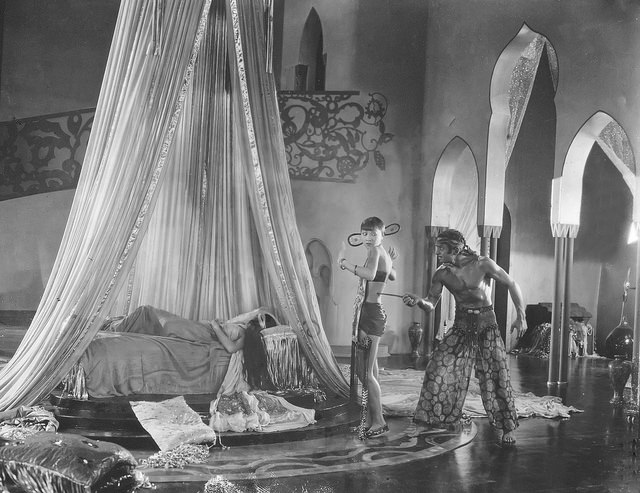
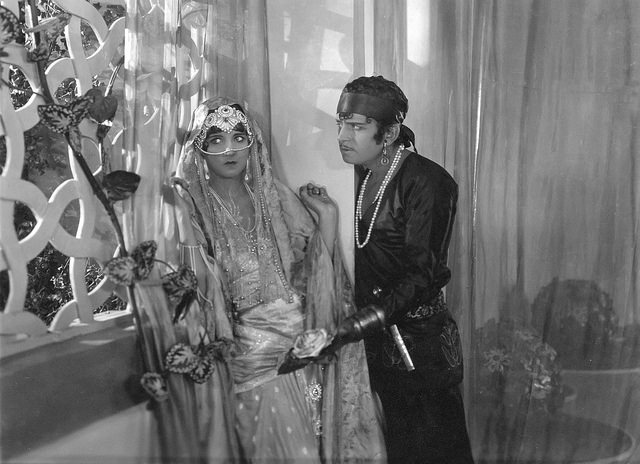
Just in time for Christmas, Masters of Cinema is rereleasing some more of its silent back catalogue, in gorgeous new dual-format DVD/Blu-ray editions. This is a Good Thing no doubt, and if there is one title especially suited for the pantomime season it’s The Thief of Bagdad (1924) – a middle eastern romp starring Douglas Fairbanks as Ahmed, a light-fingered adventurer, beautifully photographed and bulging with the last word in 1920s special effects.
Forget the effects for a minute though, forget Raoul Walsh behind the camera, Anna May Wong slinking around the corners, and William Cameron Menzies’s towering sets, and settle in for the Douglas Fairbanks show. This is Fairbanks at his very best: fortysomething, athletic, beaming, stripped to the waist and bouncing in and out of giant pots, swashbuckling and soaring through the air and under the sea. If you want to understand why Fairbanks was the King of Hollywood, this is a key text. He burns up the screen here, forcing you to smile, to chuckle, to gasp in awe at his latest trickery or feat of physical prowess, daring you to remain unmoved. It would take a heart of stone not to relent – it’s his ambition as producer that lends this film its grand scale, and his radiant personality that wins the audience’s affection as well as its awe.
The Thief of Bagdad (1924)
But you will have to possess a mind as gymnastic as Fairbanks’ buff body not to be troubled by the fact that this movie is pure orientalist claptrap. It can be done – Fairbanks on a magic carpet with his princess Julanne Johnston by his side is a sight beauteous enough to tempt you into a little light doublethinking duty. Just like Ahmed, you’ll have to earn your happiness here. It’s not a nasty film, but it is an ignorant one. If it weren’t for the gloss of that stunning production design and the stardust sprinkled by its leading man, that would be all we had to write about. As it is, we can take heart from the fact that the guff that underpins this movie is mostly well-intentioned but misguided romanticism. Rather this, you could argue, than yet another flick where the only middle eastern characters are bloodthirsty terrorists.
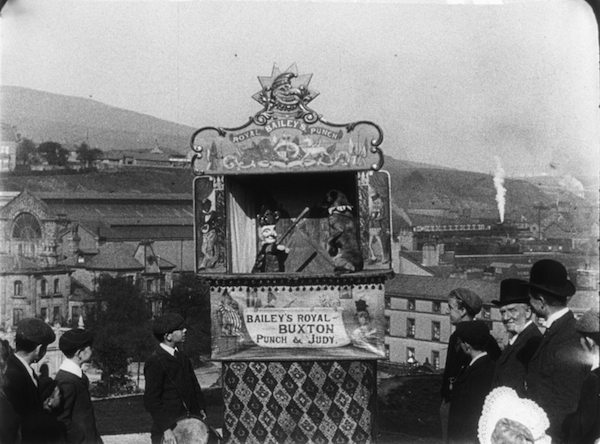
Bailey’s Royal Punch & Judy show in Halifax (1901)
Two Barrymores today, two appearances from Little Tich and too much, as usual, to recount here. But like the hard-working Cupid in La Rose Bleue (Léonce Perret, 1911), I’m going to give it my best shot. So if you’re sitting comfortably …
Today's highlight easily @professorvaness' brill Edwardian Entertainment program. Color fireworks, M&K, palmistry, clowns, fairs etc #GCM33
In a move designed to cure, or provoke, homesickness in weary British bloggers, this morning we were treated to 90 minutes of Edwardian Entertainment courtesy of Bryony Dixon and Vanessa Toulmin. Accompanying the 40-odd shorts and fragments on piano, percussion voice and everything in between were Stephen Horne and Frank Bockius on stellar form (Horne’s witty use of a kazoo, yes kazoo, in a telephone sketch was priceless). This was a peek at England in its Sunday best and some more outlandish costumes. It was all fun, fun, fun with trips to the seaside, the Punch and Judy show, fireworks, the cinematograph, barrel jumping, the fun fair, the panto and many wonderful processions showcasing our forefathers and mothers’ considerable talent in the fields of costume design and formation dancing – and not just Morris troupes and maypoles. It’s enough to make one crave a stick of rock and a trip to the illuminations. Certainly my northwestern heart leapt at a panorama of Blackpool. And who could resist the sight of a row of Mutoscopes on Morecambe beach with the sign “Look at this and get a laugh”. The perfect solution for those of us who want to watch the flicks all day without depriving ourselves of vitamin D.
If you really want sunshine at this time of year, a trip to Greece is in order, and Oi Peripeteiai Tou Villar (The Adventures of Villar, 1924), the oldest film ever restored by the Greek Film Archive, was a sketchy comic caper, doubling as a sun-dappled tour of Athens. Larky nonsense, but great shots of the Acropolis etc. And now I can say I have seen a Greek silent movie, which is sure to wow the folks down at the Rose and Crown on my return.
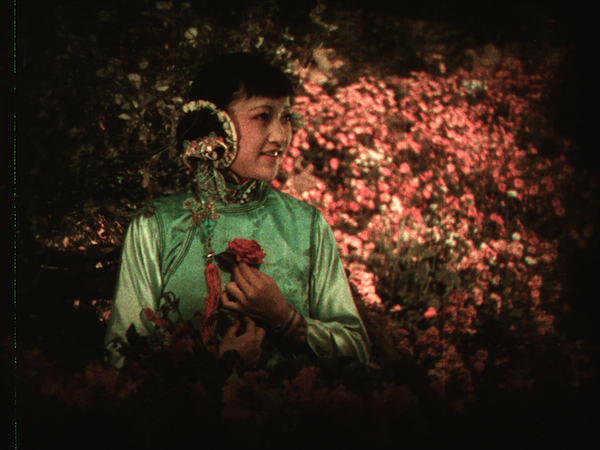
The Toll of the Sea (1922)
But if you want something really gorgeous … the second Dawn of Technicolor compilation had many diverting treats inside, culminating in The Toll of the Sea (1922). This was an exceedingly picturesque melodrama, a reboot of Madame Butterfly in which Anna May Wong plays a young Chinese woman in love with an American. But the bond of love and “marriage” is held more sacred by her than him … Oh and it all ends in sadness and sacrifice and another word beginning with S. Not before Wong’s sumptuous wardrobe and elegant garden (complete with peacock!) have been given the full Technicolor treatment, though. The sweetest of sorrow and the sugariest of eye candy.
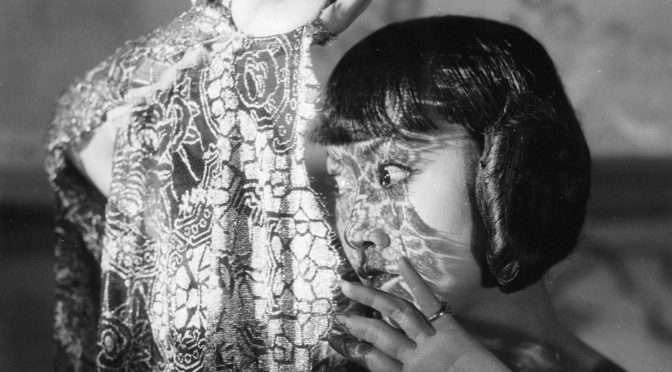
Piccadilly (1929) is a fantastic film, directed by German director E A Dupont and set in a glamorous, jazzy West End nightclub. Anna May Wong plays Shosho, a dishwasher who is “discovered” while dancing on the kitchen sink, and whose sensual routines propel her to fame as the club’s lead dancer. She wins the heart of the nightclub’s owner too, which provokes his ex (Gilda Gray) to become dangerously jealous. Anna May Wong is absolutely stunning in the film, which has been recently restored by the BFI, preserving the original’s striking blue and amber tinting and making the most of its proto-noir photography. This is a film you’ll really love, I’m sure. You can get a taste for it in this extract:
Piccadilly screens at the Prince Charles Cinema in London’s glittering West End on 13 April 2011 at 8.45pm. Tickets are £10 or £6 for members – and they’re available here. Piano accompaniment will be provided by Costas Fotopoulos.
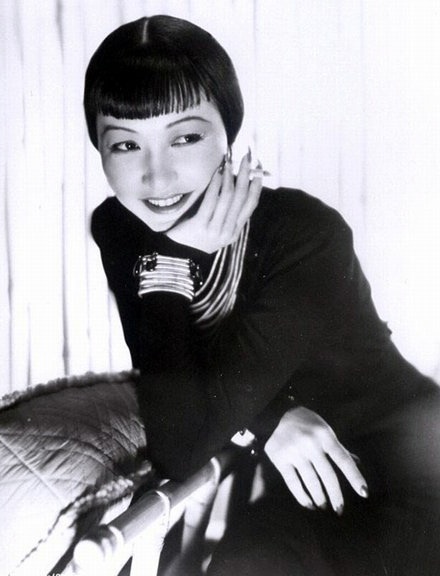
You want glamour? We got it. on 26 March, the Cinema Museum will host an evening to celebrate the life and work of the beautiful actress Anna May Wong, star of Piccadilly and Shanghai Express.
The night begins with a screening of the biographical documentary Anna May Wong – Frosted Yellow Willows: Her Life, Times and Legend, and a Q&A session with the film’s director Elaine Mae Woo. Frosted Yellow Willows is the literal translation of Wong’s real name: Wong Liu Tsong. The documentary incorporates interviews with those who knew Wong, and was made with the support of such luminaries as Kevin Brownlow and Leonard Maltin.
From humble beginnings in a Chinese laundry, she went on to star in pictures such as Technicolor’s Toll of the Sea (1922), E.A. Dupont’s Piccadilly (1929) and Josef von Sternberg’s Shanghai Express (1932) with Marlene Dietrich. Never one to rest on her laurels, Anna would utilize her fame to aid her country and the country of her ancestors during times of war. Her body of work establishes her as a true pioneer of early cinema.
For more information about the documentary, visit the official website here. The Q&A will be followed by a screening of the melodrama Song (1928):
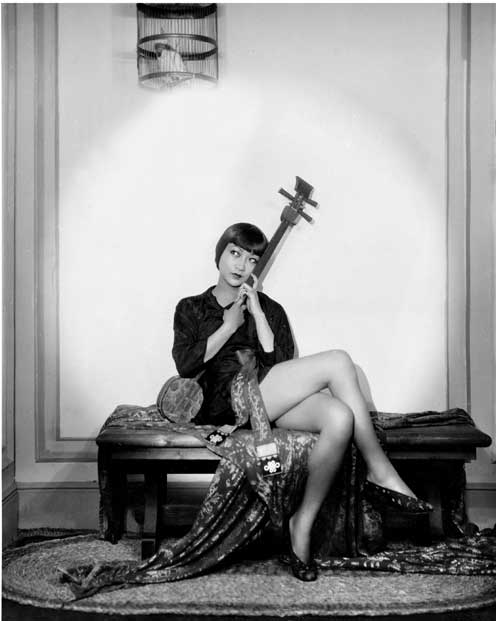
After the interval we will be screening a BFI archival 35mm print of the rarely-seen 1928 film Song (Richard Eichberg), an Anglo-German production in which Anna May Wong received top billing. In this her first European film, Anna plays a dancer drawn into a tragic romantic triangle when she meets a cabaret knife thrower (Heinrich George) and his capricious sweetheart. Song is notable both for Anna’s dancing and for the dramatic power of her performance. There will be a live piano accompaniment.
Most British silent film fans will know Wong primarily for her role in Piccadilly, but this will be a welcome chance to see one of her lesser known films, and the whole evening will be an opportunity to learn more about Hollywood’s first Chinese American leading lady.
Tickets in advance are £6.50 available from www.wegottickets.com or 0207 840 2200, and they will also be for sale on the door at £8. Doors will open at 6.30pm and refreshments will be available. The event is due to start at 7.30pm and finish at 10.30. For more information, visit the Cinema Museum website or the event’s Facebook page.
• UPDATE: This event will also be held at Liverpool John Moores University on 22 March 2011. More details here.



 Silent London