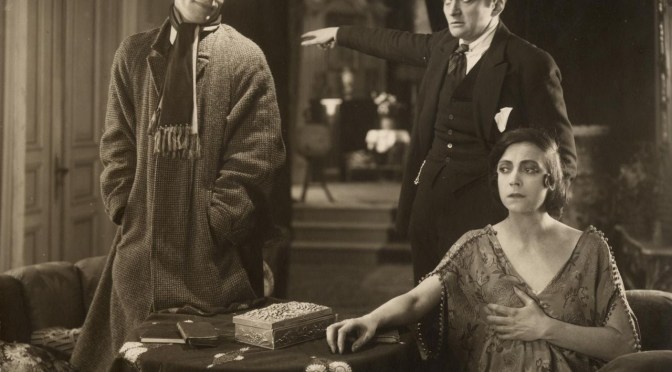
“There is more rejoicing in heaven over one sinner who repents than over ninety-nine righteous persons who need no repentance.” So the Bible says, but there was much rejoicing in heaven, or rather the second balcony of the Teatro Verdi, today over Seven Sinners (Lewis Milestone, 1925). And we don’t repent a second of it.
This is that happiest of tales, a lost film found. Australian film collector Joel Archer discovered a nitrate-damaged but still mostly watchable print of Milestone’s solo directorial debut in rural Queensland, and thanks to restoration efforts by the Academy Film Archive we are now able to enjoy a Hollywood comedy that was thought to have been destroyed in a fire in 1948.
It played really well, despite missing sections where the blooms of decay had taken over. Marie Prevost and Clive Brook play rival house-breakers trying the same stash from a ritzy mansion, who are soon joined by at least five more crooks, and a police officer who keeps “helpfully” setting the burglar alarm. It’s glossy, and witty, and starry – and exactly the kind of thing that Rian Johnson is serving up at Christmas these days. Prevost is delightful (as Michelle Facey points out in the catalogue, it is to the film’s advantage here that she is allowed to be funny and not forced into being merely decorative) and well I do love Brook, especially when he is playing comedy as he is here.
I also enjoyed the fact that this was effectively a lockdown movie. Due to some criminal wheeze or other, the house gets quarantined to contain a supposed outbreak of scarlet fever. Cue a sequence in which the wronguns all find ways to dolefully occupy the time stuck indoors, playing broken records, catching flies, stopping a dripping tap.
There was barely time to catch a Mitchell and Kenyon tram through Sheffield before attending the Women and Film History International meeting. Do heed the call for papers for next year’s Women and the Silent Screen conference in Mexico City. The theme is “transitions” and I just know that could be relevant to almost everyone’s research. And then you would get to go to Mexico. So why are you waiting?
After lunch, more women’s business. Specifically a very literary selection from the Female Madness strand. I do like the brief, verdant Amleto (Mario Caserini, 1908), and Pauvre Mère (Albert Capellani, 1906) was very pithily effective as melodrama goes. But the highlight for me was Le Memorie di una Istitutrice (Riccardo Tolentino., 1917), an Italian take on Jane Eyre. Bertha, or Pauline, Mason (Fernanda Sinimberghi) was as incendiary and gothic as you would expect, dark eyes and crimped hair and malevolent distress, while I very much liked Cretinetti alumna and future Cretinetti spouse Valentina Frascaroli as our repressed heroine. I also enjoyed (silently) booing St John Rivers, as would any self-respecting feminist bookworm. Amazing accompaniment on piano, harp and (startling) vocals for this whole programme by Meg Morley and Elizabeth-Jane Baldry. Truly spectacular.
We took a sea voyage with Queen Marie of Romania before our next feature, one of my most anticipated of the festival. Well, I cannot say that everyone agreed with me, but I loved Der Reigen (Richard Oswald, 1920). I may forever be confused by the opening with the overturned furniture and the orphan with the protective parents, but who cares? This was the Asta Nielsen and Conrad Veidt show, a battle of wills, charisma and the ability to sink to new moral depths… to the death. Asta plays Elena, a young woman seduced and abandoned (yes this Weimar plot again) but who has had her head tuned by her boyf’s friend Peter (Veidt), who had more than just romance on his mind, considering Elena an asset as well as a lover. Horrified, she takes a nannying job but finds the father of the house has a one-track mind. When mama finds them in flagrante (or something like it) she collapses and perishes on the spot. Elena agrees to marry him “for the sake of the child” but then she meets his handsome brother…
This was many things but it was never boring. And I did enjoy Elena’s glittery wardrobe as a sparkling distraction from the angst. But to be clear, I relished the angst. Was it only glancingly and suggestively about sex work, but more obviously about adultery, extortion, obsession and guilt? Why yes, but I could watch those faces work out complex feelings for ever. The acting here is big, but also complex, also real… and we were honestly blessed by Gabriel Thibaudeau’s nimble accompaniment. Among many other things, he managed to play for Asta’s catastrophic music-hall debut in a way that allowed us to hear every bum note she supposedly sang, the audience’s riotous reaction and her own crushing mortification all at once.
From thence to the book fair to learn about viral kisses shot in the dodgy part of town, romantic dinosaurs and why we can’t all be French (find out more on YouTube).
I need say no more about the evening’s special show, Tell it to the Marines (Georger W. Hill, 1926) – my thoughts are in the catalogue. Lon Chaney, nuff said!
Intertitle of the Day
“Is no profession safe from women?” Trust Marie Prevost to break the glass ceiling for should that be glass window?) by working as a house burglar in Seven Sinners.
- Sine Nomine. Can you help identify an unidentified silent film?
- You can read more about the festival, and all of the films, on the Giornate website.
- Silent London will always be free to all readers. If you enjoy checking in with the site, including reports from silent film festivals, features and reviews, please consider shouting me a coffee on my Ko-Fi page.
- I am on Letterboxd – watch me struggle to keep up with all these films.

