Last night’s Jazz on 3 celebrated the art of live accompaniment to silent film, as part of the BBC’s marvellous Sound of Cinema season. The show, presented by Jez Nelson, features jazz and improvising musicians creating live scores for silent films. Listen again here, or catch up with the sessions by watching these gorgeous clips, with music from the live session by Alison Blunt (violin), Viv Corringham (vocals), John Bisset (guitar) and David Leahy (double bass). Here, they are accompanying an experimental film by Louise Curham called Pararaha, Ruapehu, Mt Clear.
The much-loved 1925 German film A Trip to the Planets was also among the films chosen for the session.
Another modern silent here, Composted Memorial by Sally Golding, an installation and performance artist know for her cine-sculptures. She desecribes the film, which is constructed from vintage 9.5mm home-movie fragments as: “A wonky filmic resurrection, as a cine-essay dissolving in destructive magic.”
It’s an unbelievable discovery, “stranger than fiction” as Paolo Cherchi Usai of the George Eastman House told me. Orson Welles’s 1938 silent movie Too Much Johnson, believed to be lost, destroyed in a fire, has finally turned up. Not only that, the film, which is admittedly just a work print, was discovered in a warehouse in Pordenone, home of the prestigious Giornate del Cinema Muto.
Rejoice, if you are going to Pordenone this year, because Too Much Johnson will have its premiere at the festival, on 9 October 2013, before screening at the George Eastman House (where the film was restored) in the US the following week. Cast your eyes on this lovely video preview of the film – and then click here to read a short piece I wrote for the Guardian about the film and its rediscovery. In it, Cherchi Usai tells me that the Welles film this lost-and-found work reminds him most of … is none other than Citizan Kane.
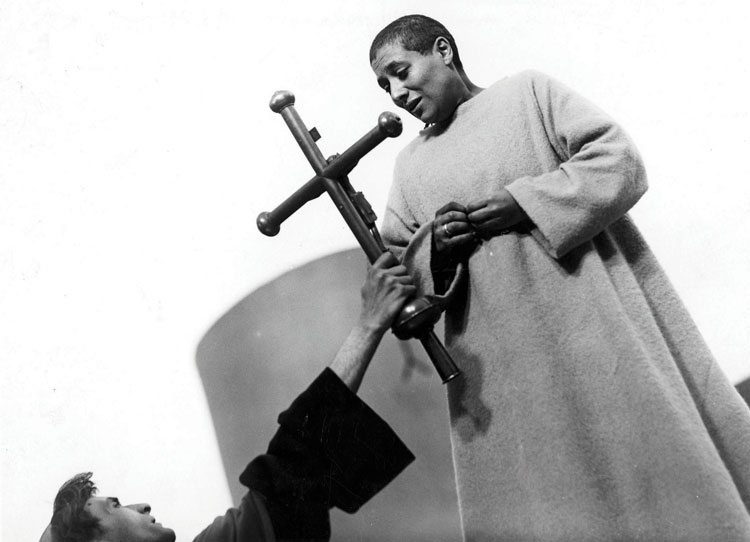
Scalarama is a far-reaching kind of film festival – one that covers the whole country, and virtually any manifestation of cinema you can think of. It’s dedicated to the spirit of the old Scala screenings in King’s Cross, London in the 80s and now in its third year, has a diverse and fascinating programme, fuelled by the passion of movie fans championing their own, often obscure, favourites. I am delighted to report that silent cinema is very much part of the month-long festival, with several screenings of Dreyer’s masterpiece, The Passion of Joan of Arc lined up, from Leicester to Canterbury. And it’s the gorgeous new Eureka print they’re screening too.
The Scalarama organisers asked me to share some thoughts about why I love silents, and why you (yes, you) should go to see The Passion of Joan of Arc, for the first in their series of podcasts supporting the festival. So listen up. I have listed the screenings below – Visit the Scalarama website for more details and links.
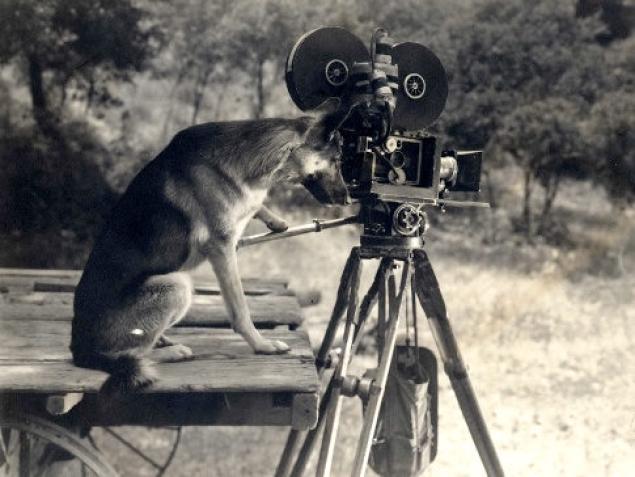
The post rate sure has slowed down around here. Blame the summer. Blame the day job. But that doesn’t mean that there are fewer silent movies being shown in London. Not at all. So this is just a gentle reminder that if you want to keep up to date with what is being shown where and when, take matters into your own hands, like Rin Tin Tin, here, and bookmark the Silent London Calendar page.
Check back regularly and you will find something new each time, we promise. Take next week: Landmark horror-doc Häxan is showing in Peckham, Neil Brand is accompanying a comedy double-bill and there is something mysterious occurring in Kennington – follow the link and all will be revealed.
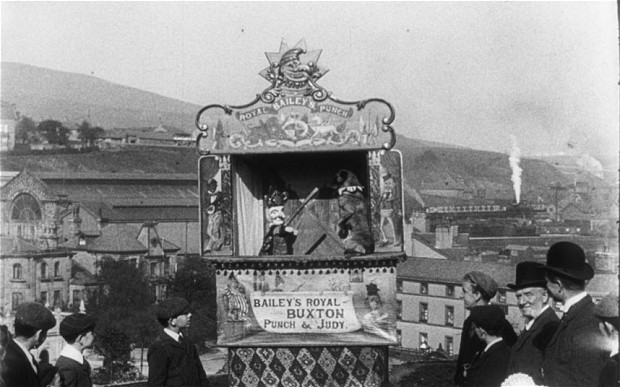
A still from Mitchell and Kenyon’s Punch & Judy Show in Halifax (1901). Copyright: BFI National Archive
So, last week, I found myself watching some early films in the BFI Southbank. Same old, same old, you might think. But these early films were being shown on massive MTV Cribs-style tellies in the BFI foyer. And while many of them were from the Mitchell and Kenyon archive we know and love, they were unseen treasures, having been gazed upon only by archivists during the past century.
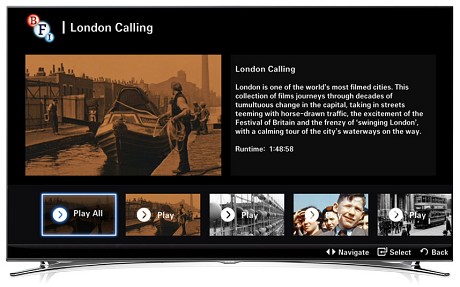
This unexpected alliance of Edwardian content and 21st-century technology has come about via the BFI’s new app, developed as part of the Film Forever project. It’s an app for Samsung Smart TV and Smart Hubs, and it allows viewers access to a treasure chest of film-related content, including a free Film of the Week (kicking off with A Zed and Two Noughts), interviews with film-makers, documentaries, and a whole heap of archival delights, including the M&K films. There will also be footage of events and interviews from the London Film Festival appearing when that all kicks off in October.
The archive goodies are separated into a variety of strands: London Calling and Cabinet of Curiosities, among them. There are silents across most of the ranges – many you’ll be familiar with, such as Daisy Doodad’s Dial or Wonderful London. It’s the Mitchell & Kenyon films that stand out though – they’re in a rather lovely collection called Edwardian Summer. There’s an hour and a half of footage here, a good hour of which is unseen. Robin Baker, the head of the BFI archive, calls these films: “Cinematic gold – you couldn’t get much more important.” What’s so vital about these short films, he explained, is that the “humanise the past”. They certainly captivated the crowd at the BFI.
You can see Blackpool in May 1904, with formally dressed holidaymakers parading on the pier or riding trams. There’s a Punch and Judy show, captured in Halifax in 1901 – your eye may be caught by the frisky puppy getting rather too close to the puppets, but don’t miss the plume of smoke that reveals a train station in the rolling hills behind the main event. A man in drag falls off a donkey (twice) in Hipperholme, West Yorkshire in 1901; Preston celebrates its Whit Fair in 1906. Delightfully, footage of the Chester Regatta delivers shots of boats gliding elegantly down the River Dee in the long hot summer of 1901. Watch a little further and you’ll discover a few courting couples doing what courting couples do in those very boats.
BFI’s Samsung Smart TV app
There’s silent London on show too – elsewhere in the package you can watch street scenes of Hoxton approximately 80 years before it became cool , for example.
I think it’s all gorgeous – I would like to sit down and watch all of the M&K treats in full, and there are some non-silent delights both sublime and ridiculous available too, including a Dufaycolor screen test featuring Audrey Hepburn and a public information film from the 70s starring Keith Chegwin. So this is wonderful news for those of you have, or are thinking of buying, a Samsung Smart TV, Hub or Blu-Ray player. It’s also good news for the rest of us. We may have to be a little patient, but as more of the BFI’s wonderful archive is digitised we can look forward to their films being made available in more ways. BFI apps for everyone please: not just on smart TVs, but on smartphones and tablets, perhaps?
This week, I was lucky enough to attend the launch of Sound of Cinema, a new cross-channel season from the BBC exploring film music in all its variety. The centrepiece of the season, arriving in September, is a three-part documentary on BBC4 by silent film composer Neil Brand called The Big Score. I’ve had a sneak preview of the series and it’s seriously fascinating stuff, with Brand tracing the development of film music from the silent era onwards, explaining exactly how classic scores work their magic on the viewing public and interviewing movie composers and big-name directors. Vangelis discusses the creation of his classic score for the most famous slow-motion sequence of them all in Chariots of Fire; Martin Scorsese talks us through his use of Jumpin’ Jack Flash in Mean Streets. In the first episode, Brand talks to silent film accompanist Bernie Anderson at Loew’s Theatre in Jersey City – and has a go on the magnificent in-house organ there.
Other elements in the season include stars discussing their favourite film music moments on BBC Radio 6; a documentary about the relationship between hip-hop and cinema on BBC Radio 1; Bobby Friction exploring Bollywood music on the BBC Asian Network; and a BBC Radio 2 documentary made by Mark Kermode called Soundtrack of my Life, which promises to be very entertaining. There’s absolutely masses planned on BBC Radio 3, including Sound of Cinema downloads by Brand and a a week of programmes hosted by Matthew Sweet. You can read more here (PDF). Radio1 film critic Rhianna Dhillon talked to me about the intriguing possibility of getting some pop acts to have a stab at scoring a film – perhaps they will get a taste for it and we’ll find some new names added to the list of regular silent film composers!
Because, yes, this all sounds a bit “talkie” for Silent London, but I’m sharing this with you because this series promises “a deep understanding of what music does for film”. It’s a subject that silent cinema fans discuss animatedly after every screening – we’re in the now unusual position of watching the same film again and again with different scores, which can make a huge difference to the experience. Perhaps, after dipping into this season. we’ll have an insight into the influences, theories and ideas rushing through the film accompanist’s mind at the next screening we attend.
Hipster-favoured photo-sharing service Instagram introduced a video option some weeks ago. It soon became clear that the square-format clips, up to 15 seconds in length, are better suited to visual-led material than talkie stuff. It’s not a great medium for recording a monologue, less still a conversation, but it’s a wonderful way to capture the impact of moving pictures. It’s like the early days of film, all over again in 2013.
I have chosen a few Instavids that have caught my eye so far. All of these “work” as silent films, even though most have ambient sound, and occasionally speech. Some of them even tell a story. They’re all pretty gorgeous too – Instagram’s filter options make it easier to put a sheen on your clips – although a few of these are strictly #nofilter.
Waiting for a festival screening to begin at Cinema Arlecchino in Bologna.
Completists, please avert your gaze. During the three days I spent at Il Cinema Ritrovato in Bologna I missed far more than I saw. With four screens, plus lectures, workshops, exhibitions, open-air screenings, and programmes for children all running at once, there is too much here for any one person to take in. It’s a festival that requires endurance, decisiveness and a philosophical approach to the ones that got away. But if you think you’re tough enough, start clearing your diary for summer 2014. And welcome to classic cinema bootcamp.
Ritrovato is all about rediscovery – the films on show here have all been found, restored or reclaimed. They are the work of film-makers whose work deserves a second look, or whose weighty reputation means that their films merit a little extra care and attention. To this end, the festival is woven from many strands – and even if one were to stay for the entire festival, it would require a certain single-mindedness to see one of them through from start to finish. On my flying visit, I didn’t have a hope. This is my way of excusing my scattergun approach to the festival – a programme of early shorts here, a classic Chaplin two-reeler projected in the Piazza Maggiore there, a lush new print of a silent Hitchcock here, a rustic Soviet melodrama there. And sound films too. Lots of them, actually, I cannot tell a lie.
According to my notes, the first film I saw at the festival was a four-minute snippet from 1913 called Hungarian Folklore, which detailed wedding traditions in the country. Good intentions and all that. This was followed by Baby Riazanskie, a chewy melodrama directed by Olga Preobrazenskaja and Ivan Pravov. I never saw another of their films – because I was distracted by other delights, and because I was slightly underwhelmed by this one. Another regret.
Zaza (1923)
My highlights included the Allan Dwan silents, especially Zaza and Manhandled starring the fantastic, feisty Gloria Swanson, and the action-packed East Side, West Side. I enjoyed many of his sound films too: witty sweet-hearted comedies from the 40s and 50s.
I was captivated by the beautiful if overlong city symphony Etudes Sur Paris – catch it for the underground canal sequences alone. I was moved by Victor Sjostrom’s social drama Ingeborg Holm (a 100-year-old Swedish Cathy Come Home) and tickled pink by Chaplin’s The Cure.
The Cure: Charlie Chaplin and Eric Campbell on the big screen in Piazza Maggiore, Bologna
Another highlight was a recently discovered collection of sweet colour films from 1906 screened using carbon light projector in the Piazzetta Pasolini late at night. I didn’t want that to end. The Farmer’s Wife, all gussied up by the BFI as part of the Hitchock 9 project, looked beautiful and its peculiarly English humour translated well to the Bologna audience.
When it comes to talkies, I was emotionally shredded and enthralled by Anna Magnani in Rossellini’s L’Amore – and again in Roma Citta Aperta. Plein Soleil, La Belle et La Bete, Chimes at Midnight … I don’t feel the least bit guilty about watching those.
The main thing I missed during my trip was Bologna itself. I strolled around the Piazza Maggiore one morning, and glimpsed the two tipsy towers, but I was far too distracted by the flickers to do any real sightseeing, or sunbathing in the 30-degree heat. Arrivederci, Bologna.
And if you’re thinking of visiting Il Cinema Ritrovato next year, here are my top five tips for festival newbies. If you’ve been to Ritrovato before, please share your tips below:
Get yourself a map of Bologna. And mark the festival venues on it. Do this before you arrive so you’re not wandering the streets panic-stricken, in search of a Gloria Swanson film, like a certain blogger of our mutual acquaintance.
Patience is a virtue. The screenings run late. And almost every film is prefaced with a long introduction, in at least two languages. Luckily the movies are worth the wait.
Health and safety. Strappy wedge sandals, cobbled streets and ten-minute gaps between screenings led me dangerously close to a few unscripted slapstick moments. There is a shuttle bus in operation between the cinemas, for those who really need assistance. For the rest of us – these strolls are the only exercise you are going to get all week. And drink lots of liquid: caffeine will get you through the schedule, but it’s hot out there, so drink plenty of water too.
See one film you’ve never heard of every day. The best festival experiences are the surprises – and the programme at Ritrovato has plenty of surprises up its sleeve.
Don’t be discouraged by the catalogue. The descriptions of films in the official catalogue are useful, and very detailed, but often a little cool. Trust your instincts – and the festival programmers.
This a fledgling idea, but a fantastic one. Amran Vance has sent up a London-silent-film-going group on Meetup.com. The plan is that silent film enthusiasts can register to join the group and then arrange trips to see silents together. It’s sociable, and there should be some chewy post-screening discussions to savour. Over to Amran:
I hope that we can attract real enthusiasts such as those who read the Silent London and Bristol Silents websites.
The point of all this is partly to introduce a social element into silent film-going in London but primarily to encourage interest in silent film, share knowledge and to support the venues that show silent film.
Clever, huh? Outings are already plotted for Sunrise and Blancanieves, so they’re off to a good start.
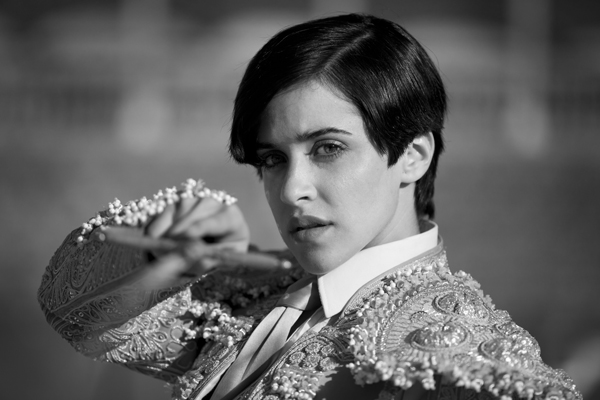
We’ve been waiting for this news as patiently as Snow White awaited her kiss of life – and here, in the shape of StudioCanal, is our Prince Charming. Pablo Berger’s utterly gorgeous, slightly twisted, Gothic fairytale Blancanieves gets a UK release on 12 July 2013. I have been intrigued by this film since we first heard about it in March 2012, and in October last year when I saw it at the London Film Festival, I became smitten. If you saw it then, or at the recent Ciné Lumière screening, you’ll know what I mean.
Blancanieves is a silent, black-and-white film – a loose adaptation of Snow White set in 1920s Spain. There is a poisoned apple, a wicked stepmother (brilliantly played by Maribel Verdú) and a coterie of dwarves, but also bull-fighting, flamenco and a pet cockerel called Pépé. It’s a beautifully accomplished homage to European silent cinema (at the screening I attended, the director paid tribute to everyone from Abel Gance to our own Anthony Asquith) and at the same time satisfyingly rich and quirky – this is a very hard film to categorise. The cinematography is at times exquisite, and the score, by Alfonso de Vilallonga, is fantastic. As yet, I don’t know whether we can expect a full or limited release – but if you love silent cinema, and Blancanieves is playing near you, you really should go to see it.
I’ve just got home from the cinema, where I saw Baz Luhrmann’s new adaptation of The Great Gatsby. Sad to say, I was pretty disappointed in the film: the unnecessary “mansplaining” voiceover, the clunky framing device, those rather chilly, stilted lead performances. Oh well, I had been forewarned about some of that, but still retaining fond memories of Romeo + Juliet, I had expected a lot more good old-fashioned fun. I was anticipating orgiastic party scenes, crammed with beauty and vigour – and all filmed in retina-bumping 3D. Somehow, those bashes, from the grand getups in Gatsby’s mansions to the sleazier affairs in speakeasies and hotel rooms, were a letdown to me. Perhaps it’s just because I can’t get get on board with the speed of the editing – I had a similar problem with Moulin Rouge! – or maybe I’m just not cut out for the talkies. Either way, all the time the champagne was flowing and the dancing girls were shimmying I was casting my mind back to some great party scenes I had seen in silent movies. Such as …
Josef von Sternberg’s grizzly gangsters lay down their guns and lift their glasses in this debauched Underworld ball.
A dance craze becomes a collective mania in Ernst Lubitsch’s The Oyster Princess.
This foxtrot in Our Dancing Daughters is especially foxy. Something tells me Joan Crawford could get into trouble …
Blub. Charlie Chaplin misses all the fun at New Year’s Eve in The Gold Rush.
In Metropolis, a seductive dancing girl energises the crowd in a questionable nightspot – but she’s not who she appears to be.
Life appears to be one long party for Colleen Moore – with damning consequences – in these snippets from the lost film Flaming Youth.
Oooh la la. One night in Paris, washed down with a lot of bubbles in Wings.
Feather and tar me if you will, but I loved this moment in The Artist.
And finally, check out the pool parties in this trailer for the first film version of The Great Gatsby – shot in 1926 but sadly lost to the ages. (You can read more about this film in the current issue of Sight & Sound.)
Share your suggestions for the best party scenes in silent movies below.
The Fashion in Film Festival is a movable feast, but one we can always rely on for some wonderful silent film screenings. This year’s event has just begun, and the focus of the festival is the French director Marcel L’Herbier, who worked in both the silent and sound eras, creating captivating, elegant and strange films of staggering beauty. This is what the festival has to say about his silent films:
During the silent period, L’Herbier’s ambition for the cinema was to create a Gesamtkunstwerk, a cinéma totalwhich would synthesise all the arts and draw together architects, artists, set designers, couturiers and costume designers. Among the many major cultural figures he collaborated with were the artists Fernand Léger, Sonia and Robert Delaunay, the composers Darius Milhaud and Arthur Honegger, the architect Robert Mallet-Stevens, designers Alberto Cavalcanti and Claude Autant-Lara, and couturiers Paul Poiret, Lucien Lelong (L’Herbier’s cousin) and Louiseboulanger. Paired with his multi-disciplinary collaborative approach, it was L’Herbier’s desire to legitimise and ennoble cinema as the ‘seventh art’ that helped establish him as a seminal figure within Paris’s vibrant cultural milieu of the inter-war years.
Using art, fashion and design as the prisms through which to examine L’Herbier’s diverse body of work, Fashion in Film’s season highlights his lifelong interest in cinematic style and aesthetics. As the costume designer Jacques Manuel once observed, costume for L’Herbier was so often a way of ‘feeding’ the ‘mechanical eye’ with evocative surfaces and textures, a way of testing the formal elements of cinema itself such as movement, rhythm, light and shadow.
To feed your own eyes, and for a direct lesson in the importance of costume design to L’Herbier’s total vision of cinematic photogénie, watch the festival’s slinky trailer here.
A true multi-disciplinarian, L’Herbier arrived at film-making after considering literature and music as possible careers, and more prosaically, having worked in a uniform factory during the first world war. When Feuillade’s leading lady Musidora took L’Herbier to see Cecil B DeMille’s melodrama The Cheat, he realised the potential of cinema, and starting out in the army’s cinematographic unit, began to learn the art of film-making. However unlikely a start this may seem, even his very first film, a propaganda piece called Rose-France, was ambitiously experimental.
L’Inhumaine
At first, L’Herbier worked for Gaumont, but his artistic dreams soon clashed with the realities of their budgets, and in 1923 he formed his own company, Cinégraphic. You may be familiar with L’Herbier’s silents already, particularly Zola adaptation L’Argent, which is available on DVD from Masters of Cinema. The Fashion in Film Festival is showing L’Argent, as well as sci-fi opera L’Inhumaine (The Inhuman Woman) and doppelganger drama Le Vertige (The Living Image). You can read the full programme of events here. Not showing at the festival, but recently released on Blu-Ray by Flicker Alley in the US, is the Pirandello adaptation Feu Mathias Pascal.
Film-maker Steve Simmons sent me this short film, his second piece of work, and how could I resist sharing it with you? It was shot in south London, in Lambeth in fact, and any hard-working city-dweller will recognise this scene. As a crossword fan, I found Crosswords‘ wry comedy compelling: its premise initially seems simple but spirals into something a touch murkier and more dangerous as events unfold. The witty combination of text and image really caught my attention and I think it’s bound to raise a smile with the readers of this blog.
Steve tells me that he was influenced by the widest possible range of movies, silent or otherwise: “Films that haved inspired me are Metropolis, Once Upon a Time in The West, City Lights,Escape from Alcatraz and I loved The Artist.”
That’s a very diverse list and you’ll notice that although Crosswords is a modern silent, it’s far from an exercise in mimicry. For one thing, it has text, but not intertitles: “I initially considered traditional title cards to display the clues and the man’s thoughts,” says Steve, “but eventually I decided it would work best if the text was incorporated into the action. I think it helps the viewer concentrate on the clues and keeps the story flowing.”
Steve would love to make another silent, he tells me, and not just a short film: “At the moment I’m writing another silent film script but it’s more of a science-fiction based story. One day, if I had the funding I would love to make a feature-length silent – that’s the dream!”
This is a guest post for Silent London by Kelly Robinson.
Sumurun screens with a live score by Amira Kheir at BFI Southbank as part of Birds Eye View Film Festival on Thursday 4 April at 6.10pm. Read more here.
Sumurun is the product of an intensely creative time in the German film industry when an extraordinary range of artistic and entrepreneurial talent emerged: creating ambitious films that challenged American productions for the international market.
Paul Davidson, the director of the German production firm Projektions-AG Union(PAGU), was a film producer unafraid of financial risk-taking and he invested large amounts of capital early on in the industry. In 1918 the company was merged with several other firms under the umbrella of Ufa, with Davidson becoming an executive on its board. Much of Ufa’s success was the result of the absorption of PAGU’s talent, which included directors such as Ernst Lubitsch and Paul Wegener and stars such as Pola Negri and Ossi Oswalda. Indeed because of its established reputation it still produced under the PAGU brand and retained a considerable degree of independence.
With financial support from the German bank, Ufa began a policy of big-budget films aimed at the international market. In 1918, Davidson suggested Lubitsch try making one of these Großfilmes, epic productions indebted to the Italian spectacle films, such as Giovanni Pastrone’s Cabiria (1914) – films which in their budgets and enormous sets were an attempt to compete with Hollywood. Lubitsch assembled a regular production team around him for a series of these ambitious films, including his co-writer Hanns Kräly, the set designer Kurt Richter, and cameraman Theodor Sparkuhl. Famous actors such as Pola Negri added star allure to these films and became a big draw for audiences’ world-wide. Sumurun is one of several extraordinary films that resulted from these collaborations during the late 1910s and early 1920s.
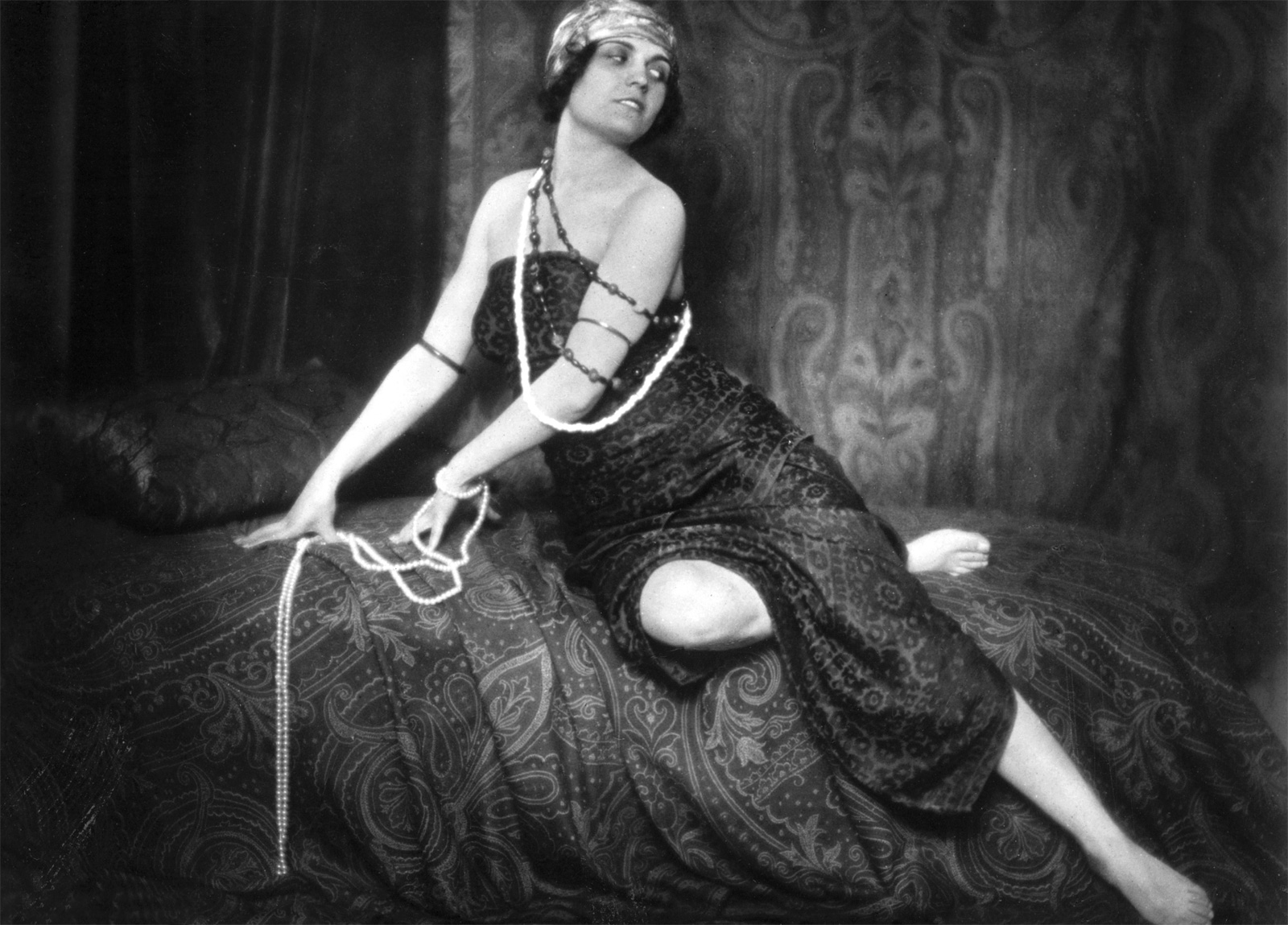
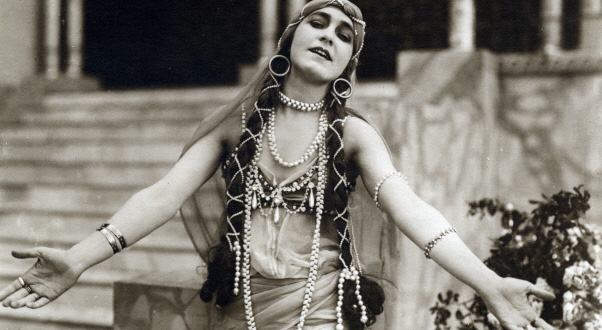
Pola Negri
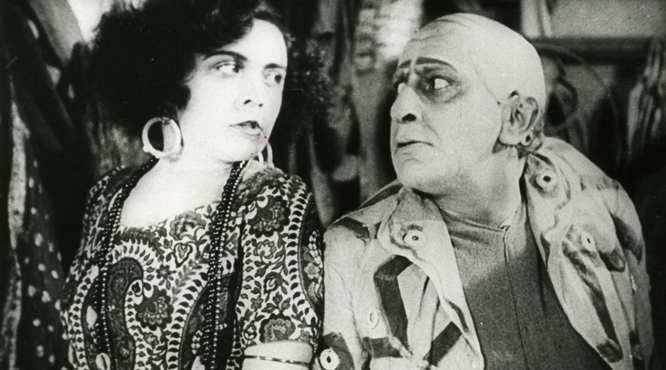
Pola Negri was born Barbara Appollonia Chalupiec in Yanowa, near Lipno in Poland. She took as her professional name the last name of Ada Negri, an Italian poet she admired and the diminutive form of Apollonia as a first name. She had danced at the Imperial Theatre in St Petersburg and had acted on stage and screen in Poland before being invited by Max Reinhardt to Germany to star in Sumurun (a story derived from The Arabian Nights) after she had appeared in a Polish theatrical version. It was here that Negri met Lubitsch, who was a Reinhardt player and comedy short director at the time, and who was playing the role of the hunchback opposite her in the German theatrical version (a role he would recreate in the film). They became good friends and he made her the star of several of the large-scale costume pictures for Ufa. Lubitsch told her: “We’re going to make a picture of Sumurun. Reinhardt’s letting us have the sets and costumes. We’ll use most of the actors from the stage productions. We’ll hardly even have to rehearse. It’ll cost practically nothing.” (Pola Negri, Memoirs of a Star). Production started in September 1920. It was substantially cut and released by First International in the US in October 1921 with the new title One Arabian Night. Negri remembered its production as: “a very easy and happy chore. Except for a few Lubitsch innovations, it was essentially a photographed stage play.” (Memoirs of a Star)
This kind of dismissive assessment has plagued One Arabian Night, with even relatively recent biographies of Lubitsch granting the film scant attention. However it is an important film, both as an example of Germany’s aesthetic advancements and also in the context of Negri’s and Lubitsch’s career. For instance it was this film that impressed Mary Pickford so much that she brought Lubitsch to the US for Rosita (1923). The film’s critical neglect is most likely a result of viewing the bowdlerised US print, which is missing thirty minutes. Thankfully now we can see the fully restored version.
Sumurun (1920)
Many historians agree that German films improved when Hollywood films began to be seen in Germany from 1921, and yet, interesting approaches to cinematography preceding the American influence are evident in films such Sumurun. For instance, in the opening of the film where the light streaming through blinds in the caravan causes chiaroscuro patterns. Cameraman Sparkuhl also has a tendency to hold closeups from a high angle, which adds variety to some of the scenes. Indeed, most of the closeups of Pola Negri, particularly the scenes of her dancing in Sumurun, are shot in this manner. This may have been a way of singling Negri out from the rest of the characters; similar to the technique of filming stars that was developing in Hollywood.
German film’s reputation for elaborate set design is evident in Sumurun. There is a rhythm both in the set design and also in the movement of figures within that design. Lotte Eisner has noted how the American musical would pattern itself on the “delicate arabesques” in this film (The Haunted Screen). Contemporary reviews often observed how Lubitsch’s films were on a par with the best American productions. Variety reviewing the film in 1921 commented: “The production is colorful throughout, the atmosphere of the East being perfect in detail.” These films were incredibly successful in Germany and abroad. Their settings, such as Sumurun’s Persia, and subject matter, offered audiences an escape from everyday reality. Negri observed that “one of the reasons [for the success of Sumurun] was certainly because its intensely romantic oriental fatalism was precisely the kind of escapism a war-weary people craved for” (Memoirs of a Star).
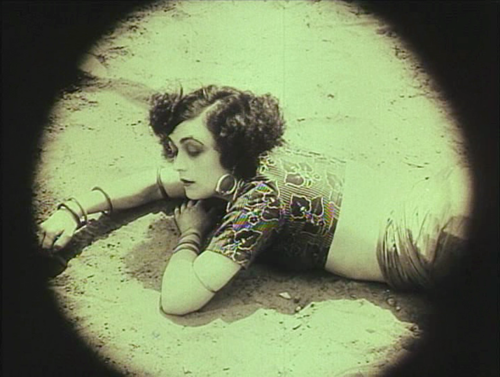
Pola Negri in Sumurun
Negri and Lubitsch were among the first international celebrities to be brought to the US – later director-star duos included Mauritz Stiller and Greta Garbo. Negri arrived under contract with Paramount in 1922 to a storm of publicity. The press went wild over an affair with Charles Chaplin and supposed spats between her and Gloria Swanson, whose top star status at Paramount she challenged. Her vampish screen persona was conflated with anecdotes about her private life. The press spread rumours about her many lovers and delighted in reporting quirky acts such as her walking a tiger on a leash down Hollywood Boulevard.
Negri had became known abroad for playing roles where women exploited their sexuality for economic and political gain (see also Carmen and Madame Dubarry). Her swaggering sexuality is parodied sublimely by Marion Davies in The Patsy (1926). Diane Negra has observed the transformation that her persona undertook in the move from Germany to Hollywood. In the Hollywood films her femme fatale image was tempered and the films frequently ended happily. The American films also deemphasised the ethnic and class dimensions found in earlier films. Her US films were not as successful as the European ones and Negra argues that this was the result of her ethnic sexuality. Her Italian surname, Polish ethnicity and connections to German film industry meant she could not (or would not) be fully assimilated. In public and private she appeared to resist being Americanised. “As the unassimilatable woman, both in ethnic and sexual terms, she stood for a type that was in fact far more transgressive than the thoroughly American, upper-middle-class flapper who, for all her supposed flouting of social conventions, was nearly always safely married off in the end.” (‘Immigrant Stardom in Imperial America: Pola Negri and the Problem of Typology’, Diane Negra).
Costas Fotopoulos is based in London and works internationally as a concert and silent film pianist, and as a composer and arranger for film, the stage and the concert hall. He regularly provides live improvisations to silent films at BFI Southbank and he has also accompanied films at other major British venues as well as in New York, Warsaw and Italy. I interviewed him after a screening of Sunrise: A Song of Two Humans in Winchmore Hill, north London, organised by Around the Corner Cinema. We also discussed his score for modern silent film The Projectionist.
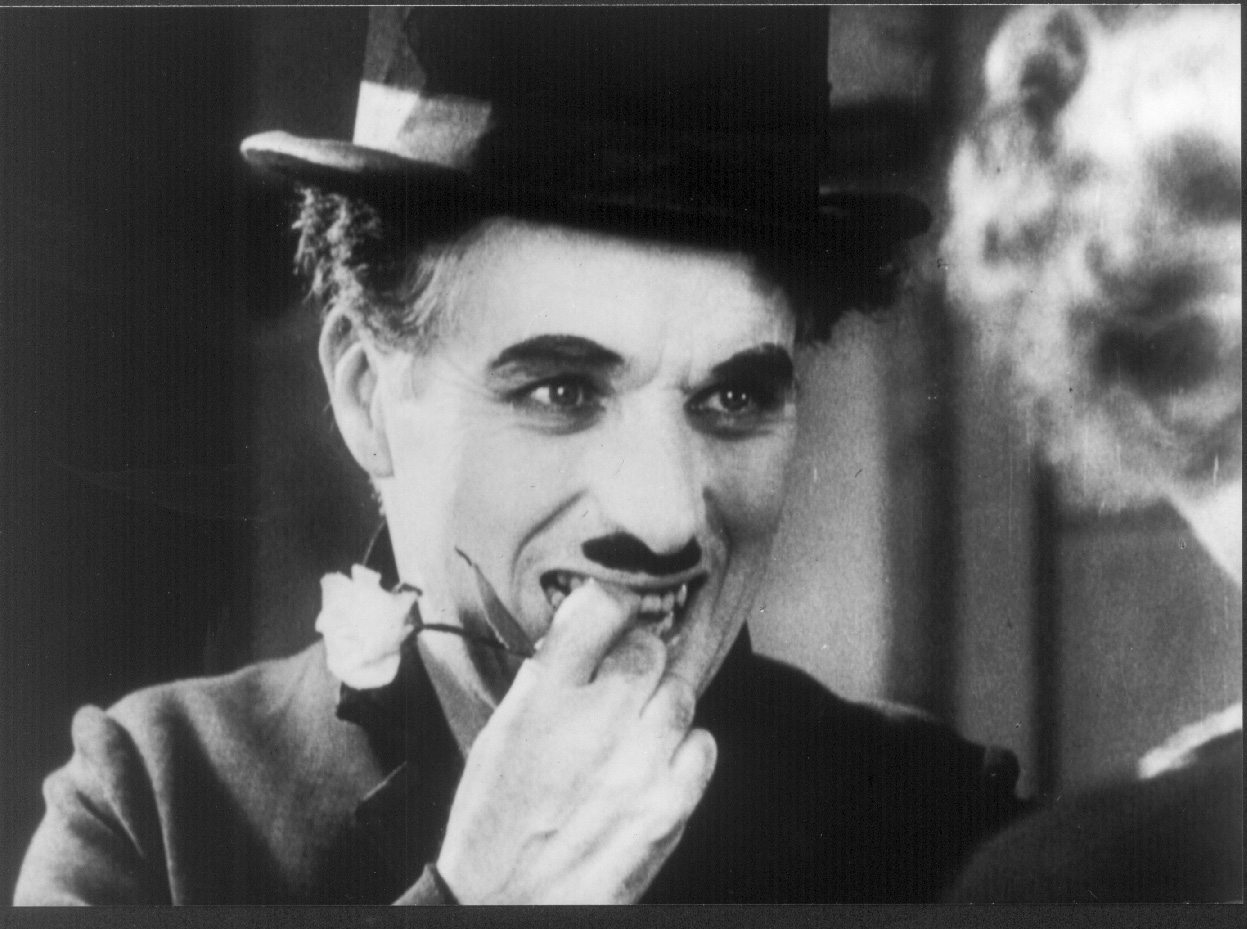
It’s podcast o’clock once more. This time I’m joined in the studio by the marvellous Pete Baran, and in the pub by Lucie Dutton, who tells us all about British silent film director Maurice Elvey. All that, plus a guest appearance by Otto Kylmälä, film-maker and festival organiser, praising the “subtle brilliance and mature beauty” of his favourite silent movie, Chaplin’s City Lights.
If you want to get in touch with us about anything you hear on the podcast tweet @silentlondon or leave a message on the Facebook page: facebook.com/silentlondon.
It’s not often I find myself recommending a natural history programme, but on Tuesday night this week a BBC4 nature documentary will celebrate the work of film pioneer Percy Smith. Edwardian Insects on Film is punchy name of the hour-long doc, which is part of the channel’s Alien Nation insects season. As the video above shows, the film follows wildlife film-maker Charlie Hamilton Jones’s attempts to replicate Smith’s ingenious film The Acrobatic Fly (1910). It promises to be a rare opportunity to look in detail at early cinema methods and technology – and an even rarer opportunity to see such things on TV.
While the tricksy manipulations of The Acrobatic Fly are many miles away from modern wildlife film’s hands-off observe-from-a-distance approach, the documentary also looks at Smith’s pioneering work in timelapse photography (the gorgeous The Birth of a Flower, 1910), which is still a staple of the genre – used for example in David Attenborough’s The Private Life of Plants (1995). Attenborough himself makes an appearance in the programme, as will a few other faces familiar to readers of this blog.
Smith continued working in the film industry into the 30s, most notably making the Secrets of Nature series for British Instructional Films from 1922-33. Should you want to know more, BFI Screenonline has plenty of information about Smith and his films, some of which are available on DVD, or like the clips above, on the BFI YouTube channel:
Smith was a true pioneer, inventing original (and bizarre) methods for time lapse and micro cinematography, involving all kinds of home-made devices, including alarms all over his home to wake him up in the middle of the night if the film in the camera needed changing. With endless patience, he could spend up to two and a half years to complete a film. He also had the popular touch, with the happy knack (as he put it himself) of being able to feed his audience “the powder of instruction in the jam of entertainment”. Modern film technique could hardly better the results achieved by Smith in the first decades of the century and his early masterpiece Birth of a Flower (1910) has never been out of distribution.
Edwardian Insects on Film screens on BBC4 at 9pm on Tuesday 19 March 2013 and again at 2.40am on Wednesday 20 March 2013.
Yasujiro Ozu wasn’t always quite the Yasujiro Ozu we know from Tokyo Story and Late Spring. And he was certainly nothing like the film-maker you would expect if you had never seen those films, just been told about them as slow, domestic dramas on the theme of loss. Ozu has always put the fun into formalism, with playfully picturesque compositions and his famous cutaway “pillow shots” inserting frames of pure, simple cinema into his simmering narratives.
Later Ozu films are so routinely described as distinctively Japanese, as distinctively Ozu-esque that it may surprise many to learn that the director was actually a huge fan of Hollywood cinema. When he first started work at the Shochiku studio as a young man, he horrified the boss by claiming to have only seen a handful of Japanese films, and hundreds of American pictures. The twentysomething Ozu first aspired to make comedies, aping the slapstick of Harold Lloyd and the wit of Lubitsch.
The BFI collected a handful of Ozu’s campus comedies in a box set last year – and while their subject matter and setting seem very different from Ozu’s sound films, there was much that was familiar: a certain poignancy to the humour; the awkwardness of social and family situations; the sense of change and loss on growing old and leaving friends and family behind.
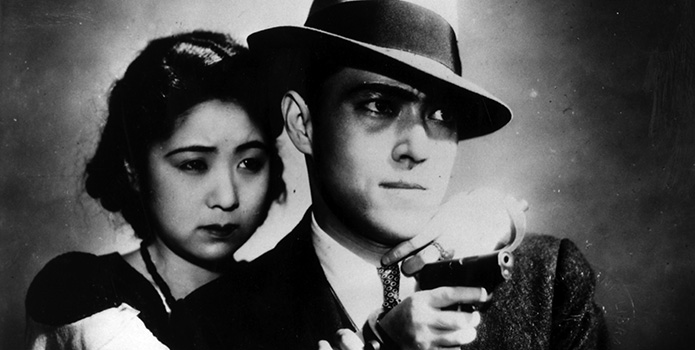
Dragnet Girl (1933)
Now the BFI has brought together more of Ozu’s earlier, funnier material for a second set, but this time with a darker theme. The Gangster Films set reflects Ozu’s Hollywood influences, sure, but also a changing Japan, more urban, more hi-tech, more susceptible to western influences. In the student comedies, our slacker heroes are horrified by the brazen manners of so-called modern girls – Ozu’s gangsters embrace them, at least for a short while. The films featured in this new set are Dragnet Girl,A Straightforward Boy (fragment), Walk Cheerfully and That Night’s Wife. I don’t want to lump these films together, certainly the fragment is its own beast, but they do share some characteristics. The three features are all set in an Americanised Tokyo, accented with deep shadows and populated by Japanese gangsters straight out of US novels and films – double-breasted suits, sharp-brimmed hats and shiny leather shoes. Their molls have bobbed hair and fur collars, high-heeled shoes and glint in their eye.
The beauty of watching the gangster movies is to see Ozu’s cinematic style grow despite his influences. Or to put it in David Bordwell’s words: “The exotic and formulaic genre allows Ozu to experiment stylistically, moving toward that highly overt narration that was to become his trademark.” While the gangster films offer us Hollywood thrills in the shape of guns, girls and skulduggery, the poetics, the cutaways and composition are all Ozu’s own.
That Night’s Wife (1930)
Full disclosure: I’d quite like you to buy this box set. I contributed one of the essays in the accompanying booklet, on Walk Cheerfully. You’ll find more erudite words there too from Tony Rayns, Bryony Dixon and Michael Kerpan. The films are the thing, of course, and they are beautifully accompanied by Ed Hughes’ scores. The set has been reviewed in Film International, by Wheeler Winston Dixon, and in Sight & Sound, by Philip Kemp.
However, I’m not just writing to plug the box set, but to bring you some information about a forthcoming screening of Walk Cheerfully at BFI Southbank on 22 April. This is a members’ ballot screening, and you should know by now whether you have a ticket, though I suppose there may also be some more available nearer the date. This is a special screening and will be an experience very different to watching the DVD. First, the music will be a live improvised score that combines traditional Japanese music with electronic distortions – and a 78rpm record player. Walk Cheerfully is certainly a toe-tapping film, so I have high hopes for this. More details below:
Sylvia Hallett and Clive Bell are the two musicians improvising a live score for Walk Cheerfully. The pair have worked together for several years on projects for film, dance and theatre, as well as numerous international concert and festival performances. Their duo album The Geographers is on the Emanem label.
Clive Bell is a specialist in Japanese traditional music; he lived in Tokyo where he studied the shakuhachi (Japanese flute). Later he learned to play the khene, a bamboo mouth organ from Thailand – a bright-toned, chordal wind instrument that is an ancestor of the accordion. Sylvia Hallett is a violinist, composer and instrument maker, with a unique personal approach to live electronics.
Clive Bell writes: “Walk Cheerfully is a film full of subtle surprises, that deserves a fresh-sounding score. Our musical accompaniment will blend these Far Eastern instruments, and the more familiar violin, with electronic looping and pitch-shifting. The live orchestra which accompanied Japanese screenings in the 1930s often mixed traditional Japanese instruments such as shamisen (lute) and taiko drum with trumpet, violin, clarinet and piano. Instead of a piano, we use electronics to extend the music’s range into magic and atmospheres.
“Ozu was a keen student of American cinema, but made films that remained essentially Japanese. We hope to return the compliment by creating a rich musical mix of Western and Japanese, of contemporary and traditional. And, when the gangsters play their 78rpm records in their club, we will activate an antique 78rpm record player of our own.”
The second surprise is that the film will be accompanied by live Benshi narration – as Japanese film screenings were in the silent era. The Benshi will be performed by Tomoko Komura, who will both translate the intertitles and narrate the film.
If you want to learn more about Ozu, and his silent work, I can’t think of a more enjoyable way to begin.
Walk Cheerfully screens at NFT1 on 22 April 2013 at 6.30pm. Read more here.
This is a guest post for Silent London by Chris Edwards of the Silent Volume blog.
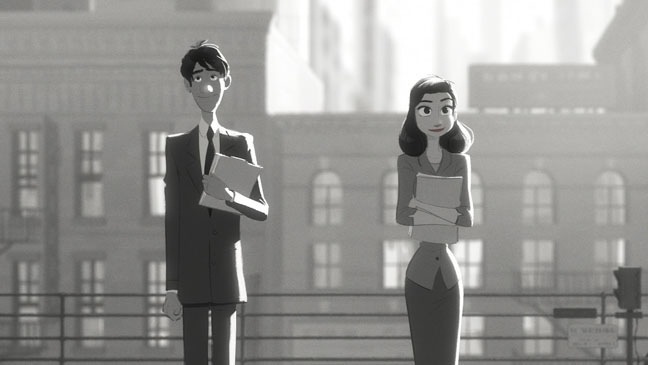
I don’t want anyone accusing me of ingratitude, much less of being a grouch. So I’m going to tell you all the reasons I think Paperman is wonderful, before I tell you why it’s not.
Paperman has been rightfully lauded, you see. At least, if we’re talking about the animation itself, which, it seems to me, is the major preoccupation of those praising the film. Fair enough. In an industry fuelled by hype, Paperman is, legitimately, indisputably, a leap forward.
This is Disney’s newest cartoon short: a black-and-white film you’ll see just ahead of Wreck-It Ralph. Utilising a newly developed program called Meander, allowing them to draw traditional images over pre-constructed CG designs, Disney’s animators have created characters who move with the fluidity of 3-D animation, while possessing the warmth and expressiveness of a 2-D line. The effect is remarkable, and beautiful.
Paperman is set in New York City, in the 1940s. The film opens with two strangers: a man and a woman, both in their early-twenties, meeting on an elevated train platform, after the wind blows one of the Man’s documents into the Woman’s face. Her lipstick leaves a mark on the paper. He is smitten. So is she. As her train pulls away from the platform, she is looking out the window, back at him. It will become his mission to find her.
The animation here is very … precise. Disciplined. This is the work of men and women with a clear vision: They knew they were making a cartoon, not an oil painting; and that a little exaggeration was for the best. So the wind nudges the man’s lanky frame just right — but not quite realistically. As the man himself does not look like a real man, but rather, a man rendered in Disney’s style, so too is his reaction a little more than it would be from you or me.
I should add that this scene is dialogue-free, as is the rest of Paperman. It is “silent”, at least in the sense that WALL-E has been called silent. In fact, you hear lots of things in Paperman. You just don’t hear words.
As in true silent films, the absence of chatter in Paperman allows us to focus on the visuals, and director John Kahrs is generous with them. I clearly remember the young woman’s smile: a half-smirk, half-grin she gives the Man after seeing the lipstick mark. You’d never see that look on a dame in a film from the 40s, but it’s a familiar one among my friends today. Kahrs lets us savour it.
The office where the Man works is likewise inspired. It’s a deadening workspace, recalling the fleet of identical desks in The Apartment (and of course, The Crowd), but on a smaller scale. The Man seems decades younger than his colleagues, all of whom frown at him. Watching the film a second time, I found myself wondering why he was there. If his job is entry-level, why is he the only young person in the room? Is he an intern? Is this during the war, and his peers are overseas? Maybe he’s the Boss’s son? The Boss, a severe fellow, had some of the qualities of a stern dad. And maybe a disappointed one.
A seven-minute film cannot answer these questions, at least in any detail. But it is a credit to Disney’s team that they could create characters rich enough to inspire them. By the time the Man spies the Woman through a window in the skyscraper across the street — almost level with his own office, no less — we’re pulling for him; convinced he should and must get her attention. He begins folding his stack of blank forms (the symbols of the job he hates) into paper airplanes, whizzing them unsuccessfully above or below his target, or past her — and we yearn, with him, for one of them to connect.
We can all relate, can’t we? We’ve all felt lost and powerless this way. Kahrs, describing his own experience of New York City to animation historian Jerry Beck, recalled how odd it was “to feel alone while being surrounded by people all the time.” We sense the Man’s aloneness too, and his loneliness. At this point, Paperman feels like a seven-minute version of Lonesome, the 1928 (mostly) silent film about two sad young people who meet, fall in love, and then lose each other in the wash of humanity that is the big city. Lonesome is a great film.
But all good things must end. And in Paperman, the good things end before the film does.
Explaining why is easy; doing so without spoilers is not. What I can say is that I was deeply, deeply disappointed by the ending of this film, not because of the outcome (a happy ending or a sad one would have been fine), but because of the mechanism. After several lovely minutes, built out of fine details, and true gestures, and hard-won audience investment rooted in believable characters doing believable things, the Man’s problem is finally solved through … magic realism.
Boo to that. Boo to it for being a sudden turn, taking us out of one universe and into another. Boo to it for being unnecessary. Boo to it for being depressingly predictable — we’re suckers for this stuff nowadays, be it Twilight or Beasts of the Southern Wild. Why here? Why squander the good will and creative effort of the first four minutes of Paperman for a resolution that is (merely) splendid to look at? Admittedly, it is that—manic, well-choreographed, even funny, I suppose, if it doesn’t annoy you.
And it may not. Many people will find the ending of Paperman delightful, and fully in keeping with what came before. They would tell me I’m nit-picking. But some would also, I think, tell me I’m asking too much from a cartoon. And they’d be wrong to do that.
Nothing could be more romantic on this cupid-blessed, rose-scented day than to draw the curtains, light the candles, snuggle your loved one close and watch a film – a silent film, that is. Silent movies have more romance about them than their dialogue-laden counterparts. These films drip with intense, unspoken passion; those lingering closeups of limpid eyes speak directly to our emotions; and, of course, everyone looks sexier in black and white.
So, this Valentine’s morn, I asked the Silent London Twitter followers, a wise bunch, which films they would select for a night of silent seduction:
Any favourite #silentfilm suggestions for Valentine's Day? I think ONE WEEK is quite romantic. Or do you prefer, say, SEVENTH HEAVEN?
Other votes went to Sunrise, City Lights, Underground, The Lodger (from another, er, sceptic).
So, what’s your perfect silent Valentine’s movie? And do you agree with me that talkies just aren’t quite the same when it comes to the lovey-dovey stuff? Let me know in the comments below:







 Silent London