This is a guest post for Silent London by Sabina Stent. Sabina has a PhD in French studies from the University of Birmingham and is a regular contributor to Zero magazine. Her PhD thesis was on Women Surrealists: sexuality, fetish, femininity and female surrealism – and you can read it in full here. This article is an edited extract from her thesis, focusing on the early cinema of Luis Buñuel.
Sabina Stent
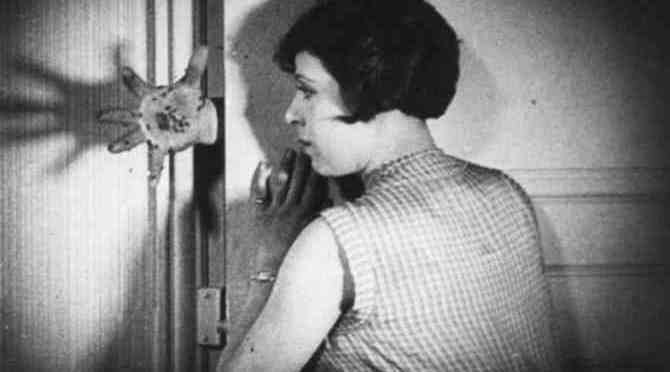
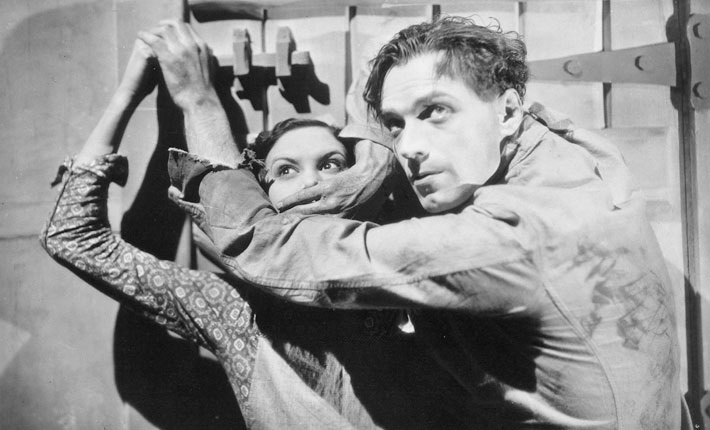
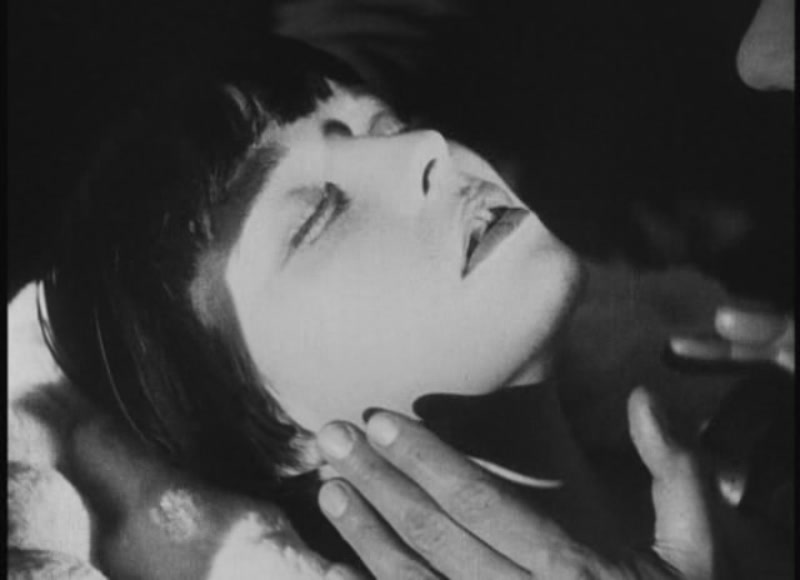
There are particular images that were central to the Surrealist movement. The human hand, for example, became a frequent Surrealist motif and can be seen in the movement’s films, paintings and photography. Why were these motifs so important to Surrealism and why do we continue to discuss them as part of the movement’s history? To understand why we must look to the Surrealist films of the 1920s, specifically Un chien andalou (Salvador Dalí and Luis Buñuel, 1928) and L’Age d’Or (Buñuel, 1930) and how key scenes emphasised the reoccurring themes that were so central to this movement.
The repetition of hands in Un chien andalou is, to put it simply, a symbol of fetish: what hands can do and how they can generate both intense pleasure and intolerable pain. Williams has commented that ‘the function of the fetish arises from the fear of castration’ and can only be preserved through making the object in question a symbol of fetish.[1] The repetition of wounded and severed hands in the film represents castration fear, and more specifically, a disembodied phallus. This is emphasised when we realise that all the hands, whether injured or exuding ants, are male. Continue reading Surrealism, symbols and sexuality in Un Chien Andalou (1929) and L’Age d’Or (1930)→
Clara Bow never had a role quite as good as Clara Bow. This mini comic is a tribute to the beauty and talent of the famous flapper, but also a testament to her tragic life and truncated career. The author, Jessica Martin, is an actress herself, best known for her work on Spitting Image and Doctor Who, so it follows that one of the strongest panels here dwells on the mechanics of screen performance. It’s a triptych of Bow’s eyes demonstrating the three stages of “it”: lovesick, passionate and innocent. But by and large, It Girl, which was inspired by a TV documentary on Bow, is concerned with the drama off-set: sex, drugs and mental instability.
Black-and-white panels flash back and forth across Bow’s life, looping in her childhood in Brooklyn, her Hollywood glory and her secluded decline. The gutsy rags-to-riches story is suited to the punchy graphic format. Bow’s beauty on screen was manifested not just in her slinky figure and doe eyes but her restless, vivacious movement and the comic-book style expresses this quality far better than a straight portrait or photograph. Bow’s appeal was famously elusive – the famous “It” of the comic’s title – if this graphic novelette leaves the reader craving the real thing that is nothing to be ashamed about.
It Girl plunges the reader straight into Bow’s psychological traumas, opening with a violent nightmare and a suicide attempt, then tumbling fast into a flashback to her childhood hardships. The pace never lets up, and across these 12 pages there is enough incident and emotional pain to flesh out a novel – or indeed a lifetime. It’s a whistlestop tour through a notoriously salacious biography, and as such it’s an experience that is as bewildering as it is bewitching.
Martin’s affection for her subject is tangible, though, and this is an invigorating introduction to Clara Bow. After this taster, it would be a hard heart that didn’t immediately want to reach for a DVD of It or Mantrap.
This is a guest post for Silent London by Stephen Horne, silent film musician and composer. The Silents by Numbers strand celebrates some very personal top 10s by silent film enthusiasts and experts.
Looking at some of the dictionary definitions of the word “haunting”, it strikes me that they are applicable to silent films in general. After all what could be more poignant, evocative or difficult to forget than watching long passed-away performers, their mute emotions given voice by music? The following films have extra elements that have made them lodge in my memory like nagging melodies. Usually there is something about them that is unexpected, unresolved or ambiguous. They often feel as though they end on an ellipsis, a cinematic ” … ”
These are all films that I have accompanied at some point, which is probably a big reason for their place in my heart. As I’m sure every silent film musician can testify, when a live accompaniment is going well, it can sometimes feel as if you are channeling the film in a way that can be positively uncanny. One warning. It’s in the nature of this subject that often what lingers most in the mind is the denouement. Therefore, what follows could potentially be regarded as an extended spoiler. Please approach with caution!
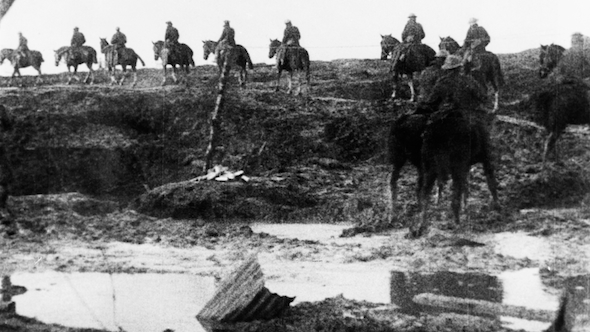
The Battle of the Ancre and the Advance of the Tanks (1917)
The Battle of the Ancre and the Advance of the Tanks (1917)
While The Battle of the Somme is much better known, the final images of its “sequel” remain more firmly in my mind. Seen in spectral silhouette, soldiers prepare “to continue the great fight for freedom”, as the intertitle puts it. Of course, what they are also heading towards is further slaughter. The original official score, a cue sheet medley rediscovered by Toby Haggith of the Imperial War Museum, calls for this finale to be accompanied by Land of Hope and Glory. Seldom has a musical suggestion seemed, at least to a modern sensibility, more heartbreakingly wrong. Which somehow makes it right.
J’Accuse (1919)
J’Accuse (Abel Gance, 1919)
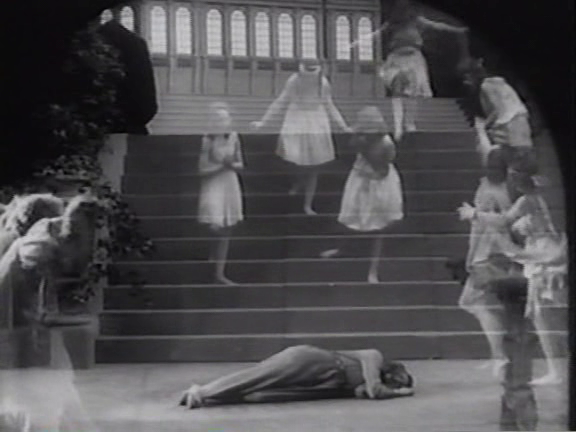
Gance’s first world war classic is full of images that scarify the memory. The March of the Dead is the most famous example: is it to be interpreted literally, allegorically or as a mass hallucination? The knowledge that Gance used real soldiers on leave from the front as actors makes the viewing experience all the more impactful: we are watching the cinematic portrayal of a phantom army, played by people who were soon to become phantoms themselves.
However, the moment that always slays me is a quiet one in the scene that immediately follows. Jean, now completely mad, re-enters his old home, looks around … and calls out his own name. He has lost everything, including himself.
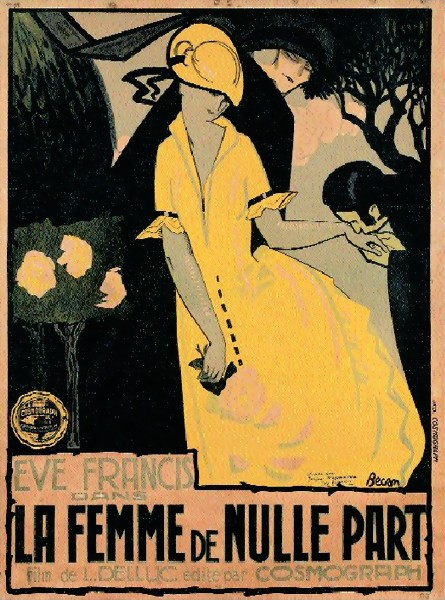
The Woman From Nowhere (Louis Delluc, 1922)
The Woman from Nowhere (Louis Delluc, 1922)
In 1996 the BFI programmed a season of films to coincide with the publication of Gilbert Adair’s book Flickers. Marking the centenary of cinema, this often-whimsical tome wove brief essays around a single still from one film of every one of those hundred years. Gilbert explained in his introduction to the screening of this little-known film that he had never actually seen it. All he knew was the still image included in his book, but it was one that had haunted him: a woman standing alone, perhaps lost, on a path in the middle of nowhere. He had always wondered about the backstory that had led her to this point and was almost scared to watch the film, in case the reality disappointed him. Truthfully I don’t remember the film in detail, but now the same image lingers in my mind. For me the woman from nowhere is still standing on that road, lost for ever.
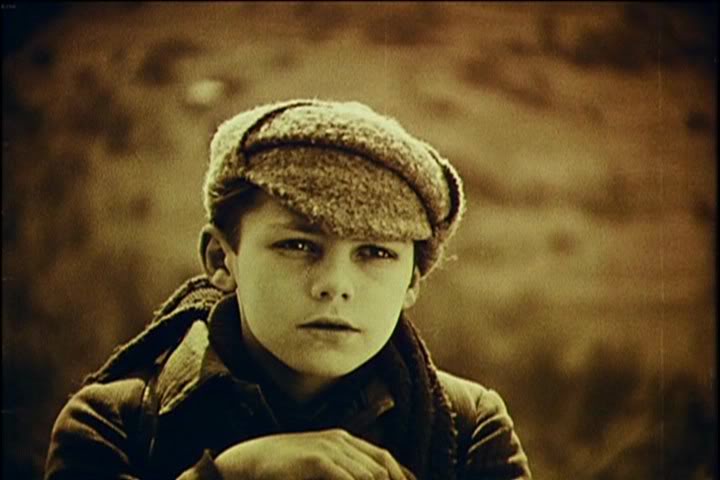
Visages d’Enfants (Jacques Feyder, 1925)
Visages d’Enfants (Jacques Feyder, 1925)
One of the most heartbreaking films ever made, despite the perfectly rendered happy ending. What lingers is the impression of a child’s struggle to comprehend bereavement, uncannily conveyed in Jean Forest’s dark eyes. The moment when the boy sees his father crying for the first time is very prescient of the ending of The Bicycle Thieves.
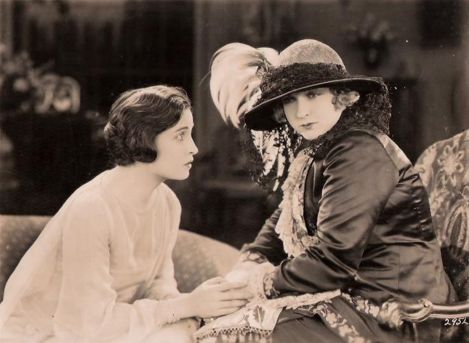
Stella Dallas (1925)
Stella Dallas (Henry King, 1925)
Where does Stella go, after she walks away from the window? Something in her expression indicates that she has come untethered and I always imagine that she eventually drifts into homelessness. Sometimes if I see an elderly homeless woman, having a conversation with an unseen third party, I think: “Stella – talking to her daughter … ”
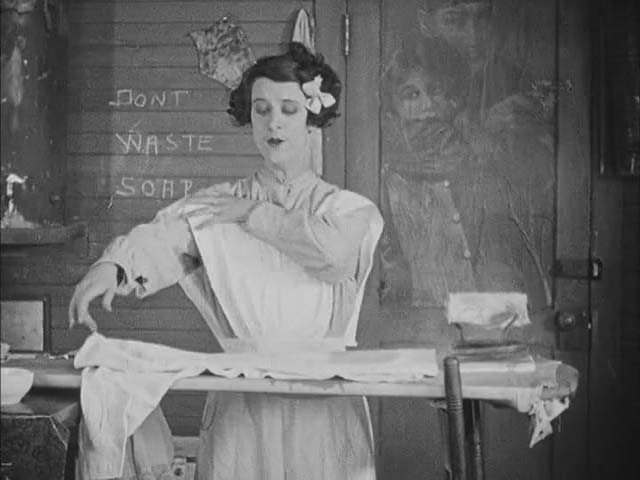
Exit Smiling (1926)
Exit Smiling (Sam Taylor, 1926)
Is it possible for a comedy to be haunting? The film is delightfully funny, but it is the heartbroken expression on Beatrice Lillie’s face at the bittersweet climax that seems to resonate longer. Her character has been courageous and loveable and she deserved better. It’s also a surprising and brave way for a comedy to end.
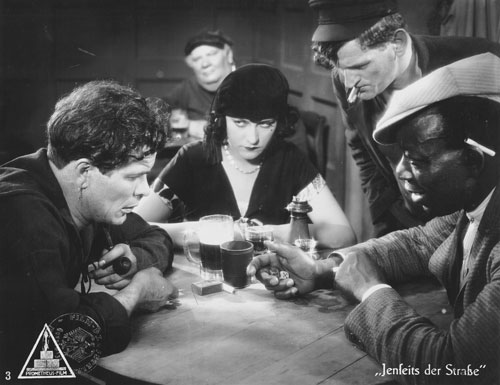
Jenseits der Strasse (1929)
Jenseits Der Strasse (Leo Mittler, 1929)
I saw this at the Bonner Sommerkino many years ago. The expression on the face of Lissy Arna’s streetwalker in the last scene burned itself into my memory. The moment itself is partially comic, as the gross belly of her next client protrudes centre-frame. However as she tries to smile at him, her vacant eyes belie the fact that her personal window of happiness has definitively slammed shut.
A Cottage on Dartmoor (1929)
A Cottage on Dartmoor (Anthony Asquith, 1929)
What I love most about Asquith’s masterpiece is the ambiguity of its final act. Few other silent films seem to generate so much discussion of character motivation. Is Sally’s forgiveness of Joe purely born of compassion or does she perhaps regret her life choices? When he asks “are you happy?” she seems to pause a beat too long, before turning her head away from him and answering “very”.
The final scene, which transcends an often wonderful but undeniably uneven film, is poignant in many ways. Louise Brooks’ character is watching herself in a screen test – one that will determine her future career in talking films – when she is shot dead by her ex-lover. While silent film Louise dies in the foreground, sound film Louise continues to sing on, framed in the screen behind her. It seems like a metaphor for both Brooks’ own soon-to-be curtailed career and the imminent death of silent films.
The Force That Through The Green Fire Fuels The Flower (Otto Kylmälä, 2011)
A slight indulgence, partly as this is a 21st-century silent, but also because I provided the music. However, I make no apology, as Otto Kylmälä’s seven-minute jewel of a short ends with a truly haunting moment that I won’t spoil, as it’s not generally available to watch at the moment. But you’ll know it when you see it. Come to think of it, the moment is accompanied by a rather haunting melody… …
This is a guest post for Silent London by Robyn Ludwig,. The Silents by Numbers strand celebrates some very personal top 10s by silent film enthusiasts and experts.
Gertie the Dinosaur (Winsor McCay, 1914)
Long before there was Bambi or Simba, there was Gertie. The simple ink dinosaur charmed vaudeville audiences with her feisty attitude, and she remains to this day a masterpiece of keyframe animation.
Humorous Phases of Funny Faces (J Stuart Blackton, 1906)
The first entirely animated film, Humorous Phases is a classic lightning sketch film, with chalkboard characters brought to life through stop-motion and cutout animation.
Felix in Hollywood (Otto Messmer, 1923)
Here the iconic kitty meets Charlie Chaplin, Douglas Fairbanks and film censor William Hays, in the first cartoon to feature caricatures of Hollywood celebrities.
Fantasmagorie (Emile Cohl, 1908)
The morphing stick figure clown, inspired by Humorous Phases, is considered the earliest frame-by-frame hand-drawn animation.
Aschenputtel (Lotte Reiniger, 1922)
Reiniger’s elegant silhouette animation creates a surreal fairytale world that is both shadowy and sharp.
There’s a silent half-hour comedy on the iPlayer right now. It will be there until 19 March 2014 and I reckon you should check it out. Here’s the link.
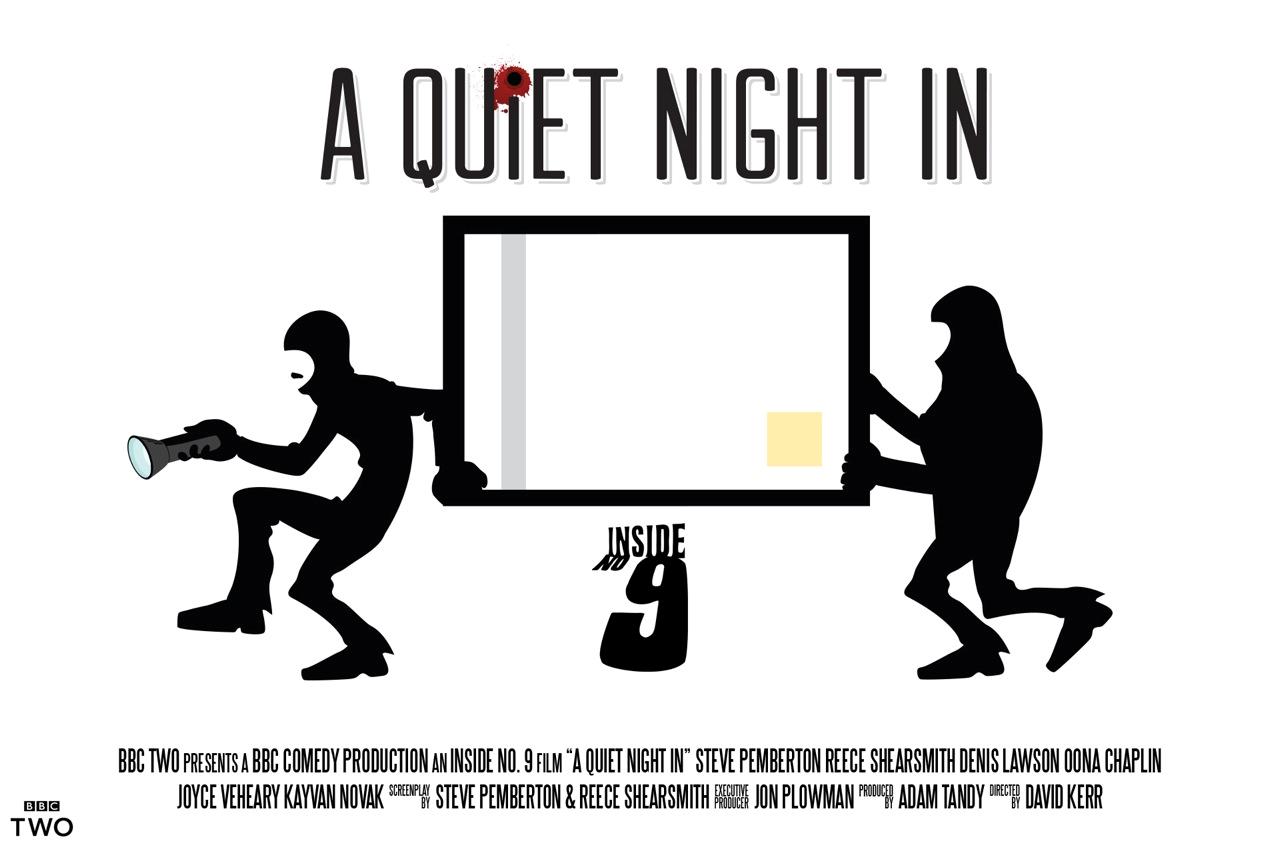
Steve Pemberton and Reece Shearsmith’s new anthology series of standalone half-hour comedies has been picking up rave reviews. But the excitement turned positively feral on Wednesday night when episode two, A Quiet Night In, aired on BBC2. The episode features an old rich geezer (Denis Lawson), the two cat burglars who are trying to half-inch his priceless modern art (Pemberton and Shearsmith), his trophy, er, wife (Oona Chaplin) and a door-to-door salesman (Kayvan Novak) – and for the very most part, it is deliciously dialogue-free.
Just to be clear, Inside No.9 last night was a masterclass. IN EVERYTHING. iPlayer at your earliest convenience.
What I really like about what Pemberton and Shearsmith have done is that the idea may be an old one (they have talked about Mel Brook’s Silent Movie as an inspiration), but the tone of A Quiet Night In is far from rowdy slapstick of much modern silent humour, or even the genre-spoofing horror-comedy of their Psychoville series, which was just as inventive as Inside No 9 is shaping up to be. A Quiet Night In is a clever, and very dry comedy – in parts it is almost bleak. It is certainly not for kids, nor sensitive dog lovers. And you’ll never look at kitchen paper, Post-Its and baking foil the same way again.
A silent Inside Number 9 – magnificent! And with Oona Chaplin, too. http://t.co/wd550HMoSQ
That Oona Chaplin has a starring role will doubtless please the silent fans – one can only imagine what her grandfather would have made of what lurks under the bedstead here …
On this site you can find out a little more about A Quiet Night In, and watch clips, including a video of the creators discussing their motivation for writing a silent episode.
All this will have to tide us over until Matt Lucas’s Pompidou airs later in the year on BBC1. Yes, the Little Britain star is working on an entirely silent comedy series for the Beeb’s flagship channel. No catchphrases, no David Walliams. Lucas is co-writing, and he will play the title character, “an elderly aristocratic English oddball who has fallen on hard times but who remains upbeat and resourceful”.
It seems the idea is catching: two very famous ITV stars want to develop their own silent comedy project too. Mr Lucas is very supportive, as you can see.
I wonder if @antanddec’s forthcoming silent comedy TV show will be called ‘Let’s Get Ready To Mumble.'
In my screening programme Nobody Ordered Wolves, I am always seeking startling work that will match the shock of entering the unusual spaces I seek out for the events. When I happened upon Kilburn’s Tin Tabernacle – an amazing tin church built in the Victorian period, its insides later converted by sea cadets to surreally resemble a ship’s – I knew I needed a film that would produce the same “shock of the old”. As luck would have it, there remained a work about the sea that held the same surprise that entering a ship run aground in North London did for me. The film is Finis Terrae and it was produced by neglected master director Jean Epstein.
As a child, Jean Epstein (1897–1953) was, “afraid to go to the cinema”:
I had heard perfectly reasonable adults speak strongly about horrific details of the conflagration at the charity bazaar where, it seemed, a bishop was burned alive. In my premature logic, I told myself that if a bishop can die at the cinema, all the more reasonable that I would, since I was surely not so well protected by the will of God; I would cry and stamp my feet and enter into mad crises of despair when I would see my parents prepare to go to the cinema: I was never sure they’d return alive.
This piece of magical thinking maps out Epstein’s later career in the cinema. Filmmaking was a matter of mortal stakes for the Polish-French director, writer and poet, and was carried out with an evangelical, religious fervour. Despite crowning achievements and innovations in a variety of fields – encompassing silent and sound work, commercial biopics and avant-garde shorts, high cinema theory and thoroughgoing technical experimentation – Epstein’s ability to capture the life of the sea is unparalleled.
Whatever childhood qualms he held were brushed aside after making the acquaintance of the Lumière Brothers themselves. Abandoning his studies as a doctor, Epstein jumped at the chance to co-direct a film biography of Louis Pasteur. He then produced a string of studio works in the 1920s, before founding his own film company where he directed some startling narrative works, from melodrama (Coeur Fidele, 1923) to horror (The Fall of the House of Usher, 1928). In parallel, Epstein was bravely and idiosyncratically theorising the world of the cinema. Although the subjects in his writings are diverse (even choosing from the sadly limited number available in translation), his consuming passion is how to make the focus of cinema what he terms “photogénie”. While even Epstein himself admitted “you fall flat on your face trying to define photogénie”, at its core, it is the specific extra quality that objects take on when they are filmed, and the new light that this casts on them. Epstein describes this process in typically lyrical fashion:
One of cinema’s greatest power is its animism. On screen there is no still life. Objects have attitudes. Trees gesture. Mountains … signify. Each element of staging becomes a character.
For Epstein, this idea held equal weight in theory and practice: his version of The Fall of the House of Usher focuses on the desperate, haunted attempt by Roderick Usher to capture the image of his sister in a portrait that he is obsessively paints of her. This provides a ripe metaphor for Epstein’s own artistic battle, as he tries to use the aesthetic means of film to reflect the world back to the viewer. Epstein was known for his use of many formal techniques (superimpositions, slow-motion, extreme close up) but his aim was never to create an alienating surrealism, but instead cast a cinematic spell that would reveal an object as it truly is.
Yet, after producing … Usher, his most formally lavish film, he separated himself from the Paris cinema milieu and departed for remotest Brittany.
I had the feeling that it was impossible to further capture the real using the unreal. Finis Terrae was my attempt to get past this dead end.
Although Epstein had long been fascinated by the sea, it was a grotesque fascination: half disgust and half attraction. Citing Edgar Allen Poe’s story The Imp of the Perverse, he described his consuming fear of the ocean, though a fear ‘that obliges us to do what we are afraid to do.’ Epstein made five films about the sea across two decades, starting with Finis Terrae in 1929. All but one is set on the Breton coast; like the rhythms of the tide that he placed so centrally in these films, his mind and travel plans kept pulling him back to the region.
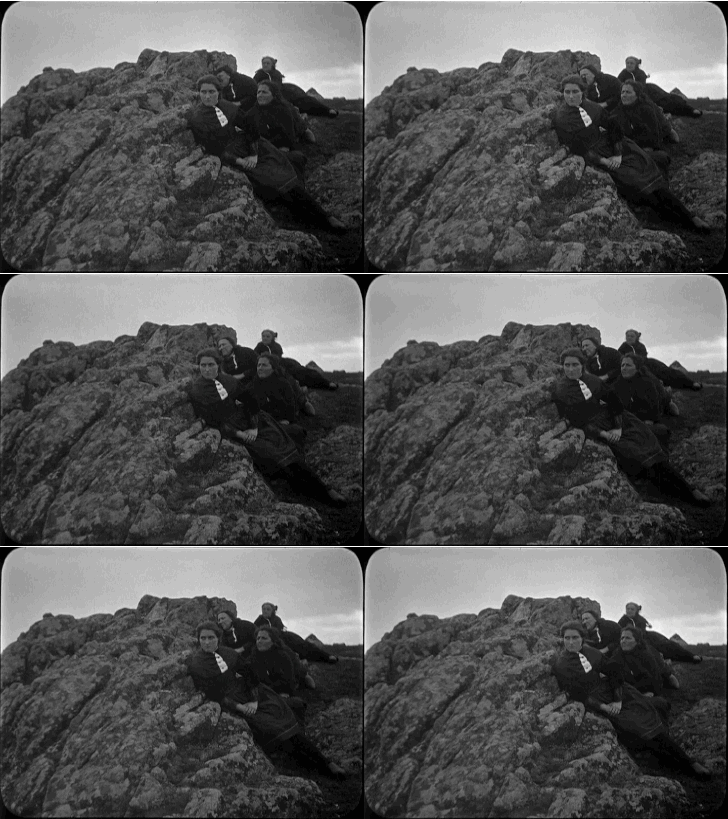
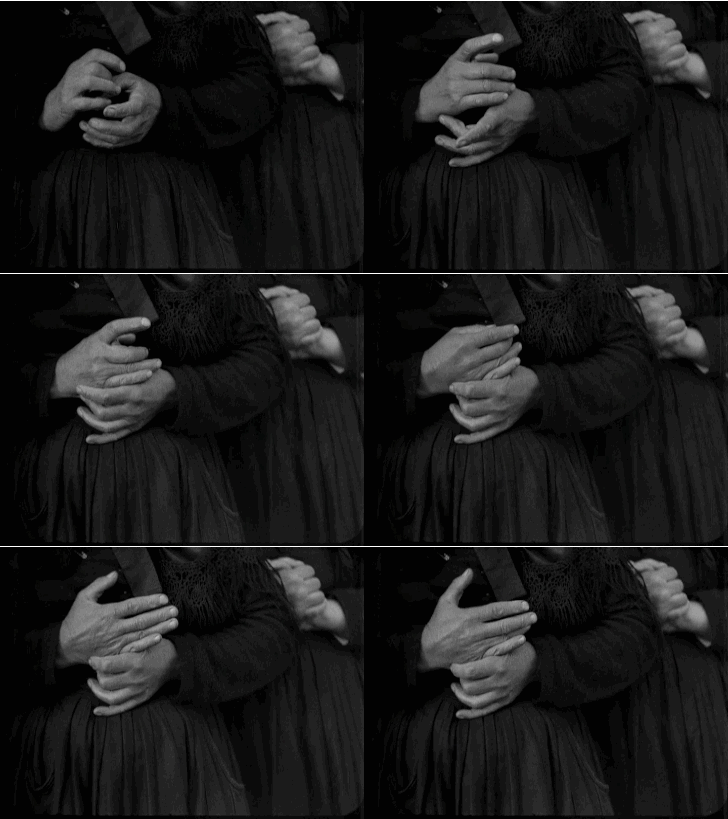
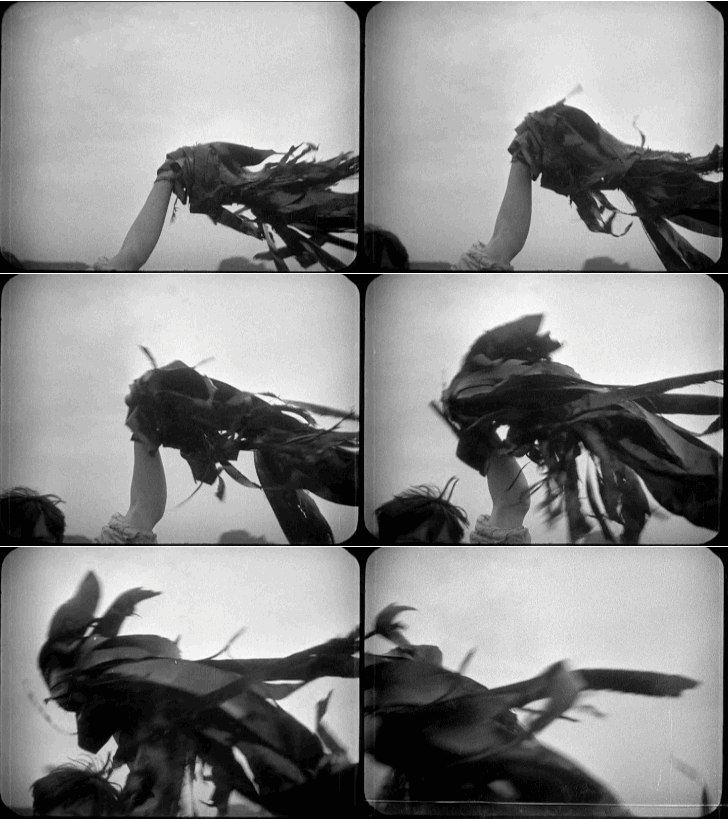
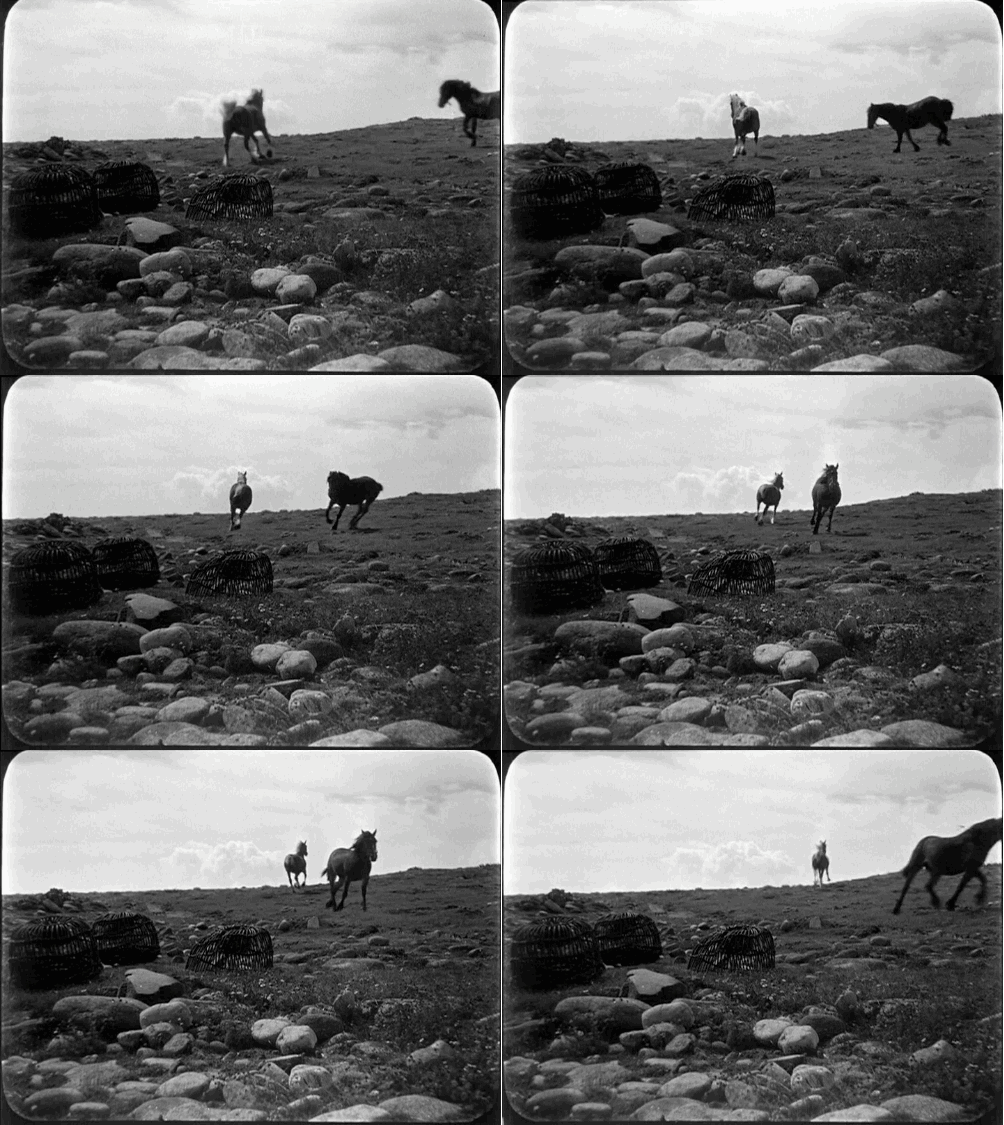
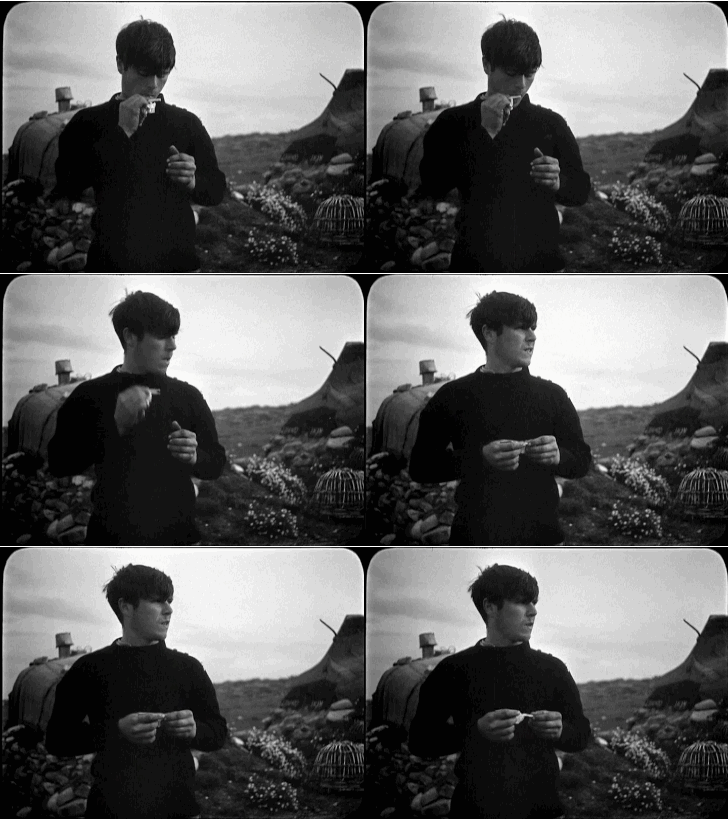
In Finis Terrae, the untouched quality of the Breton coastline allowed him to showcase seemingly simple elements to spectacular degree: the folding of a pair of arms, the fluttering of ribbons in a girl’s hair and, most persistently, the moods of the sea against the unchanging rocks. The space of Brittany gave him licence to completely renew his aesthetics, finding in the coastline the kind of natural photogénie that he had struggle to produce through artificial means in his earlier work:
Leaving the Ouessant archipelago, I felt I was taking with me not a film, but a fact and once this fact had been transported to Paris, something of the material and spiritual reality of the island life would henceforth be missing. An occult business.
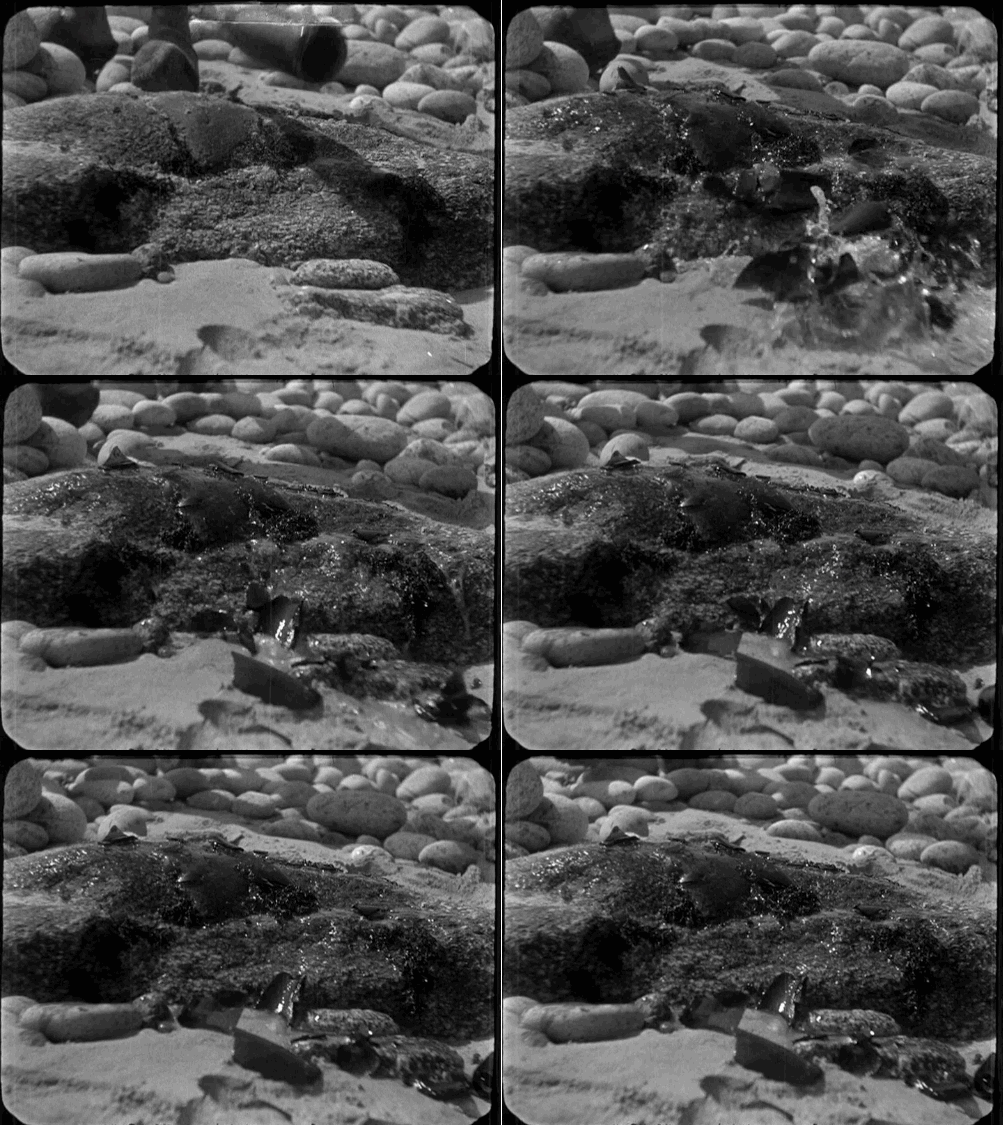
Epstein believed that cinema held the unique power to show us the fundamental objective truth that is usually shattered by subjectivity; he delighted in the French term for a camera lens, le objectif. Appropriately then, Finis Terrae’s plot was “torn from the headlines”, though markedly more sedate headlines than the cinema usually draws on. In the film, a seaweed gatherer on a remote coastal island accidentally cuts himself on a bottle, and the wound quickly becomes infected. Initially he is derided by the other seamen for his malingering, but soon they realise the mortal stakes and attempt the difficult sea crossing to the mainland.
As Epstein hoped, his mode of framing life in Ouessant acts as an “eye-freshener”: one comes away from the film brimming with cinema’s potential. Although Epstein exposes much that is exotic and novel in his docudrama, the film never patronises the Breton lifestyle. One thinks of Murnau and Flaherty’s Tabu: A Tale of the South Seas(1931), which, despite its beauty and “documentary” approach, has an outsider’s touch throughout, seeking to fillet the lives of the islanders for their “otherness”. Whether or not one can claim objectivity, Epstein was not simply another Paris intellectual seeking authenticity in the “naïve” life of the natives. Brittany represents a space of the uncanny for Epstein, where the smallest mistake can have life-threatening consequences:
In this place and people is resumed the mystery of men dedicated to land that is but rock, to sea that is but foam, to a hard and perilous trade suffering a meagre self-sufficiency.
Instead of “the other”, Epstein shows life in Brittany as a legitimate alternative to the alienation of modern life. He also had other reasons for seeking alternate lifestyles: as was uncovered when his full archives were made available, Epstein was gay and, under a pseudonym had written a pioneering treatise on Masculine Homosexual Ethics. With this information, the companionship between the younger seaweed gatherers takes on a new cast. Brittany at that time was heavily dominated by the Catholic church, but fishermen – unable to attend mass on a regular basis – were relatively exempt from their sway. In the male-only world of the archipelagos, a beautiful and separate world could flourish. The narrative trajectory of Finis Terrae can easily be read as a parable of two male lovers who come to realise their value to each other.
Epstein’s other works of the sea are equally compelling, but it is with this first work that he made his definitive statement about the power of the ocean. Coastal life is constantly in flux; for a filmmaker who believed that “still life is an abominable on screen … a sin against the very nature of cinema”, it allowed him the perfect location to capture the ecstatic essence of film.
This article is heavily indebted to Jean Epstein: Critical Essays and New Translations (Amsterdam University Press), which is available as a Creative Commons licenced free e-book here. Many thanks also to Bathysphere Productions for generously sharing a viewing copy of James June Schneider’s beautiful documentary Jean Epstein: Young Oceans of Cinema, which will be included in the upcoming (and much needed) box set of Jean Epstein’s works from Potemkine, due to be released in May 2014 to coincide with a retrospective of his works at the Cinemateque Française.
This is a guest post for Silent London by Nina Giacomo from Brazil, who blogs at Primeiro Cinema. The Silents by Numbers strand celebrates some very personal top 10s by silent film enthusiasts and experts.
The great majority of the films made between the origins of cinema and the 1910s had colour in some way. People often don’t know that because a lot of films from the 1920s were actually released in black and white and so the evolutionary view of film history makes us think that silent cinema was deprived of colour. But, since the beginnings of cinema, a lot of research was done into colour film and two tendencies were explored: the colourisation after the film had been shot and the capture of “natural colours” while shooting.
This is not a “top 10” list … It is a selection of 10 films that show a variety of ways of giving colour to the moving image. It is my list of 10 must-watch silent colour films!
Annabelle Serpentine Dance (Edison, 1895)
The first of many films dedicated to the “serpentine dance” created by the american dancer Loïe Fuller in 1889. The hand colourisation, frame by frame, represents Fuller’s spectacular stage effects, which combined the constant flow of the dress’s movement with the projection of electrical lights.
Pierrette’s Escapades (Alice Guy-Blaché, 1900)
A vibrant example of hand-colouring made by Gaumont.
Untitled experiments (Edward Turner, 1901/02)
Theses pictures, recently discovered, are actually a series of tests for a new invention. They show how early the attempts to reproduce “natural colours” began.
A Trip to the Moon (Georges Méliès, 1902)
The colour version of this film was unknown until 1993, when it was found in Barcelona in a terrible condition. Not until 2010 could the restoration could be released and it transformed the image we have of this most iconic of all silent films.
The Lonedale Operator (DW Griffith, 1911)
Here we have an interesting use of colour in silent cinema. The young lady can only trick the bandits (making them believe that she has a gun, when actually it is a wrench) because the scene takes place at night. The blue tinting suggests the time of day.
This classic has just been restored and the new version will be shown in February at the Berlin International Film Festival with its original tinting and toning … I can’t wait to see it.
Virginian Types: Blue Ridge Mountaineers (1926)
An amazing example of Pathécolor, just recently discovered. It shows us a late use of this method that was pioneered by Pathé in France during 1905. Stencils were used to automate the hand-colouring of films.
Lonesome (Paul Fejos, 1928)
A hybrid in many ways: this is a silent, talkie, black-and-white and colour motion picture. The colour scenes are just marvellous.
The Love Charm (Howard Mitchell, 1928)
And here is a little known example of the two-colour Technicolor process. A weird love story in amazing colours.
Nina Giacomo
Do you agree with Nina’s choices? Share your suggestions below
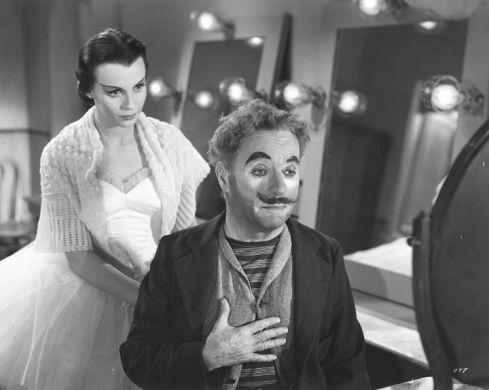
Claire Bloom and Charlie Chaplin in Limelight (1952)
Don’t tell me you missed the fact this year, this February in fact, we are celebrating 100 years of Charlie Chaplin’s Tramp. Kid Auto Races, Chaplin’s first screen appearance as the anarchic scruff, was released on 7 February 1914. It’s a cinematic centenary of the best kind – one that affords the opportunity for screenings of wonderful films and some clever-clever comment and analysis too. An event at the BFI Southbank on 4 February will add a little star power to proceedings, as well as some new insights into the Tramp and his creator.
At The Centenary of the Little Tramp David Robinson will be talking specifically about how Chaplin drew on the music hall tradition of his youth to create his signature character – and how those influences stayed with him and found a beautiful expression in the gorgeous 1952 film Limelight.
This special event marks the centenary of the birth of Charlie Chaplin’s ‘little tramp’. One hundred years ago this week the iconic character first stepped in front of the camera at the Keystone studios. David Robinson, Chaplin’s official biographer, presents his latest thoughts on Chaplin and the tramp and celebrates the launch of his new book ‘The World of Limelight,’ commissioned by the Cineteca di Bologna, which draws on previously unpublished material from the Chaplin Archive.
Robinson will be launching his book at the event and I think copies will be on sale after the talk with perhaps a booksigning too. A particularly well-informed little bird tells me that Chaplin’s co-star in Limelight, English actress Claire Bloom, will be in attendance also. In fact, Robinson’s book is dedicated to her. Here’s a little more about the book:
Limelight was first cast not as a film script, but as a long novella, Footlights, with the supplementary Calvero’s Story. Both are here published for the very first time – the ultimate raison d’être of this volume. Out of these Chaplin extracted a screenplay which passed through several drafts before being transferred to the screen.
The accompanying commentary in this volume explores the documentary reality of the world which Chaplin recreated from his memories and evoked for posterity – London, the music hall and ballet at the end of an era, the outbreak of the First World War. The book is illustrated with images from the author’s own collection, and reproductions of documents and photographs from the Chaplin archives, which clearly depict the development of the film LIMELIGHT that David Robinson so intricately describes.
This is a guest post for Silent London by noted silent cinema musicians Neil Brand and Philip Carli. The Silents by Numbers strand celebrates some very personal top 10s by silent film enthusiasts and experts.
There are more of these X-rated moments than you might think and people will have plenty of their own choices according to taste, shockability and squeamishness. By definition, all silent cinema is pre-Code and Will Hays was brought into the Hollywood fold as censor in the 1920s not just because of Hollywood’s own scandals, but because filmmakers were pursuing stronger, more adult storylines and nobody seemed to be taking the lead on what was acceptable. So, by way of giving the lie to the idea that silent cinema is somehow cinema in adolescence, here’s a list of some memorable times when the boundaries were pushed, in descending chronological order.
All Quiet on the Western Front (1930)
All Quiet on the Western Front (1930)
And yes it was also released as a silent! A soldier grips the barbed wire during an attack, a shell explodes and only his arms remain hanging from the wire. One of many unforgettably horrific images from this great film.
Diary of a Lost Girl (1929)
Diary of a Lost Girl (1929)
The brothel dance as the couples peel off to their various rooms is as easygoingly suggestive as you could want and easily more “real” than anything Von Stroheim could have dreamed of. Mind you, Louise Brooks would undoubtedly have made it into this list somewhere.
Joan Crawford and Norman Kerry in The Unknown (1927)
The Unknown (1927)
Having cut off his own arms for love of Joan Crawford (who can’t bear to be touched), murderer Alonzo (Lon Chaney) has to watch her responding sensually to the arms of a circus Strong Man (Norman Kerry) she has fallen in love with. Again, most Chaney films would qualify for this list, particularly the Tod Browning ones, for a whole different set of reasons. The Penalty, Victory, West of Zanzibar, all feature scenes or entire plotlines that would have trouble getting past the censor five years later. Meanwhile, Joan Crawford had already made at least one appearance in an extant pornographic film while still a struggling actress.
Captain Salvation (1927)
Captain Salvation (1927)
An X-certificate intertitle in which Pauline Starke screams at Lars Hanson “My step-pa ‘helped’ me once – a good thing the baby died!”
The Flame of the Yukon (1926)
The Flame of the Yukon (1926)
A fiery end for the villain in this movie (if memory serves) who is set alight by a kerosene lamp thrown at him, the flames only being quenched when he falls to his death.
Behind the Door (1919)
Behind the Door (1919)
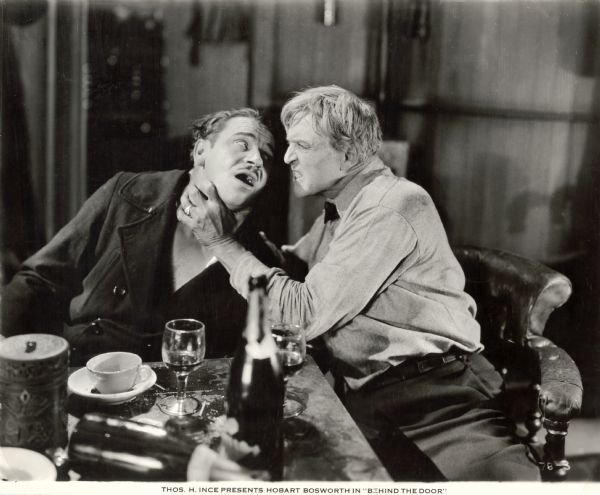
With memories of WW1 still fresh in the minds of audience and makers alike, this uncompromising tale of a husband’s bloodthirsty revenge on brutal German submariners who raped his wife ends with the title “I tried to skin him alive but the sonofabitch died on me!”
Intolerance (1916)
DW Griffith gave Babylon the full treatment, including a bathing orgy with lovingly shot nudes. Even more so than was the case with Cecil B De Mille and scantily clad classical maidens, Griffith seems to have demanded jaw-dropping realism and sensuality from his cast.
The Cheat (1915)
Sessue Hayakawa brands Fannie Ward in unflinching close-up, because as he puts it, he brands “all his property …”
Hypocrites (1913)
Lois Weber’s film has a quite gorgeous “Naked Truth” wandering through most of the four allegorical reels. Although this was obviously intended to edify rather than titillate, audiences were unlikely to have been as artistically mature about this as Weber might have hoped. Mayor James Curley of Boston supposedly insisted that clothing be painted on her in every frame in order to get the film past the city censors.
An Interesting Story (1904)
A man gets run over flat by a steamroller in James Williamson’s An Interesting Story – OK, two cyclists inflate him back to life again, but think what a shock it would have been to audiences of the time!
This is a guest post for Silent London by Alison Strauss, director of the Hippodrome Festival of Silent Cinema, Bo’ness. The Silents by Numbers strand celebrates some very personal top 10s by silent film enthusiasts and experts.
Our Dancing Daughters (1928)
Our Dancing Daughters (1928, Harry Beaumont)
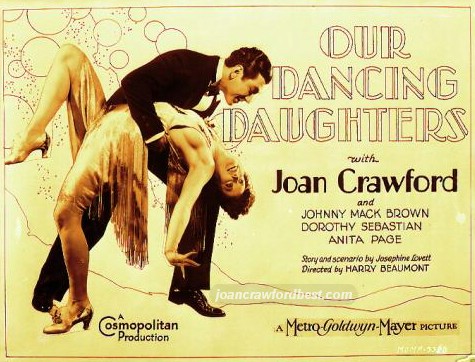
The moment when fun-loving flapper Joan Crawford launches herself on to the dance floor and sets the party alight with a high-tempo Charleston, ripping her skirt to a more liberating length as she goes.
Danse Serpentine (1896, Auguste and Louis Lumiere)
The 45-second kaleidoscopic record of a vaudeville dance – created by pioneering dancer Loie Fuller – in which an anonymous performer elegantly whirls her arms in the long-flowing fabric of her costume to mesmerising effect, thanks to the immaculate hand-tinting work of the Lumiere Brothers’ army of finely skilled women behind the scenes.
Pandora’s Box (1929, Georg Wilhelm Pabst)
Trained dancer and former Ziegfeld Follies girl, Louise Brooks is electrifying as Lulu, especially when, with all eyes on her, she takes to the floor at her own wedding with yet another admirer – a female guest – and the pair dance in a sexually charged vertical embrace.
The Four Horsemen of the Apocalypse (1921, Rex Ingram)
Another raunchy tango, this time with Rudolph Valentino in a sequence that launched him as a legend. The woman in Julio’s arms submits to his overpowering masculinity in this iconic routine that set the standard for all subsequent movie tangos.
(Watch from 14 mins, 50 seconds)
That’s My Wife (1929, Lloyd French)
Stan Laurel is persuaded by Oliver Hardy to masquerade as his wife in order to secure the bequest of a rich uncle. In one of the funniest sequences Stan, looking lovely in an evening gown, dances the two-step with Ollie in an effort to shimmy a stolen necklace down through his undergarments!
This is a guest post for Silent London by Paul Joyce, who blogs about silent and classic cinema at Ithankyouarthur.blogspot.co.uk. The Silents by Numbers strand celebrates some very personal top 10s by silent film enthusiasts and experts.
Cinematic dreams are a staple of the silent era more than any other, possibly because much of what was on screen had only previously been experienced in dreams for contemporary audiences. Now our dreams are founded on over a century of cinema and we’re so much harder to impress but … we can still dream on. Here’s a top ten of silent dreams with a couple of runners up as a bonus.
The Astronomer’s Dream (1898)
A madly inventive three minutes from George Méliès in which an old astronomer is bothered by a hungry moon as the object of his observation makes a rude appearance in order to eat his telescope.
Dream of a Rarebit Fiend (1906)
A feast of special effects in Edwin S Porter’s cautionary tale on the matter of over-indulging in beer and cheese. Jack Brawn plays the titular fiend who suffers all manner of indignities once he staggers home to his bed, whereupon his sleep is interrupted by rarebit imps and his bed flies him high into the night sky … Proof that the whole cheese-and-dreams rumour is actually true.
Atlantis (1913)
Atlantis (1913)
In August Blom’s classic – the first Danish feature film – Olaf Fønss’ doctor dreams of walking through the sunken city of Atlantis with his dead friend, as the passenger ship he is on begins to sink. It’s either a premonition or recognition that his true feelings have been submerged … JG Ballard was obviously later inspired to write The Drowned World.
Poor Little Rich Girl (1917)
Poor Little Rich Girl (1917)
After being accidentally overdosed with sleeping draught by careless servants, Mary Pickford’s character falls into a deep and dangerous sleep … As she hovers on the edge of oblivion the story runs parallel between the doctor trying to save her and her dreams in which those she knows are transformed in her Oz-like reverie. Sirector Maurice Tourneur excels as “the hopes of dreamland lure the little soul from the Shadows of Death to the Joys of Life”.
When the Clouds Roll By (1919)
When the Clouds Roll By (1919)
Douglas Fairbanks is harassed by vengeful vegetables after being force-fed too many in an effort to drive him to suicide (yep, it’s a comedy). Directed by Victor Fleming, who later returned to dreams with Dorothy and that Wizard. Continue reading The top 10 silent film dream sequences→
This is a guest post for Silent London by Kelly Robinson, and the first in a new series of posts bringing you very personal top 10s from silent cinema experts and enthusiasts.
From a programming point of view, it’s always good to have a few shorts up your sleeve: either to accompany a feature or to make up a shorts programme, which are always a good way to introduce new audiences to silent film. I’m trying to write short screenplays at the moment and I’m inspired by these film-makers, several of whom spent the majority of their careers working on shorts.
How to be an American Citizen (Alice Guy-Blaché, 1912)
Made in the US by Solax, film pioneer Alice Guy-Blaché’s production company, this is such a brilliant darkly anarchic comedy. View the version on the Retour de Flamme (06) disc by Lobster Films for one of the most inspired accompaniments to a silent film.
Ménilmontant (Dimitri Kirsanoff, 1926)
Breathtakingly stylish (talk about Eisenstein’s “kino fist”!) but also heartbreakingly moving, this is avant-garde cinema of the 1920s at its most profound. The scene on the bench is as poignant as anything by Chaplin or more recent master Krzysztof Kieslowski. Unforgettable.
Charlie Chaplin in Kid Auto Races (1914)
Kid Auto Races (Henry Lehrman, 1914)
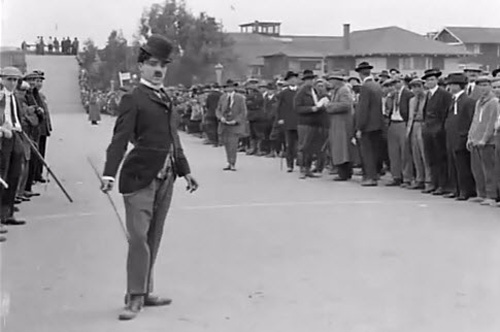
Chaplin’s Keystone films are sometimes written off as unsophisticated fare, preceding a more nuanced approach to style and content at later studios. However, Chaplin’s performance here is pure clown, and shows why contemporary audiences immediately wanted more, more, more of “The Little Fellow”.
Leave ’em Laughing (1928)
Leave ’em Laughing (Clyde Bruckman, 1928)
I just have to think about the final sequence of the Laurel and Hardy classic and I start chuckling madly to myself.
Daisy Doodad’s Dial (Florence Turner, 1914)
“The Vitagraph Girl” pulls a face at being one of the first screen stars.
The Battles of the Coronel and Falkand Islands (Walter Summers, 1927)
This is a guest post for Silent London by Jo Pugh, based on hitherto unpublished information about the military record of British film director Walter Summers.
“I did fairly well in the war – not that it would interest you very much.” – Walter Summers, interviewed by Garth Pedler in 1972
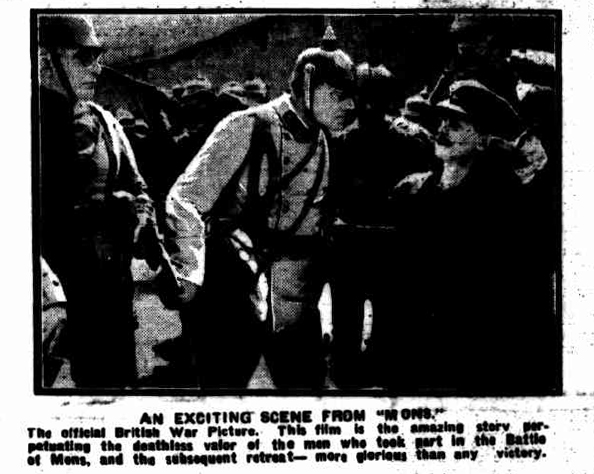
In 1924, Metro-Goldwyn-Mayer went to town on the international distribution of the British war film Mons, from the British director Walter Summers. Chronicling the 1914 defeat of the British Expeditionary Force in France (but a defeat as great as any victory – to paraphrase a classic Summers intertitle) Mons was promoted alongside Ben-Hur and its director “Captain Walter Summers, D.S.O., M.C.” praised for his wartime experience. One newspaper went further, asserting that Mons had “a genuineness and a reality that could only have been achieved by a director who had actually lived and fought during the immortal retreat.”[1]
Mons
History written by the victors is one thing, but history written by movie studio advertising executives may not meet the highest standards of evidence: Walter Summers did not fight at Mons, Walter Summers was not a Captain in the Great War, Walter Summers was not the recipient of a DSO. But the truth is not any less interesting. Walter Summers was a highly decorated war veteran but the precise details of his early life and military career have become a little mangled through a combination of hazy memory and the application of a bit of stardust. Surviving records allow us access to a little understood side of Summers and seem to place his film career in a slightly different light.
Walter Summers’ birth certificate
Walter George Thomas Summers was born on 2 September 1892 in the West Derby district of Liverpool. This date has become confused, probably because Summers seems so confused about it himself, writing conflicting ages on just about every official form going. His mother and father were both actors, his father (also Walter) a member of one of D’Oyly Carte’s touring companies who had a close association with Liverpool’s Royal Court Theatre. He died when Summers was quite young, leaving his mother, Mary Ann, to bring up Walter and his three sisters, Mary, Beatrice and Irene in Liverpool. In the 1911 census, Walter gives his occupation as “Theatrical Property Maker” – his association with the theatre began very early. On his application to become an officer, Arthur Lawrence, manager of the Royal Court Theatre, Liverpool, testifies as to Walter’s good character for the period 1903-6[2], in other words from the age of about 11 to 14. In their haste to join up in 1914, many young men lied about their age. Summers was a more seasoned 22 (though, characteristically, he wrote 21 on his form) and unlike many of his compatriots was not contemplating leaving England for the first time: he had already travelled to Australia and South Africa with Thomas Quinlan’s opera company, prior to his first film work with London Film Productions. This latter role probably culminated in work on George Loane Tucker’s version of The Prisoner of Zenda[3], in which a certain amount of armed European conflict is treated with all the seriousness of a works outing.
A thorougly Prussian baddie: Arthur Holmes-Gore as Duke Michael of Strelsau in The Prisoner of Zenda (1915). Holmes-Gore was killed at Gallipoli
London Film’s studio was a former skating rink at St Margaret’s, just over Richmond Bridge, which explains why Summers, the Liverpool boy, joined the army at Kingston. He joined up in October 1914, less than two months after the defeat at Mons. In retrospect, MGM’s claim that he fought at the battle is not very plausible: only members of the British Expeditionary Force, regular soldiers who had joined up before the war started, fought at Mons. Summers was a member of Kitchener’s volunteer army and would have been among the first significant wave of recruits to reach France. Even so, he didn’t leave England until the autumn of 1915, almost exactly a year after he had joined up. Joining as a private, Summers quite quickly rose to the rank of Sergeant in the 9th battalion of the East Surrey Regiment. This battalion is most closely associated with the playwright RC Sherriff, who used his experiences serving within it as the basis for his most famous play Journey’s End, subsequently directed on stage and then in 1930 on screen by James Whale, who had himself served in the Worcestershire Regiment. Summers and Sherriff knew each other but seemingly as comrades, not friends. Summers arrived in France a year before Sherriff and shortly after the battalion had suffered appalling losses at the battle of Loos. Subsequently, the 9th East Surrey fought at Ypres and the Somme. At the latter in July 1916, Summers was awarded the Distinguished Conduct Medal for his service at the Battle of Delville Wood. “A nightmare that men will dream again,” wrote the journalist Philip Gibbs, of the month-long conflict over the small piece of woodland believed to offer some tactical advantage. By the end of it, thousands had been killed and barely a tree was left standing.
Military Artist drawing of the Battle of Delville Wood, The Somme. July 1916. First published in “The Great War” Ed. H.W. Wilson, 1917
Summers won his Military Medal for leading a fighting squad of eight men from the battalion in a risky daylight raid on 25 January 1917 near Hulluch, in the Pas de Calais. One of six such squads, with orders to identify the unit opposite, “inflict losses” and obtain a sample of German bread, the small force ran across no man’s land under the cover of somewhat tardy smoke bombs and a smattering of “wild and erratic” machine gun fire.[4] With the element of surprise, the British killed a number of Germans (Summers shot at least one) before meeting “hostile resistance”. Summers’ group were among the last to withdraw from the German trenches. The force returned with three prisoners and the bread sample. By its own account it had suffered seven casualties and inflicted around 21. German records in contrast put their losses at eight.[5] Summers was personally commended for “the determined and fearless leading of his fighting squad”. Reading the description of the attack in the unit’s war diary, it is impossible not to be reminded of the raid depicted in Journey’s End. This is because it was indeed Sherriff’s inspiration for the attack that preoccupies his characters in the second half of the play.[6]
Janet Gaynor and her Christmas tree, via the Toronto Silent Film Festival
Merry Christmas and a happy new year to all our readers!
It has been a very busy year – in the best kind of way. We witnessed the long-awaited return of Napoléon to the capital, a short but fascinating British Silent Film Festival – and the birth of a new intimate screening series, the Kennington Bioscope at the Cinema Museum.
There have been some wonderful screenings at our favourite venues – from the Gothic silents at the BFI Southbank to a range of international films at the Barbican cinema. Retrospectives of Marcel L’Herbier and Jean Grémillon at both venues introduced many of us to the further reaches of French silent cinema. Theatrical releases of Underground, Nosferatu and The Epic of Everest boosted silent movie awareness hugely. Blancanieves proved that the art is not lost.
On a personal note, I was lucky enough to visit the festivals at Bologna and Pordenone, and I have enjoyed another year of blogging, writing and speaking about the silent cinema I love.
Next year, we’re anticipating a Buster Keaton season at the BFI Southbank, the 10th Slapstick festival and several events to mark the centenary both of the Little Tramp and the onset of the first world war. For more details, of course, you can check the ever-expanding listings.
But before we get too ahead of ourselves, let me know below what your highlights and yes, maybe lowlights, of 2013 were silent-film wise. Was it a good year for the silents?
Followers of Silent London intending to attend the London Symphony Orchestra’s live accompaniment to Michel Hazanavicius’ 2012 The Artist, in December this year, might care to know about Royal Albert Hall screenings of “the genuine article” in the 1920s.
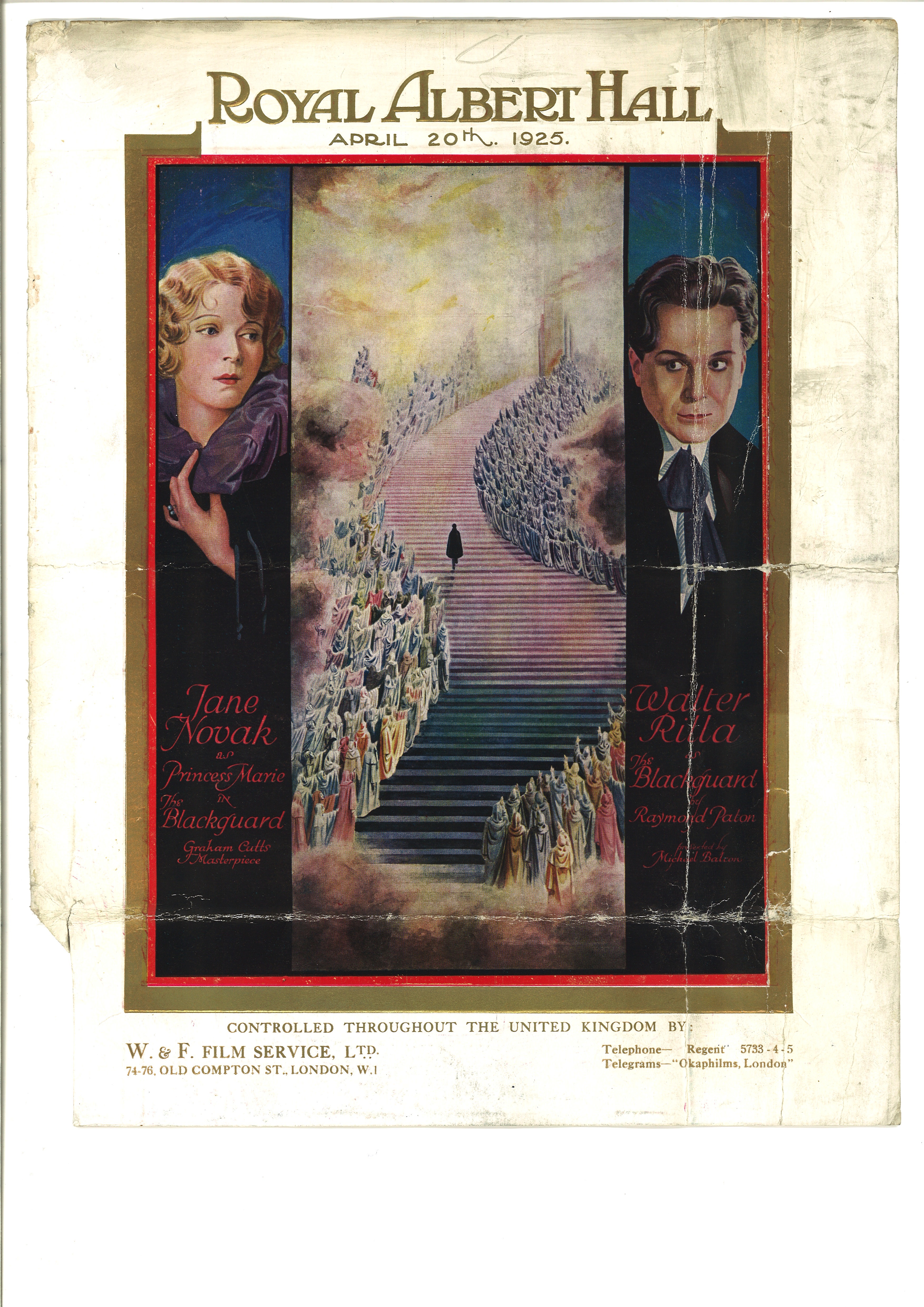
The end of the first world war was marked with a variety event, including films, at the hall. Subsequent presentations, running from October to December 1919, celebrated Allenby in Palestine and Lawrence in Arabia. Antarctic and Everest expeditions were commemorated in benefit screenings. In 1926, the RAF band contributed to a programme including a lecture by the aviator Alan Cobham, the film recording his arrival back in London after his flight to Australia, and an address from the prime minister of Australia: of course, the Imperial Institute was a close neighbour, perhaps influencing the selection of items recorded in the archive. European films screened included Murnau’s 1926 Faust and Turzhansky’s 1926 adaptation of Jules Verne’s Michel Strogoff. A lavish souvenir pamphlet (above) was published to accompany the trade show of Graham Cutts’ 1925 TheBlackguard, an adaptation of Raymond Paton’s novel, featuring a romance between a Russian princess and a violinist. A special attraction at the event was a dance performed by Serge Morosov “of the Imperial Russian School of Ballet”.
Faust (1926)
The novelist Naomi Mitchison, sister of JBS Haldane (a founding member of the Film Society) recalled in her memoirs the long run of Fritz Lang’s Die Nibelungen in the summer of 1924. The London Symphony Orchestra performed a Wagnerian prelude and a sub-Wagnerian score for the film (commented upon by Picturegoer critics as derivative), composed by G Huppertz.
The Sea Hawk (1924)
In addition to orchestral accompaniments, programmes give details of songs and soloists. Furthermore, for Frank Lloyd’s swashbuckler The Sea Hawk (1924), the prow of a ship was installed in front of the screen, while for Southern Love (Herbert Wilcox, 1924), balcony decorations and special effects were provided.
Indeed, a brief survey of Royal Albert Hall programmes confirms a more general observation to be drawn from the trade and general press: in the 1920s, performance and staging manifestly contributed much to the cinematic experience in London and to British audiences’ enjoyment of films, even outside regular cinema venues.
Amy Sergeant
The Artist screens at the Royal Albert Hall on 30 & 31 December 2013, with the London Symphony Orchestra and composer-pianist Ludovic Bource, conducted by Ernst Van Tiel. There is no official dress code for this event but anyone who wishes is encouraged to celebrate the elegance and style of Hollywood’s Golden Age of Glamour, and not just for the New Year’s Eve performances.
I know, we don’t look our age, but yes, Silent London has been keeping movie fans updated on silent film news, reviews and events for three whole years now. Thanks to everyone who reads this site, for your support, enthusiasm and intelligent comments. It has been, and continues to be, the cat’s particulars, and never a gimlet.
In the interview, Chandler asks Stephen about how he started out playing for silent films, and Stephen reveals that The Passion of Joan of Arc was the intimidating first film he ever accompanied. They also discuss the differences between composition and improvisation, and in more detail, the music that Stephen has played and written for Stella Dallas, The Manxman, Prix de Beauté and The First Born. Thanks to Chandler and Stephen for allowing me to post this fascinating conversation here on Silent London.
This is a guest post for Silent London by Neil Brand
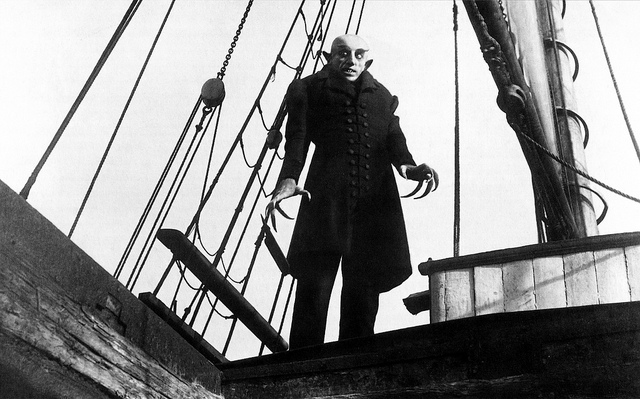
In 1925, Bram Stoker’s widow, Florence, won a plagiarism case against film producer Albin Grau over the latter’s 1922 chiller, Nosferatu. To be frank, Grau didn’t have a leg to stand on – he had applied for a licence to film Dracula, been refused by Florence and gone ahead with filming anyway, changing a few character names. This hardly distanced his film from Stoker’s Dracula, whose plot he had lifted lock, stock and barrel for Nosferatu and Florence successfully sued to get his company closed down and every copy of the film destroyed. Thanks to one vital copy, lodged at the time in the US where Stoker’s novel was already out of copyright, we still have the movie and every print now available descends from that one saved positive.
But I’m beginning to think that a skilful lawyer could actually have argued Florence down. Over a lifetime of playing this masterpiece I have noticed that in two vital areas scriptwriter Henrik Galeen and director FW Murnau actually created a new monster that Stoker would barely have recognised – firstly Van Helsing is a small-part character who is in no way responsible for Dracula’s destruction; secondly Nosferatu, minus Dracula’s brides, only has eyes for only one woman – Mina Harker. And it’s beauty that kills the beast.
Nosferatu (1922)
I’ll go further – Nosferatu/Orlok is not Dracula, but director FW Murnau himself – with the result that today’s vampires flitting through Twilight and The Diaries are the children, not of Stoker’s night, but of Galeen and Murnau’s. And the music they make is very different.
The magnificent central section of the film depicts the vampire heading towards Whitby/Wisborg on board ship, disposing of the crew one by one like some hideous onboard buffet while Harker/Hutter plods back home across the mountains. Waiting on the beach is Hutter’s wife, the strange, other-worldly Mina, staring out to sea and during her sleepwalking catatonia delivering the devastating line: ‘My lover is coming!’
Nosferatu (1922)
But which lover, the Count or the Husband? Let’s look at what has brought them all to this point – Orlok has seen Mina’s picture and is about to gorge himself on Hutter for the second night running. Mina, staying with friends who have rescued her from a perilous walltop sleepwalk, suddenly sits up in bed with a cry – across a single shot-cut (but miles of the Carpathian Mountains) Orlok freezes in mid-bite and turns to face the direction of her ‘voice’ – off camera right. In Witold, she slumps. In Transylvania, he moves away, his meal untouched. The next time we see him moving he is heading away from the castle and towards Mina, bearing his coffins. From then on it is as if she is already under his power – and, I would argue, he is under hers.
Nosferatu (1922)
It is impossible to play Orlok’s arrival in Whitby/Wisborg as anything but heroic – the beautiful shot of the ship sailing itself to the dock; the scuttling figure with the coffin stopping outside Mina’s house for a brief smile and his first head-and-shoulder close-up in the movie; then the final river trip, standing proudly in a supernaturally powered rowboat, which deposits him at his new property where he enters by melting through the locked doors. No wonder Herzog chose Wagner for that sequence in his Nosferatu 70 years later. Orlok is a conqueror claiming his kingdom, from which he will stare balefully at Mina’s window while his rats destroy the city. And we are now, however unwillingly, rooting for him.
Murnau, by all accounts promiscuously gay and self-conscious about his appearance, obviously loved his vampire with the outsider’s love of a soulmate gifted with powers he can only dream of. Every flesh-and-blood male character in the film is weak or deluded; Hutter himself can only sit feebly by while Mina takes the strong course in dealing with both infection and infector. But as she makes up her mind we see Orlok imprisoned in his palace imploring her attention with a look that can only be described as heart-breaking. When she acquiesces, he comes to the feast like Don Juan triumphant, the shadow of his bony fingers enclosing, not her neck but her heart, which he squeezes as she writhes beneath him. Herzog would provide the perfect closure for their nuptials, Orlok looking up from her throat at the dawning light, only to have her draw his head gently back to her neck with the gentlest of arm-movements.
FW Murnau
Audiences new to the film always laugh at the opening and the speeded-up actions, but it is a wonderful tonic to hear the silence descend as Murnau and his vampire exert their power. I have never been able to play triumph at the Nosferatu’s demise because we have been taught by Murnau to admire and pity him as well as fear him, and in the last thirty years Herzog, Coppola and Joss Whedon have all followed Murnau’s lead. Genius that he was, Murnau made the connection half a century before the rest of us did – we know Orlok because he is us.
Every silent film is an invitation to the musician to tell their version of the story and, yes, “Nosferatu, the Love Story” is a spin, one of many that could be applied to this great film. But here’s my point: treating it musically as a horrific love story opens vistas of new insight on this masterpiece that are vastly greater and more rewarding than the simple terrors of the night. And when the tension between horror, lust and desire is working, one can almost hear the new blood coursing through the vampire’s veins …
We’re all saddened by the idea of silent film heritage sites falling into decay and disrepair. So I thought you would like to know about this crowdfunding campaign to restore the historic Essanay Studios in Chicago. As if you don’t know, the Essanay Studio was a major player in the first years of the American movie industry. Stars associated with the studio in its infancy include Chaplin, Gloria Swanson, Wallace Beery, Ben Turpin, Francis X Bushman and, of course, Broncho Billy Anderson, who funded the company in 1907 with George Kirke Spoor.
The studio building is now a college, and is seeking help with funding for renovations, and to transform itself into an arts centre, with a studio, performance space and an area where people can come and learn some silent movie history.
Before there was Hollywood, there was Chicago. This initiative seeks to preserve and revitalize one of the world’s first and last remaining silent film studios and a unique piece of a great city’s history. The restoration and rebirth of the Essanay Film Studio Complex will provide an opportunity for people of all ages and backgrounds to learn and experience the magic and mystery of early film-making and Chicago’s unique role. It will also extend and expand the studio’s cultural legacy by providing a community space for the performing arts.
After blogging the whole festival day-by-day, there was just one job left to do: a quick wrap-up for the Guardian film blog. How nice to see a picture of Mabel Normand on a national newspaper website!
You can always keep up-to-date with my non-Silent-London writings (should you wish to), here on my website.