Happy holiday Silent Londoners! They say that if you remember 2025, then you weren’t watching enough silent movies. How much do you recall?
For myself I sure watched a lot of silent films, clocking up several festivals and individual screenings. Pordenone and Bologna, Zurich, Hippfest, Slapstick, Cinema Rediscovered, Women and the Silent Screen in Belgium, plus The Gold Rush centenary, Anna May Wong, Gosta Berlings Saga, Stella Dallas, Lillian Gish, Lois Weber, Film on Film and more at the Southbank. Did you catch Bonn, San Franciscso, the non-stop action at the Kennington Bioscope, or any of the many, many silent screenings all around the world? How about Sherlock Holmes?
As so often, I am going to have to ask a certain purist contingent to do their breathing exercises and locate the nearest fainting couch. Everyone else, buckle up!
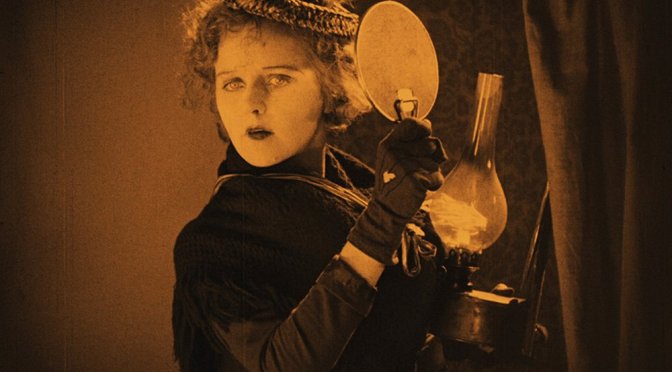
I have not one but two cases of pop silents to report. And as ever, I remain optimistic for both. First up is one that may be familiar to many already. The Pet Shop Boys, one of the truly great pop bands of the 80s and 90s, wrote an electronic-orchestral score for Battleship Potemkin (Sergei Eisenstein, 1925) several years back. There was a special outdoor screening in Trafalgar Square, where the band performed the score with the Dresdner Sinfoniker, orchestrated by Torsten Rasch, back in 2004. I missed that occasion, but I heard that it was pretty epic, despite the rain. Talk about Eastern Bloc sailors and West End, um, squares.
Season’s greetings Silent Londoners. It has been a whirlwind of a year. How much do you remember?
Personally, I watched silent movies on three different continents this year, so I have some great cinema memories from 2024. Pordenone and Bologna, San Francisco, Istanbul, Locarno… and back home, Hippfest, Bristol, Sherlock Holmes at Alexandra Palace, Dorothy Arzner and more at the Southbank, non-stop action at the Kennington Bioscope. We celebrated some major anniversaries. Plus there was a lot of love for Anna May Wong, and Sessue Hayakawa.
This is a guest blog for Silent London by Maria Wyke, professor of Latin at University College London.
Worn out from watching Paul Mescal battle with CGI baboons, rhinos and sharks in the Roman arena? Or trying to avoid the Marvel-style struggle for the future of the Roman empire playing out in a cinema near you? Then you might be interested in these two screenings coming up at the end of November of very different antiquity films from 100 years ago or more. Gladiator II explicitly presents itself as a sequel to Gladiator (2000). That hugely successful film drew on the Hollywood blockbusters of the Cold War era and they in turn built on the global success of antiquity films already established at the start of the 20th century. Those early films, however, often reconstructed the ancient world in ways never taken up by later cinema. These upcoming screenings bring back to us that otherwise lost innovation, vibrantly supported by the live accompaniment of professional musicians.
The Odyssey (1911, dirs. F. Bertolini, A. Padovan and Giuseppe de Liguoro)
Entering the Ancient World through Silent Cinema
Saturday 30 November 2024, 16:45-17:45 at the Morecambe Winter Gardens
As part of a Northern Silents event, this variety programme begins with a British travelogue, Visit to Pompeii (1901, dirs. George A. Smith and Charles Urban), that takes elegant tourists on a journey around the excavated city and up to the crater of Vesuvius. An Italian historical drama, Nero, or the Burning of Rome (1909, dirs. Luigi Maggi and Arturo Ambrosio)shows the emperor repudiating his wife and driving her to suicide at the command of his beautiful mistress. The people rebel, Rome burns, the emperor plays his lyre. Through cinematic superimposition, a terrified Nero sees a nightmare vision of the Christians suffering for his crimes. His own suicide soon follows.
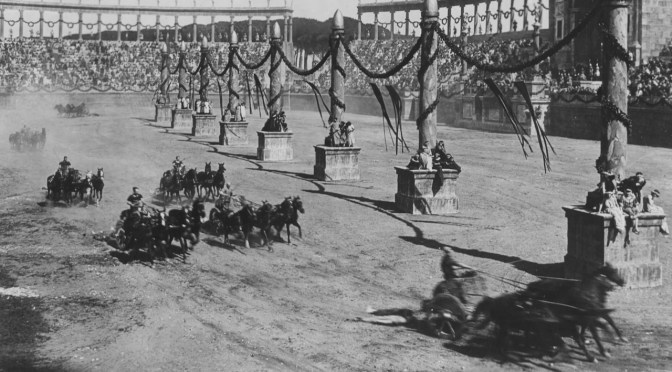
Similarly, The Odyssey (1911, dirs. F. Bertolini, A. Padovan and Giuseppe de Liguoro) uses special effects imaginatively to present the daring escape of Odysseus and his crew from a monstrous giant, the apparition to him of his protective goddess, and his miraculous transformations to hide his true self from the suitors who hound his wife back at home. The climactic finale is an American animation, A Roman Scandal (1926, dirs. Charles R. Bowers and Bud Fisher), based on the newspaper comic strip adventures of Mutt and Jeff. Magically transported back to ancient Rome, little Jeff finds himself racing a chariot before the beady eyes of emperor Mutt. In a parody of the great race sequence in Fred Niblo’s Ben-Hur (1925), cunning is the winner.
Quo vadis? (1924, dirs. Gabriellino D’Annunzio and George Jacoby)
Quo vadis? (1924, dirs. Gabriellino D’Annunzio and George Jacoby)
Sunday 1 December 2024, 14:15 at BFI Southbank NFT1, London
Magnificent and disturbing, this epic film revels in the debauchery often associated with ancient Rome. The emperor Nero is played as a satanic grotesque by the star Emil Jannings. At the opening of the film, we see him lie resplendent on a couch in the grounds of his ornate palace. He peers with sadistic amusement at a series of female victims being thrown into the fountain to fatten his fish.
The Latin title of the film or ‘Where are you going?’ refers to the question that the apostle Peter was supposed to have asked when he saw Christ coming to save the Christians in Rome. It also refers to a celebrated nineteenth-century novel that told the story of a fictional girl, Lygia, who turns the Roman soldier Vinicius toward God despite Nero’s attempts to stop her. The first half of the film ends with the camera focussing in on a hand gripping a cross. It is a sign that the soldier’s conversion is underway.
The second half of the film puts that story in the broader context of the burning of the city and the subsequent persecution of the Christian community. Here red tinting marks out the danger for Rome and the excitement for viewers. A cast of thousands charges the imperial palace. Christians are arrested and Christ himself makes two appearances. Eventually Nero commits suicide, and the Cross is declared victorious. But not before we are offered a range of extraordinary spectacles: extravagant banquets; beatings and murder; thwarted rapes; a city on fire; a strongman wrestling a bull, lurid martyrdoms and soldiers from the provinces riding to the rescue.
Both screenings are being run in association with the AHRC-funded research project Museum of Dream Worlds based at University College London and led by myself, Maria Wyke. The project (drawing on the surviving films in the BFI National Archive) asks how did early cinema design its Greek and Roman dreamworlds? What did cinema gain from recreating the distant past? What did that past gain from being recreated in moving images? The project also considers how these films were once used as instruments of education and what educative potential they might have today.
Ivo Blom is offering a free download of his recent book Quo vadis?, Cabiria and the ‘Archaeologists’: Early Italian Cinema’s Appropriation of Art and Archaeology (Kaplan, 2023) over on his site, as well as the link to buy a paper copy.
Stand outside Alexandra Palace on a clear evening with a full moon, as I did last night, and you can take in the whole city. London may be as silent as it gets from this vantage point, but the landscape is loud in its own way. The glittering towers that dominate the skyline were all built in the last 50, probably 20 years. The red lights dotted in among them are all cranes, standing by to change the shape of the city once again. Scan the horizon, and you’ll be reassured perhaps to see the dome of St Paul’s – a symbol of continuity, a connection between modern times and the age of Christopher Wren, going back to 1710.
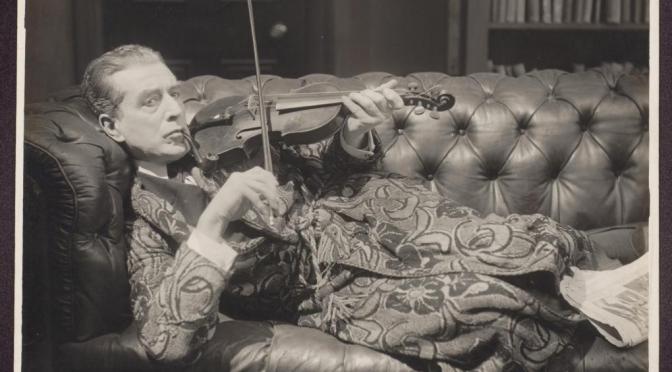
Swivel on your heel, and pivot to 1873 or thereabouts, when Ally Pally itself, the “People’s Palace” first opened. I had a date to keep at the theatre, recently restored to what the owners call a state of “arrested decay” and reopened to the public. We were there to travel back to a fuzzy combination of the 1880s and the 1920s, to revel in the BFI London Film Festival’s latest archive presentation: Silent Sherlock.
Blood, sweat and tears on the screen today. And to cap it all off, prizes! That’s Friday in Pordenone, folks. Read all about it.
Your scribe is a little squeamish, I must confess, so this morning I had to resort to an old trick, and pop my glasses off during some of Arabi (Nadezhda Zubova, 1933), a drama about sheep farmers organising to form a collective and defeat the feudal powers that exploit their labour under the old system. That doesn’t make me squeamish, I’m all for it – it was the killing and skinning of lambs that turned my stomach. Still, I thought this was terrific, with some very sharp editing, especially in the opening sequence, and lovely low camerawork of the herd out in the field.
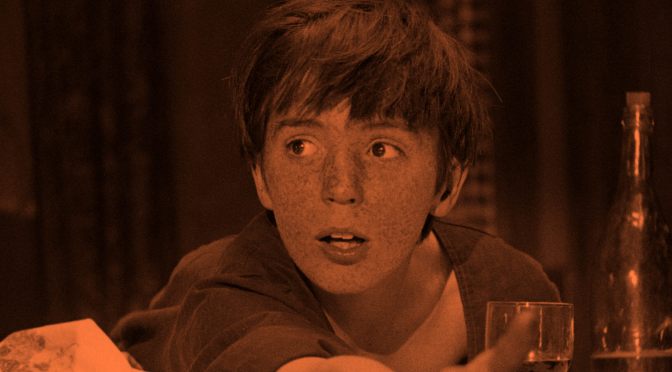
Julien Duvivier, the great French director of films including 1937’s Pépé Le Moko, was very clear which was his favourite out of his many beautiful silent films. “Poil de Carotte: without hesitation,” he said. “Of all the films I have made, this is closest to my heart.” Made, and remade. Duvivier directed this silent Poil de Carotte in 1925, and then remade it as a sound film in 1932. He later began work on a third, colour version, but this was never realised.
Poil de Carotte, or Carrot Top or Red Hair, is based on an 1894 novella by Jules Renard, the autobiographical tale of an abused, redheaded child, driven right to the edge. Duvivier had been hired to write the screenplay for a proposed adaptation of the book, to be shot by the director Jacques Feyder.
Back to school time! Here’s a roundup of the silent movie news I really want to share with you as summer turns into autumn. Just think how many of these forthcoming delights you could enjoy for less than the cost of a dynamically priced Oasis ticket.
Screenings and festivals
I missed StummFilmTage Bonn this year again – both in person and online. But Paul Joyce and Paul Cuff both kept us up to date with their fabulous blogs.
Season’s greetings Silent Londoners. It’s that time of year when we like to look back at the year, and especially at all the great silent movies we watched.
2023 was a busy year. We had in-person and online film festivals, seasons, screenings and conferences, some fabulous new restorations, discs and some big anniversaries. We had new books and DVDs to enjoy. I was a little distracted, but the silent film scene was booming.
Michael Powell made films in the south of France. Before that one. His first job in the film industry was working at the Victorine studios of Rex Ingram, just outside Nice, in the mid-1920s. He was 19 and he took on pretty much any job he could on set, trying to learn the business from the ground up. It worked, didn’t it? He even appeared in front of the camera a few times, often playing a sappy creation called Cicero Simp in the Riviera Revels comic shorts.
Love film? Yeah I thought so. Next week, the BFI Film on FIlm Festival takes place at BFI Southbank – a very special event where everything shown will be projected on the good old analogue stuff. The full programme is here and it is amazing. The films are showing 8-11 June, and each one is bound to be a hot ticket.
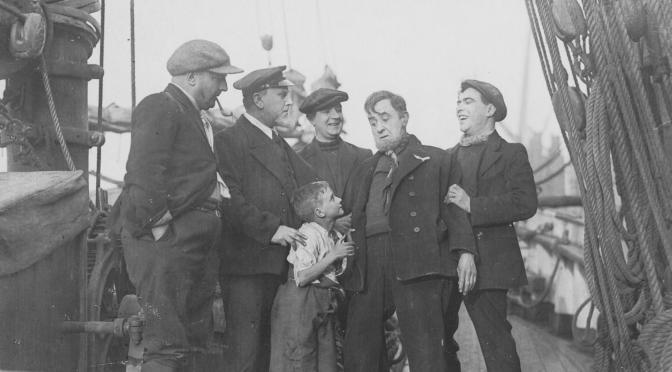
Needless to say, the silent films in the programme will be shown with live music. And I have a special offer for Silent London readers, who can get two tickets for the price of one on a double-bill of beautiful, quintessentially British films scripted by Lydia Hayward and directed by Manning Haynes. These are two of the films that were adapted from the stories of British comic writer W.W. Jacobs – think Jerome K. Jerome or P.G. Wodehouse.
Lots to enjoy at the BFI Film on Film festival this summer (8-10 June) but now the lineup is out we can confirm that there are silents to be savoured among the banquet. British silents in fact: The First Born (Miles Mander, 1928), and two Manning Haynes films: Sam’s Boy (1922) and The Boatswain’s Mate (1924). All three films with be screened on vintage prints with live piano accompaniment, naturally. And I am also intrigued by a programme of dialogue-free “visual documentaries” dating from 1947-71 with live musical accompaniment.
Remember I told you about the fabulous resource that is WeimarCinema.org? This comprehensive website is also a journal, and the Spring 2023 edition has just been published. Contents include a dossier by Oksana Bulgakova on the difficult reception of Eisenstein’s Battleship Potemkin in Berlin in 1926, as well as essays by Tom Gunning, So Mayer, Tatjana Hramova, Leonard Quaresima, Michael Cowan and Anton Kaes. Oh, and, um, me on Pabst. I especially enjoyed reading Mayer on Queer Weimar Cinema Across Borders, ahead of tomorrow’s Gender Rebels event in Bristol.
“My memory goes back to the very first films. My ambition goes far ahead of today.”
Michael Powell, on the ballet sequence of The Red Shoes
Let me just tap this microphone a couple of times. Cough once. Thumbs up. We’re good to go? I have a little announcement to make and it is a wee bit off-topic.
Season’s greetings Silent Londoners. It’s that time of year when we like to look back at the year, and especially at all the great silent movies we watched.
Who knows what normal is any more? But this year we had in-person film festivals, seasons, screenings and conferences a-plenty. We had new books and DVDs to enjoy. New websites too! And honestly, silent cinema seems to be more popular than ever.
Edited by Tony Kaes and Cynthia Walk, this capacious website is a comprehensive source for anyone studying, or refreshing their interest in, Weimar Cinema. There are guides to where to watch films online, other useful websites, and more traditional publications. They also publish “scholarly web-based essays that benefit from moving images and links”, so get in touch if you have something you’d like to write for them. I really liked this, by Paul Flaig, on “Chaplin’s cinematic promise”. They also welcome submissions of archival material, dossiers and updates to their listings.
British Cinema: A Very Short Introduction, by Charles Barr (Oxford University Press)
An entertaining and very informative tour of British film history, starting from the silent days of course, but taking a more productive route than a simple chronological tour. Yet, Barr covers everything from Rescued By Rover to Hitchock, Quota Quckies, Powell and Pressburger, Ealing, the British New Wave and Chariots of Fire right up to titles as recent as Last Night in Soho. I particularly enjoyed the way he paired films to discuss them, eg comparing such near-simultaneous yet wildly different releases as Downton Abbey and Sorry We Missed You. When you finish reading this valuable book you are sure to immediately turn the TV on to Talking Pictures, and I don’t blame you.
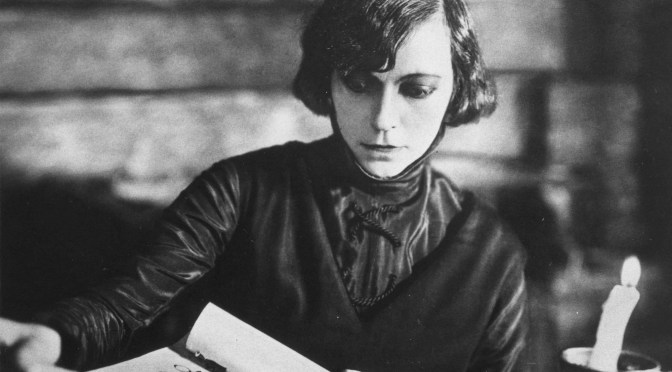
This is probably my final Asta Nielsen-related post for a while. I am delighted to be able to tell you that I was a guest on the Folger Shakespeare Library’s podcast, Shakespeare Unlimited, to talk about Nielsen and her Hamlet.
I had a long chat with Shakespeare Unlimited host Barbara Bagaev about the film, and its context in Nielsen’s career. You can access information about the podcast here and listen to my episode and read the transcript here. You can also find Shakespeare Unlimited wherever else you find your podcasts.
This blogpost is based on the introduction I gave to a screening of this film in the BFI Southbank season that I curated, In the Eyes of a Silent Star: The Films of Asta Nielsen. The season continues until 16 March and there are many great films yet to see.
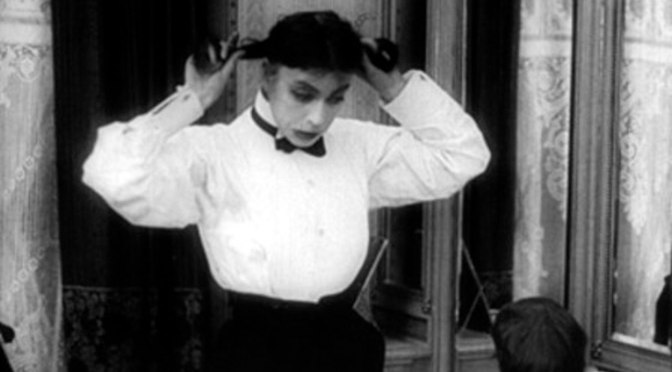
Asta Nielsen was one of the first truly international film stars, mobbed by crowds when she made personal appearances and beloved by audiences all over the world. Was she the first? You might call it a tie between her and the French comedian Max Linder, who made his name with a dapper, high-class comic character in a dress suit. When they burst on to the scene, Charlie Chaplin was four years away from making his debut. Although acclaimed as a tragedienne, the melancholic counterpart to Linder’s slapstick sensation, Nielsen proved often that she could do funny, too. And in tails as well.
In fact she had needed a little encouragement to play humorous scenes at drama school. “It all went wrong when I had to try my hand at comedy,” she wrote in her memoir. “Every type of humour was utterly foreign to me.” But in many ways the seriousness and commitment she brought to drama was her secret weapon as a comedienne. And as Robert C. Allen has written, perhaps the confidence boost of global stardom gave her the freedom to be silly.
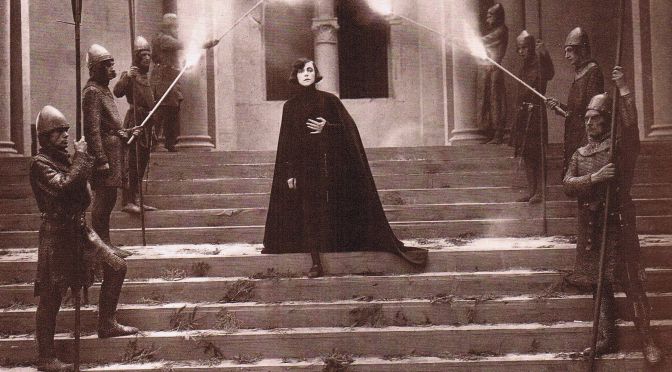
Hamlet is a woman! At least she is in this German feature film, Hamlet: A Drama of Vengeance (1921). And not just any woman, but the inimitable Danish diva Asta Nielsen.
From Sarah Siddons to Maxine Peake, many actresses have played the Prince of Denmark, and a fragment of Sarah Bernhardt’s stage interpretation of the role was even captured in a short film shown at the Paris Exposition in 1900. However, the distaff twist in this film was prompted, or at least justified, by Edward P Vining’s scholarly 1881 book The Mystery of Hamlet: An Attempt to Solve an Old Problem, which makes the case for Prince Hamlet being so feminine a character that his contradictory nature is best explained by imagining that underneath the black tunic he’s really a woman. The film also draws on Danish history and a German play from 1704 called Fratricide Punished. The gender-swap allows for an intriguing new take on Shakespeare’s text, recasting his hero/heroine’s relationships with Ophelia, Horatio and Gertrude in fresh moulds.
This is a guest post for Silent London by Dr Rebecca Harrison. Harrison is a film critic and a lecturer in the Theatre, Film and Television Studies department at the University of Glasgow. She is the author of From Steam to Screen: Cinema, the Railways and Modernity (IB Tauris, 2018).
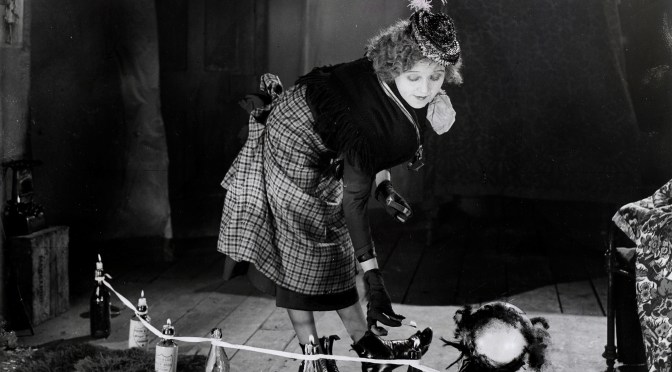
Known as ‘The Queen of Happiness’ during her reign as Britain’s foremost star of the screen, Betty Balfour very nearly meets her unhappy match in Love, Life and Laughter, the 1923 feature that until recently the BFI had feared lost. Directed by George Pearson, the picture was found in the Netherlands in 2015 (thanks to a cinema that failed to return the film to the distributor), and the newly restored version appeared in October as the Archive Special Presentation at the 2019 London Film Festival. While the audience had to make do with digital projection rather than a print, we were treated to a improvised live score by composer and accompanist Meg Morley – not to mention 70 minutes of Balfour’s luminescent presence on screen. Continue reading LFF review: Love, Life and Laughter (1923)→
I was just finishing my last post (on Bait – go see it), when this very exciting news came in. The 2019 London Film Festival Archive Special Presentation will be the lost Betty Balfour film that was discovered in the Netherlands a few years ago: Love, Life and Laughter (George Pearson, 1923). Continue reading Breaking Betty Balfour news: Love, Life and Laughter (1923) at the LFF→





 Silent London