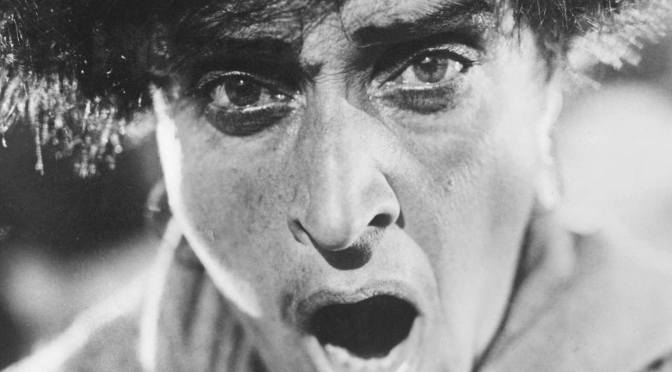
As so often, I am going to have to ask a certain purist contingent to do their breathing exercises and locate the nearest fainting couch. Everyone else, buckle up!
I have not one but two cases of pop silents to report. And as ever, I remain optimistic for both. First up is one that may be familiar to many already. The Pet Shop Boys, one of the truly great pop bands of the 80s and 90s, wrote an electronic-orchestral score for Battleship Potemkin (Sergei Eisenstein, 1925) several years back. There was a special outdoor screening in Trafalgar Square, where the band performed the score with the Dresdner Sinfoniker, orchestrated by Torsten Rasch, back in 2004. I missed that occasion, but I heard that it was pretty epic, despite the rain. Talk about Eastern Bloc sailors and West End, um, squares.
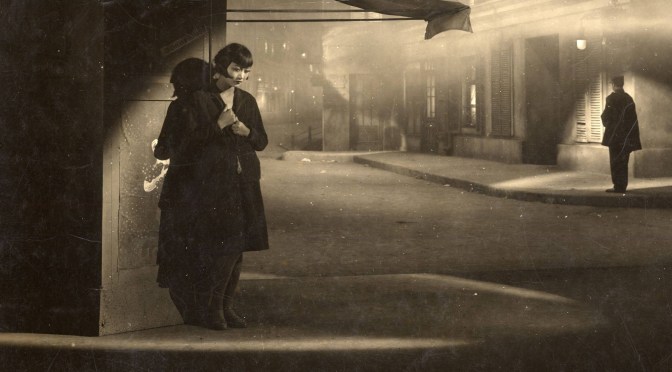
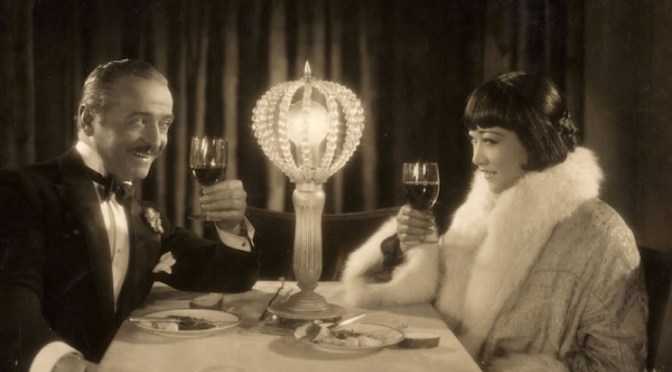
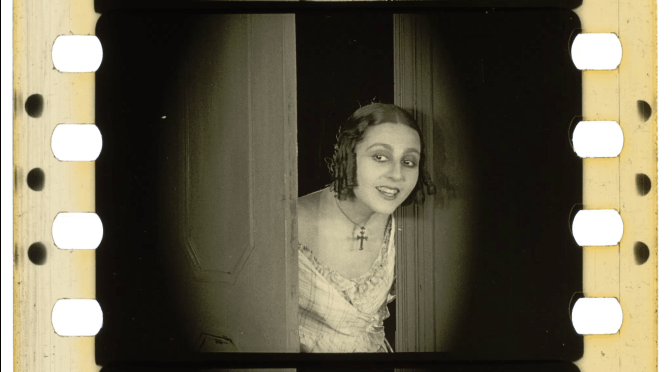
On Sunday I had the very great pleasure of introducing a double-bill of Anna May Wong silents: the UK premieres of new restorations of Song (Richard Eichberg, 1928, restored by Filmmuseum Düsseldorf) and Pavement Butterfly (Richard Eichberg, 1929, restored by DFF) at Cinema Rediscovered in Bristol. Beautiful films, a beautiful audience and simply gorgeous musical accompaniment by Stephen Horne. Wish you could have been there – maybe you were?
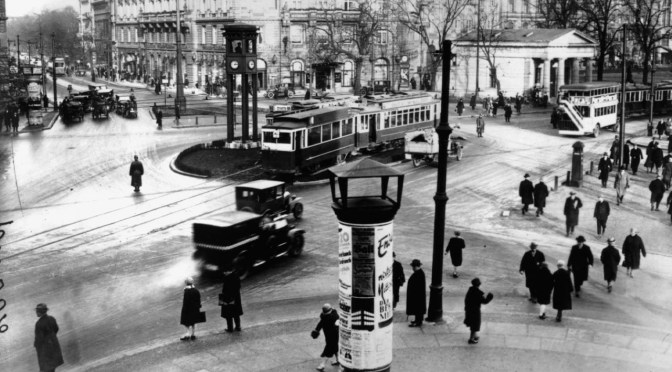
I may live in the 21st century on the south coast of England, but here on my desk it often looks like I am somewhere else entirely. Weimar-era Berlin, to be precise. It is the epicentre of some truly great silent filmmaking, such as the works I often share on this blog, it is the setting and source for the first film book I wrote (Pandora’s Box, as you asked), and it is here that we find the origins of much of the Golden Age of Hollywood cinema that I write about elsewhere.
It also sometimes looks this way when I am reading the news, but that, perhaps, is another matter.
This is a guest blog for Silent London by Maria Wyke, professor of Latin at University College London.
Worn out from watching Paul Mescal battle with CGI baboons, rhinos and sharks in the Roman arena? Or trying to avoid the Marvel-style struggle for the future of the Roman empire playing out in a cinema near you? Then you might be interested in these two screenings coming up at the end of November of very different antiquity films from 100 years ago or more. Gladiator II explicitly presents itself as a sequel to Gladiator (2000). That hugely successful film drew on the Hollywood blockbusters of the Cold War era and they in turn built on the global success of antiquity films already established at the start of the 20th century. Those early films, however, often reconstructed the ancient world in ways never taken up by later cinema. These upcoming screenings bring back to us that otherwise lost innovation, vibrantly supported by the live accompaniment of professional musicians.
The Odyssey (1911, dirs. F. Bertolini, A. Padovan and Giuseppe de Liguoro)
Entering the Ancient World through Silent Cinema
Saturday 30 November 2024, 16:45-17:45 at the Morecambe Winter Gardens
As part of a Northern Silents event, this variety programme begins with a British travelogue, Visit to Pompeii (1901, dirs. George A. Smith and Charles Urban), that takes elegant tourists on a journey around the excavated city and up to the crater of Vesuvius. An Italian historical drama, Nero, or the Burning of Rome (1909, dirs. Luigi Maggi and Arturo Ambrosio)shows the emperor repudiating his wife and driving her to suicide at the command of his beautiful mistress. The people rebel, Rome burns, the emperor plays his lyre. Through cinematic superimposition, a terrified Nero sees a nightmare vision of the Christians suffering for his crimes. His own suicide soon follows.
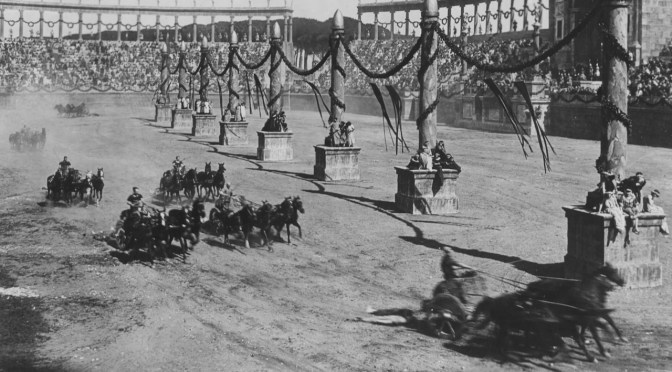
Similarly, The Odyssey (1911, dirs. F. Bertolini, A. Padovan and Giuseppe de Liguoro) uses special effects imaginatively to present the daring escape of Odysseus and his crew from a monstrous giant, the apparition to him of his protective goddess, and his miraculous transformations to hide his true self from the suitors who hound his wife back at home. The climactic finale is an American animation, A Roman Scandal (1926, dirs. Charles R. Bowers and Bud Fisher), based on the newspaper comic strip adventures of Mutt and Jeff. Magically transported back to ancient Rome, little Jeff finds himself racing a chariot before the beady eyes of emperor Mutt. In a parody of the great race sequence in Fred Niblo’s Ben-Hur (1925), cunning is the winner.
Quo vadis? (1924, dirs. Gabriellino D’Annunzio and George Jacoby)
Quo vadis? (1924, dirs. Gabriellino D’Annunzio and George Jacoby)
Sunday 1 December 2024, 14:15 at BFI Southbank NFT1, London
Magnificent and disturbing, this epic film revels in the debauchery often associated with ancient Rome. The emperor Nero is played as a satanic grotesque by the star Emil Jannings. At the opening of the film, we see him lie resplendent on a couch in the grounds of his ornate palace. He peers with sadistic amusement at a series of female victims being thrown into the fountain to fatten his fish.
The Latin title of the film or ‘Where are you going?’ refers to the question that the apostle Peter was supposed to have asked when he saw Christ coming to save the Christians in Rome. It also refers to a celebrated nineteenth-century novel that told the story of a fictional girl, Lygia, who turns the Roman soldier Vinicius toward God despite Nero’s attempts to stop her. The first half of the film ends with the camera focussing in on a hand gripping a cross. It is a sign that the soldier’s conversion is underway.
The second half of the film puts that story in the broader context of the burning of the city and the subsequent persecution of the Christian community. Here red tinting marks out the danger for Rome and the excitement for viewers. A cast of thousands charges the imperial palace. Christians are arrested and Christ himself makes two appearances. Eventually Nero commits suicide, and the Cross is declared victorious. But not before we are offered a range of extraordinary spectacles: extravagant banquets; beatings and murder; thwarted rapes; a city on fire; a strongman wrestling a bull, lurid martyrdoms and soldiers from the provinces riding to the rescue.
Both screenings are being run in association with the AHRC-funded research project Museum of Dream Worlds based at University College London and led by myself, Maria Wyke. The project (drawing on the surviving films in the BFI National Archive) asks how did early cinema design its Greek and Roman dreamworlds? What did cinema gain from recreating the distant past? What did that past gain from being recreated in moving images? The project also considers how these films were once used as instruments of education and what educative potential they might have today.
Ivo Blom is offering a free download of his recent book Quo vadis?, Cabiria and the ‘Archaeologists’: Early Italian Cinema’s Appropriation of Art and Archaeology (Kaplan, 2023) over on his site, as well as the link to buy a paper copy.
Stand outside Alexandra Palace on a clear evening with a full moon, as I did last night, and you can take in the whole city. London may be as silent as it gets from this vantage point, but the landscape is loud in its own way. The glittering towers that dominate the skyline were all built in the last 50, probably 20 years. The red lights dotted in among them are all cranes, standing by to change the shape of the city once again. Scan the horizon, and you’ll be reassured perhaps to see the dome of St Paul’s – a symbol of continuity, a connection between modern times and the age of Christopher Wren, going back to 1710.
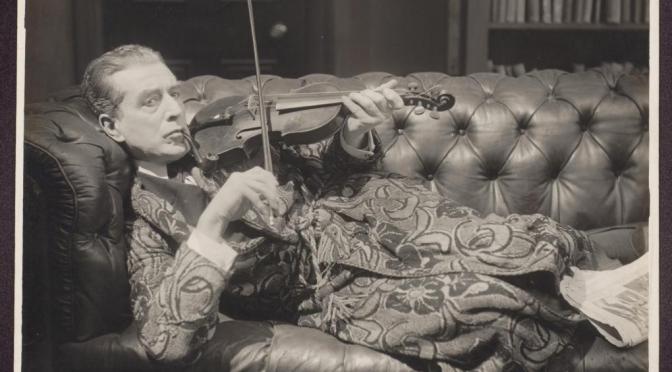
Swivel on your heel, and pivot to 1873 or thereabouts, when Ally Pally itself, the “People’s Palace” first opened. I had a date to keep at the theatre, recently restored to what the owners call a state of “arrested decay” and reopened to the public. We were there to travel back to a fuzzy combination of the 1880s and the 1920s, to revel in the BFI London Film Festival’s latest archive presentation: Silent Sherlock.
It’s supposed to be big mystery: what do women want from a romantic partner? But there is no mystery at all. GSOH every time. That’s good sense of humour, of course. So if you’re in anyway romantically inclined, you’ll already be asking yourself: what is the FUNNIEST way I can celebrate Valentine’s Day next year.
If you know you know that Slapstick Festival celebrates visual comedy in all its forms. But that include silent cinema and there are especially strong offerings on that score this year, including lashings of Buster Keaton (with expert Polly Rose on hand to guide you through his work), including the gala screening of Steamboat Bill Jr. (1928), accompanied by the European Silent Screen Virtuosi, led by Günter A. Buchwald, on the Friday night at Bristol Beacon. Plus Harold Lloyd, Sarah Duhamel, Laurel and Hardy, Charlie Chaplin, WC Fields, and lots more.
A confession. I was conspiring over breakfast, and reader, this was a two-cappuccino problem. The upshot? I was a little late in getting started with the screenings today. But I certainly knew that I was going to be up late, with the gala… and the end-of-festival celebrations!
My sunny morning stroll to Cinemazero was rewarded with a simply terrific film from Uzbekistan. In Her Right (Grigorii Cherniak, 1930), a group of workers from the collective farm are sent to the factory to boost the workforce there, and to learn those valuable Soviet methods. One woman from the village defies her husband and sheds her burqa to join them. It’s a life-changing experience and not only does she gain independence through work, but she inspires others to do the same, through a filmed speech, that the workers clamour to watch, even after he enraged husband slashes the screen. Even with her “throat” cut, in a silent film, she continues to speak her truth. So you have noted already that this is once again pro-Soviet, anti-Islam propaganda in intent, but this is also a remarkable film in style and action. Our Hollywood friends would applaud the excellent, and indeed poignant, action sequence in which our heroine runs to jump on the train to the factory, is repeatedly shoved away by male guards and then, when it seems she has finally found a helping female hand, her husband leaps – for a second we think he has dragged her form the moving train, but no, he only has her coat in his hands. Nail-biting stuff. And the scene in which they watch the film is also very strong. Günter Buchwald at the keys for this one, keeping the energy at exactly the right pace.
Blood, sweat and tears on the screen today. And to cap it all off, prizes! That’s Friday in Pordenone, folks. Read all about it.
Your scribe is a little squeamish, I must confess, so this morning I had to resort to an old trick, and pop my glasses off during some of Arabi (Nadezhda Zubova, 1933), a drama about sheep farmers organising to form a collective and defeat the feudal powers that exploit their labour under the old system. That doesn’t make me squeamish, I’m all for it – it was the killing and skinning of lambs that turned my stomach. Still, I thought this was terrific, with some very sharp editing, especially in the opening sequence, and lovely low camerawork of the herd out in the field.
Wouldn’t you like to go Behind the Scenes with DW Griffith and Florence Lawrence? I sure would, that’s why I was bright and early at the Verdi this morning for the 1980 Biograph package. Behind the Scenes, per the catalogue is the “happy exception” among the 1908 output. Well it certainly had punch. A distraught mother must tear herself from her daughter’s sickbed to kick her heels and shake her hips on the vaudeville stage to earn a crust. But as the crowd roars out for an encore, her baby girl is slipping away from this life; Grandma rushes to the stage door… If “too late!” is the essence of the melodramatic narrative then this was a textbook case. We stayed to see Lawrence reappear as the titular character in The Red Girl, in which a collection of ethnic stereotypes conspire to rob a “girl miner” but Lawrence defies racist convention to lend a hand instead. Impressive to see Lawrence Harry Houdini her way free after being tied up and dangled over a precipice above the rushing river. Extra exciting with John Sweeney at the keys, of course.
Sometimes the old songs are the best, right? Familiarity can breed contentment. And nowhere will you find more consensus on that than here in Pordenone. So today I was happy to rewatch a couple of silent films I love, spend a little time with one of my all-time favourite silent stars. And then see something entirely new to me!
First, the old friends. This morning, we ventured back into the imaginations of Maurice Tourneur, and Ben Carré, with the 1918 adaptation of Maurice Maeterlinck’s The Blue Bird. Such a strange and beautiful, terrifying and wholesome journey into the shadow world of dreams, where bread and sugar and water have souls, the dogs and cats can talk, lost grandparents always have the table set for supper and babies wait impatiently to be born. If you have not seen this, you possibly can’t imagine quite how weirdly pretty it is. Variety’s critic wrote: “It is quite safe to assert that nothing quite like Director Tourneur’s work has ever been shown on the screen.” So hats off to Tourneur and Carré, and doubly so to Neil Brand and Elizabeth-Jane Baldry, who transported us to an enchanted realm with their music. I wrote about the film in more detail here, should you be interested.
And verily, on Tuesday, the fourth day of Le Giornate del Cinema Muto, the rains came down upon us. And things got quite soggy inside the theatre too, what with Mary Pickford nearly drowning in the hold of her own houseboat in Pride of the Clan, a parcel of wonderful underwater films in the early afternoon, and a wild ride to Neptune’s kingdom to close the day.
Before the rain began, I spent a couple of rapt hours in the Canon Revisited strand this morning. Carl Th Dreyer’s Leaves From Satan’s Book (1920) travels through the centuries with God’s Fallen Angel, who is doing his evil work among humans who prove reliably weak in the face of temptation. Surrendering one’s soul to sin is not to be advised, but surrendering oneself to cinematic greatness – that is a balm for the ills of the modern age. This is a film of deceptive subtlety, and slow-burning excitement. The camera stays still so long that when it moves, the moral universe tilts. The austerity of the first, biblical sequence gives way by degrees to a faster editing rhythm, and cutaways to sympathetic details, a flock of geese, a cat toying with a mouse, a baby in her crib. Soon we’re in action thriller territory as we finally wash up in Finland in 1918, via the Spanish Inquisition and the French Revolution. Dreyer, being Dreyer, the faces, not least of Helge Nissen as the shape-shifting Satanas, carry boundless weight. It’s a masterpiece, an early one, from a man who made much better films, even, but still. And yes I am smug about having watched it with John Sweeney’s soul-stirring accompaniment, which likewise knew when to hold back and when to rush forward through the ages.
I promise you, I really am in Pordenone, not in Paris. But honestly, the geography is becoming a little subjective. We seem unable to escape the Rive Gauche for long. This morning, a really quite exceptionally taut melodrama from Louiis Feuillade, with sets,of course, by Ben Carré, illustrated how the Latin Quarter exerts its own gravitational pull, morally, if not physically. In La Tare (1911), part of Feuillade’s “La Vie telle qu’elle est” (Life as It Is) series, Renée Carl gave a really beautiful performance as Anna, who works in the dance halls of the Latin Quarter, but given the chance, moves to the South of France and devotes herself to a new career caring for patients young and old in a nursing home. Ah, but cruel fate intervenes and a medical student who used to tap her for cash in the Paris days, takes it upon himself to inform the medical board that their “secular saint” is really a “girl of easy virtue”, sooner than you can say “Madonna-whore complex”. And so we are left with a tragic, yet ambiguous ending, following a rather harrowing scene in the unemployment office with a crowd of women, all of whom had remarkable faces (no, not Léontine, I don’t think, but maybe this is the kind of place where she might be found). A very special film, enhanced, naturally, by John Sweeney’s sensitive accompaniment.
“They’re eating the dogs. They’re eating the cats.” Proof, if proof were needed, that the American people saw through such anti-immigrant propaganda more than 100 years ago, comes in Dee-Dubya’s 1908 New York comedy Deceived Slumming Party – our first film of Sunday morning. Fraudulent tour guides promise show rich tourists the gritty realness of Chinatown and the Bowery, but the trick is, it’s all staged. Everyone in the opium den was upright and chatty before the tour group arrived, in fact, the barroom fights in the Bowery are choreographed by the bartender (DW Griffith himself) and the “meat grinder” in the Chinese restaurant kitchen, the one that the staff are “feeding” with cats and dogs and rats, is nothing but a sham.
Rich kids slumming it in Chinatown, you say? Hold that thought while we segue from comedy to melodrama, in the shape of Driven from Home (James Young, 1927), which yanked and yanked and yanked at the heartstrings with poor Virginia Lee Corbin disowned by her wealthy father after she married for love, although her devoted mother (Margaret Seddon) was on her deathbed and calling out to see her baby once more. Add to this a subway excavation accident, a scheming vamp housekeeper (Virginia Pearson), and you might not think there was room for an excursion to the Chinatown underworld but you would be wrong, as this film was playing in the Anna May Wong strand. So indeed here we witnessed a scant five minutes of Anna May Wong, as a Chinese restauranteur’s “legal wife and illegal accomplice” radiating more star power than the rest of the rest of the (perfectly good) cast could ever dream of. We understand this is a racist trope, yet it is quite nifty to think that on the evidence of this year’s Giornate, in any given situation, Anna May Wong can locate a secret door in seconds.
Grey skies clung to the Verdi this afternoon but you can’t put a dampener on a homecoming like this one. I’ve been to several festivals this year, but nothing really compares to the Giornate. And our hearts were warmed by festival director Jay Weissberg’s words of welcome, in which we pointed out how vital it is, these days more than ever, to cherish these events that bring people together in a shared endeavour.
Today was a day of varying shades and two colour schemes. We had a couple of stonking great classics. And also a slate of fragments, curios, oddities and ends – several of which had their merits, albeit in their own unconventional way. In fact, a certain aura of strangeness hung over the whole day, which you might attribute to the unseasonal weather, but I am partially putting down to the after-effects of watching Megalopolis last weekend.
Can YOU help put names to 14 unidentified films screening at this year’s Giornate del Cinema Muto? The festival is asking for your contribution to a very exciting project. Elif Rongen-Kaynakçi explains more.
The story goes that in the early days of the Giornate del Cinema Muto, a small group of film historians sat in a theatre, watched films arriving from different archives from around the world, and identified them by shouting out the names of the actors and actresses appearing on the screen. Whether true or somewhat apocryphal, this is still an appealing idea for film historians and archivists alike. Surely, there are still many unidentified films in the archives, and what better resource in the world than the combined brainpower of the Pordenone crowd would be able to identify them? Following on the trail of exciting, successful, and fun initiatives like the LostFilms.eu portal and various archival YouTube channels, a couple of try-out sessions held by Eye Filmmuseum, and hugely inspired by the “Mostly Lost” Workshops held at the Library of Congress Conservation Center in Virginia from 2012 to 2019, we are launching a film identification thread at this year’s Giornate.
This year 14 films, sourced from 6 archives, each individually numbered, will be screened as shorts before features scattered through the week. The catalogue notes about them have been written by the archivists concerned, providing as much information as possible about the material, its provenance, and any contextual information that might be helpful for identification. Still images are provided as memory aids where possible. We encourage you to make your suggestions in various ways; whether in discussions during lunch or dinner, but also on the white board at the festival hospitality office, here on this Silent London page, or the “Pordenone People” Facebook group. Please provide evidence when you can, whether to support your suggestions or to prove a theory wrong. Please explain why you think in a certain direction, or why you’d rule out some options. And don’t forget to share with us the sources you are using to support your theory.
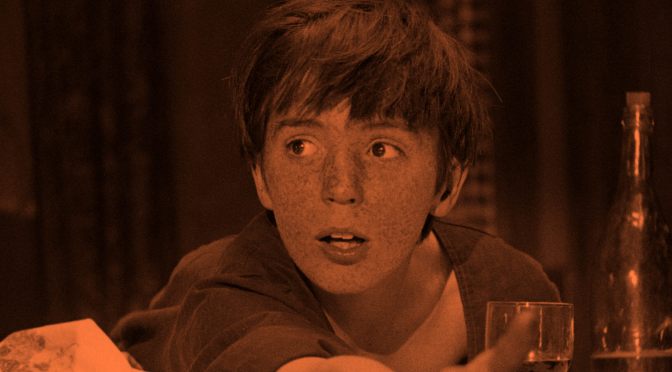
Julien Duvivier, the great French director of films including 1937’s Pépé Le Moko, was very clear which was his favourite out of his many beautiful silent films. “Poil de Carotte: without hesitation,” he said. “Of all the films I have made, this is closest to my heart.” Made, and remade. Duvivier directed this silent Poil de Carotte in 1925, and then remade it as a sound film in 1932. He later began work on a third, colour version, but this was never realised.
Poil de Carotte, or Carrot Top or Red Hair, is based on an 1894 novella by Jules Renard, the autobiographical tale of an abused, redheaded child, driven right to the edge. Duvivier had been hired to write the screenplay for a proposed adaptation of the book, to be shot by the director Jacques Feyder.
The original music for the 1929 Moscow screening of the film has been recreated by the composer Leo Geyer and myself Richard Bossons.
Though a silent film, the visual rhythm of Dziga Vertov’s Man with a Movie Camera is often akin to a musical composition. Vertov’s biographer John MacKay suggested that he used the frames of the film and the intervals between them in a similar way to notes on a score. The film is structured so that its tempo gradually increases to reach an extraordinary climax at the end, a thrilling montage of chaotic images created by the film’s editor, Elizaveta Svilova. The Soviet film scholar Yuri Tsivian wrote that “Man with a Movie Camera invades the territory of sound cinema as far as a silent film can reach.”
“Sixty years later I am still bringing people to see Napoléon, that’s quite true. And also bringing people back to the cinema because this is the age where they watch Lawrence of Arabia on their mobile phones, for God’s sake. The cinema was designed for sharing, and that is sharing the reactions to the film. It’s not just being in the same room as a lot of other people. It’s much more emotional than that.” Kevin Brownlow on restoring Napoléon
“Never forget, that this masterpiece is also a monsterpiece.” Georges Mourier on restoring Napoléon
The story of Napoléon will never end, I suspect. This mammoth film, made by Abel Gance at the height of the silent era, intended to be just the start of telling the emperor’s tale, has been through a lot already. This site has covered Kevin Brownlow’s exhaustive restoration of the film, and the late Carl Davis’s process of writing a new score. You may well have had the opportunity to see their lustrous five-and-a-half-hour version, either at one of the live screenings in London, California and elsewhere, or on the film’s release: in cinemas, on Blu-ray, and on BFI Player. It’s a phenomenal experience, even before the famous triptych finale, when the screen gets wider, and wider, and wider.
Napoléon (Abel Gance, 1927)
Alongside this story, there has always been the shorter, Francis Ford Coppola restoration, scored by his father Carmine and screened at the Radio City Music Hall in New York, running at about four hours.
And now there is another Napoléon version, clocking in at seven hours and five minutes, the product of a 16-year digital restoration project at the Cinématheque Française, with the support of the CNC, which will make its debut this year. And you will surely get a chance to see this one.
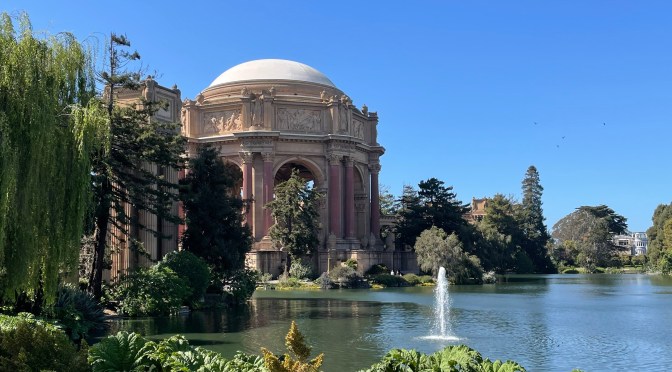
I was looking for Yoda when I bumped into Eadweard Muybridge. These are the circles film history moves in. This year’s San Francisco Silent Film Festival, the 27th, took place in the grandeur of the theatre of the Palace of Fine Arts, an elegant neo-classical folly of gigantic proportions, built as a temporary attraction for the 1915 Panama-Pacific Exposition and then rebuilt in more permanent form 50 years later. Here, time is a pretzel. Like the architecture, cinema becomes both ancient and the modern: live performances of century-old works.
Before the films began, I ventured just a few yards from the Palace for a guided tour of the LucasFilm building, home of some of the film industry’s most cutting-edge special effects and beloved animatronic characters. Case in point: our meeting point was at the Yoda Fountain, just in front of the of the offices, a thrilling rendez-vous for anyone’s inner child. That’s when my jet lag and a tendency to meander led me to take a wrong turn into the 19th century, and the statue of Muybridge, the photography pioneer who discovered the secrets of motion in a series of still frames – cinema in its simplest form. Born in Kingston, Surrey, Muybridge began his photography career in San Francisco, and the city is justifiably proud of his work and its legacy. Somehow, my sense of direction led me right back where I started from.
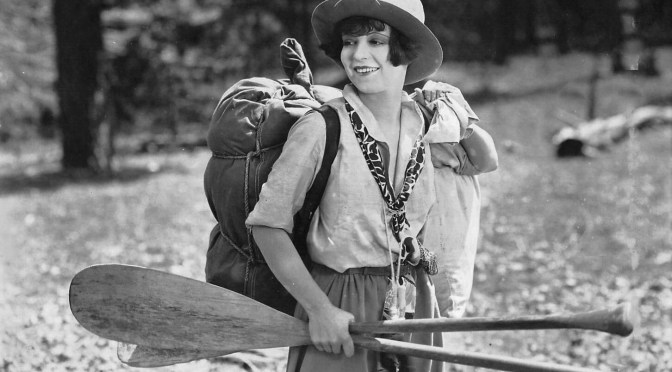
The fashionable set is always the first to name a trend. So if you know you know, but if you don’t know you need to know that 2024 is the year of Coquette Core, a prettified aesthetic that can be boiled down to: put a bow on it. That’s technically a beribboned bow with a lower-case b, not a Clara Capital-B-Bow, but the difference is only nominal. At this year’s Hippodrome Silent Film Festival we celebrated the age of the flapper, with all things frilly, feminine and flirtatious.
If you wanted to keep up with the new womenswear trends in the 1920s and 1930s, the cinemagazine Eve’s Film Review would have been your bible, and one of my favourite events at this year’s Hippfest was Jenny Hammerton’s presentation on these witty and inventive female-interest dispatches. Here, every cinemagoer could truly learn how to be “a modern”, and more specifically, how to save your stockings from mud-spatters, advice that all of us in Bo’ness could truly use.