25 years after giving Un Chien Andalou a screaming chorus and a killer bass line to create Debaser, Black Francis of the Pixies has returned to silent cinema. While his latest endeavour is unlikely to rock your world in the same way that Doolittle did, there’s a little something here to entice fans of his jagged, surreal perspective. The Good Inn was written by Black Francis and Josh Frank, and its sublime illustrations are by Steven Appleby. A novel that occasionally borrows the form of a screenplay or a graphic novel, peppered with songs, intertitle cards and subtitles, this work is determined to be elusive. In the authors’ words, it’s “an illustrated novel, based on an in-the-works soundtrack, for a feature-length film that has yet to be made, about the first narrative pornographic movie ever made”. That all adds up to so much more than a mouthful, that it may well be a dog’s dinner.
With music, film history, cinema, and literature all vying for attention here, something had to give, and something has to shine. Hands-down, it’s the illustrations that carry the day here: Appleby’s diagrams, panoramas and visual gags elevate The Good Inn from messy indulgence to a book you may well want to treasure. As well as more conventional illustrations, Appbleby has provided annotated maps, visual gags, and charts to explain the passing of time, or the fallibility of memory. Without Appleby’s input, The Good Inn could be rather an ordeal.
This is a guest post for Silent London by Sabina Stent. You can read more of her reviews at silverembers.com
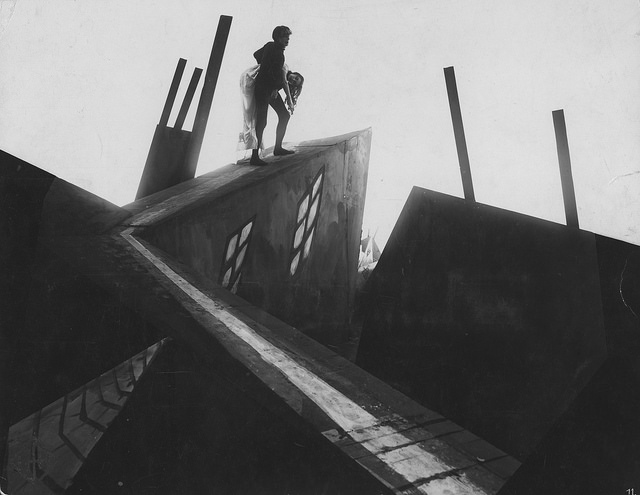
The name “Dr Caligari” may cause a shudder to those of a weaker disposition. The eponymous character of the 1920 classic Das Cabinets des Dr Caligari has long been a figure of terror – and with good reason. The film has been described not just as one of the first “horror” films, but one of the first examples of a movie generating a real psychological uneasiness in its audience. Caligari has been labelled in many different ways – German expressionism, horror story, psychological thriller and a classic of the silent era – but it was also Germany’s first postwar cinematic success, and it reflects the anguish of the people who had been through four terrible years.
Thanks to those classic expressionist touches, the sharp and angled sets, gothic imagery and expressionist undertones, Caligari was as visually frightening as its narrative. More recent audiences may have also been unsettle by the poor physical condition of prints of the film. Despite numerous attempts to finesse the quality of the film – first by the Filmmuseum München in 1980 and followed by the German Federal Film Archive (Bundesarchiv-Filmarchiv) in Koblenz (1984) and as part of the Lumière European MEDIA project in 1995 – imperfections were still evident: visible scratches, jumps and blank screens, blurred title cards, unstable images and bleached-out, near-featureless faces.
The Cabinet of Dr Caligari (1920)
Caligari’s story is told in partial flashback as Francis (Friedrich Fehér) tells the tale of the horrors that he and fiancée Jane (Lil Dagover) have endured at the hands of the Doctor. One day Francis and his friend Alan (Hans Heinrich von Twardowski) attend a local carnival where they watch the act of Dr Caligari (Werner Krauss) and the somnambulist Cesare (Conrad Veidt) “who has slept for 23 years but will tonight wake from his dream-like trance”. The only time Cesare speaks is to tell carnivalgoers their fortune. Cesare “knows the past and sees the future” and when Felix asks “how long will I live?” his serious, haunting response is: “To the break of dawn”. Yet the fear is not restricted to the carnival. At night Cesare is woken by Caligari to do his deathly bidding, and so begins a series of murders, abductions and mental unravelling.
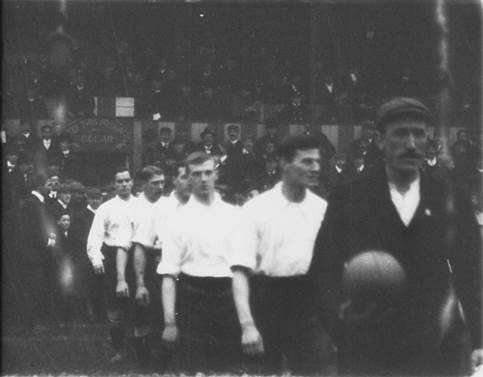
Ready for the game tonight? Warm up with this treat from the BFI archives. England play Ireland at Manchester City’s Hyde Road ground on 14 October 1905. The film is only three minutes long, but don’t worry, I can reveal that England won the game 4-0!
This is a guest post for Silent London by Robert Seidman, author of Moments Captured, a novel based loosely on the work and life of the pioneering 19th century photographer Eadweard MuybridgeThe Silents by Numbers strand celebrates some very personal top 10s by silent film enthusiasts and experts.
Nine Firsts – and One Disputed First – by Eadweard Muybridge, Photographer Extraordinaire
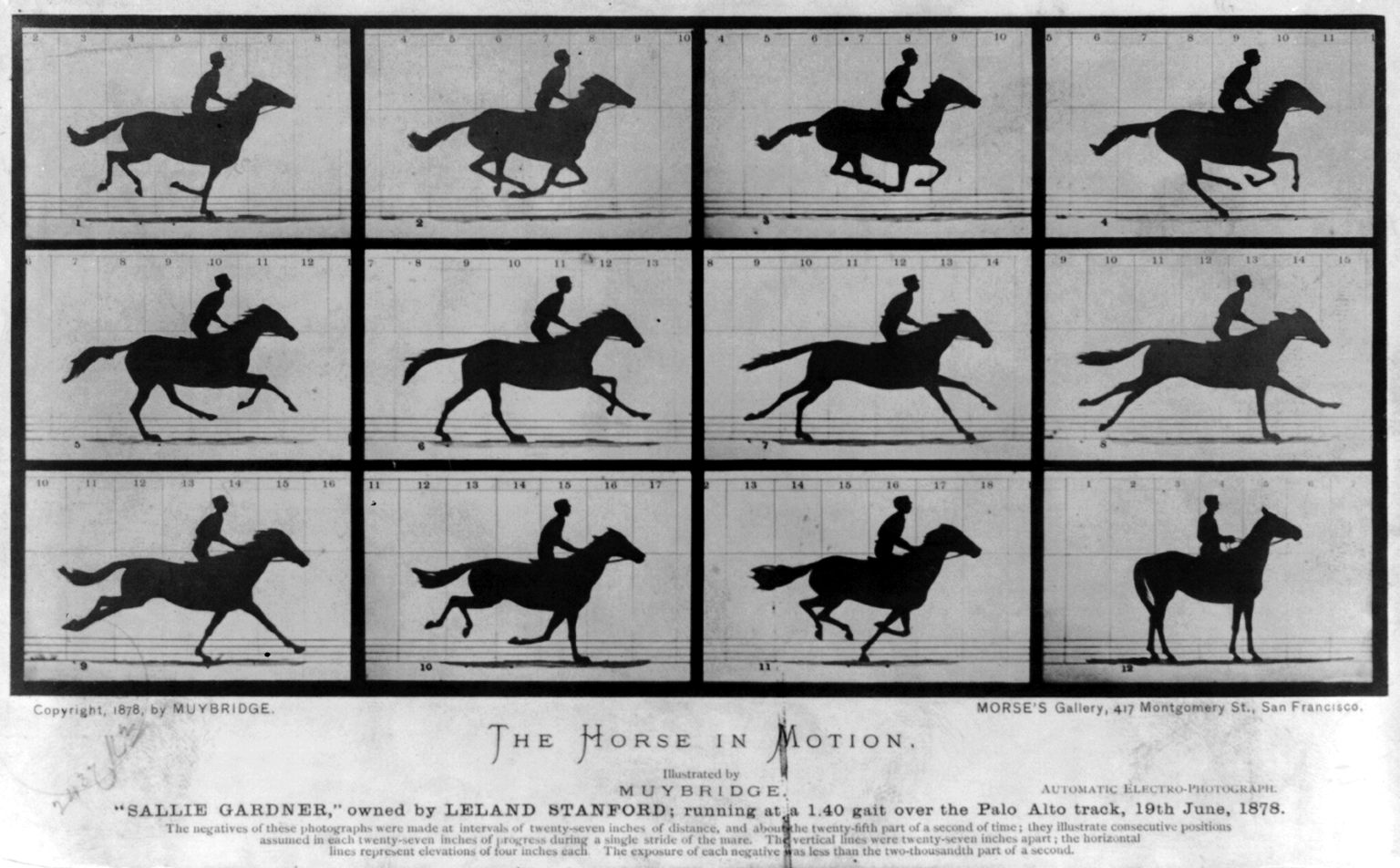
The Horse in Motion
1. The Trotting Horse
In 1878 Eadweard Muybridge (1830-1904) created the mechanism that recorded the first photographs of a horse trotting. No photographer had ever been able to capture such rapid motion before. Muybridge’s multi-camera mechanism stopped time and seized motion itself so that he and his employer, California’s ex-governor Leland Stanford, could analyse the animal’s gait and improve the training of his racehorses.
2. The Photo Finish
Muybridge was at a racetrack when two horses finished in a dead heat. The usual volatile debate followed about which animal had triumphed. The dispute tripped Muybridge’s innovative impulse, and soon Eadweard invented the first device to record the “photo finish”. In a letter to Nature magazine in May 1882, Eadweard Muybridge argued that every horse race should make use of a high-speed photo at the finish to determine the winner. A camera very much like the one that Muybridge deployed still determines the outcome of contested horse races.
3. Photo Finish Ubiquity
The idea of Muybridge’s photo finish was later expanded to include other sporting events, including foot races and swimming contests. Today, on TV and in film, the grace and agility of divers and swimmers, sprinters and footballers are presented in stop-motion, yet another of Muybridge’s contributions to the way we see and perceive.
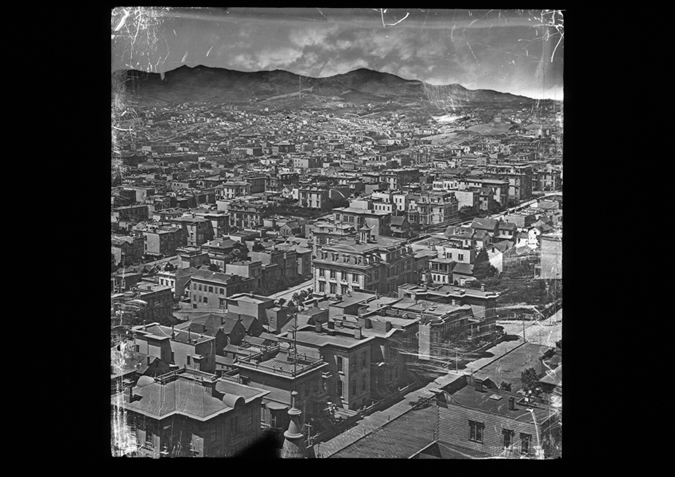
The first panel of Muybridge’s panorama (Eadweardmuybridge.co.u)
4. Panorama
In January 1877, Muybridge placed his view camera on the roof of railroad magnate Mark Hopkins’ half-finished mansion in the posh Nob Hill neighborhood of San Francisco and began the process that recorded the most detailed and complete – though not the first – panoramic view of the city. Starting at 11am and using the contemporary equivalent of a telephoto lens, Muybridge took 13 photos as he carefully moved his camera around in 360 degree circle. The panorama remains the most complete description of the City’s “Golden Era” before its partial destruction in 1906 by an earthquake and subsequent fire.
5. The American West and US National Parks
Throughout the late 1860s Muybridge produced a stunning portfolio of the wild beauties of the American West, including breathtaking documentation of Yosemite before it became a national park. Multiple historians assert that the photos helped spur the National Parks movement itself. Theodore Roosevelt, the father of the US National Parks system, was directly influenced by Muybridge’s and other early photographers views of the American wilds.
On Saturday night at Glastonbury 2014, the mud, the terrible noodles and the hangovers will all be worth it. For the first time ever, a silent film will play the country’s leading rock festival. Neil Brand and the Dodge Brothers will perform their rousing score for William’s Wellman’s rail-riding rollercoaster Beggars of Life in the Pilton Palais cinema tent, at 6pm on 28 June. We’ll be there – will you?
Gloria Swanson, film star and fully fledged fashionista.
“To the feminine mind nothing appeals quite as strongly as clothing, hats, or shoes – in fact finery of any kind,” opined Moving Picture World in 1916. Gentlemen spectators apparently preferred films with fighting in them. On finishing this fascinating survey of how the fashion and film industries met and grew together in the early 20th century, I’m inclined to excuse MPW’s sweeping generalisation.
Clothing, and fashion, are at the heart of everything that Hollywood has ever done. All film is spectacle, early film unambiguously so – and nothing epitomises the excesses of La-La Land more than the view of preening, primped movie stars lining up on the red carpet draped in borrowed couture and jewels. Baffling then, to remember that the first film actors were required to supply their own costumes. Turning up well-dressed to an studio (as the supremely stylish teenage Gloria Swanson did at Essanay) could secure you a chance at stardom. Even when studios had appointed a seamstress, numbers were so short that they would frequently be called upon to play roles on screen. In fact, Hollywood wardrobe departments would be staffed by many a former actress. And because few people kept proper records of who did what in the early studios, it is the memories of stars such as Swanson and Lillian Gish that often provide the clearest picture of how the costumes were supplied, chosen and recycled in-house.
Lillian Gish wears a negligée designed by Henri Bendel in Way Down East (1920)
To begin with, Michelle Tolini Finamore’s scholarly illustrated book examines fashion trends that made for great movie subject matter, from the exploited women working in sweatshops that churned out shirtwaists for America’s increasingly well-dressed urban working-class, to the extravagant picture hats that caused havoc in Nickelodeons, to the risque Paris styles that marked a lady out as a vamp. The idea that US fashions were practical and democratic and French ones outlandish and revealing kicks off a major theme in this book – the battle for fashion supremacy between first New York then LA with Paris.
Don’t believe everything you read in the press. Contrary to published reports, legendary silent film actor Lillian Gish is not dead – she’s alive and well and totally winning at Twitter. Using the handle @MsLillianGish, the star of Broken Blossoms and The Birth of a Nation drops wisdom on the internet from a great height every day. Check out her Twitter biography, which is typically witty, informative and self-effacing: “I am the greatest actress of all time. If I had been a scientologist, you all would be one today. Yeah, I rocked it like that.”
Not content with enjoying Ms Gish’s wise words 140 characters at a time, I asked the star if she would be happy to answer a few questions for the benefit of the Silent London readers. To my great delight, she accepted. Unfortunately the time difference did not allow us to conduct the interview live, but I posted some questions to Ms Gish, and with her help of her loyal secretary she was able to answer them. Her responses are illuminating, I think you’ll agree. Here is the transcript of my interview with Lillian Gish …
This beautiful short, Hungerford: Symphony of a London Bridge, is a mini city symphony directed by Alex Barrett in 2010. It has won several awards, appeared at many festivals, and here at Silent London we have long admired it. Barrett, a writer, film-maker and regular Silent London contributor, has a more ambitious project in the works, though: London Symphony, a feature-length silent film about our fair capital. Barrett is a huge admirer of European silent cinema, and the city symphonies of the 1920s avant-garde. He plans to start shooting London Symphony later this year. Here’s how he describes the project:
London Symphony is a poetic journey through the city of London, exploring its vast diversity of culture and religion via its various modes of transportation. It is both a cultural snapshot and a creative record of London as it stands today. The point is not only to immortalise the city, but also to celebrate its community and diversity.
He’ll be asking for your help though – Barrett and his team want to crowdfund their movie, and you’ll be hearing more about that in the summer on these very pages.
It was a great honour for me to be asked to speak on the opening night of the Toronto silent film festival recently. It’s just a pity that geography was against us. But the speech was recorded ahead of time, and looked very smart, thanks to a colleague in the multimedia department at the Guardian generously helping me out – Andy Gallagher shot, produced, edited and did absolutely everything except sit on that blue chair.
You will probably be able to spot that it’s my first stab at presenting something like this, but it’s on the topic of silent film intertitles, which I am very enthusiastic about – the too-often unsung heroes of silent cinema. I hope you enjoy it.
Film-maker Simon Smith has made another silent cinema mashup to delight any Londoner. His previous film spliced scenes from Friese-Greene’s The Open Road (1927) with the same London streets filmed in 2013. The new clip embeds scenes from the Wonderful London actuality into vistas of the capital in 2014. The effect is stunning – it’s fascinating to compare London as it is and as it was, and as the 1920s city-dwellers step out of their fuzzy sepia frames they become ghosts haunting our 21st-century streets.
As much as London has been rebuilt and redeveloped over the past century, this clip reminds us that its past has not been erased, just sunk below the surface.
This is a guest post for Silent London by John Sweeney. John Sweeney is one of London’s favourite accompanists, composing and playing for silent film and accompanying ballet and contemporary classes. He researched and compiled the music for the Phono Cinéma-Théatre project and is one of the brains behind the wonderful fortnightly Kennington Bioscope at the Cinema Museum. The Silents by Numbers strand celebrates some very personal top 10s by silent film enthusiasts and experts. When Silent London started with these lists I joked with a friend that what was needed was a list of silent films to avoid: no sooner had I spoken than films started coming to mind, but I also started thinking of the opposite list, of films that aren’t anything like as well known as I think they should be. So, I’ve settled for five films that you might think would be good but really aren’t, and five films that are definitely worth seeking out. Opinions differ and it’s quite possible that I’ve missed the point of some the films – put me right in the comment space below if you disagree.
Five silent films to avoid
Note: I make no claim that these are the worst films – merely that they should be a lot better given their reputation, or who made them.
20,000 Leagues Under the Sea (1916)
20,000 Leagues Under the Sea (1916, Stuart Paton)
Yes, this film features groundbreaking underwater photography for a few minutes, but the screenplay is stupid, the acting is ridiculous, and the editing’s completely random. On IMDB someone writes “It’s by no means a bad movie”, but it is, it really is! Do not watch this movie.
If it’s submarines that float your boat, try Submarine, directed by Frank Capra.
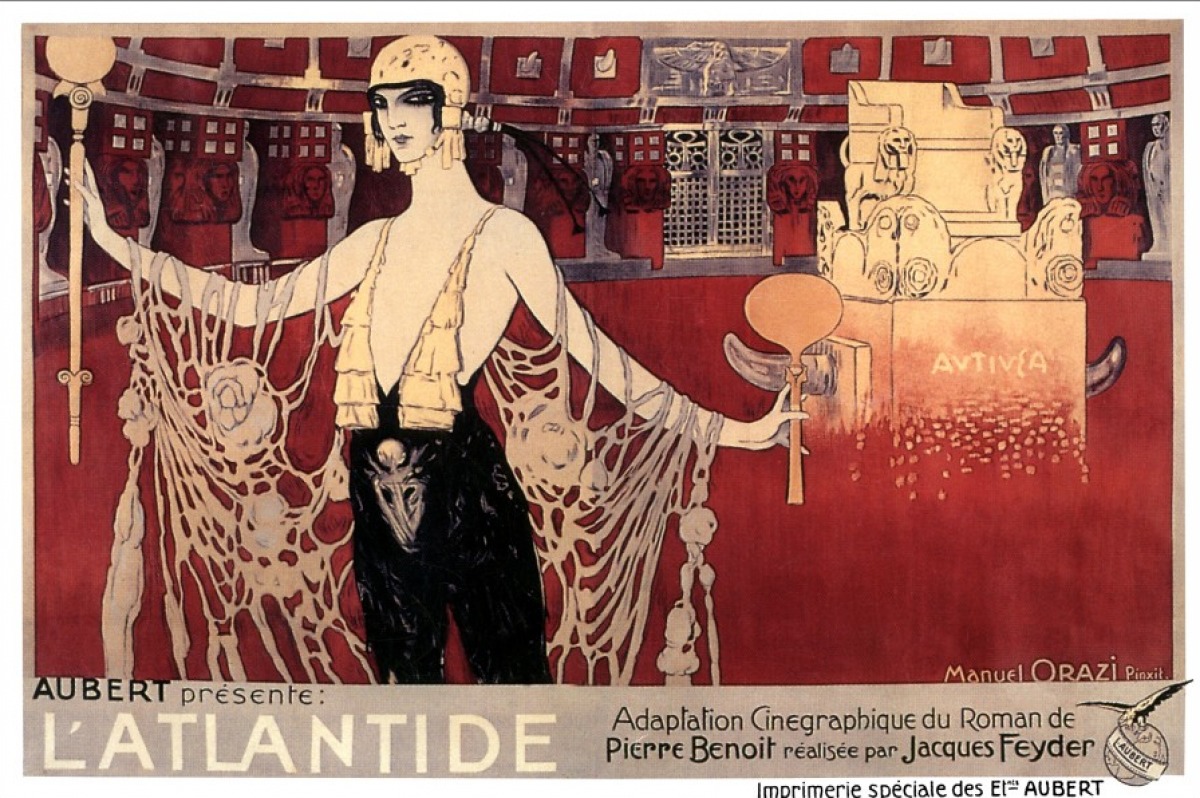
Atlantide (Jacques Feyder)
L’Atlantide (1921, Jacques Feyder)
Jacques Feyder was a wonderful director, as anyone who’s seen his Visages d’enfantswill know, but this exotic farrago, weighing in at almost three hours, is dreadful. Two French soldiers stumble on the lost kingdom of Atlantis, in the middle of the Sahara Desert (!), which is ruled by the ageless Queen Antinéa. Featuring far too much sand and a decidedly uncharismatic performance from Stacia Napierkowska as the supposedly endlessly fascinating and desirable queen, you really don’t need to see this film.
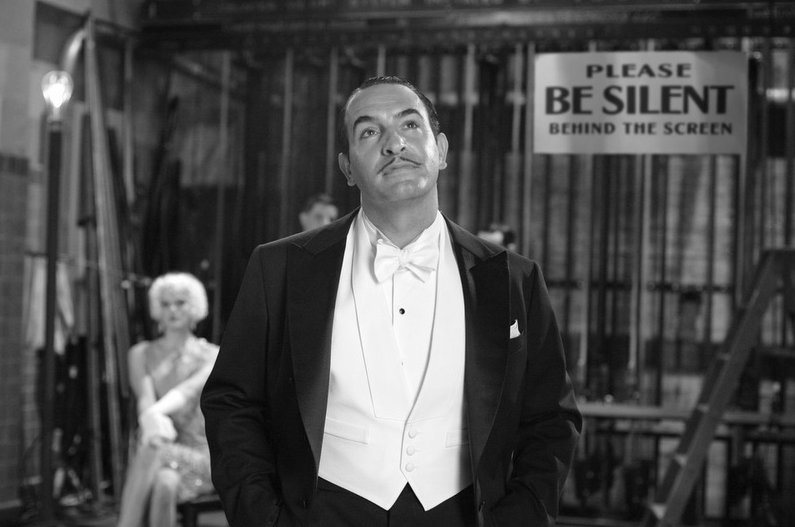
The Silent London social media accounts are here to help, so on Thursday evening, I passed on the news that The Artist is screening on BBC2 on Sunday night.
Finally get around to doing that thing you said you would do one day. THE ARTIST is on BBC2 on Sunday night http://t.co/9ICoM728R0
How about it guys? I’m assuming you’ve seen The Artist, you don’t want to see it, or you can set the tape for it*. So why not nominate Sunday night silent movie night. Stick on a film, and tell me what you’re watching here in the comments or on Facebook or Twitter, using the hashtag #silentfilmthatsnottheartist. It’s the perfect excuse to enjoy a silent, and chat to your friends at the same time. And isn’t that half the point of these modern silents? To revive our passion for the real deal?
Not sure what I will be watching, but it may well be something British, or first-world-war-ish. How about you? Are you in?
I watched my first silent films, not on my grandpa’s knee, nor at one of these grand screenings with live music that they have nowadays, but in a sixth-form college classroom while being guided through my film studies A-level. It’s not a very romantic story, but I loved what I saw, and while studying for my exams, and subsequently at university, I sought out, saw, and enjoyed many more silents – going from a teenage film fan to an early cinema buff-in-waiting. The film studies syllabus (WJEC, a few years ago now) that I took was great – introducing us to relatively obscure arty silents as well as a healthy appreciation of Hollywood industry mechanics and even a smattering of theory. It stood me in good stead for my English lit & lang degree and a master’s in film history. Plus, I doubt the 18-year-old me would ever have got to see Un Chien Andalou without it. If you want someone to take the blame for Silent London, you can point your finger squarely at a tertiary college in Ealing W5. (I chose the college, incidentally, primarily because it was so close to the famous film studios.)
The point is, I think that sixth form is a great time to introduce people to early and silent film. Teenagers who seek out noisy bands and edgy art want off-beat films to watch too. Silents fit the bill perfectly. There’s something off-kilter about silent movies when you first meet them, and something unexpected about a supposedly modern subject area taking you so far back into the past.
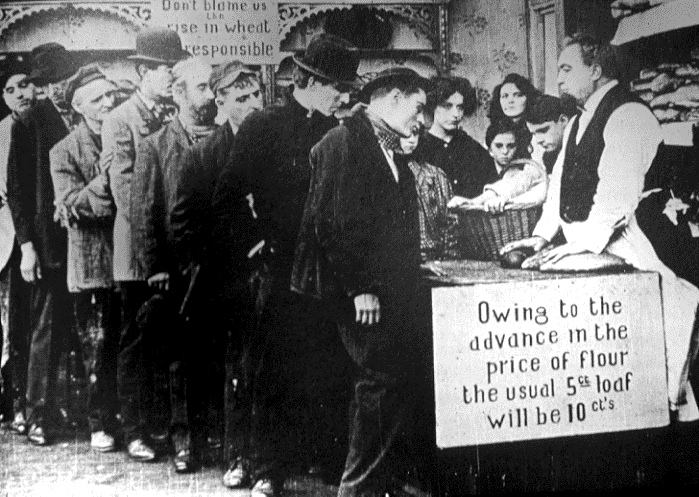
A Corner in Wheat (DW Griffith, 1909)
Cheering then, to see Keith Withall’s Studying Early and Silent Cinema land on my desk. It’s an expansion of a 2007 volume and clearly informed by two things: his years spent teaching film studies at FE and HE level, and a passion for attending the film festivals at Pordenone and Bologna. This is a useful work for anyone interested in silent cinema to use as a reference but a great introduction to the subject for students. It’s a read-this-now-watch-that thing, and I’m all for it. Not only that, but Withall blogs too, posting thoughtful, erudite essays at cinetext.wordpress.com
Withall’s expanded book is an enjoyable and wide-ranging introduction to the key concepts and landmarks in the early and silent film period. This guide tackles a breathtakingly vast amount of material in the clearest of terms, and always with one eye on the here-and-now. There are references not just to modern films and attitudes, but also practical consideration of the availability of viewing material. Case studies examine classic films in detail, while wider sweeps take in potted histories of alternative and smaller national cinemas. Throughout, Withall encourages students towards wider exploration of the subject area – and most importantly, towards further viewing.
Studying Early and Silent Cinema by Keith Withall will be on sale in May 2014, priced £16.99 in paperback (ISBN: 978-1-906733-69-8) and £50 in hardback (ISBN: 978-1-906733-70-4), published by Auteur
This is a guest post for Silent London by Kelly Robinson. If you haven’t seen The Wind, be warned that this article discusses the ending of the film.
Ethereal, delicate, poetic, otherworldly are just some of the somewhat elusive adjectives used to describe Lillian Gish since the early years of her stardom. Effusive admirer Vachel Lindsay said “Lillian Gish could be given wings and a wand if she only had directors and scenario writers who believed in fairies.” However, in reality Gish had her feet firmly on the ground. She had a career spanning eight decades, was a spokeswoman for cinema’s history with high artistic ambitions for herself and for the medium. King Vidor, who directed her in La Boheme (1926) commented: “The movies have never known a more dedicated artist than Lillian Gish.”
In his autobiography A Tree is a Tree Vidor said that Gish was incredibly assertive and had her own thoughts about the filmmaking process. Indeed, she knew a great deal about cinematography and in particular lighting. She had learned her trade during the more collaborative process of the silent era, where she had received extensive tutelage from DW Griffith in a production context where actors frequently worked without scripts and where they were encouraged to collaborate on characterisation and staging. She may only have had had a small acting role in Griffith’s Intolerance (1916), however she designed and furnished sets, helped with lighting and cutting, wrote intertitles and advertising copy.
Will this be something we consider to be a truly silent film? Who knows. But it’s dialogue-free, delightful and comes to us courtesy of our friends at Aardman Animations, whose support for the Slapstick Festival is legendary. Shaun the Sheep the Movie is scheduled for release in spring 2015. Not just for kiddywinks, we’re sure.
From Aardman, the creators of Wallace & Gromit and Chicken Run, comes the highly anticipated big screen debut of Shaun the Sheep. When Shaun decides to take the day off and have some fun, he gets a little more action than he baa-rgained for! Shaun’s mischief accidentally causes the Farmer to be taken away from the farm, so it’s up to Shaun and the flock to travel to the Big City to rescue him. Will Shaun find the Farmer in the strange and unfamiliar world of the City before he’s lost forever? Join Shaun and the flock on their hilarious, action-packed adventure in Shaun the Sheep the Movie – only in cinemas Spring 2015.
Betty Balfour as Tip Toes in Love, Life and Laughter (1923). Photograph: British Film Institute
Betty Balfour as Tip Toes in Love, Life and Laughter (1923). Photograph: British Film Institute
Love, Life and Laughter (1923). Photograph: British Film Institute
Love, Life and Laughter (1923). Photograph: British Film Institute
Genuinely exciting news for silent film fans. A long-thought-lost film starring the wonderful Betty Balfour, and directed by the somewhat elusive George Pearson, has been returned to us. The film is Love, Life and Laughter (1923): Betty “Queen of Happiness” Balfour stars in a typically winning role as Tip Toes, an impoverished chorus girl who dreams of fame on the music-hall stage. She befriends a young aspiring writer, also down on his luck, and they decide on a plan – to meet two years later back at their tenement building to see if either of them have achieved their fondest wishes.
Love, Life and Laughter was found in a cinema in Hattem, in the Netherlands. The cinema was due to be rebuilt and so the anonymous film cans stored there were taken to EYE, the the Dutch Film Museum, in the hope that they might contain footage of local historical interest.
The BFI’s curator of silent film, Bryony Dixon, welcomes the discovery with open arms, saying:
Contemporary reviewers and audiences considered Love, Life and Laughter to be one of the finest creations of British cinema, it will be thrilling to find out if they’re right! We hope to be able to acquire some material from our colleagues at EYE soon so that British audiences can have a chance to see this exciting discovery.
We know that the copy EYE has acquired of Love, Life and Laughter has Dutch intertitles and has the original tints and tones intact – and we do have reason to believe that it is a very special picture. Contemporary reviews praised the film, with the Telegraph saying it was “destined in all probability to take its place among the screen classics”. In the Manchester Guardian, CA Lejeune’s gives nicely rounded sense of the film, and its importance:
Love, Life and Laughter is the latest Pearson film, and legend has it that the latest Pearson film is aways the best. It is certainly the most ambitious, spectacular at times in the De Mille ballroom manner, lit and photographed with a beauty to dream of. Devotees have called it George Pearson’s masterpiece, and so it is – of bluff. He lights common things uncommonly, and legend makes them symbolic; he catches a series of farcical situations, and legend makes them comic; legend turns sentimentality into sentiment, and confusion into mystery.
This fantasy of a chorus girl and a young poet is clever, but chiefly clever in simulating cleverness, in tickling the intellectual vanity of its audience with a goose feather, coloured peacock by imagination. It will succeed. And its success will be the result not of innate quality but of the great Welsh-Pearson legend – and, when all is said and done, nothing else matters.
That rather guarded review takes on a new aspect when we remember that the “great Welsh-Pearson legend” has now been forgotten, and their films have almost entirely vanished – which has the affect of rather enhancing the title’s allure. Until its rediscovery, Love, Life and Laughter sat on the BFI’s 75 Most Wanted list of much-missed British films.
A 1923 programme for the film offers this romantic and tantalising description:
“The Story is but a simple exposition of the oldest, yet ever youngest desire of the human heart, the achievement of an earnest ambition. The incidents tell in picture form of the striving of a boy and girl, against the odds of the world. The portrayal of this struggle towards a final goal of the desired happiness is unconventional in treatment. The Boy and Girl laugh and weep, succeed and fail, move onward and forward to an inevitable destiny, and to a climax which should live long in the memory.”
One of the many attractive elements to this news is that the film’s subject matter – of two starry-eyed types struggling to achieve their artistic ambitions – resonates against the life stories of the director and star both. Poignantly, in light of the fact that this film has been missing for so long, both Balfour and Pearson were highly acclaimed in the silent era and subsequently forgotten by most. It’s discoveries such as this, in fact, that make us appreciate anew how terrible the odds of survival for silent cinema are – with 75% of silents by the wayside, for each one we treasure there are three more we may never see.
Test your knowledge of silent movies and the silent era with our new quiz. Simply match the Mordaunt Hall review to the correct movie and impress your peers for years.
This is a guest post for Silent London by Kelly Robinson
Cecil B DeMille is perhaps predominantly remembered for his big-budgeted biblical epics of the 1940s and 50s. For instance, the captivatingly lurid Samson and Delilah and The Ten Commandments are both still television staples. However, DeMille had a career that spanned several decades and he made more than 50 films in the silent era alone. Many of these early titles were similarly lavish and sensationalist, whilst also seeking to exploit contemporary social concerns.
Jesse L Lasky, Vice President of Famous Players-Lasky (Paramount), encouraged “modern stuff with plenty of clothes, rich sets, and action”. Savvy to the growing female audience, Lasky contracted screenwriter Jeanie Macpherson to portray women “in the sort of role that the feminists in the country are now interested in … the kind of girl that dominates … who jumps in and does a man’s work.” The result was several delightful, enormously successful, marital comedies, starting with Old Wives for New and followed by Don’t Change Your Husband. Why Change Your Wife? completes the “does what it says on the tin” trilogy. With their focus on female glamour and desire, these films offer more permutations of the “New Woman”, which Birds Eye View has explored in previous Sound & Silents strands.
Why Change Your Wife? (1920)
Considering his somewhat indomitable, patriarchal image, it is perhaps surprising to find a large number of women amongst Demille’s regular collaborators. Anne Bauchens edited his films, from Carmen (1915) all the way through to The Ten Commandments (1959), his last film. In his unpublished autobiography he wrote that it was an essential clause in every contract that she be his editor. In the Los Angeles Herald Examiner he is quoted as saying that: “‘though a gentle person, professionally she is as firm as a stone wall … We argue over virtually every picture.”
This is a guest post for Silent London by David Cairns, a film-maker and lecturer based in Edinburgh who writes the fantastic Shadowplay blog. The Silents by Numbers strand celebrates some very personal top 10s by silent film enthusiasts and experts.
It’s impossible to tot up a list of “the greatest” or even “my favourite” lost films, since they are by definition lost and impossible to assess, at least without using supernatural powers or outright lying. These are just 10 that produce in me a particularly sharp pang of longing.
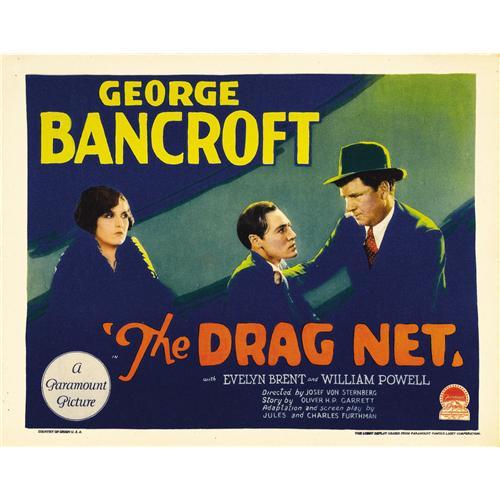
The Drag Net (1928)
1) The Drag Net(1928). Since Josef Von Sternberg’s Underworld reinvented the gangster movie as romantic tragedy, and still stands up as a rip-roaring urban fantasy comparable in its antisocial mayhem to a Grand Theft Auto game with love scenes, the fact that the second silent crime thriller he made, refining his take in the genre, is not known to survive anywhere, is heartbreaking.
Sternberg was particularly targeted by the vicissitudes of fate in his career. Weirdly, those of his films whose destruction was ordered, such asThe Blue Angel (by the Nazis), The Devil is a Woman (by Spain’s Guardia Civil) have survived, whereas The Case of Lena Smith exists only as a tantalising 10-minute fragment. A Woman of the Sea may have been destroyed on the orders of its producer, Charlie Chaplin, but a second print remains unaccounted for …
FW Murnau
2) Similarly, while the British courts ordered FW Murnau’s Nosferatu destroyed for copyright infringement, the unauthorised adaptation of Draculasurvived, but nearly all his earlier movies are lost, including Der Januskopf(The Janus-Face, 1920), an unauthorised adaptation of Dr Jekyll and Mr Hyde. Why this matters: the star was Conrad Veidt (seen looking angst-ridden in a few grainy stills), the screenplay was by Caligari scribe Hans Janowitz, and Bela Lugosi had a smaller role. Plus, you know, it’s Murnau. Doing a horror film.
Several of Murnau’s German silents are completely lost or survive only in tiny pieces. 4 Devils, his last Hollywood film, is also MIA.
The Patriot (1928)
3) Another German in Hollywood, Ernst Lubitsch, suffered a major loss when The Patriot(1928) vanished from the earth. This is particularly appalling since the film won best screenplay (Hans Kraly) at the 1930 Academy Awards. Also, the star of the film is Emil Jannings. The movie is far enough removed from Lubitsch’s usual brand of movies that it might be hard to know exactly what we’re missing, but the trailer for this one surivives and the vast, expressionistic sets haunted by Lubitsch’s restless camera make this look like one of the most impressive films of the silent era. Sob.
4) The Divine Woman(1928) is, of course, Greta Garbo. Her director is fellow Swede Victor Sjostrom (or Seastrom) and her co-star is Lars Hanson. And there are nine minutes of this in existence to make you yearn for the rest all the more desperately. What we can see in the clip (which turned up in Russia after Glasnost) suggests a rather more boisterous Garbo than we’re used to seeing, throwing herself at Hanson and yanking him about by the hair in an affectionate but rather rough fashion. Another 71 minutes of that, please.
Alfred Hitchcock and Alma Reville filming The Mountain Eagle
5) The Mountain Eagle(1926). Its own director thought this one was rubbish, but as he was Alfred Hitchcock I’d still like to see it. It was his second directorial effort. A recent restoration of his first, The Pleasure Garden, has revealed it to be a better film than we all thought. Who knows what a rediscovery of the followup might reveal?










 Silent London