“Tonight I want to welcome you to a showing of a naughty little number I made with my own money – $800,000 of it.” – Gloria Swanson introducing Queen Kelly in 1967
Silent cinema icon Gloria Swanson was born on this day in 1899. Today, 127 years later, is the publication day for my new book The Curse of Queen Kelly. The title of the book is taken from a phrase Swanson herself used for the disastrous production of her film Queen Kelly, directed, until she fired him, by the great Erich von Stroheim.
My book, published today by Sticking Place Books, tells the full story of how Swanson and Stroheim – and Joseph P. Kennedy became tangled up together in the attempt to make an impossible film. And it tells exactly what happened next, to this brilliant, transgressive and enduring unfinished film.
There are a number of ways you could choose to celebrate this auspicious date:
Age: Somewhere from 92 to 96 years old. Or brand new, maybe?
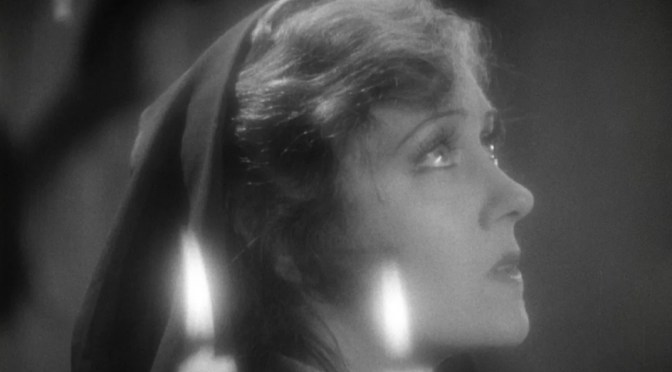
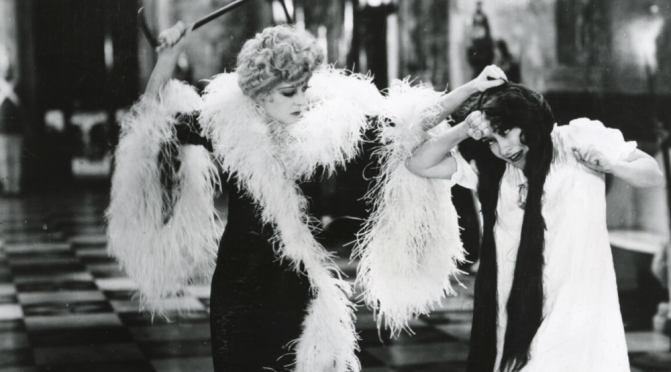
Appearance: Decadent visions of dissipated European royalty in palatial grandeur, and seedy expat iniquity in East Africa. Erich von Stroheim directed this film, so every frame bursts with expensive vices, exposed flesh, outlandish costumes, drifts of spring blossom or swags of velvet and the occasional splash of bodily fluids. Not to mention more candles than Barry Lyndon, more or less. Gloria Swanson is the star…
Happy holiday Silent Londoners! They say that if you remember 2025, then you weren’t watching enough silent movies. How much do you recall?
For myself I sure watched a lot of silent films, clocking up several festivals and individual screenings. Pordenone and Bologna, Zurich, Hippfest, Slapstick, Cinema Rediscovered, Women and the Silent Screen in Belgium, plus The Gold Rush centenary, Anna May Wong, Gosta Berlings Saga, Stella Dallas, Lillian Gish, Lois Weber, Film on Film and more at the Southbank. Did you catch Bonn, San Franciscso, the non-stop action at the Kennington Bioscope, or any of the many, many silent screenings all around the world? How about Sherlock Holmes?
I awoke with good intentions but encountered even better conversations. And thus, my film viewing on this, the final day of the 44th Giornate del Cinema Muto, began at midday, with Koko the Clown. Which is a wonderful way to begin. This cartoon, Ko-Ko at theCircus (Dave Fleischer, 1926), with our inky friend squaring off against a giant, had me in stitches – which is how I ended the day too. Apt, perhaps to start with animation when today was really all about the kiddywinks.
I have been a little slow to start up some mornings. But one thing you can guarantee that I will get out of bed for is Victor Sjöström. Victor Sjöström’s 1912 debut film no less, banned outright in Sweden, but available for us lucky degenerates on the capacious Verdi screen, with a truly wonderful accompaniment by Stephen Horne. Variously known as The Cruelty of the World, The Gardener or The Broken Spring Rose, this is a really special film and I do think the first title is the best one.
Feature films? What a concept. They don’t always seem to be the dominant form here at Pordenone. But this afternoon was an exception to that rule, with a triple-bill of four-to-six-reelers back to back. Welcome to a world of truly immersive narrative entertainment, It’s the future.
It may seem that the Giornate is in its own bubble, a hundred years or more removed from the real world, wrapped up in the fashions and the fads of the past. But we’re still looking out at the world every day, and no matter how the text on screen tries to guide us, we bring our 21st-century interpretation to everything that passes in front of our eyes. Sometimes the challenge is to wind back the clock, to see the past as our ancestors did when they were living through it. Sometimes we have no choice but to view images of the world as it was while burdened with the knowledge of our shared history, and of our violent present.
Last night I dreamt I went to East Lynne again… Ellen Wood is directing my subconscious now. I love this mini melodrama strand and I really enjoyed today’s instalment, which was the lavish 1925 Fox adaptation, East Lynne (Emmett Flynn), scripted by Lenore Coffee and starring Edmund Lowe as Carlyle and Alma Rubens as Lady Isabel – a very handsome pair and just right for this ill-starred pair.
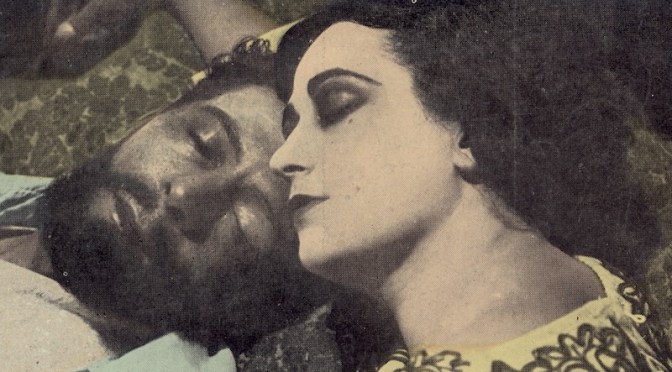
Monday finished with a zinger. I mean a Zingari. Italia Almirante Manzini wowed the Verdi as Wilejka, a heavy-lidded beauty with great hair, but in this case as a heavy-lidded beautiful Gypsy shepherdess with great hair. In Zingari (Mario Almirante, 1920) Wilejka falls in love with a man, Abaldo (Amleto Novelli, no less) that her father, the leader of the camp, forbids her to marry. There is many a consultation of the cards, a fireside dance, a storm, a threatening villain, a crushing pang of jealousy, an assassination and naturally, a barn on fire before this will all end happily ever after.
Is it still a pathetic fallacy even if the weather is true but the drama is not? As I set out to begin my day with some major melodrama, there was heavy weather in the skies above Pordenone also. We shook off the rain in the Verdi foyer, while we prepared to dampen our faces with tears during the first of this year’s adaptations of East Lynne.
The Giornate dawned with grey skies but good times, a respite from Storm Amy and all the rest of the week’s turbulence, a day of pretty views and outbreaks of mild escapism. Many of us were just grateful to be get here, let alone arrive on time, after the transport situation was especially complex this year. It was an especially mellow start to the festival for me. Blame it on the 3am alarm call, the cold medication or just the pleasurable daze of seeing so many familiar faces all at once. Will I sneeze or snooze my way through the first day of films? Who knows? And will my ears ever “unpop” from the plane? Join me now to find out.
You may or may not know this, but when I started Silent London I was working at the Guardian newspaper. So, it was at this time, when I was reading and writing about the silent era, and sitting in the Guardian office (rarely at the same time, I hasten to add) that I first became just a little obsessed with C.A. Lejeune.
Caroline Alice Lejeune, pioneering press film critic, media celebrity, Manchester icon and one half of the Sunday Ladies, with the Sunday Times’s Dilys Powell, is a pet subject of mine. I find her writing to be witty and wise and gentle, and her story, of falling in and out of love with the cinema, to be absorbing and not a little moving. It is also fascinating to me how she first got her job as the first real film critic on the Manchester Guardian, and moved to the Observer for another three decades. So I have been doing a little research. Well a lot in fact.
On Sunday I had the very great pleasure of introducing a double-bill of Anna May Wong silents: the UK premieres of new restorations of Song (Richard Eichberg, 1928, restored by Filmmuseum Düsseldorf) and Pavement Butterfly (Richard Eichberg, 1929, restored by DFF) at Cinema Rediscovered in Bristol. Beautiful films, a beautiful audience and simply gorgeous musical accompaniment by Stephen Horne. Wish you could have been there – maybe you were?
“Is this really what you want to learn from the past?”
– Breaking Plates (Karen Pearlman, 2025)
Let the train take the strain they say, and so I did, curating my own idiosyncratic, mostly silent, tour of female film history this week – and all by rail. Please rest assured that no leading ladies were lashed to the tracks in the making of this movie. Nor is this post sponsored by Eurostar. I should be so lucky.
This cute preamble has simply delayed me telling you that I took the choo-choo to Brussels, birthplace of such 20th-century film icons as Audrey Hepburn, Agnès Varda (foreshadowing) and Chantal Akerman. So my first stop, naturally, was a pilgrimage to one of the most famous addresses in cinema history, 23 Quai de Commerce, 1080 Bruxelles, to pay homage to Akerman, Delphine Seyrig, and Jeanne Dielman herself by posing outside the door of the heroine’s apartment building wielding a potato peeler. Important feminist film praxis, and in the estimable company of Maggie Hennefeld to boot. All joking aside, there is a frisson to be felt standing on this spot, where Akerman filmed the exteriors for her 1975 masterpiece, and it is in a very pleasant corner of the city. Do visit, with or without kitchen implements. Don’t miss the Marguerite Duras quotes that pave the nearby park, and the gorgeous, watercolour-style mural of Dielman at her kitchen table by Spanish muralist Alba Fabre Sacristan. I recommend checking out her portfolio on Instagram: the subject matter of the majority of her work throws a different light on this apparently demure picture of a middle-aged woman in her housecoat.
This is a long overdue post, but perhaps I was simply enjoying the research too much. Picking up an occasional series on this site, here are some short reviews of new books on silent film that have passed across my desk recently. Yes, I am a lucky duck.
Silent to Sound: British Cinema in Transition, by Geoff Brown
If a story is worth telling, and this one certainly is, then it is worth telling with style. In this case, Geoff Brown relates the story of the arrival of sound in the British film business with an eye for the eccentricities and absurdities that make it not just a pivotal moment in the medium, but a good yarn, and one that is revelatory about the national industry. Geoff Brown, journalist and researcher, has been studying the arrival of sound in Britain for years now as part of an AHRC-funded project and the result is this deeply enjoyable and admirably detailed book about a long and strange process, which when told with Brown’s light touch and quick humour is as diverting as it is informative. The serious point is that Brown’s emphasis, where he has access, is always on the films themselves. And that, along with the quotations from the critical discourse that I particularly cherish, is what really gives this book its colour.
Bonjour mes amis. Aimez-vous les films de Charlie Chaplin ? Are you wearing your pearls? Supping on truffle soup? Tooting your toy saxophone? Bien, alors nous pouvons commencer.
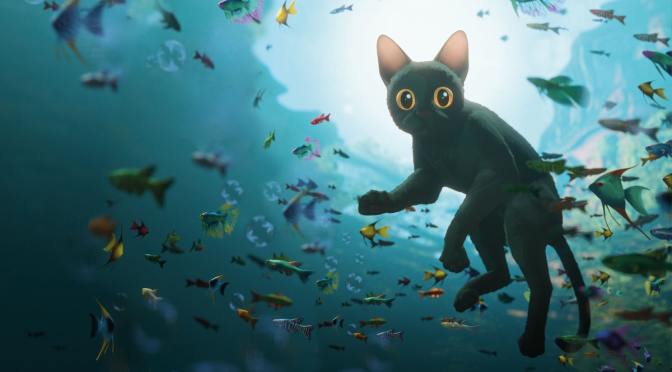
Last night, the fantasy adventure Flow (Gints Zilbalodis, 2024) won the Academy Award for Best Animated Feature. This dialogue-free drama follows a cat, forced to travel far from home in unfamiliar company when an ecological disaster submerges the earth in flood waters.
Just when I thought I was out, they pull me back in!
At the start of the film it appears that the cat lives with a besotted artist who pays tribute to the feline with sculptures of diverse sizes. But even this ailurophile human has abandoned the home, and their pet. As the waters rise and rise, our formerly cosseted hero must learn to survive and make common cause with a ragtag crew comprising a capybara, a secretary bird, a dog and a ring-tailed lemur. Against the odds, the animals have to save themselves from a manmade catastrophe.
Thank you for bearing wth me during a few several technical glitches related to this year’s poll. Relax, enjoy your glass of wine-flavoured carbonated beverage, and welcome to our glittering award ceremony. I have counted the votes, and I am ready to announce the winners of the Silent London Poll of 2024!
Congratulations to all the people mentioned below – as ever, these categories were bursting at the seams with excellent, worthy nominations and a great reminder of how exciting the global silent film scene is. Thank you for all your votes, and your comments, especially.
Without further ado, let me open this giant stack of golden envelopes. Here are your winners.
1. Best orchestral silent film screening of 2024
Your winner: The Winning of Barbara Worth (Henry King, 1926), with a score composed by Neil Brand, arranged by George Morton, conducted by Ben Palmer, performed live by the Orchestra da Camera di Pordneone, at Giornate del Cinema Muto, Pordenone
I said:“t’s a big, big movie, with the youthful star trio of Ronald Colman (on $1,750 a week), Vilma Banky (on $1,000 a week) and Gary Cooper (on $50 a week!) in a desert love triangle, and a tremendously terrifying climax, as the townsfolk run for their lives when the river bursts its manmade bounds. Plus we were to enjoy the world premiere of a wondrous new score composed by Neil Brand, arranged by George Morton, conducted by Ben Palmer, and performed live tonight by the Orchestra da Camera di Pordenone. If you know the film you will know that it is celebrated for its scale, but also that this is a Frances Marion script, with a touch of melodrama (Vilma overhearing Ronald’s confession that he won’t propose to her, but not the reason why), her pet subject of adopted children, and her love of a grand theme – here the pioneers’ battle for mastery over the elements, and capitalism’s battle for mastery over the populace. You’ll also know that between the big action scenes there are several more sedate moments, discussions of policy and payroll. As, quite frankly, we have come to expect, Brand’s score was buoyant and nimble, keeping the film on its toes, teasing out the romance and flooding (yes, I went there) the auditorium with sound during those blockbuster setpieces, starting with a sandstorm in the first reel and the deluge in the last. Timed to a T, so that image and sound met in perfect harmony, and just a joy to listen to – for what it’s worth, I think it’s a winner. Geddit?”
Lillian Gish in The Wind (1928)
2. Best silent film screening with a solo musician or small ensemble of 2024
Season’s greetings Silent Londoners. It has been a whirlwind of a year. How much do you remember?
Personally, I watched silent movies on three different continents this year, so I have some great cinema memories from 2024. Pordenone and Bologna, San Francisco, Istanbul, Locarno… and back home, Hippfest, Bristol, Sherlock Holmes at Alexandra Palace, Dorothy Arzner and more at the Southbank, non-stop action at the Kennington Bioscope. We celebrated some major anniversaries. Plus there was a lot of love for Anna May Wong, and Sessue Hayakawa.
This is a guest blog for Silent London by Maria Wyke, professor of Latin at University College London.
Worn out from watching Paul Mescal battle with CGI baboons, rhinos and sharks in the Roman arena? Or trying to avoid the Marvel-style struggle for the future of the Roman empire playing out in a cinema near you? Then you might be interested in these two screenings coming up at the end of November of very different antiquity films from 100 years ago or more. Gladiator II explicitly presents itself as a sequel to Gladiator (2000). That hugely successful film drew on the Hollywood blockbusters of the Cold War era and they in turn built on the global success of antiquity films already established at the start of the 20th century. Those early films, however, often reconstructed the ancient world in ways never taken up by later cinema. These upcoming screenings bring back to us that otherwise lost innovation, vibrantly supported by the live accompaniment of professional musicians.
The Odyssey (1911, dirs. F. Bertolini, A. Padovan and Giuseppe de Liguoro)
Entering the Ancient World through Silent Cinema
Saturday 30 November 2024, 16:45-17:45 at the Morecambe Winter Gardens
As part of a Northern Silents event, this variety programme begins with a British travelogue, Visit to Pompeii (1901, dirs. George A. Smith and Charles Urban), that takes elegant tourists on a journey around the excavated city and up to the crater of Vesuvius. An Italian historical drama, Nero, or the Burning of Rome (1909, dirs. Luigi Maggi and Arturo Ambrosio)shows the emperor repudiating his wife and driving her to suicide at the command of his beautiful mistress. The people rebel, Rome burns, the emperor plays his lyre. Through cinematic superimposition, a terrified Nero sees a nightmare vision of the Christians suffering for his crimes. His own suicide soon follows.
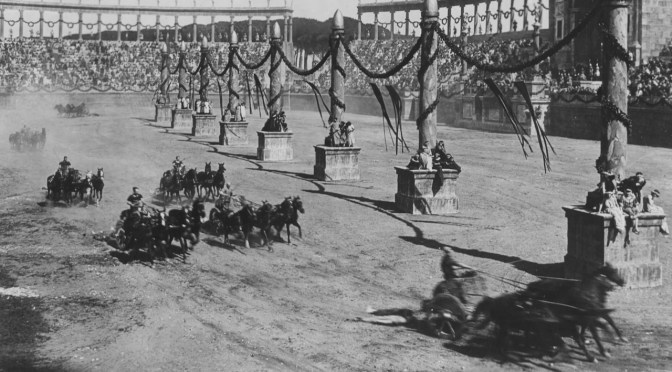
Similarly, The Odyssey (1911, dirs. F. Bertolini, A. Padovan and Giuseppe de Liguoro) uses special effects imaginatively to present the daring escape of Odysseus and his crew from a monstrous giant, the apparition to him of his protective goddess, and his miraculous transformations to hide his true self from the suitors who hound his wife back at home. The climactic finale is an American animation, A Roman Scandal (1926, dirs. Charles R. Bowers and Bud Fisher), based on the newspaper comic strip adventures of Mutt and Jeff. Magically transported back to ancient Rome, little Jeff finds himself racing a chariot before the beady eyes of emperor Mutt. In a parody of the great race sequence in Fred Niblo’s Ben-Hur (1925), cunning is the winner.
Quo vadis? (1924, dirs. Gabriellino D’Annunzio and George Jacoby)
Quo vadis? (1924, dirs. Gabriellino D’Annunzio and George Jacoby)
Sunday 1 December 2024, 14:15 at BFI Southbank NFT1, London
Magnificent and disturbing, this epic film revels in the debauchery often associated with ancient Rome. The emperor Nero is played as a satanic grotesque by the star Emil Jannings. At the opening of the film, we see him lie resplendent on a couch in the grounds of his ornate palace. He peers with sadistic amusement at a series of female victims being thrown into the fountain to fatten his fish.
The Latin title of the film or ‘Where are you going?’ refers to the question that the apostle Peter was supposed to have asked when he saw Christ coming to save the Christians in Rome. It also refers to a celebrated nineteenth-century novel that told the story of a fictional girl, Lygia, who turns the Roman soldier Vinicius toward God despite Nero’s attempts to stop her. The first half of the film ends with the camera focussing in on a hand gripping a cross. It is a sign that the soldier’s conversion is underway.
The second half of the film puts that story in the broader context of the burning of the city and the subsequent persecution of the Christian community. Here red tinting marks out the danger for Rome and the excitement for viewers. A cast of thousands charges the imperial palace. Christians are arrested and Christ himself makes two appearances. Eventually Nero commits suicide, and the Cross is declared victorious. But not before we are offered a range of extraordinary spectacles: extravagant banquets; beatings and murder; thwarted rapes; a city on fire; a strongman wrestling a bull, lurid martyrdoms and soldiers from the provinces riding to the rescue.
Both screenings are being run in association with the AHRC-funded research project Museum of Dream Worlds based at University College London and led by myself, Maria Wyke. The project (drawing on the surviving films in the BFI National Archive) asks how did early cinema design its Greek and Roman dreamworlds? What did cinema gain from recreating the distant past? What did that past gain from being recreated in moving images? The project also considers how these films were once used as instruments of education and what educative potential they might have today.
Ivo Blom is offering a free download of his recent book Quo vadis?, Cabiria and the ‘Archaeologists’: Early Italian Cinema’s Appropriation of Art and Archaeology (Kaplan, 2023) over on his site, as well as the link to buy a paper copy.




 Silent London