Happy holiday Silent Londoners! They say that if you remember 2025, then you weren’t watching enough silent movies. How much do you recall?
For myself I sure watched a lot of silent films, clocking up several festivals and individual screenings. Pordenone and Bologna, Zurich, Hippfest, Slapstick, Cinema Rediscovered, Women and the Silent Screen in Belgium, plus The Gold Rush centenary, Anna May Wong, Gosta Berlings Saga, Stella Dallas, Lillian Gish, Lois Weber, Film on Film and more at the Southbank. Did you catch Bonn, San Franciscso, the non-stop action at the Kennington Bioscope, or any of the many, many silent screenings all around the world? How about Sherlock Holmes?
Season’s greetings Silent Londoners. It has been a whirlwind of a year. How much do you remember?
Personally, I watched silent movies on three different continents this year, so I have some great cinema memories from 2024. Pordenone and Bologna, San Francisco, Istanbul, Locarno… and back home, Hippfest, Bristol, Sherlock Holmes at Alexandra Palace, Dorothy Arzner and more at the Southbank, non-stop action at the Kennington Bioscope. We celebrated some major anniversaries. Plus there was a lot of love for Anna May Wong, and Sessue Hayakawa.
Stand outside Alexandra Palace on a clear evening with a full moon, as I did last night, and you can take in the whole city. London may be as silent as it gets from this vantage point, but the landscape is loud in its own way. The glittering towers that dominate the skyline were all built in the last 50, probably 20 years. The red lights dotted in among them are all cranes, standing by to change the shape of the city once again. Scan the horizon, and you’ll be reassured perhaps to see the dome of St Paul’s – a symbol of continuity, a connection between modern times and the age of Christopher Wren, going back to 1710.
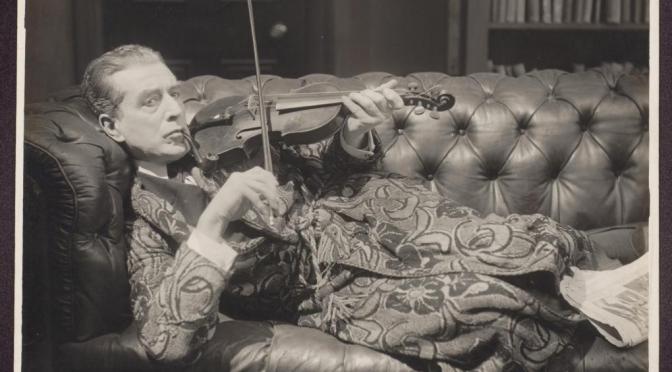
Swivel on your heel, and pivot to 1873 or thereabouts, when Ally Pally itself, the “People’s Palace” first opened. I had a date to keep at the theatre, recently restored to what the owners call a state of “arrested decay” and reopened to the public. We were there to travel back to a fuzzy combination of the 1880s and the 1920s, to revel in the BFI London Film Festival’s latest archive presentation: Silent Sherlock.
As you should know by now, this blog does indeed play favourites. And Stephen Horne’s score for Hitchcock’s The Manxman (Alfred Hitchcock, 1928) is one of my all-time favourites. I loved it at the London Film Festival in 2012, and again with the orchestra in Pordenone inn 2022. Beautiful music, flavoured with folk and nourished by emotion. The film’s not bad, either.
However, for us physical-media fans, limited copies of the CD version are available now. Rumour has it that Horne may have a few of said CDs to sell in Pordenone next week. So if you’re lucky, you can stop him and buy one.
Also next week, the first digital single will be released. I listened to it while writing this post, which is probably why there are tears on my keyboard. I have no higher recommendation…
The Manxman will be screened with Stephen Horne’s orchestral score by the 2025 San Francisco Silent Film Festival on 11 January 2025 at Grace Cathedral. I think I wrote the screening notes for this – hope I did the film justice.
Back to school time! Here’s a roundup of the silent movie news I really want to share with you as summer turns into autumn. Just think how many of these forthcoming delights you could enjoy for less than the cost of a dynamically priced Oasis ticket.
Screenings and festivals
I missed StummFilmTage Bonn this year again – both in person and online. But Paul Joyce and Paul Cuff both kept us up to date with their fabulous blogs.
Season’s greetings Silent Londoners. It’s that time of year when we like to look back at the year, and especially at all the great silent movies we watched.
2023 was a busy year. We had in-person and online film festivals, seasons, screenings and conferences, some fabulous new restorations, discs and some big anniversaries. We had new books and DVDs to enjoy. I was a little distracted, but the silent film scene was booming.
Season’s greetings Silent Londoners. It’s that time of year when we like to look back at the year, and especially at all the great silent movies we watched.
Who knows what normal is any more? But this year we had in-person film festivals, seasons, screenings and conferences a-plenty. We had new books and DVDs to enjoy. New websites too! And honestly, silent cinema seems to be more popular than ever.
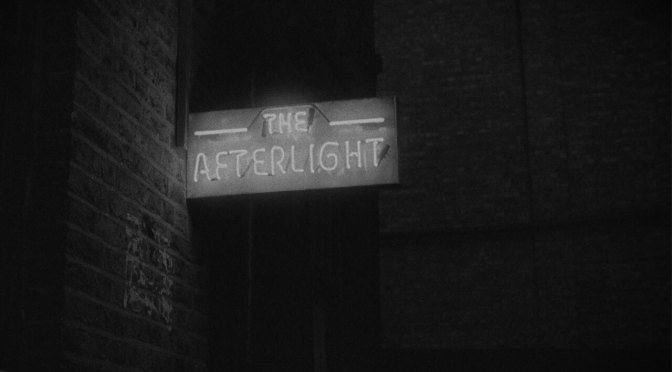
The Afterlight is the last-chance saloon for the lost souls of film history. It’s a conceptual experiment, one that stalks the shadows of world cinema, gathering the spectres of movie stardom as it stumbles all the way to obsolescence. This new film from Charlie Shackleton, which played the Experimenta strand of the London Film Festival, is cast entirely from the grave and destined to self-destruct. Composed of snippets of archive cinema, The Afterlight stars only actors whose obituaries have already been published and exists only in one 35mm print, which will deteriorate, just a little, with each screening, until even these echoes diminish.
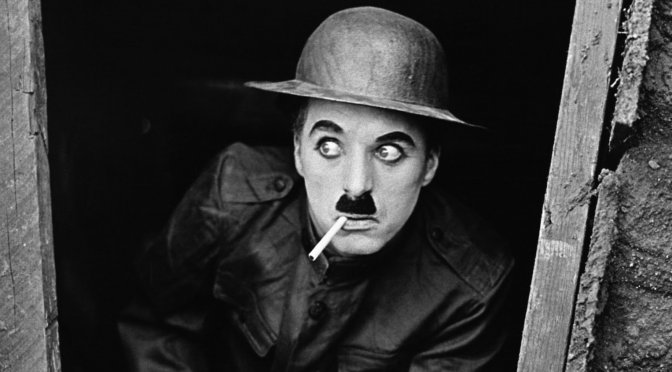
It’s a bold, almost alarming title. At this distance, can it be possible to uncover The Real Charlie Chaplin? And if there is something hidden in the biography this most famous of filmmakers, one that can without trepidation be called an icon, might those of us who love his films really want to know?
Rest easy then, as this documentary by Peter Middleton and James Spinney (Notes on Blindness) has no disturbing revelations. That is, as long as you have already been reading those large gaps between the lines of his biography. Chaplin liked the company of young women – girls, in fact. He married teenagers. He sometimes (often?) treated them badly. It’s a been said before and it is stated again here without excuses or attacking the women such as Lita Grey who testified to his ill-treatment. This has been trumpeted in some quarters as a belated #MeToo reckoning for Chaplin. That would be very belated. In truth we have always known this, but some fans refuse to hear it.
This is a guest post for Silent London from Michelle Facey AKA The Bioscope Girl to tell you about some exciting silent cinema events scheduled for London and online now that the Giornate has come to an end.
Well, my silent film lovelies, its been a long time coming. Those who’ve been to the 40th Giornate del Cinema Muto in Pordenone are now home or wending their ways back around the world. I’m sorry that myself and others who form the steering Kennington Bioscope team, apart from John Sweeney of course, essential to festival proceedings, felt unable to be there on this occasion, but hopefully next year we’ll all reunite around the Verdi and the Posta. At least we were able to join in online and keep abreast of all the essentials of the physical fest, via the insights, intertitles and general Giornate goss of Silent London’s much welcomed daily blogs, written by Italian moonlight. We missed being with everyone there and kindly, several of you let us know throughout the week that you missed us too.
The eye wants to travel, and never more so than in these pandemic times. Which means that this presentation from the BFI’s blockbuster Japan season is actually more welcome on its delayed arrival.
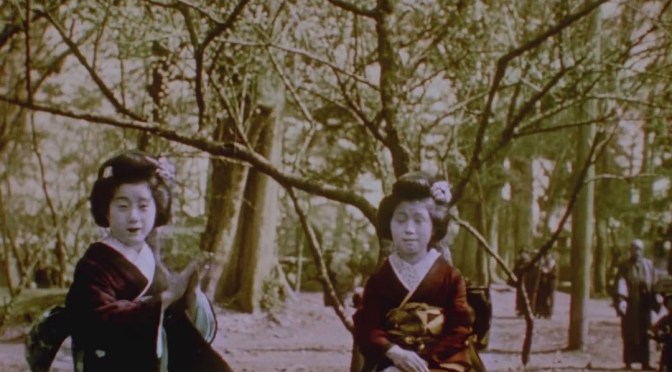
In Around Japan With a Movie Camera, across an hour and a quarter, we are transported through space and time to Japan in the very early 20th century – the films span the period from 1901 to 1913. But you’ll want to devote a full ninety minutes to this one and click the “Watch introduction” button on the BFI Player. The films are more than ably introduced by the BFI’s own Bryony Dixon and Japanese film historian Mika Tomita, and the programme is hosted by Michelle ‘Bioscope Girl’ Facey. They also take time to introduce the band, as it were. The films are accompanied by Cyrus Gabrysch, Costas Fotopolous, Stephen Horne and Lillian Henley – their hands are sometimes visible thanks to the ingenuity of Gabrysch’s pandemic-era innovation, the “piano-cam”.
Following on from the excellent livestreams they’ve been presenting on their YouTube channel throughout the lockdown period, the fine folks at the Kennington Bioscope have partnered with the London Film Festival to showcase The Cheaters (1930) in the aptly named Treasures strand. A rare silent film from Australia, it is the only surviving feature made by the McDonagh sisters – writer/director Paulette, actress Isabel (aka Marie Lorraine) and art director Phyllis.
No time to blog today but there is NEWS to share. So here goes, welcome to Silent London’s News in Brief column.
• The virtual Pordenone lineup is live now! Laurel and Hardy, Brigitte Helm, Sessue Hayakawa, Ruan Lingyu! And all your favourite Pordenone musicians. Tickets for the whole shebang start at €9.90, and go on sale next week.
• Exciting news from Denmark, where an exhibition devoted to Asta Nielsen will run from the end of October to the middle of next August. More on this soon …
I will have more news to share soon. Exciting news!
• Silent London will always be free to all readers. If you enjoy checking in with the site, including reports from silent film festivals, features and reviews, please consider shouting me a coffee on my Ko-Fi page.
This is a guest post for Silent London by Dr Rebecca Harrison. Harrison is a film critic and a lecturer in the Theatre, Film and Television Studies department at the University of Glasgow. She is the author of From Steam to Screen: Cinema, the Railways and Modernity (IB Tauris, 2018).
Known as ‘The Queen of Happiness’ during her reign as Britain’s foremost star of the screen, Betty Balfour very nearly meets her unhappy match in Love, Life and Laughter, the 1923 feature that until recently the BFI had feared lost. Directed by George Pearson, the picture was found in the Netherlands in 2015 (thanks to a cinema that failed to return the film to the distributor), and the newly restored version appeared in October as the Archive Special Presentation at the 2019 London Film Festival. While the audience had to make do with digital projection rather than a print, we were treated to a improvised live score by composer and accompanist Meg Morley – not to mention 70 minutes of Balfour’s luminescent presence on screen. Continue reading LFF review: Love, Life and Laughter (1923)→
I was just finishing my last post (on Bait – go see it), when this very exciting news came in. The 2019 London Film Festival Archive Special Presentation will be the lost Betty Balfour film that was discovered in the Netherlands a few years ago: Love, Life and Laughter (George Pearson, 1923). Continue reading Breaking Betty Balfour news: Love, Life and Laughter (1923) at the LFF→
This is just a short review – I’ll be writing more about the film closer to its release.
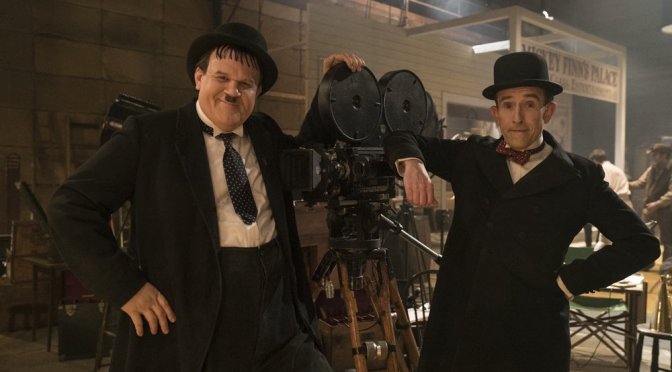
There’s a scene in Stan & Ollie, in the offices of a London production company, in which Steve Coogan, playing Stan Laurel, sits down to wait for his appointment and arches his back just enough that his bowler hat rises off his head. And then lets it fall back on again. In the next few minutes he performs a silent slapstick comedy routine that is as exquisitely delicate as it is hilarious. The receptionist gazes at him with contempt. She doesn’t recognise him, and she isn’t impressed. It’s a sublime moment in Jon S Baird’s bittersweet film, which expresses on what exactly it means to be a has-been in a world of novelties, to be dismissed by the ignorant and constantly rediscovered even by the faithful.
It’s 1953, and Laurel and Hardy find themselves on tour in Britain. Their toxic split is several years behind them, but they are back together to transfer their movie hits to the stage and they are competing with new talent at every turn: Norman Wisdom in the theatres, and Abbott and Costello in the cinemas. Stan and Ollie are reduced to the smallest halls, and horribly diminished audiences. Even their most loyal fans assume they have retired, or worse. Still, when they perform Hard-Boiled Eggs and Nuts, or The Trail of the Lonesome Pine, the audience is in hysterics. Stan, forever the brains of the outfit, keeps Ollie’s spirits up by promising a movie at the end of the tour. But if he can’t even win over the producer’s receptionist, that prospect looks doubtful.
Happy London Film Festival programme launch day! The festival runs 10-21 October this year and there are oodles of films showing, from the competition titles and the galas to the weird and wonderful pieces in the experimental and short categories. Yadda, yadda, yadda. Let’s cut to the chase. We have no time here for talkies. What does the 62nd London Film Festival have to offer in the way of silent cinema? Plenty. More than usual, I’d say. Some we knew about, some we didn’t.
The really good news – none of these silent screenings need clash with Pordenone. That is to say, there are duplicate screenings to avoid that.
The Great Victorian Moving Picture Show
Nineteenth-century films, shot on 68mm film, beautifully restored, introduced by Bryony Dixon and accompanied by John Sweeney and his Biograph Band. Oh, and they are screening at the actual, flipping IMAX. This is going to be massive. If your mouth isn’t already watering, I don’t know what to do with you. This year’s Archive Gala should be a silent cinema experience like no other. Book now.
This year’s London Film Festival Archive Gala has been announced – and it’s big.
You may have had a sneak preview of the Victorian films, shot on 68mm film, that the BFI has been restoring recently. Samplers have popped up at a few festivals and conferences over the past year or so. The clarity and the detail in these early films are incredible. For this year’s Archive Gala, the BFI are going to project these beauties in their natural home – at the IMAX. Step aside, Christopher Nolan. Your host for the evening will be Bryony Dixon and music will be provided by the maestro John Sweeney – and his Biograph Band.
Sweeping away the veil of time, this Archive Gala will project Britain’s earliest films at their grandest scale (68mm, almost four times the image size of regular 35mm film) on the nation’s biggest screen, the BFI IMAX. Festival-goers will be astounded by the sheer clarity, scale and spectacle of these incredibly rare surviving fragments of our first films, preserved by the BFI National Archive. Breathing new life into these filmic ghosts, superbly restored from the 68mm original nitrate prints under the meticulous and painstaking supervision of the BFI’s Conservation Centre, these films will be presented digitally in their fully fleshed, large format, high-definition glory for the first time in over 120 years.
The Great Victorian Moving Picture Show will reveal the quality, scope and scale of their technical ambition in developing a new media, combined with their avid curiosity in the world opening up around them. It also showcases the drive and media savvy of the showmen and film pioneers who sold audiences this new perception of reality. This unique opportunity promises to show the Victorians in a whole new light, blowing the lid off any preconceptions of our forebears and dispelling the image of the stuffy, stoic, stern Victorian for good.
In a night not to be missed, this one-off gala event will transport the audience back to the end of Victoria’s long reign, a time when competing showmen were projecting their moving picture shows in London’s great West End theatres. Among the frontrunners was the peerless William Kennedy-Laurie Dickson, whose British Mutoscope and Biograph Company enjoyed a long residency at the Palace Theatre of Varieties (now known as the Palace Theatre on Cambridge Circus, home to a different magician in Harry Potter and the Cursed Child). Of Scottish heritage, Dickson, who had worked for Thomas Edison, arrived in London in 1897 with his own very special USP: large-format films – the IMAX films of their day – aiming to outgun his rivals with his high quality pictures.
At only a minute or so long, these films range in date from 1897-1901, serving up an eclectic spread of subjects, from gorgeous panoramic vistas to dizzying ‘phantom rides’, from music hall turns to the pomp of royal pageantry, from the bustle of the Victorian street to genuine dispatches from the Boer War. The night has been programmed by and will be presided over by BFI silent film curator Bryony Dixon, with music from composer/pianist John Sweeney and his Biograph Band.
I can’t wait. The Great Victorian Moving Picture Show will take place on 18 October at the BFI IMAX in London. Tickets will go on sale soon, I guess, with the rest of the London Film Festival events.
Silent London will always be free to all readers. If you enjoy checking in with the site, including reports from silent film festivals, features and reviews, please consider shouting me a coffee on my Ko-Fi page.
I first heard Robert Land’s name earlier this year. The context was: “Robert Land … ever heard of him?” I hadn’t, of course. But suddenly Land was in sight everywhere: films of his played at Bologna and there was a very informative piece on this Austrian-Czech director in Sight & Sound. At Ritrovato, I saw the rather plodding comedy I Kiss your Hand, Madame (1927), starring Marlene Dietrich, but I missed the screening of the rather better regarded Little Veronika (1929) and worried that I had made an error.
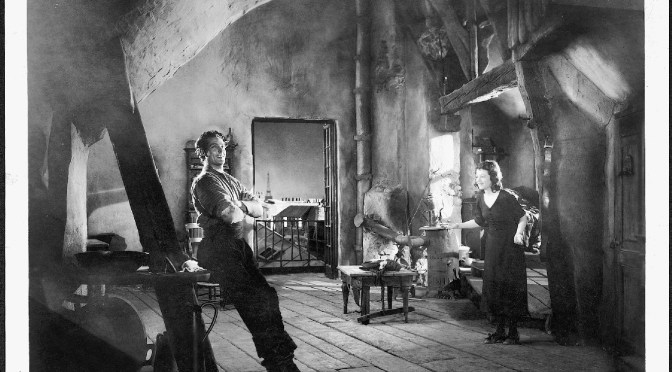
Hurrah for the Archives strand at London Film Festival, which brought the new restoration of Little Veronika to my doorstep today, on 35mm with live accompaniment of the highest quality from John Sweeney. Made around the same time, and for the same production company, as Pandora’s Box, and more to the point, Diary of a Lost Girl, Little Veronika is a short, sharp tale of rustic innocence in peril.
Kleine Veronika (1929)
Little Veronika (played by Käthe von Nagy, an experienced, if young, actress) lives with her family in the Tyorl, caring for furred creatures, being polite to the neighbours and doing her chores like the good girl she promises to be. She goes to Vienna to visit her glamorous Aunt Rosie (Maly Delshaft, the wife in Varieté), who has grown impressively wealthy and well-dressed in her decade in the capital. Aunt Rosie has slinky lingerie and lives in a big house with several other women. You’d have to be as innocent as Veronika not to know what’s going on, how Aunt Rosie earns her money, or what plans her new friends have for her future.
The cat is out of the bag. The programme for the 61st London Film Festival has been announced and there is only one question on our lips: “Got any silents?” The answer is …
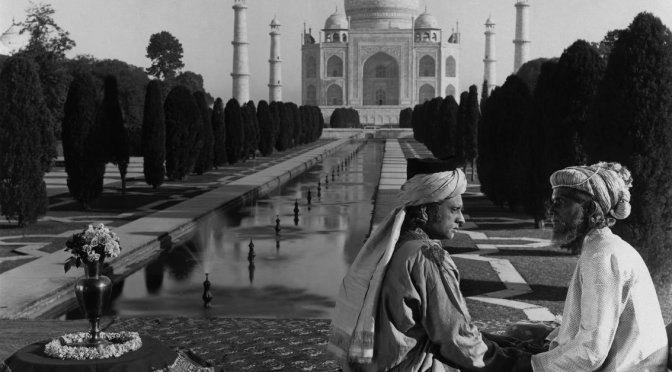
Shiraz (1928)
First things first, we already knew that this year’s LFF Archive Gala would be Shiraz, a sumptuous late-silent Indo-German production, which relates the romantic story behind the building of the Taj Mahal. This gorgeous film, freshly restored by the BFI, will be accompanied by a new score, composed by Anoushka Shankar. The gala screening takes place on 14 October 2017 at the Barbican and tickets are already on sale now. Read more here. And why not book a ticket here too?







 Silent London