All posts by PH

Pamela Hutchinson is a freelance writer, critic, historian and curator.

Win tickets for a silent movie night at Hackney Attic

The Lucky Dog (1919)

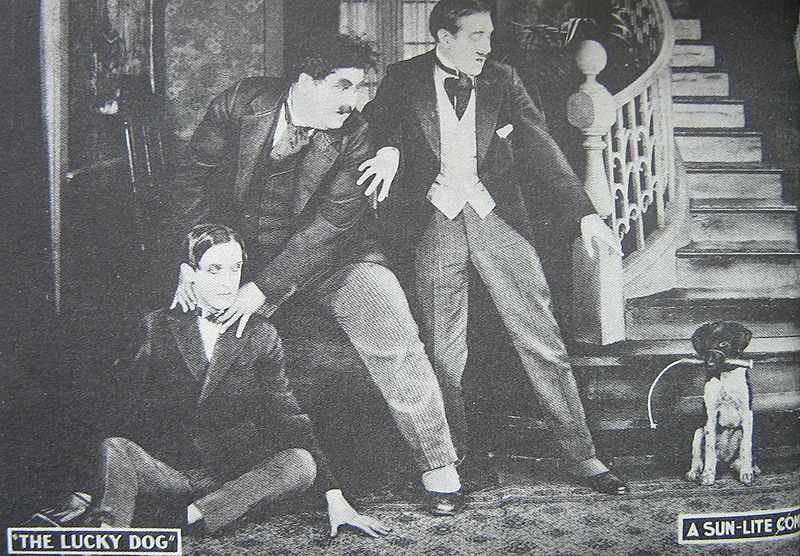
Competition time again, Silent Londoners, and this time I am giving away tickets for a night of silent film and live music at one of our favourite venues, Hackney Attic. The lucky winner can look forward to an uproarious evening, featuring Buster Keaton, Charlie Chaplin, Laurel & Hardy (in their first film together) and even Felix the Cat – plus a surprise! This latest event in the Filmphonics series has been put on by the silent film fanatics at the Lucky Dog Picturehouse. Here’s what they have to say about it:

The Lucky Dog Picturehouse specialise in providing an authentic 1920’s silent film experience, with live piano soundtrack. Collecting together 5 of the best silent film shorts ever made by some of the world’s greatest silent stars. Buster Keaton attempts to build his new flat-pack home in the stunt-filled ‘One Week’. You’ll find a love-lorn Charlie Chaplin in ‘The Pawn Shop’. Laurel & Hardy team up for the first time ever in ‘The Lucky Dog’ (featuring a dog to rival Uggie from The Artist). To balance the dog ‘Felix the Cat’ makes a madcap appearance. And the final film is “TBC” but it might involve a certain “Trip to the Moon”. All of the films will be scored by live keyboard accompaniment. Just as they were supposed to be seen.

Lucky Dog Picturehouse

To win a pair of tickets to the Lucky Dog Picturehouse night, simply email the answer to this simple question to silentlondontickets@gmail.com with Lucky Dog in the subject header by noon on Friday 17 May 2013.

  • In which British town was Stan Laurel born?

The Lucky Dog Picturehouse night at Hackney Attic is on Sunday 19 May at 7.30pm. Tickets start at 7pm for members (with £2 off if you book for The Great Gatsby the same day). Click here to book and for more information.

Fashion in Film Festival – Marcel L’Herbier

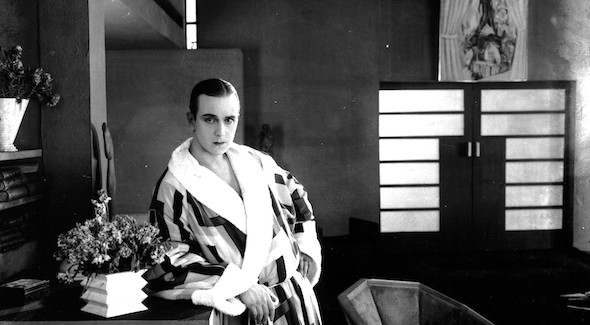
L'Argent
L’Argent

The Fashion in Film Festival is a movable feast, but one we can always rely on for some wonderful silent film screenings. This year’s event has just begun, and the focus of the festival is the French director Marcel L’Herbier, who worked in both the silent and sound eras, creating captivating, elegant and strange films of staggering beauty. This is what the festival has to say about his silent films:

During the silent period, L’Herbier’s ambition for the cinema was to create a Gesamtkunstwerk, a cinéma totalwhich would synthesise all the arts and draw together architects, artists, set designers, couturiers and costume designers. Among the many major cultural figures he collaborated with were the artists Fernand Léger, Sonia and Robert Delaunay, the composers Darius Milhaud and Arthur Honegger, the architect Robert Mallet-Stevens, designers Alberto Cavalcanti and Claude Autant-Lara, and couturiers Paul Poiret, Lucien Lelong (L’Herbier’s cousin) and Louiseboulanger. Paired with his multi-disciplinary collaborative approach, it was L’Herbier’s desire to legitimise and ennoble cinema as the ‘seventh art’ that helped establish him as a seminal figure within Paris’s vibrant cultural milieu of the inter-war years.

Using art, fashion and design as the prisms through which to examine L’Herbier’s diverse body of work, Fashion in Film’s season highlights his lifelong interest in cinematic style and aesthetics. As the costume designer Jacques Manuel once observed, costume for L’Herbier was so often a way of  ‘feeding’ the ‘mechanical eye’ with evocative surfaces and textures, a way of testing the formal elements of cinema itself such as movement, rhythm, light and shadow.

To feed your own eyes, and for a direct lesson in the importance of costume design to L’Herbier’s total vision of cinematic photogénie, watch the festival’s slinky trailer here.

A true multi-disciplinarian, L’Herbier arrived at film-making after considering literature and music as possible careers, and more prosaically, having worked in a uniform factory during the first world war. When Feuillade’s leading lady Musidora took L’Herbier to see Cecil B DeMille’s melodrama The Cheat, he realised the potential of cinema, and starting out in the army’s cinematographic unit, began to learn the art of film-making. However unlikely a start this may seem, even his very first film, a propaganda piece called Rose-France, was ambitiously experimental.

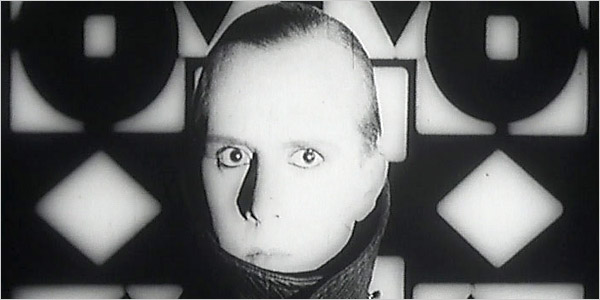
L'Inhumaine
L’Inhumaine

At first, L’Herbier worked for Gaumont, but his artistic dreams soon clashed with the realities of their budgets, and in 1923 he formed his own company, Cinégraphic. You may be familiar with L’Herbier’s silents already, particularly Zola adaptation L’Argent, which is available on DVD from Masters of Cinema. The Fashion in Film Festival is showing L’Argent, as well as sci-fi opera L’Inhumaine (The Inhuman Woman) and doppelganger drama Le Vertige (The Living Image). You can read the full programme of events here. Not showing at the festival, but recently released on Blu-Ray by Flicker Alley in the US, is the Pirandello adaptation Feu Mathias Pascal.

Le Vertige
Le Vertige

To read more about L’Herbier, and the films showing in the Fashion in Film Festival 2013, read Samuel Wigley’s piece on the BFI website, which includes a sumptuous picture gallery. Also, in this month’s issue of Sight & Sound magazine, David Cairns offers an excellent study of the films showing at the festival and a director he describes as “commingling High Seriousness and High Camp in an ecstatic personal vision”. Now, don’t you want to see what that looks like?

Read more and book tickets, here on the Fashion in Film Festival website. The festival runs from 10-19 May.

A Boy and His Atom: the world’s smallest silent movie

Full disclosure: this is basically an advert for IBM. But it tickled me, because this mind-boggling short reminds us that “primitive” film-making is often the most ingenious. This is stop-motion animation at the molecular level, which sounds too convoluted for words. But in the finish, it’s quite adorable.

The ability to move single atoms — the smallest particles of any element in the universe — is crucial to IBM’s research in the field of atomic memory. But even nanophysicists need to have a little fun. In that spirit, IBM researchers used a scanning tunneling microscope to move thousands of carbon monoxide molecules (two atoms stacked on top of each other), all in pursuit of making a movie so small it can be seen only when you magnify it 100 million times. A movie made with atoms.

You can watch a video about the making of A Boy and His Atom here.

The British Silent Film Weekend 2013 – reporting back

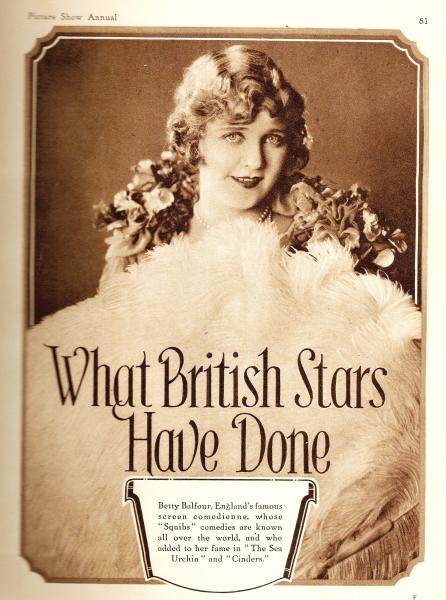
Betty Balfour
Betty Balfour

As you know, this year the British Silent Film Festival has taken a year off – but luckily for us, it’s the kind of year off where two all-day events still go ahead. Just to keep things ticking over, as it were. So last weekend there was a symposium on British silent cinema, held at King’s College London and organised by Dr Lawrence Napper. The following day the Cinema Museum hosted an all-dayer of screenings, themed on the tantalising idea of “sensation-seeking”.

I attended both events and while it didn’t feel like the festival was running, it was a real treat to be immersed in British silent film in this way. Let’s hope the festival returns back to full strength next year.

The papers at the symposium were limited to 20 minutes apiece, but covered a wide range of topics, from Edwardian theatre to state censorship to international co-productions to saucy novels. One hardly knows where to begin.

There were two papers with a theatrical bent: Ken Reeves’s dip into musical comedy theatre and its links to silent film concluded with some ideas for “crossover” events that would mix theatre, film and audience participation to spread the love about early British cinema. Audience participation? Reader, I sang. Very badly. Theatre historian David Mayer’s unforgettable presentation played and replayed the same baffling scrap of film as he uncovered the truth behind its creation. The scene of a waterfall bursting its bank and bringing down a bridge (and a couch and four) was, it turned out, not shot on location but on stage at the London Hippodrome in 1902, where a collapsible stage could be dropped and filled with water to create watery scenes. There was more – involving elephants on a slide. Elephants. Read more here.

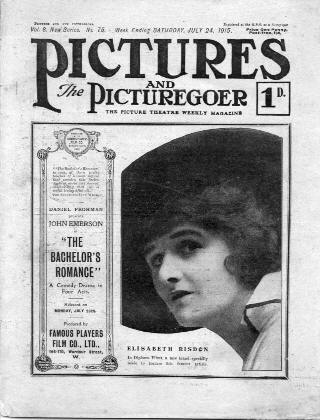
Elisabeth Risdon on the cover of The Picturegoer July 1915

Lucie Dutton, sometimes of this parish, also talked about the stage, presenting a history of film director Maurice Elvey‘s early career – in theatre in London and New York, before moving into the pictures with his star Elisabeth Risdon. She was followed by John Reed from the National Screen and Sound Archive in Wales, who took us through the production, loss, rediscovery and restoration of Elvey’s landmark film, The Life Story of David Lloyd George. Intriguingly, Reed pointed out a few instances in which Elvey could be seen in the film, waving a handkerchief and appearing to direct the action. Could this be because in these scenes the prime minister was played not by Norman Page but by Lloyd George himself? It’s an enticing thought.

Another famous British director was under the spotlight – one even more renowned than Elvey. Charles Barr presented on what we do know, and what we don’t, about the first film that Hitchcock ever shouted action on: Always Tell Your Wife. It’s an adaptation of a stage comedy starring theatre veterans Seymour Hicks and Ellaline Terriss and it seems the director fell out with his inflexible actors and therefore a “fat youth” from the props room was elevated to the job. You may struggle to see bold Hitchcockian strokes in what we have left of the film (which screened at the Cinema Museum on the Saturday), but we do have the director’s handwriting, unmistakably, in an insert shot of a telegram.

Jackeydawra Melford (trom thebioscope.net)

Far less well known than Hitchcock, but fascinating to hear about, was showman-turned-film director Mark Melford. His name, just like most of his films, may be lost to time, but Stephen Morgan attempted to flesh out his story, taking his cue from a Bioscope blogpost of 2007 that posed the pertinent question: “Who needs films to write film history anyway?” We did see a clip from the recently rediscovered romp The Herncrake Witch, directed by and starring Melford (amended, see comments) as well as being based on one of his own comic operas and also featuring his daughter (Jackeydawra, named thus due to her parents’ love of Jackdaws. True story). The story of the Melfords was hugely entertaining, but Morgan concluded by making the hugely important point that the study of lost films and forgotten film-makers is vital to a full understanding of the silent film era as a whole.

And of course, one never knows when a lost film will suddenly become an un-lost film. It happened to The Herncrake Witch and The Life Story of David Lloyd George after all. And it wasn’t so long ago that a treasure trove of Mitchell & Kenyon works was unearthed, giving us an invaluable glimpse of (mostly working-class) Edwardian Britain. In one of the day’s most diverting 20-minute segments, Tony Fletcher played a selection of Mitchell & Kenyon’s fiction films, while explaining a little more about them. The films were comedies, often chases and knockabout stuff, all with a backdrop of industrial northern England – factory gates, brick kilns and terraced streets. I particularly liked the mischievous snow comedy and the animated intertitles in a short called (I think) Driving Lucy.

The Battles of the Coronel and Falkand Islands (1927)

More comedy, but this time of the you-couldn’t-make-it-up school: Alex Rock put recent Leveson revelations in the shade with a paper on the Metropolitan Police’s tangled relationship with the film industry. Its rather heavy-handed Press Bureau, founded in 1919, was popularly known as the Suppress Bureau. You can guess why. Rock’s paper traced the development of an official documentary film, supported by the Met, called Scotland Yard, and the squashing of another, based on the memoirs of a former detective.

The correspondence of public servants baffled, outraged or simply dismissive of the “movies” is unexpectedly entertaining, and never more so than in Jo Pugh’s paper on the official military response to Walter Summers’ The Battles of the Coronel and Falkland Islands. I could barely keep up with the information he was imparting, partly because I was giggling so much. Really. The good news is that we should hear more from Jo’s research and more about the film too as a little bird tells me a full restoration (possibly in time for next year’s Great War centenary) is in process.

Continue reading The British Silent Film Weekend 2013 – reporting back

Win tickets to see Guests of the Nation (1935) at the Barbican

Guests of the Nation (1935)

Chances to see Irish silents are very far and few between, so this orchestra-accompanied screening of Guests of the Nation promises to be something very special. That title doesn’t refer to Irish hospitality – this film is an adaptation of a Frank O’Connor short story, and the “guests” in question are British hostages of Irish freedom fighters. The author even has a cameo role in the film. It’s a late silent, filmed in the mid-1930s and features a few faces you may recognise from sound films.

I don’t know much about the film myself, but the Barbican website has this to say about it:

Guests of the Nation, preserved in the IFI Irish Film Archive, is one of a handful of indigenous dramas made in Ireland during the silent period and is a remarkable work. Here, we are delighted to present the film with live orchestral accompaniment, with Niall Byrne as the composer and David Brophy conducting.

Based on a short story by Frank O’Connor (a frequent contributor to The New Yorker) reflecting his experience in the Irish War of Independence and Civil War, the film concerns the friendship between British military prisoners and their IRA captors during the War of Independence.

Shot during the summers of 1933 and 1934 by a group of passionate amateurs under the direction of playwright and theatre director, Denis Johnston, the film features early screen performances from the legendary Barry Fitzgerald, Cyril Cusack, Shelah Richards, Hilton Edwards, Denis O’Dea, and, indeed, Frank O’Connor himself.

To win one of three pairs of tickets to see Guests of the Nation at the Barbican, just send the answer to this question to silentlondontickets@gmail.com by noon on Wednesday 10 April. The winner will be chosen at random from the correct entries.

  • Guests of the Nation actor Cyril Cusack played the Fireman Captain in which Francois Truffaut film?

Guests of the Nation screens at 4pm on Sunday 14 April at the Barbican Cinema. To book tickets, please click here.
Crosswords: a modern silent set in London


Film-maker Steve Simmons sent me this short film, his second piece of work, and how could I resist sharing it with you? It was shot in south London, in Lambeth in fact, and any hard-working city-dweller will recognise this scene. As a crossword fan, I found Crosswords‘ wry comedy compelling: its premise initially seems simple but spirals into something a touch murkier and more dangerous as events unfold. The witty combination of text and image really caught my attention and I think it’s bound to raise a smile with the readers of this blog.

Steve tells me that he was influenced by the widest possible range of movies, silent or otherwise: “Films that haved inspired me are Metropolis, Once Upon a Time in The West, City Lights, Escape from Alcatraz and I loved The Artist.”

That’s a very diverse list and you’ll notice that although Crosswords is a modern silent, it’s far from an exercise in mimicry. For one thing, it has text, but not intertitles: “I initially considered traditional title cards to display the clues and the man’s thoughts,” says Steve, “but eventually I decided it would work best if the text was incorporated into the action. I think it helps the viewer concentrate on the clues and keeps the story flowing.”

Steve would love to make another silent, he tells me, and not just a short film: “At the moment I’m writing another silent film script but it’s more of a science-fiction based story. One day, if I had the funding I would love to make a feature-length silent – that’s the dream!”

Sumurun: Ernst Lubitsch and Pola Negri’s Arabian night

Pola Negri and Ernst Lubitsch in Sumurun

This is a guest post for Silent London by Kelly Robinson.

Sumurun screens with a live score by Amira Kheir at BFI Southbank as part of Birds Eye View Film Festival on Thursday 4 April at 6.10pm. Read more here.

Sumurun is the product of an intensely creative time in the German film industry when an extraordinary range of artistic and entrepreneurial talent emerged: creating ambitious films that challenged American productions for the international market.

Paul Davidson, the director of the German production firm Projektions-AG Union (PAGU), was a film producer unafraid of financial risk-taking and he invested large amounts of capital early on in the industry. In 1918 the company was merged with several other firms under the umbrella of Ufa, with Davidson becoming an executive on its board. Much of Ufa’s success was the result of the absorption of PAGU’s talent, which included directors such as Ernst Lubitsch and Paul Wegener and stars such as Pola Negri and Ossi Oswalda. Indeed because of its established reputation it still produced under the PAGU brand and retained a considerable degree of independence.

With financial support from the German bank, Ufa began a policy of big-budget films aimed at the international market. In 1918, Davidson suggested Lubitsch try making one of these Großfilmes, epic productions indebted to the Italian spectacle films, such as Giovanni Pastrone’s Cabiria (1914) – films which in their budgets and enormous sets were an attempt to compete with Hollywood. Lubitsch assembled a regular production team around him for a series of these ambitious films, including his co-writer Hanns Kräly, the set designer Kurt Richter, and cameraman Theodor Sparkuhl. Famous actors such as Pola Negri added star allure to these films and became a big draw for audiences’ world-wide. Sumurun is one of several extraordinary films that resulted from these collaborations during the late 1910s and early 1920s.

Pola Negri
Pola Negri

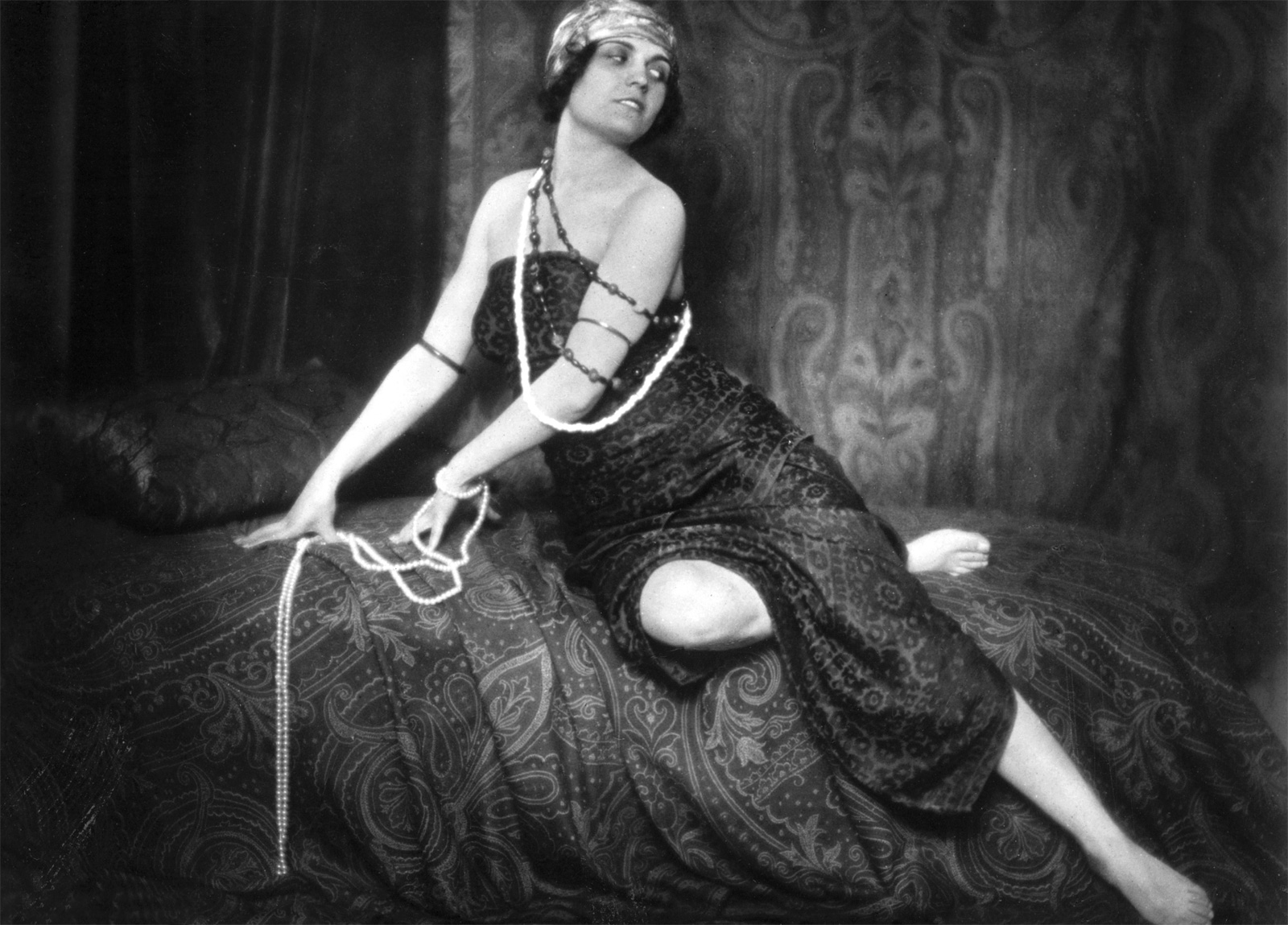
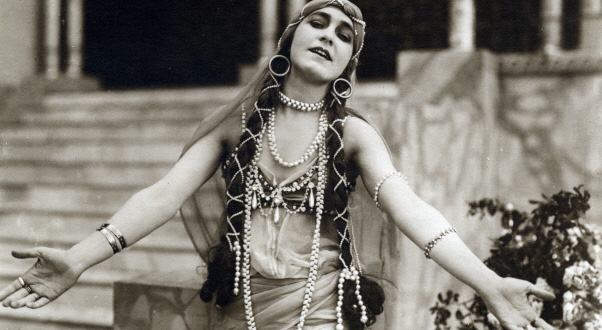
Pola Negri was born Barbara Appollonia Chalupiec in Yanowa, near Lipno in Poland. She took as her professional name the last name of Ada Negri, an Italian poet she admired and the diminutive form of Apollonia as a first name. She had danced at the Imperial Theatre in St Petersburg and had acted on stage and screen in Poland before being invited by Max Reinhardt to Germany to star in Sumurun  (a story derived from The Arabian Nights) after she had appeared in a Polish theatrical version. It was here that Negri met Lubitsch, who was a Reinhardt player and comedy short director at the time, and who was playing the role of the hunchback opposite her in the German theatrical version (a role he would recreate in the film). They became good friends and he made her the star of several of the large-scale costume pictures for Ufa. Lubitsch told her: “We’re going to make a picture of Sumurun. Reinhardt’s letting us have the sets and costumes. We’ll use most of the actors from the stage productions. We’ll hardly even have to rehearse. It’ll cost practically nothing.” (Pola Negri, Memoirs of a Star). Production started in September 1920. It was substantially cut and released by First International in the US in October 1921 with the new title One Arabian Night. Negri remembered its production as: “a very easy and happy chore. Except for a few Lubitsch innovations, it was essentially a photographed stage play.” (Memoirs of a Star)

This kind of dismissive assessment has plagued One Arabian Night, with even relatively recent biographies of Lubitsch granting the film scant attention. However it is an important film, both as an example of Germany’s aesthetic advancements and also in the context of Negri’s and Lubitsch’s career.  For instance it was this film that impressed Mary Pickford so much that she brought Lubitsch to the US for Rosita (1923). The film’s critical neglect is most likely a result of viewing the bowdlerised US print, which is missing thirty minutes. Thankfully now we can see the fully restored version.

Sumurun (1920)
Sumurun (1920)

Many historians agree that German films improved when Hollywood films began to be seen in Germany from 1921, and yet, interesting approaches to cinematography preceding the American influence are evident in films such Sumurun. For instance, in the opening of the film where the light streaming through blinds in the caravan causes chiaroscuro patterns. Cameraman Sparkuhl also has a tendency to hold closeups from a high angle, which adds variety to some of the scenes. Indeed, most of the closeups of Pola Negri, particularly the scenes of her dancing in Sumurun, are shot in this manner. This may have been a way of singling Negri out from the rest of the characters; similar to the technique of filming stars that was developing in Hollywood.

German film’s reputation for elaborate set design is evident in Sumurun. There is a rhythm both in the set design and also in the movement of figures within that design. Lotte Eisner has noted how the American musical would pattern itself on the “delicate arabesques” in this film (The Haunted Screen). Contemporary reviews often observed how Lubitsch’s films were on a par with the best American productions. Variety reviewing the film in 1921 commented: “The production is colorful throughout, the atmosphere of the East being perfect in detail.” These films were incredibly successful in Germany and abroad. Their settings, such as Sumurun’s Persia, and subject matter, offered audiences an escape from everyday reality. Negri observed  that “one of the reasons [for the success of Sumurun] was certainly because its intensely romantic oriental fatalism was precisely the kind of escapism a war-weary people craved for” (Memoirs of a Star).

Pola Negri in Sumurun

Negri and Lubitsch were among the first international celebrities to be brought to the US – later director-star duos included Mauritz Stiller and Greta Garbo. Negri arrived under contract with Paramount in 1922 to a storm of publicity. The press went wild over an affair with Charles Chaplin and supposed spats between her and Gloria Swanson, whose top star status at Paramount she challenged.  Her vampish screen persona was conflated with anecdotes about her private life. The press spread rumours about her many lovers and delighted in reporting quirky acts such as her walking a tiger on a leash down Hollywood Boulevard.

Negri had became known abroad for playing roles where women exploited their sexuality for economic and political gain (see also Carmen and Madame Dubarry). Her swaggering sexuality is parodied sublimely by Marion Davies in The Patsy (1926). Diane Negra has observed the transformation that her persona undertook in the move from Germany to Hollywood. In the Hollywood films her femme fatale image was tempered and the films frequently ended happily. The American films also deemphasised the ethnic and class dimensions found in earlier films. Her US films were not as successful as the European ones and Negra argues that this was the result of her ethnic sexuality. Her Italian surname, Polish ethnicity and connections to German film industry meant she could not (or would not) be fully assimilated.  In public and private she appeared to resist being Americanised. “As the unassimilatable woman, both in ethnic and sexual terms, she stood for a type that was in fact far more transgressive than the thoroughly American, upper-middle-class flapper who, for all her supposed flouting of social conventions, was nearly always safely married off in the end.” (‘Immigrant Stardom in Imperial America: Pola Negri and the Problem of Typology’, Diane Negra).

Kelly Robinson

Silent film pianist Costas Fotopoulos – video interview

Costas Fotopoulos is based in London and works internationally as a concert and silent film pianist, and as a composer and arranger for film, the stage and the concert hall. He regularly provides live improvisations to silent films at BFI Southbank and he has also accompanied films at other major British venues as well as in New York, Warsaw and Italy. I interviewed him after a screening of Sunrise: A Song of Two Humans in Winchmore Hill, north London, organised by Around the Corner Cinema. We also discussed his score for modern silent film The Projectionist.

The Silent London podcast: Maurice Elvey, City Lights and unsilent films

City Lights (1931)
City Lights (1931)

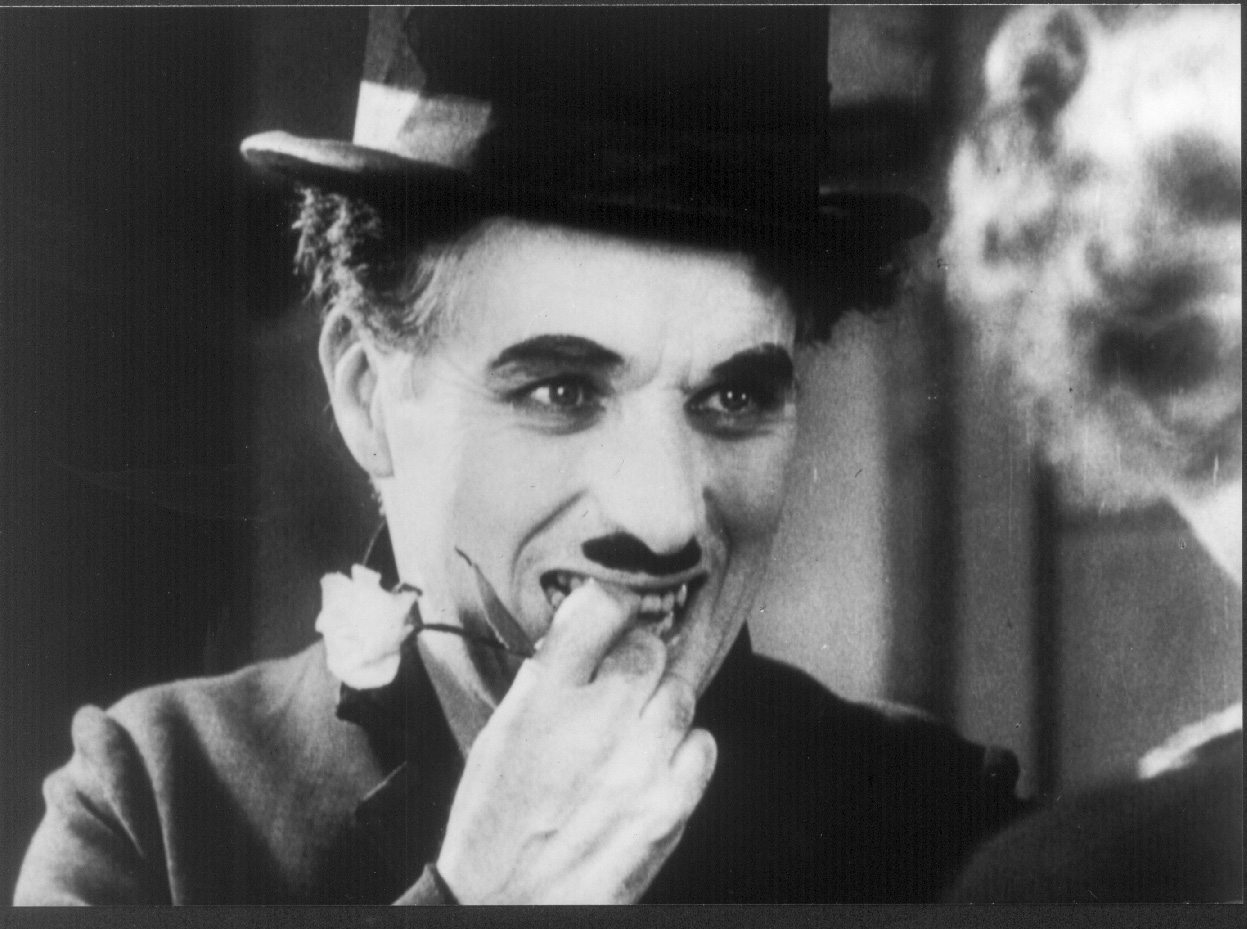
It’s podcast o’clock once more. This time I’m joined in the studio by the marvellous Pete Baran, and in the pub by Lucie Dutton, who tells us all about British silent film director Maurice Elvey. All that, plus a guest appearance by Otto Kylmälä, film-maker and festival organiser, praising the “subtle brilliance and mature beauty” of his favourite silent movie, Chaplin’s City Lights.

Is City Lights a silent film? Perhaps it’s an “unsilent film” – we’ll be talking about them, as well as discussing your suggestions for the best silent films for small children and taking a look at the listings too – including the British Silent Film Festival’s 2013 incarnation and not forgetting Napoléon.

There’s also a lot more Robocop than you may expect. Don’t ask.

silentlondonpodcast5

The Silent London Podcast is available on iTunes. Click here for more details.  The music is by kind permission of Neil Brand, and the podcast is presented in association with SOAS radio.

If you want to get in touch with us about anything you hear on the podcast tweet @silentlondon or leave a message on the Facebook page: facebook.com/silentlondon.

Edwardian Insects on Film, BBC4

It’s not often I find myself recommending a natural history programme, but on Tuesday night this week a BBC4 nature documentary will celebrate the work of film pioneer Percy Smith. Edwardian Insects on Film is punchy name of the hour-long doc, which is part of the channel’s Alien Nation insects season. As the video above shows, the film follows wildlife film-maker Charlie Hamilton Jones’s attempts to replicate Smith’s ingenious film The Acrobatic Fly (1910). It promises to be a rare opportunity to look in detail at early cinema methods and technology – and an even rarer opportunity to see such things on TV.

While the tricksy manipulations of The Acrobatic Fly are many miles away from modern wildlife film’s hands-off observe-from-a-distance approach, the documentary also looks at Smith’s pioneering work in timelapse photography (the gorgeous The Birth of a Flower, 1910), which is still a staple of the genre – used for example in David Attenborough’s The Private Life of Plants (1995). Attenborough himself makes an appearance in the programme, as will a few other faces familiar to readers of this blog.

Smith continued working in the film industry into the 30s, most notably making the Secrets of Nature series for British Instructional Films from 1922-33. Should you want to know more, BFI Screenonline has plenty of information about Smith and his films, some of which are available on DVD, or like the clips above, on the BFI YouTube channel:

Smith was a true pioneer, inventing original (and bizarre) methods for time lapse and micro cinematography, involving all kinds of home-made devices, including alarms all over his home to wake him up in the middle of the night if the film in the camera needed changing. With endless patience, he could spend up to two and a half years to complete a film. He also had the popular touch, with the happy knack (as he put it himself) of being able to feed his audience “the powder of instruction in the jam of entertainment”. Modern film technique could hardly better the results achieved by Smith in the first decades of the century and his early masterpiece Birth of a Flower (1910) has never been out of distribution.

Edwardian Insects on Film screens on BBC4 at 9pm on Tuesday 19 March 2013 and again at 2.40am on Wednesday 20 March 2013.

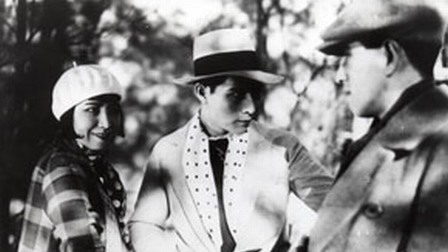
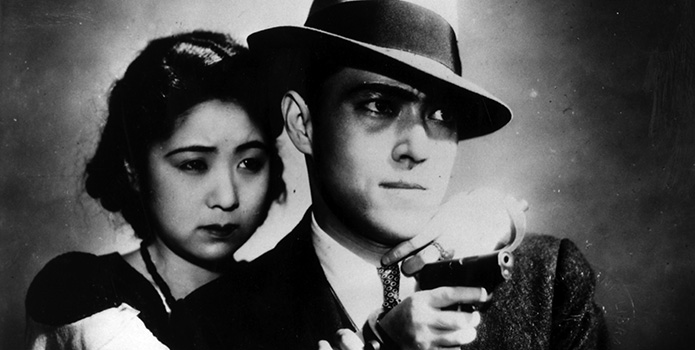
Yasujiro Ozu’s gangster youth

Walk Cheerfully (1930)

Yasujiro Ozu wasn’t always quite the Yasujiro Ozu we know from Tokyo Story and Late Spring. And he was certainly nothing like the film-maker you would expect if you had never seen those films, just been told about them as slow, domestic dramas on the theme of loss. Ozu has always put the fun into formalism, with playfully picturesque compositions and his famous cutaway “pillow shots” inserting frames of pure, simple cinema into his simmering narratives.

Later Ozu films are so routinely described as distinctively Japanese, as distinctively Ozu-esque that it may surprise many to learn that the director was actually a huge fan of Hollywood cinema. When he first started work at the Shochiku studio as a young man, he horrified the boss by claiming to have only seen a handful of Japanese films, and hundreds of American pictures. The twentysomething Ozu first aspired to make comedies, aping the slapstick of Harold Lloyd and the wit of Lubitsch.

The BFI collected a handful of Ozu’s campus comedies in a box set last year – and while their subject matter and setting seem very different from Ozu’s sound films, there was much that was familiar: a certain poignancy to the humour; the awkwardness of social and family situations; the sense of change and loss on growing old and leaving friends and family behind.

Dragnet Girl (1933)
Dragnet Girl (1933)

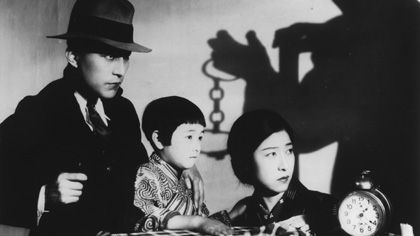
Now the BFI has brought together more of Ozu’s earlier, funnier material for a second set, but this time with a darker theme. The Gangster Films set reflects Ozu’s Hollywood influences, sure, but also a changing Japan, more urban, more hi-tech, more susceptible to western influences. In the student comedies, our slacker heroes are horrified by the brazen manners of so-called modern girls – Ozu’s gangsters embrace them, at least for a short while. The films featured in this new set are Dragnet Girl, A Straightforward Boy (fragment), Walk Cheerfully and That Night’s Wife. I don’t want to lump these films together, certainly the fragment is its own beast, but they do share some characteristics. The three features are all set in an Americanised Tokyo, accented with deep shadows and populated by Japanese gangsters straight out of US novels and films – double-breasted suits, sharp-brimmed hats and shiny leather shoes. Their molls have bobbed hair and fur collars, high-heeled shoes and glint in their eye.

The beauty of watching the gangster movies is to see Ozu’s cinematic style grow despite his influences. Or to put it in David Bordwell’s words: “The exotic and formulaic genre allows Ozu to experiment stylistically, moving toward that highly overt narration that was to become his trademark.” While the gangster films offer us Hollywood thrills in the shape of guns, girls and skulduggery, the poetics, the cutaways and composition are all Ozu’s own.

That Night's Wife (1930)
That Night’s Wife (1930)

Full disclosure: I’d quite like you to buy this box set. I contributed one of the essays in the accompanying booklet, on Walk Cheerfully. You’ll find more erudite words there too from Tony Rayns, Bryony Dixon and Michael Kerpan. The films are the thing, of course, and they are beautifully accompanied by Ed Hughes’ scores. The set has been reviewed in Film International, by Wheeler Winston Dixon, and in Sight & Sound, by Philip Kemp.

However, I’m not just writing to plug the box set, but to bring you some information about a forthcoming screening of Walk Cheerfully at BFI Southbank on 22 April. This is a members’ ballot screening, and you should know by now whether you have a ticket, though I suppose there may also be some more available nearer the date. This is a special screening and will be an experience very different to watching the DVD. First, the music will be a live improvised score that combines traditional Japanese music with electronic distortions – and a 78rpm record player. Walk Cheerfully is certainly a toe-tapping film, so I have high hopes for this. More details below:

Sylvia Hallett and Clive Bell are the two musicians improvising a live score for Walk Cheerfully. The pair have worked together for several years on projects for film, dance and theatre, as well as numerous international concert and festival performances. Their duo album The Geographers is on the Emanem label.

Clive Bell is a specialist in Japanese traditional music; he lived in Tokyo where he studied the shakuhachi (Japanese flute). Later he learned to play the khene, a bamboo mouth organ from Thailand – a bright-toned, chordal wind instrument that is an ancestor of the accordion. Sylvia Hallett is a violinist, composer and instrument maker, with a unique personal approach to live electronics.

Clive Bell writes: “Walk Cheerfully is a film full of subtle surprises, that deserves a fresh-sounding score. Our musical accompaniment will blend these Far Eastern instruments, and the more familiar violin, with electronic looping and pitch-shifting. The live orchestra which accompanied Japanese screenings in the 1930s often mixed traditional Japanese instruments such as shamisen (lute) and taiko drum with trumpet, violin, clarinet and piano. Instead of a piano, we use electronics to extend the music’s range into magic and atmospheres.

“Ozu was a keen student of American cinema, but made films that remained essentially Japanese. We hope to return the compliment by creating a rich musical mix of Western and Japanese, of contemporary and traditional. And, when the gangsters play their 78rpm records in their club, we will activate an antique 78rpm record player of our own.”

The second surprise is that the film will be accompanied by live Benshi narration – as Japanese film screenings were in the silent era. The Benshi will be performed by Tomoko Komura, who will both translate the intertitles and narrate the film.

If you want to learn more about Ozu, and his silent work, I can’t think of a more enjoyable way to begin.

Walk Cheerfully screens at NFT1 on 22 April 2013 at 6.30pm. Read more here.

Modern Times at the Royal Festival Hall: tickets for a tenner

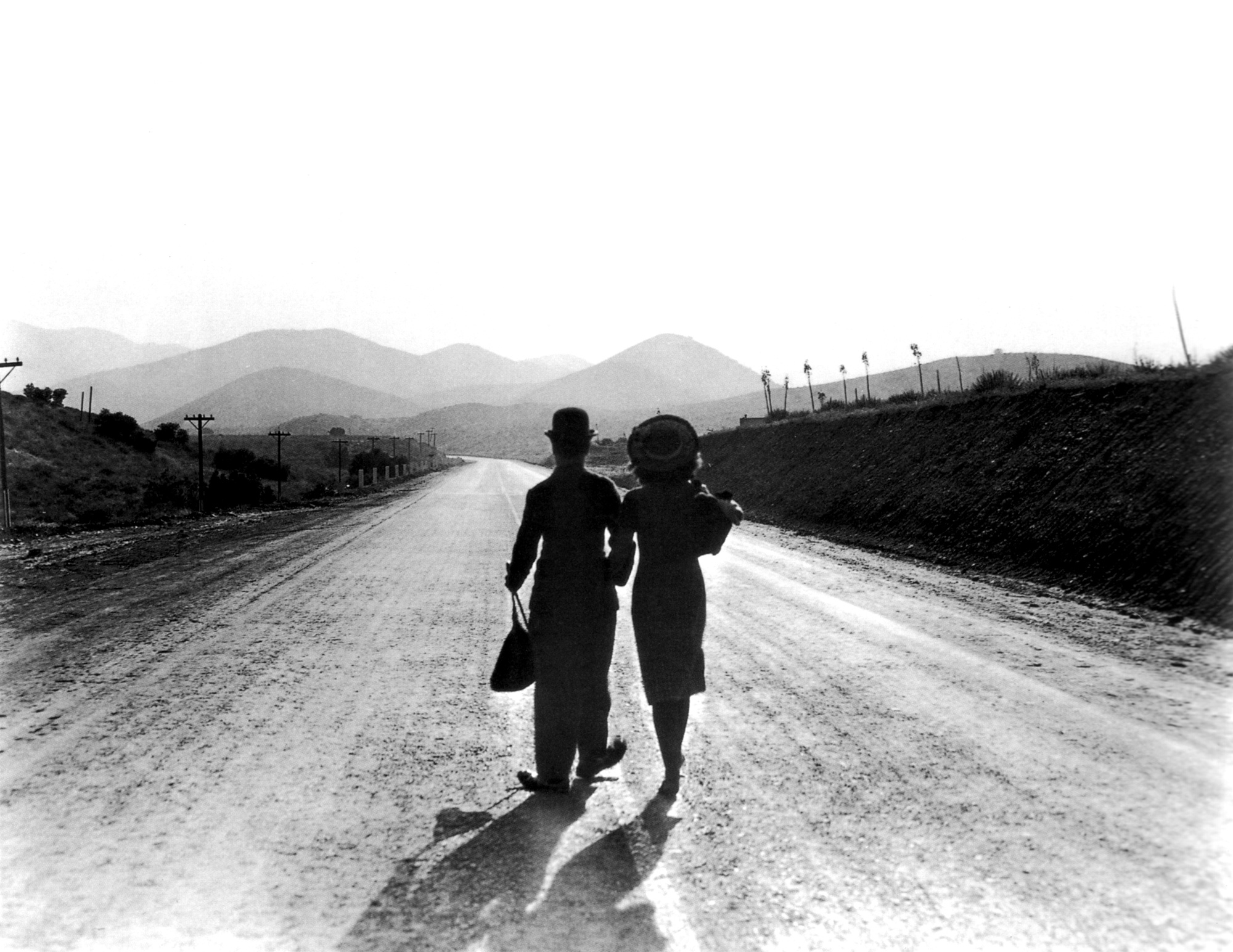
Charlie Chaplin and Paulette Goddard in Modern Times

This date should already be in your diaries. Charlie Chaplin’s wise and heartwarming not-so-silent silent film Modern Times screens at the Royal Festival Hall on the South Bank on 22 March, with the Philharmonia Orchestra conducted by Carl Davis. It’s a magnificent movie: a slyly hilarious portrait of Depression-era America, with a tremendous score written by Chaplin himself. There’s a lot to love about Modern Times – not least the final screen appearance of the Little Tramp and the debut of Chaplin’s song Smile.

If you’d like to see Modern Times, and who wouldn’t, you can take advantage of this special offer and get best available seats for just £10 if you quote FILM when booking online or by calling 0844 847 9910. Find out more and book online here.

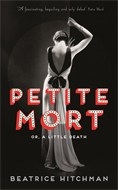
Petite Mort by Beatrice Hitchman – book review

20130309-132540.jpg

It’s a commonplace that the cinema struggles to translate the scope and nuances of great literature. Conversely, fiction often fails to capture the joys and texture of the film experience. There are exceptions to both rules, of course, and Beatrice Hitchman’s Paris-set debut aspires to the latter form of bilinguality; to commute the strange pleasures of early cinema to the printed page.

The simplest but least effective way to go about this involves a lot of research and an evangelist’s joy in sharing knowledge. These pages are littered with Max Linder postcards, asides on the intricacy of in-camera editing and the (re)invention of the Latham Loop – but there’s more to Petite Mort than that. The geek in me delighted in this scene-setting, notably the flies swarming around the studio, but Petite Mort is most cinematic when it dispenses with the history lessons.

Hitchman’s classy prose reveals not just a film lover’s appreciation for the pictorial, but a photographic appreciation for the texture of light: “slanted light”, or “light that moves like treacle”. Naturally enough, Hitchman’s silences are also tangible. In one scene, a painful pause between two lovers transmutes a cinematic trope of romance into something far more disturbing: “The silence runs down from their joined hands and over them and spreads out over the carpet, blending with the sunset, which is unexpectedly fiery and distinct. They sit like statuary of a king and a queen, saying nothing to each other. Eventually the silence fills the whole house.”

20130309-132732.jpg
Beatrice Hitchman

Petite Mort takes place in two distinct golden ages of French cinema. And these reels are clipped, cut up and spliced together in a way that immediately betrays the author’s experience as a film editor. In 1967 a journalist called Juliette investigates the rediscovery of a film from 1913; while in the earlier part of the century, country girl Adèle moves to Paris, finds work at Pathé and becomes romantically and fatally involved with a rich married couple. Juliette’s curiosity is aroused by the fact that the rediscovered print is still missing a section – a trick “doppelgänger” shot that made the film, Petite Mort, famous and may, she intuits, contain the secret of the murder trial that made its star, Adèle, notorious.

imageAnd Adèle has a doppelgänger of her own, her sister Camille, introduced as “a bright-eyed, sly duplicate of myself”. Doubles and duplicity abounds – from the multiple plotlines to that bold double entendre of a title and Adèle’s bisexual affairs. While Petite Mort builds to a whodunnit revelation, it’s these flashy patterns that catch the eye – just as that complicated ‘doppelgänger’ special effect is advertised as the highlight of the lost film. This diversionary tactic is perfectly in keeping with the novel’s cinematic contexts – both of them. Early film has been characterised by Tom Gunning as a transition between the “cinema of attractions” (trick films such as those by Méliès, or the absinthe fairies and ghosts conjured by Adèle’s lover André) and the “cinema of narrative integration” (bluntly, Griffith’s developments in storytelling across the Atlantic). However, as Vicki Callahan argued in Sight & Sound last year, the epic serials of Louis Feuillade (Fantômas and Les Vampires) from this era blur the distinctions between the two modes, following a “principle of uncertainty … a use of cinema that questions our understanding of the real”. Those early serials and their knotted narratives are evoked by Petite Mort in the two-timing, amateur-sleuthing plot, but also in the slippery, fused identities of our heroines. Callahan traces this tricksy approach to narrative cinema to the French New Wave and beyond (citing Rivette’s Céline et Julie vont en bateau (1974) and Assayas’ Les Vampires remix Irma Vep (1996)).

That Petite Mort incorporates a history of French film audacity into its sexy plot is a trick shot of its own. It’s an elegantly written, richly satisfyingly novel, and in its own distinctive way, utterly cinematic too.

Petite Mort by Beatrice Hitchman is published by Serpent’s Tail, RRP £12.99 as a hardback or ebook. Find out more.

Birds Eye View Sound & Silents – Sumurun and The Adventures of Prince Achmed

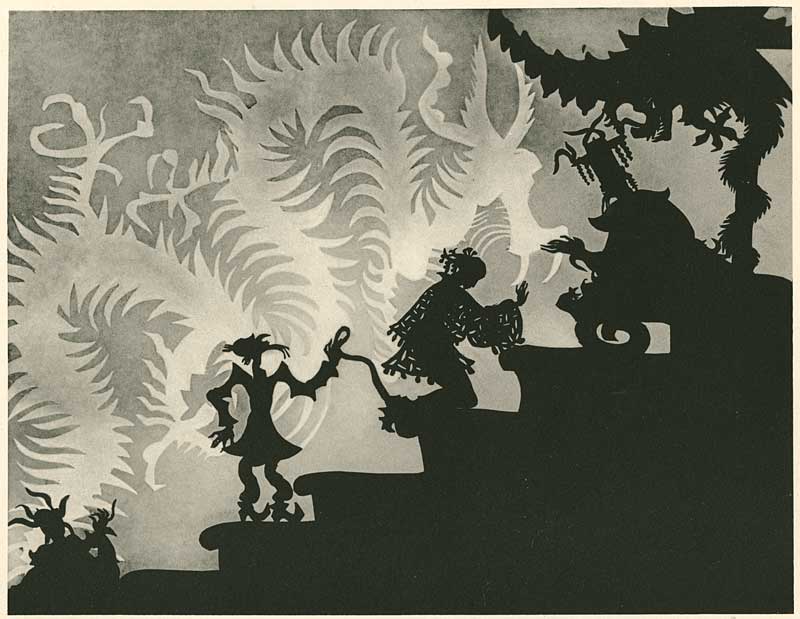
The Adventures of Prince Achmed (1926)

Birds Eye View is one of Silent London’s favourite film festivals – a celebration of female film-makers with an exceptionally strong and musically adventurous silent cinema strand. Last year, even though the festival was on haitus, the Sound & Silents programme brought us a selection of newly scored Mary Pickford films. This year, in keeping with the overall theme of the festival, the screenings have an Arabian flavour.

The two films in the Sound & Silents segment are, to be frank, German – but the first, Lotte Reiniger’s trailblazing cutwork animation The Adventures of Prince Achmed (1926) is based on a story from 1,001 Arabian Nights, as also, perhaps more loosely, is the second, Ernst Lubitsch’s boisterous harem farce Sumurun (1920). Achmed, widely acknowledged as the first animated feature film, and still as elegantly beautiful today as in the 1920s, probably needs no introduction from me.

Sumurun (1920)
Sumurun (1920)

The latter film is a slightly guilty pleasure of mine – a rather well-made romp, enlivened by the sinuous presence of the young Pola Negri, and the more demure charms of Swedish ballerina Jenny Hasselqvist. Lubitsch himself appears as a leery clown with hunchback, but his real star turn is behind the camera, crafting a fast-paced and vivacious comedy out of unpromising material. Sumurun had been a stage hit for Max Reinhardt’s company in Berlin, and Negri had starred in both that production as well as one back in her hometown of Warsaw – perhaps it’s therefore no surprise that this film is so slick, with such larger-than-life performances, including Paul Wegener as a bully-boy sheik. I will concede, of course, that it is rarely, if ever, politically correct.

Sound & Silents is as much admired for its musical commissions as its programming, and it’s intriguing that these German Arabian pastiches will be accompanied by scored from musicians whose roots lie in both Western Europe and the Middle East – British-Lebanese Bushra El-Turk and Sudanese-Italian Amira Kheir.

Multi-award-winning contemporary classical composer Bushra El-Turk creates a new work for a chamber ensemblecombining classical Western and traditional Middle Eastern instrumentation, accompanying The Adventures of Prince Achmed, the world’s first feature-length animation. Currently on attachment to the London Symphony Orchestra’s Panufnik Programme, British-Lebanese El-Turk’s acclaimed work has also been performed by the BBC Symphony Orchestra and London Sinfonietta.

Singer, musician and songwriter Amira Kheir blends contemporary jazz with East African music for a multi-instrumental 5-piece band, scoring landmark fantasy-drama Sumurun (One Arabian Night). Kheir has recently won acclaim for her ‘beautiful and fearless’ (Songlines) first album and her BBC Radio 3 and London Jazz Festival debuts.

Initially at least, the Sound & Silents screenings will be held in London and Bristol. Bushra El-Turk’s score for The Adventures of Prince Achmed premieres at a screening at the Southbank Centre on Thursday 7 March, with a second performance on Friday 5 April at the Barbican. Sumurun plays with Amira Kheir’s new score at BFI Southbank on Thursday 4 April and will then show at the Watershed Cinema in Bristol on Sunday 14 April. Click on the links for more information and to book tickets. Find out more about Birds Eye View here.

Disney’s disappointing Paperman

20130219-205637.jpg

This is a guest post for Silent London by Chris Edwards of the Silent Volume blog.

I don’t want anyone accusing me of ingratitude, much less of being a grouch. So I’m going to tell you all the reasons I think Paperman is wonderful, before I tell you why it’s not.

Paperman has been rightfully lauded, you see. At least, if we’re talking about the animation itself, which, it seems to me, is the major preoccupation of those praising the film. Fair enough. In an industry fuelled by hype, Paperman is, legitimately, indisputably, a leap forward.

This is Disney’s newest cartoon short: a black-and-white film you’ll see just ahead of Wreck-It Ralph. Utilising a newly developed program called Meander, allowing them to draw traditional images over pre-constructed CG designs, Disney’s animators have created characters who move with the fluidity of 3-D animation, while possessing the warmth and expressiveness of a 2-D line. The effect is remarkable, and beautiful.

Paperman is set in New York City, in the 1940s. The film opens with two strangers: a man and a woman, both in their early-twenties, meeting on an elevated train platform, after the wind blows one of the Man’s documents into the Woman’s face. Her lipstick leaves a mark on the paper. He is smitten. So is she. As her train pulls away from the platform, she is looking out the window, back at him. It will become his mission to find her.

The animation here is very … precise. Disciplined. This is the work of men and women with a clear vision: They knew they were making a cartoon, not an oil painting; and that a little exaggeration was for the best. So the wind nudges the man’s lanky frame just right — but not quite realistically. As the man himself does not look like a real man, but rather, a man rendered in Disney’s style, so too is his reaction a little more than it would be from you or me.

I should add that this scene is dialogue-free, as is the rest of Paperman. It is “silent”, at least in the sense that WALL-E has been called silent. In fact, you hear lots of things in Paperman. You just don’t hear words.

As in true silent films, the absence of chatter in Paperman allows us to focus on the visuals, and director John Kahrs is generous with them. I clearly remember the young woman’s smile: a half-smirk, half-grin she gives the Man after seeing the lipstick mark. You’d never see that look on a dame in a film from the 40s, but it’s a familiar one among my friends today. Kahrs lets us savour it.

20130219-210550.jpg

The office where the Man works is likewise inspired. It’s a deadening workspace, recalling the fleet of identical desks in The Apartment (and of course, The Crowd), but on a smaller scale. The Man seems decades younger than his colleagues, all of whom frown at him. Watching the film a second time, I found myself wondering why he was there. If his job is entry-level, why is he the only young person in the room? Is he an intern? Is this during the war, and his peers are overseas? Maybe he’s the Boss’s son? The Boss, a severe fellow, had some of the qualities of a stern dad. And maybe a disappointed one.

A seven-minute film cannot answer these questions, at least in any detail. But it is a credit to Disney’s team that they could create characters rich enough to inspire them. By the time the Man spies the Woman through a window in the skyscraper across the street — almost level with his own office, no less — we’re pulling for him; convinced he should and must get her attention. He begins folding his stack of blank forms (the symbols of the job he hates) into paper airplanes, whizzing them unsuccessfully above or below his target, or past her — and we yearn, with him, for one of them to connect.

We can all relate, can’t we? We’ve all felt lost and powerless this way. Kahrs, describing his own experience of New York City to animation historian Jerry Beck, recalled how odd it was “to feel alone while being surrounded by people all the time.” We sense the Man’s aloneness too, and his loneliness. At this point, Paperman feels like a seven-minute version of Lonesome, the 1928 (mostly) silent film about two sad young people who meet, fall in love, and then lose each other in the wash of humanity that is the big city. Lonesome is a great film.

20130219-210646.jpg

But all good things must end. And in Paperman, the good things end before the film does.

Explaining why is easy; doing so without spoilers is not. What I can say is that I was deeply, deeply disappointed by the ending of this film, not because of the outcome (a happy ending or a sad one would have been fine), but because of the mechanism. After several lovely minutes, built out of fine details, and true gestures, and hard-won audience investment rooted in believable characters doing believable things, the Man’s problem is finally solved through … magic realism.

Boo to that. Boo to it for being a sudden turn, taking us out of one universe and into another. Boo to it for being unnecessary. Boo to it for being depressingly predictable — we’re suckers for this stuff nowadays, be it Twilight or Beasts of the Southern Wild. Why here? Why squander the good will and creative effort of the first four minutes of Paperman for a resolution that is (merely) splendid to look at? Admittedly, it is that—manic, well-choreographed, even funny, I suppose, if it doesn’t annoy you.

And it may not. Many people will find the ending of Paperman delightful, and fully in keeping with what came before. They would tell me I’m nit-picking. But some would also, I think, tell me I’m asking too much from a cartoon. And they’d be wrong to do that.

I say Disney can do better.

Chris Edwards

Paperman is nominated for the Best Animated Short Academy Award at Sunday’s Oscars. You can watch it online here.

Silent films for Valentine’s Day

Beyond the Rocks (1922)

Nothing could be more romantic on this cupid-blessed, rose-scented day than to draw the curtains, light the candles, snuggle your loved one close and watch a film  – a silent film,  that is. Silent movies have more romance about them than their dialogue-laden counterparts. These films drip with intense, unspoken passion; those lingering closeups of limpid eyes speak directly to our emotions; and, of course, everyone looks sexier in black and white.

So, this Valentine’s morn, I asked the Silent London Twitter followers, a wise bunch, which films they would select for a night of silent seduction:

And I got replies, lots of them. You can see them all on this link, but here are some highlights:

The inevitable Valentino vote:

https://twitter.com/MissElvey/status/301970757129482240

A bromance fan writes …

Fintan is selectively deaf …

Robin calls himself “bitter” but I couldn’t possibly comment

Robert plumps for The Phantom of the Opera

Ian is clearly something of a cynic:

And there were two votes for The Cameraman

Other votes went to Sunrise, City Lights, Underground, The Lodger (from another, er, sceptic).

So, what’s your perfect silent Valentine’s movie? And do you agree with me that talkies just aren’t quite the same when it comes to the lovey-dovey stuff? Let me know in the comments below:

Slapstick Festival 2013: reporting back

Harold Lloyd's The Kid Brother
Harold Lloyd’s The Kid Brother

This is a guest post for Silent London by Ayşe Behçet.

Hi everyone! You may know me from my days of writing the Charlie’s London guest posts for Silent London. What you may not know is my silent film journey started in January 2012 when I was lucky enough to attend a party at the Slapstick Festival in Bristol. It was there I met Pamela, the editor of Silent London. A few months later Charlie’s London was born, and I have been blogging here, and on my own site ever since.

Ayşe at Slapstick
Ayşe at Slapstick

So when I had the opportunity to return to Slapstick this year I jumped at the chance. For me it was a sort of homecoming and a chance to reflect on the year’s events. My partner and I volunteered at the festival this year and we still managed to see most of the programme, which was fantastic.

Thursday night’s only event was a fascinating insight into the work of Aardman Animations, famously the force behind Wallace and Gromit and Morph. Both Nick Park and Peter Lord were present, offering the chance to see the genesis of some of their greatest works. Park and Lord have long been staunch supporters of Bristol Silents and Slapstick and were both around for the duration of the festival: two great guys who always had time to chat with fellow enthusiasts and fans.

Friday unfortunately was very busy for me until the evening, meaning I missed Boris Barnet’s The Girl with the Hatbox, starring Anna Sten and introduced by Chaplin biographer David Robinson. However, I was lucky enough to see the film while in Pordenone last year:  I can tell you all it is a masterpiece whose time in the limelight is long overdue. Sten’s performance is funny and heartfelt: thankfully her talent is now being recognised.

Now, my main love of the silent era is our very own homegrown hero Sir Charles Chaplin. So the absence of Chaplin at this year’s festival did make me yearn for the twirling cane and moustache. However, the other two of the “Big Three” were present in all their glory.  Saturday night saw Harold Lloyd take centre stage as the gala’s main feature with an introduction by “national treasure” Victoria Wood (that’s what festival director Chris Daniels called her: she reluctantly accepts the title, believing the only national treasure is Joanna Lumley). Harold Lloyd’s The Kid Brother and Keaton’s The Goat brought the house down and reminded us all that we do not need CGI to have a good cinematic time. For me the highlight of the night was George Méliès’  A Trip to the Moon: conserved and restored to all its full-colour cinematic glory, with a beautiful narration by Slapstick advocate Paul McGann.

Kevin Brownlow and Christopher Stevens discuss Harold Lloyd at the Slapstick Festival

On exiting I heard an audience member comment  “Lloyd gets a little left behind when it comes to Keaton and Chaplin”. I am not sure if this is true – but after Kevin Brownlow’s fascinating “The Third Genius” presentation on Friday afternoon I most definitely felt I knew the man behind the comedy a little bit more than I did before.  Brownlow always has such wonderful insights, having met Lloyd, Chaplin and Keaton various times. Last year I was lucky enough to be in the audience for a similar presentation on Buster Keaton. It goes without saying that men such as Kevin Brownlow and David Robinson help us all to get a little closer to an era long gone.

Colleen Moore
Colleen Moore

Saturday morning saw another presentation by Brownlow: this time on Colleen Moore – to introduce a screening of Orchids and Ermine. I think that Moore has developed quite a following: a lot of masculine swooning seemed to issue from the theatre on the crowd’s exit, and I cannot say I blame them! She was gorgeous.

Saturday night’s main feature was a selection of personal Keaton favourites by Dad’s Army legend Ian Lavender. The Electric House and College were strokes of genius made at a time when Keaton’s private life was beginning to ruin the one thing he loved so dear, his art. Lavender really struck a chord with me. He showed me a true fan’s passion for Keaton and how it can be so infectious. I often have people say to me: “I don’t know anything about Charlie Chaplin, but your passion makes me want to.” That’s the effect Lavender had on me.

Sunday saw the return of the Goodies and a fantastic reprisal of I’m Sorry I Haven’t a Clue at the Bristol Old Vic plus a chance to see the brilliant June Whitfield on stage too – receiving her Slapstick/Aardman Comedy Legend award. Yet for me the highlight was Sunday night, my only Chaplin of the entire festival. OK it was not exactly a feature, a short or even a gala. It was about 30 seconds of a cameo in the 1928 Marion Davies film Show People presented by comedian Lucy Porter. Now before you wonder, no I did not swoon. I was in fact incredibly well-behaved and blogged about it instead!

So there you have it everyone: a rundown of my highlights of the 2013 Slapstick festival. I hope you have enjoyed it and thank you for all your support in making Charlie’s London what it is. You can find us on Facebook, Eblogger, Tumblr and Twitter.

Bye for now, and here’s to 2014, the centenary of The Little Tramp …

Ayşe Behçet

PS If you’re Bristol-based, bookmark the Bristol Silent calendar for silent film screenings and club nights. And visit the Slapstick website for news of next year’s festival – and the Slapstick tour

Silent Hitchcock: whatever happened to The Mountain Eagle?

Alfred Hitchcock and Alma Reville filming The Mountain Eagle

Alfred Hitchcock and Alma Reville are back in the cinemas this weekend, courtesy of Sacha Gervasi’s controversial Hitchcock, which imagines what may have gone into the making of the notorious Psycho.

Who leered at who during the filming of the shower scene is not the biggest mystery in Hitchcock’s career, however. For anyone who enjoyed this summer’s programme of silent Hitchcock films, the big question is: where is The Mountain Eagle (1926)?

Hitchcock’s second film is the only one of his to be lost –  and it may never even have been shown in Britain. It’s currently top of the BFI’s Most Wanted list, and despite the occasional hoax, we have no clues as to its location. The recent discovery of some stills from the film have renewed interest in the hunt for the lost film. Could those precious reels be lurking in the Austrian village where it was filmed?

Though The Mountain Eagle was only Hitch’s second film, the reviews were unenthusiastic and he described it himself as “a very bad movie”, he made it just before he directed The Lodger, so there really is a chance that it’s not half bad. It starred Malcolm Keen with American vamp Nita Naldi and the plot focused on a school teacher and a hermit in rural Kentucky:

Pettigrew, a shop-keeper in a mountain town of Kentucky, falls in love with the teacher, Beatrice. The girl doesn’t consider him as a lover, so he gets angry and accuses her of molesting his son Edward who has a mental illness. The girl marries the hermit, Fear O’God Fulton in order to calm the people’s anger and day by day she falls in love with her husband and a child is born. Pettigrew hides Edward and charges the hermit with his son’s murder. Fear O’God is imprisoned but he escapes and takes refuge in the mountain with his wife and son. (From Hitchcock Wiki)

Shades of The Birds maybe? Perhaps that’s just me.

By Hitch’s own account, he did not get along with Naldi at all well:

First we quarrelled about her nails. They came down from half an inch beyond the finger to a quarter. We had another discussion. They came down to an eighth. Another discussion and they were all right. The heels came down layer by layer. The makeup was altered shade by shade. The hair was changed curl by curl.

The makers of Hitchcock, and the recent TV film The Girl would undoubtedly regard that as par for the course. Though this snippet from the director’s 1937 article Life Among the Stars  is a real eyebrow-raiser:

A few weeks later, when Alma and I were married, we went to Paris for our honeymoon and spent the first day of it with Nita. But that is another story — and one I’m not going to tell.

Anyway, the reason I bring this up is that no, I have not stumbled across The Mountain Eagle, but I did discover this rather chilling but elegant silent short on Vimeo. It’s called The Projectionist, it was written and directed by film student Jamie Thraves last year and it features a piano score by Costas Fotopoulos – plus it is loosely inspired by the mystery of The Mountain Eagle.

Enjoy – and keep your eyes peeled.

  • Visit The Space for a collection of videos on Hitchock’s silent years, including featurettes on The Pleasure Garden and Matthew Sweet and Henry K Miller talking about “Hitchcock at the Picture Palace”

News for 2013 from the British Silent Film Festival

Cocaine (Graham Cutts, 1922)

If my email inbox is anything to go by, several of you have been wondering when we would hear details of the 16th British Silent Film Festival. After last year’s trip to Cambridge, many of you will have been anticipating the festival’s return to London, for one thing…

Well. There’s bad news – but happily there’s far more good news.

The BSFF is taking a break this year – but there will still be a BSFF, of sorts. And yes, some of the events will be in London, but festivalgoers will also be packing their buckets and spades for a trip to The Suffolk coast – and the historic Aldeburgh Cinema.

The centrepiece of the events, according to my insider sources, will be the screening of Hobson’s Choice (Percy Nash, 1920), starring Arthur PittJoan Ritz and Joe Nightingale – a very, very rarely seen film and a magnificent adaptation of the play by Harold Brighouse. You’ll also have a chance to see the full surviving fragment of Graham Cutts’s Cocaine (1922) and the only surviving reel of Monkey’s Paw (Manning Haynes, 1923). Speaking of Haynes – you’ll be able to feast on his delightful WW Jacobs comedies down in Suffolk – a treat for any British silent film fanatic. If you linger by the seaside, you’ll also catch the Dodge Brothers accompanying the Louise Brooks film Beggars of Life (1928), which is well worth sticking around for.

Over to the official announcement on the British Silents website.

There will be no British Silent Film Festival this year while the team regroup – however, we are organising three fantastic one off events , with three enthusiastic new hosts:

19th April One day British Silent Symposium courtesy of Lawrence Napper at King’s College, University of London –incorporating the Rachael Low lecture. A ‘Call for Papers’ will be coming soon.

20th April – All day event at the Cinema Museum – a programme of sensational London related film – The Yellow Claw, full surviving fragments of Cocaine, Monkey’s Paw, and rare shorts from other collections. Also the 21st century premiere of the 1920Hobson’s Choice a genuinely good silent adaptation of the Harold Brighouse classic made famous by David Lean.

4th May – join us by the sea as the BSFF are guests of the glorious Aldeburgh Cinema for an all-dayer, with a coastal theme, including the ‘east coast’ films of Manning Haynes and Lydia Hayward based on the W W Jacobs stories, a programme of Lifeboat films and others. The fabulous Dodge Brothers will be playing ‘Beggars of Life’on the 5th for those who want to make a weekend of it!

Full programmes and further details to follow.

The 3rd Hippodrome Festival of Silent Cinema – 13-17 March 2013

A slide advertising Stage Struck (1925) From Starts-Thursday.com

Scotland’s only silent film festival seems to go from strength to strength. The newly released lineup for the third Hippodrome Festival of Silent Cinema looks more varied and ambitious than previous years – and well worth a journey north of the border for us southern softies. It’s bigger than before, too – running from Wednesday to Sunday.

Friday night’s gala screening is Allan Dwan’s part-Technicolor comedy Stage Struck (1925), starring Gloria Swanson – with Neil Brand on the piano. Other notable highlights include the Dodge Brothers’ spirited accompaniment to the rarely seen Soviet film The Ghost That Never Returns; Japanese favourite Crossways with a score by electronic rockers Minima; and Lubitsch’s irrepressible comedy The Oyster Princess, with music from Günter Buchwald.

Elsewhere in the week, you’ll find Charlie Chaplin, Buster Keaton, Laurel & Hardy, Baby Peggy, the rediscovered Hollywood film The Goose Woman, early Scottish cinema, the Film Explainer, Berlin: Symphony of a Great City and an often-overlooked gem called The Artist

Watch a video of last year’s highlights here:

And read the full programme for the Falkirk festival here:

GALA EVENTS

Crossways (Jujiro, 1928)
  • Stage Struck – Neil Brand accompanies the glamorous Friday Night Gala starring Gloria Swanson, familiar to audiences today as bitter and forgotten silent movie queen Norma Desmond in Sunset Blvd. Includes ‘champagne’ reception.
  • The Ghost That Never ReturnsIn their Scottish debut, The Dodge Brothers make joyous music inspired by Woody Guthrie for this little-known Soviet gem.
  • Jujiro (Crossways) – Leading UK contemporary electronic ensemble Minima perform their new score for one of the first Japanese films ever shown in the West.
  • The Oyster PrincessVirtuoso Günter A. Buchwald makes his Hippodrome debut with a glorious comedy directed by Ernst Lubitsch (The Shop Around the Corner).
The Goose Woman (1925)

NEW COMMISSIONS

  • The Goose Woman After 2012 Festival success with The Black Pirate, Jane Gardner returns to perform her new score for this film based on a still unsolved real-life murder, with Hazel Morrison and Su-a Lee on percussion, cello, musical saw.
  • The Film Explainer ReturnsAndy Cannon, Frank McLaughlin and Stewart Hardy bring archive films to life with their blend of storytelling and trad folk music.
  • New Found SoundThe third year of hugely talented Falkirk Council secondary school pupils composing and performing their own scores under the mentorship of Tom Butler of the Royal Conservatoire of Scotland.
  • Scottish Screen Archive Shorts – Continuing the relationship with the national film archive, Mike Nolan and Forrester Pyke accompany shorts before selected features.
The Artist (2011)
The Artist (2011)

BIG NOISES in the SILENT ERA

  • Baby Peggy, the Elephant in the RoomUK premiere of this fascinating new documentary telling the moving and inspiring story of the oldest surviving silent film star whose acting career started at 18 months and stopped abruptly at age 4.
  • The ArtistOscar-winning performances in the modern silent movie sensation.
  • Bright, Steady and Free from Flickr’: Early Cinema in Bo’ness and Beyond Prof John Caughie of the University of Glasgow uncovers new research into this fast-changing chapter in the history of Scotland’s early cinema
  • A Chance to DanceLearn the Charleston and other early jazz steps from the Roaring Twenties in this public dance workshop for everyone aged 16 and over.
Buster Keaton's One Week (1920)
Buster Keaton’s One Week (1920)

SILENT OVERTURES FOR FAMILIES, CHILDREN & YOUNG PEOPLE

  • Chaplin & Keaton Double BillBring a clean jam jar to get 2-for1 tickets to see Neil Brand accompanying Chapin’s The Immigrant and Keaton’s One Week.
  • Another Fine Mess with Laurel & HardyThe boys’ triple bill of Putting Pants on Philip, Their Purple Moment and Double Whoopee with Günter A. Buchwald.
  • Make Movie Music!The Glasgow Improvisers Orchestra return with a fun-filled session for primary schools using the classic Berlin, Symphony of a City.
  • #HippFest @ FusionUsing his incredible vocal talent, human beatboxer Jason Singh creates soundtracks with Fusion, a popular night for Bo’ness young people.

Watch a trailer for the 2013 festival here:

The Hippodrome Festival of Silent Cinema runs from 13-17 March. Tickets go on sale at 10am today. Call 01324 506850, or visit the Steeple Box Office, High Street, Falkirk FK1 1NW.To read more and to book online, visit www.hippfest.co.uk. If you book before 25 February – you’ll get a 10% discount on your tickets!