Just like last year, the British Silent Film Festival hits London town, but not in its traditional form. Very much as was the the case last year, actually, the festival proceeds in a slightly cut-down version, comprising a symposium at Kings College London on Friday 2 May 2014 and a full day of screenings at the Cinema Museum on the next day.
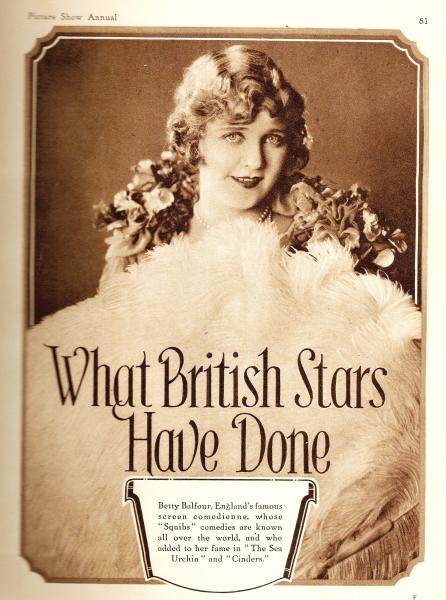
There’s a loose theme to those screenings at the Cinema Museum – runaway women or some such. I like. More to point: Betty Balfour fans – fill your boots. And if you want to submit a proposal for a paper to the symposium, you have until 31 March – so hurry up, clever clogses.
Here are the full details for each day:
The British Silent Film Festival Symposium 2014 will take place on 2nd May 2014 at King’s College, London.
Following the success of last year’s symposium, this one-day event again seeks to draw together scholars and enthusiasts of early British cinema, and operate as a forum for the presentation of new research, scholarship and archival work into film culture in Britain and its Empire before 1930. Possible areas may include but will not be confined to: Cinema in the context of wider theatrical, literary and popular culture; Empire and cinema; Cinema and the First World War.
An early evening screening of The Wonderful Story (Graham Cutts, 1922) will be included in the day’s events.
Proposals (around 200 words in length) are invited for 20 minute papers on any aspect of new research into film-making and cinema-going in Britain and its Empire before 1930. Please submit them to Lawrence.1.Napper@kcl.ac.uk by 31st March.
Put-upon ladies take on the world in this programme of rarely seen silents from the BFI National Archive.
A double bill from talented Hungarian director Geza von Bolvary, stars Britain’s favourite actress Betty Balfour as the stand-in princess in The Vagabond Queen (1929) and besotted bottle-washer in Bright Eyes (1929). Also yearning to break free, an oppressed wife hangs her hopes on a typewriter in J.M. Barrie’s The Twelve Pound Look (1920) and a programme of shorts continues the theme.
PROGRAMME
10.00-11.30 The Twelve Pound Look
11.30-12.00 Break
12.00-13.30 The Vagabond Queen
13.30-14.30 Lunch
14.30-16.00 Shorts programme
16.30-18.00 Champagner/Bright Eyes
Doors open at 09.00 for a 10.00 start.
Refreshments will be available in our licensed café/bar.
TICKETS & PRICING
£25 for the full day, £15 for a half day, £8 for one session. Sorry, no concessions.
Advance tickets may be purchased from WeGotTickets, or direct from the Museum by calling 020 7840 2200 in office hours.
I’ve just returned from the Hippodrome Festival of Silent Cinema in Bo’ness, Falkirk. It’s a fantastic event – I really enjoyed myself and only wish I could stay longer. To give you a flavour of the weekend, if you missed out this time, here’s a mini-podcast and a selection of social media updates too. Surely there is no cooler hashtag for a #silentfilm event than #hippfest?
Hats off to Alison Strauss and her team and Falkirk Community Trust to – Hippfest is a triumph.
This is a guest post for Silent London by Sabina Stent. Sabina has a PhD in French studies from the University of Birmingham and is a regular contributor to Zero magazine. Her PhD thesis was on Women Surrealists: sexuality, fetish, femininity and female surrealism – and you can read it in full here. This article is an edited extract from her thesis, focusing on the early cinema of Luis Buñuel.
Sabina Stent
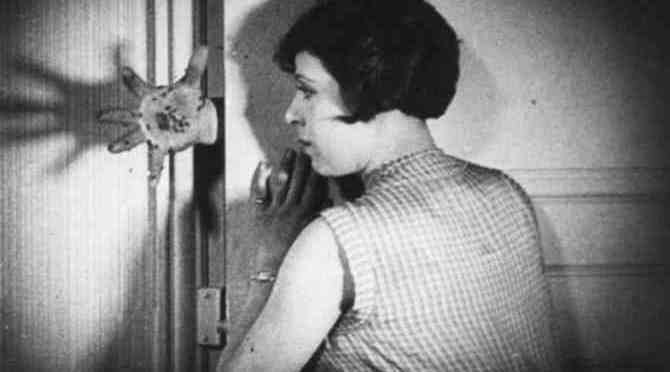
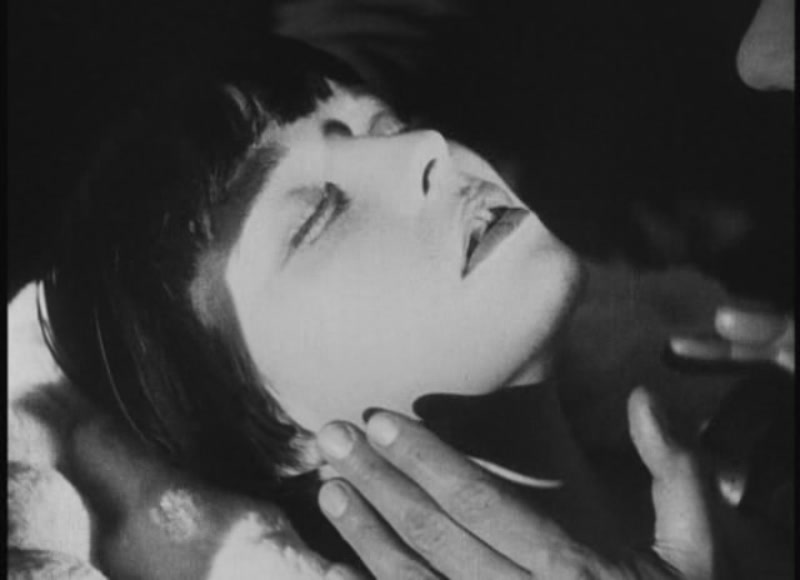
There are particular images that were central to the Surrealist movement. The human hand, for example, became a frequent Surrealist motif and can be seen in the movement’s films, paintings and photography. Why were these motifs so important to Surrealism and why do we continue to discuss them as part of the movement’s history? To understand why we must look to the Surrealist films of the 1920s, specifically Un chien andalou (Salvador Dalí and Luis Buñuel, 1928) and L’Age d’Or (Buñuel, 1930) and how key scenes emphasised the reoccurring themes that were so central to this movement.
The repetition of hands in Un chien andalou is, to put it simply, a symbol of fetish: what hands can do and how they can generate both intense pleasure and intolerable pain. Williams has commented that ‘the function of the fetish arises from the fear of castration’ and can only be preserved through making the object in question a symbol of fetish.[1] The repetition of wounded and severed hands in the film represents castration fear, and more specifically, a disembodied phallus. This is emphasised when we realise that all the hands, whether injured or exuding ants, are male. Continue reading Surrealism, symbols and sexuality in Un Chien Andalou (1929) and L’Age d’Or (1930)→
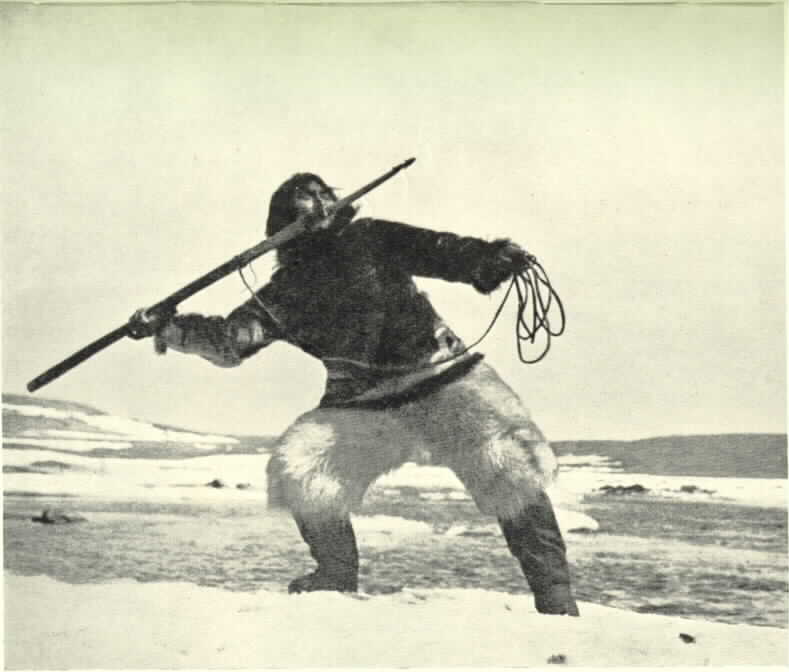
One of the most enduring, and controversial, of silent films is to screen at the Southbank Centre in April, with a very special soundtrack. Robert Flaherty’s Nanook of the North presented what seemed to audiences in 1922 to be an authentic “Story Of Life and Love In the Actual Arctic” – and they flocked to cinemas to see it. Nowadays we know that several of the scenes were staged, and that Nanook’s igloo was a fake – but the film remains a favourite. A docudrama rather than a documentary, made before the boundaries before those two genres were made distinct, Nanook of the North is a trailblazing film and one that is loved almost as much for the idiosyncrasies of its production as for the events on screen.
What’s particularly special about this screening is the music will be provided by a woman from the Canadian Arctic – not so far from the territory shown on screen in Nanook. Tanya Tagaq is an award-winning throat singer, who will accompany the film solo. Throat singing is traditional to the Inuit region but is usually performed by women in duets – a sort of sing-off to see which vocalist can last longest. You might remember the throat singing score for Pudovkin’s Storm Over Asia that was performed by Yat-Kha at the BFI Southbank a few years back.
Inuit throat singer, Tanya Tagaq, presents to UK audiences for the first time her live accompaniment to Robert J Flaherty’s classic 1922 silent docu-drama – Nanook of the North. To celebrate this rare screening, we are offering you the chance to win two tickets to see the film and Tanya Tagaq’s mesmerising accompaniment at Southbank Centre on Friday 4 April. To be in with the chance of winning, all you need to do is email …
To win a pair of tickets to see Nanook of the North with Tanya Tagaq at the Southbank Centre, email the answer to this simple question to silentlondontickets@gmail.com with Nanook in the subject header by noon on Friday 28 March 2014.
Nanook was not really called Nanook. What was his real name?
Good luck!
Terms and Conditions
– To enter the competition entrants must email…
– The competition closes at 12.30pm on 28/03/14 and entries sent after that time will not be considered.
– The prizewill be awarded to 1 winner and will consist of 2 tickets to see Tanya Tagaq in concert with Nanook of the North. The winner will be picked at random and notified shortly afterwards.
– The prize are as stated in the competition text, are not transferable to another individual and no cash or other alternatives will be offered.
– Prizes are subject to availability and the prize suppliers’ terms and conditions.
Clara Bow never had a role quite as good as Clara Bow. This mini comic is a tribute to the beauty and talent of the famous flapper, but also a testament to her tragic life and truncated career. The author, Jessica Martin, is an actress herself, best known for her work on Spitting Image and Doctor Who, so it follows that one of the strongest panels here dwells on the mechanics of screen performance. It’s a triptych of Bow’s eyes demonstrating the three stages of “it”: lovesick, passionate and innocent. But by and large, It Girl, which was inspired by a TV documentary on Bow, is concerned with the drama off-set: sex, drugs and mental instability.
Black-and-white panels flash back and forth across Bow’s life, looping in her childhood in Brooklyn, her Hollywood glory and her secluded decline. The gutsy rags-to-riches story is suited to the punchy graphic format. Bow’s beauty on screen was manifested not just in her slinky figure and doe eyes but her restless, vivacious movement and the comic-book style expresses this quality far better than a straight portrait or photograph. Bow’s appeal was famously elusive – the famous “It” of the comic’s title – if this graphic novelette leaves the reader craving the real thing that is nothing to be ashamed about.
It Girl plunges the reader straight into Bow’s psychological traumas, opening with a violent nightmare and a suicide attempt, then tumbling fast into a flashback to her childhood hardships. The pace never lets up, and across these 12 pages there is enough incident and emotional pain to flesh out a novel – or indeed a lifetime. It’s a whistlestop tour through a notoriously salacious biography, and as such it’s an experience that is as bewildering as it is bewitching.
Martin’s affection for her subject is tangible, though, and this is an invigorating introduction to Clara Bow. After this taster, it would be a hard heart that didn’t immediately want to reach for a DVD of It or Mantrap.
This is a guest post for Silent London by Stephen Horne, silent film musician and composer. The Silents by Numbers strand celebrates some very personal top 10s by silent film enthusiasts and experts.
Looking at some of the dictionary definitions of the word “haunting”, it strikes me that they are applicable to silent films in general. After all what could be more poignant, evocative or difficult to forget than watching long passed-away performers, their mute emotions given voice by music? The following films have extra elements that have made them lodge in my memory like nagging melodies. Usually there is something about them that is unexpected, unresolved or ambiguous. They often feel as though they end on an ellipsis, a cinematic ” … ”
These are all films that I have accompanied at some point, which is probably a big reason for their place in my heart. As I’m sure every silent film musician can testify, when a live accompaniment is going well, it can sometimes feel as if you are channeling the film in a way that can be positively uncanny. One warning. It’s in the nature of this subject that often what lingers most in the mind is the denouement. Therefore, what follows could potentially be regarded as an extended spoiler. Please approach with caution!
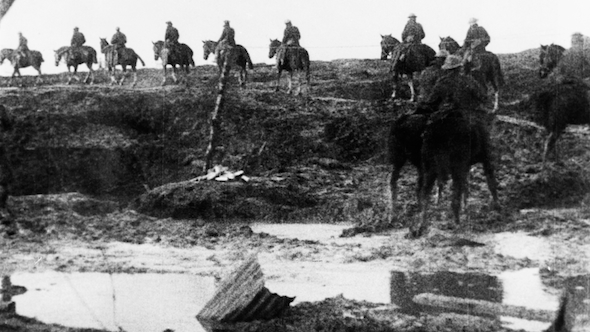
The Battle of the Ancre and the Advance of the Tanks (1917)
The Battle of the Ancre and the Advance of the Tanks (1917)
While The Battle of the Somme is much better known, the final images of its “sequel” remain more firmly in my mind. Seen in spectral silhouette, soldiers prepare “to continue the great fight for freedom”, as the intertitle puts it. Of course, what they are also heading towards is further slaughter. The original official score, a cue sheet medley rediscovered by Toby Haggith of the Imperial War Museum, calls for this finale to be accompanied by Land of Hope and Glory. Seldom has a musical suggestion seemed, at least to a modern sensibility, more heartbreakingly wrong. Which somehow makes it right.
J’Accuse (1919)
J’Accuse (Abel Gance, 1919)
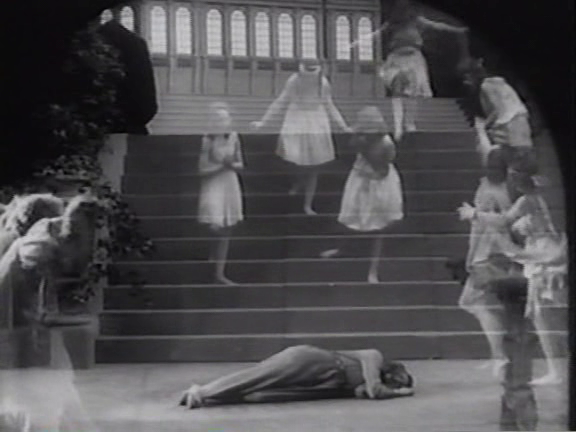
Gance’s first world war classic is full of images that scarify the memory. The March of the Dead is the most famous example: is it to be interpreted literally, allegorically or as a mass hallucination? The knowledge that Gance used real soldiers on leave from the front as actors makes the viewing experience all the more impactful: we are watching the cinematic portrayal of a phantom army, played by people who were soon to become phantoms themselves.
However, the moment that always slays me is a quiet one in the scene that immediately follows. Jean, now completely mad, re-enters his old home, looks around … and calls out his own name. He has lost everything, including himself.
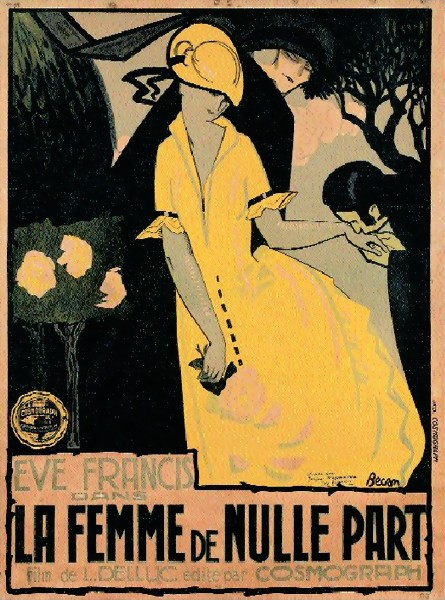
The Woman From Nowhere (Louis Delluc, 1922)
The Woman from Nowhere (Louis Delluc, 1922)
In 1996 the BFI programmed a season of films to coincide with the publication of Gilbert Adair’s book Flickers. Marking the centenary of cinema, this often-whimsical tome wove brief essays around a single still from one film of every one of those hundred years. Gilbert explained in his introduction to the screening of this little-known film that he had never actually seen it. All he knew was the still image included in his book, but it was one that had haunted him: a woman standing alone, perhaps lost, on a path in the middle of nowhere. He had always wondered about the backstory that had led her to this point and was almost scared to watch the film, in case the reality disappointed him. Truthfully I don’t remember the film in detail, but now the same image lingers in my mind. For me the woman from nowhere is still standing on that road, lost for ever.
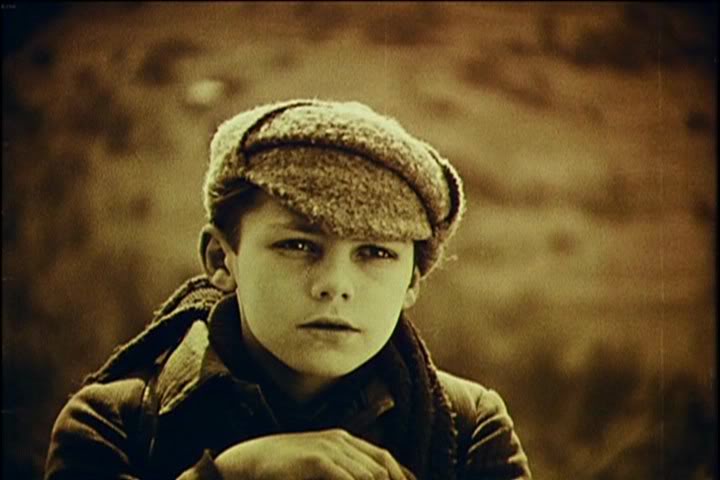
Visages d’Enfants (Jacques Feyder, 1925)
Visages d’Enfants (Jacques Feyder, 1925)
One of the most heartbreaking films ever made, despite the perfectly rendered happy ending. What lingers is the impression of a child’s struggle to comprehend bereavement, uncannily conveyed in Jean Forest’s dark eyes. The moment when the boy sees his father crying for the first time is very prescient of the ending of The Bicycle Thieves.
Stella Dallas (1925)
Stella Dallas (Henry King, 1925)
Where does Stella go, after she walks away from the window? Something in her expression indicates that she has come untethered and I always imagine that she eventually drifts into homelessness. Sometimes if I see an elderly homeless woman, having a conversation with an unseen third party, I think: “Stella – talking to her daughter … ”
Exit Smiling (1926)
Exit Smiling (Sam Taylor, 1926)
Is it possible for a comedy to be haunting? The film is delightfully funny, but it is the heartbroken expression on Beatrice Lillie’s face at the bittersweet climax that seems to resonate longer. Her character has been courageous and loveable and she deserved better. It’s also a surprising and brave way for a comedy to end.
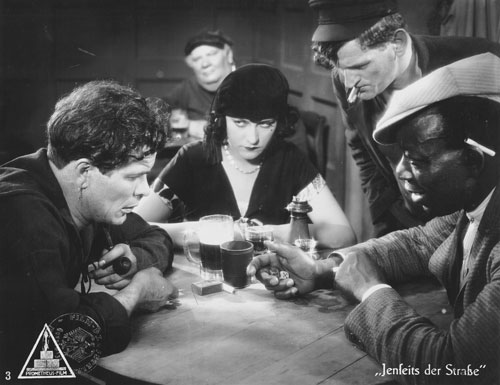
Jenseits der Strasse (1929)
Jenseits Der Strasse (Leo Mittler, 1929)
I saw this at the Bonner Sommerkino many years ago. The expression on the face of Lissy Arna’s streetwalker in the last scene burned itself into my memory. The moment itself is partially comic, as the gross belly of her next client protrudes centre-frame. However as she tries to smile at him, her vacant eyes belie the fact that her personal window of happiness has definitively slammed shut.
A Cottage on Dartmoor (1929)
A Cottage on Dartmoor (Anthony Asquith, 1929)
What I love most about Asquith’s masterpiece is the ambiguity of its final act. Few other silent films seem to generate so much discussion of character motivation. Is Sally’s forgiveness of Joe purely born of compassion or does she perhaps regret her life choices? When he asks “are you happy?” she seems to pause a beat too long, before turning her head away from him and answering “very”.
The final scene, which transcends an often wonderful but undeniably uneven film, is poignant in many ways. Louise Brooks’ character is watching herself in a screen test – one that will determine her future career in talking films – when she is shot dead by her ex-lover. While silent film Louise dies in the foreground, sound film Louise continues to sing on, framed in the screen behind her. It seems like a metaphor for both Brooks’ own soon-to-be curtailed career and the imminent death of silent films.
The Force That Through The Green Fire Fuels The Flower (Otto Kylmälä, 2011)
A slight indulgence, partly as this is a 21st-century silent, but also because I provided the music. However, I make no apology, as Otto Kylmälä’s seven-minute jewel of a short ends with a truly haunting moment that I won’t spoil, as it’s not generally available to watch at the moment. But you’ll know it when you see it. Come to think of it, the moment is accompanied by a rather haunting melody… …
This is a guest post for Silent London by Robyn Ludwig,. The Silents by Numbers strand celebrates some very personal top 10s by silent film enthusiasts and experts.
Gertie the Dinosaur (Winsor McCay, 1914)
Long before there was Bambi or Simba, there was Gertie. The simple ink dinosaur charmed vaudeville audiences with her feisty attitude, and she remains to this day a masterpiece of keyframe animation.
Humorous Phases of Funny Faces (J Stuart Blackton, 1906)
The first entirely animated film, Humorous Phases is a classic lightning sketch film, with chalkboard characters brought to life through stop-motion and cutout animation.
Felix in Hollywood (Otto Messmer, 1923)
Here the iconic kitty meets Charlie Chaplin, Douglas Fairbanks and film censor William Hays, in the first cartoon to feature caricatures of Hollywood celebrities.
Fantasmagorie (Emile Cohl, 1908)
The morphing stick figure clown, inspired by Humorous Phases, is considered the earliest frame-by-frame hand-drawn animation.
Aschenputtel (Lotte Reiniger, 1922)
Reiniger’s elegant silhouette animation creates a surreal fairytale world that is both shadowy and sharp.
There’s a silent half-hour comedy on the iPlayer right now. It will be there until 19 March 2014 and I reckon you should check it out. Here’s the link.
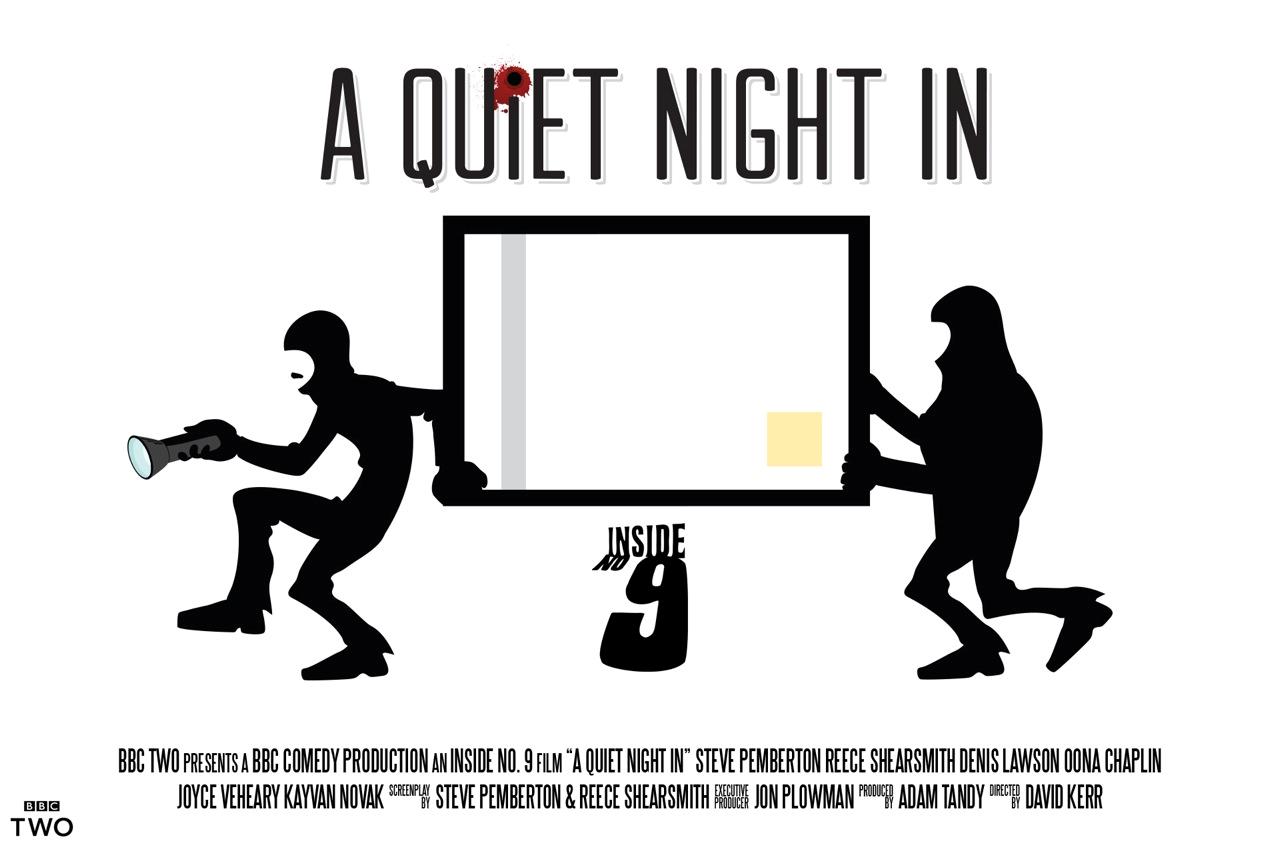
Steve Pemberton and Reece Shearsmith’s new anthology series of standalone half-hour comedies has been picking up rave reviews. But the excitement turned positively feral on Wednesday night when episode two, A Quiet Night In, aired on BBC2. The episode features an old rich geezer (Denis Lawson), the two cat burglars who are trying to half-inch his priceless modern art (Pemberton and Shearsmith), his trophy, er, wife (Oona Chaplin) and a door-to-door salesman (Kayvan Novak) – and for the very most part, it is deliciously dialogue-free.
Just to be clear, Inside No.9 last night was a masterclass. IN EVERYTHING. iPlayer at your earliest convenience.
What I really like about what Pemberton and Shearsmith have done is that the idea may be an old one (they have talked about Mel Brook’s Silent Movie as an inspiration), but the tone of A Quiet Night In is far from rowdy slapstick of much modern silent humour, or even the genre-spoofing horror-comedy of their Psychoville series, which was just as inventive as Inside No 9 is shaping up to be. A Quiet Night In is a clever, and very dry comedy – in parts it is almost bleak. It is certainly not for kids, nor sensitive dog lovers. And you’ll never look at kitchen paper, Post-Its and baking foil the same way again.
A silent Inside Number 9 – magnificent! And with Oona Chaplin, too. http://t.co/wd550HMoSQ
That Oona Chaplin has a starring role will doubtless please the silent fans – one can only imagine what her grandfather would have made of what lurks under the bedstead here …
On this site you can find out a little more about A Quiet Night In, and watch clips, including a video of the creators discussing their motivation for writing a silent episode.
All this will have to tide us over until Matt Lucas’s Pompidou airs later in the year on BBC1. Yes, the Little Britain star is working on an entirely silent comedy series for the Beeb’s flagship channel. No catchphrases, no David Walliams. Lucas is co-writing, and he will play the title character, “an elderly aristocratic English oddball who has fallen on hard times but who remains upbeat and resourceful”.
It seems the idea is catching: two very famous ITV stars want to develop their own silent comedy project too. Mr Lucas is very supportive, as you can see.
I wonder if @antanddec’s forthcoming silent comedy TV show will be called ‘Let’s Get Ready To Mumble.'
As with recent exhibitions of the photography, typography and graphic design work of Aleksandr Rodchenko (at the Hayward in 2008 and at Tate Modern in 2009), it is gratifying to see the Gallery for Russian Arts and Design, London, introducing a new generation to the stunning power and exuberance of Soviet film posters. This show reinforces an impression that disorientation and montage were methodically deployed across a number of design practices to arresting and persuasive effect. The respect for this work accorded by contemporary critics is acknowledged by the GRAD show’s inclusion of an advertisement for the 1926 Second Exhibition of Film Posters: people came to recognise the monograms of “named” designers; the dedication of artists to public art was officially celebrated and promoted.
The largest collection of Soviet film posters, to my knowledge, is held by the Russian State Library in Moscow, deposited as a consequence of copyright requirements. Unfortunately, in many instances, little is known about the commissioning process, nor the circumstances and extent of information supplied to designers at the time the posters were produced concerning the films advertised. To those of us familiar with the Moscow archive, the range of formats will come as no surprise – nor will the anonymity of some designers. For visitors acquainted with glossy, flat, reproductions of posters in such coffee-table compilations as Susan Pack’s Film Posters of the Russian Avant-Garde (Taschen, 1995), the raw texture of the lithographs on display will serve as a reminder of the technical constraints under which the work was produced. Photogravure and modern offset printing came to Russia only late in the 1920s. Offprints of the posters are here available as postcards or at A3 (£25) and a1 (£60). Posters, I recall, were a great hit at the British Council’s Yuri Gagarin installation.
The GRAD show, drawn from two private collections mostly of the monogrammed variety – the Stenberg Brothers feature prominently), alongside readily identifiable excerpts from films: Dziga Vertov’s Man with a Movie Camera (1929) and Victor Turin’s Turksib (1929) sit alongside Vsevolod Pudovkin’s Chess Fever (1924) and Storm over Asia (1928); an excerpt from Pudovkin’s The End of St Petersburg (1927) is accompanied by posters by Izrail Bograd and Semyon Semyonov-Menes for the same film (both featuring the monumental equestrian statue of Alexander III – as it appears in the film). An “Avrora” sailor’s hat-band, in a section of a Stenbergs’ hoarding, is sufficient to evoke Eisenstein’s October (1927).
The show confirms an appetite on the part of Soviet audiences for cinematic entertainments tragic, dramatic and comedic. The Stenbergs’ poster for Aleksandr Ivanovskii’s The Decembrists (1926) demonstrates the Soviet regime’s concern to establish precedents in Russian history for the October Revolution. There is also ample evidence of the export of American and European films to Russia in the post-Revolutionary period, likely to receive a welcome reception: for instance, Murnau’s Der letzte Mann (1924), significantly known in Russia as A Man and a Livery, is represented by Emil Jannings proudly standing foreground in his preposterously braided hotel commissionaire’s uniform, with, in the background, the shadowy, hunched figure he is destined to become once retired to the hotel’s basement washroom.
The show’s thin catalogue (overpriced at £25) includes short essays by co-curator Lutz Becker and co-editor Alexandra Chiriac. The former covers key aspects of art school training, film production and distribution; the latter pays obeisance to Walter Benjamin (the 1926-27) Moscow Diary and 1936 essay The Work of Art in the Age of its Technical Reproducibility) while, sadly, failing to counter Benjamin’s uninformed estimation of the talents of Igor Ilinskii, undeservedly reported as “an inscrupulous and inept imitator of Chaplin”. Russian audiences appreciated Ilinskii as one of their finest actors, on stage and screen. An appendix outlines the education, careers and varied output of the designers recognised.
I look forward to GRAD’s coming exhibitions, notably its 2014 summer show of Soviet textiles.
In my screening programme Nobody Ordered Wolves, I am always seeking startling work that will match the shock of entering the unusual spaces I seek out for the events. When I happened upon Kilburn’s Tin Tabernacle – an amazing tin church built in the Victorian period, its insides later converted by sea cadets to surreally resemble a ship’s – I knew I needed a film that would produce the same “shock of the old”. As luck would have it, there remained a work about the sea that held the same surprise that entering a ship run aground in North London did for me. The film is Finis Terrae and it was produced by neglected master director Jean Epstein.
As a child, Jean Epstein (1897–1953) was, “afraid to go to the cinema”:
I had heard perfectly reasonable adults speak strongly about horrific details of the conflagration at the charity bazaar where, it seemed, a bishop was burned alive. In my premature logic, I told myself that if a bishop can die at the cinema, all the more reasonable that I would, since I was surely not so well protected by the will of God; I would cry and stamp my feet and enter into mad crises of despair when I would see my parents prepare to go to the cinema: I was never sure they’d return alive.
This piece of magical thinking maps out Epstein’s later career in the cinema. Filmmaking was a matter of mortal stakes for the Polish-French director, writer and poet, and was carried out with an evangelical, religious fervour. Despite crowning achievements and innovations in a variety of fields – encompassing silent and sound work, commercial biopics and avant-garde shorts, high cinema theory and thoroughgoing technical experimentation – Epstein’s ability to capture the life of the sea is unparalleled.
Whatever childhood qualms he held were brushed aside after making the acquaintance of the Lumière Brothers themselves. Abandoning his studies as a doctor, Epstein jumped at the chance to co-direct a film biography of Louis Pasteur. He then produced a string of studio works in the 1920s, before founding his own film company where he directed some startling narrative works, from melodrama (Coeur Fidele, 1923) to horror (The Fall of the House of Usher, 1928). In parallel, Epstein was bravely and idiosyncratically theorising the world of the cinema. Although the subjects in his writings are diverse (even choosing from the sadly limited number available in translation), his consuming passion is how to make the focus of cinema what he terms “photogénie”. While even Epstein himself admitted “you fall flat on your face trying to define photogénie”, at its core, it is the specific extra quality that objects take on when they are filmed, and the new light that this casts on them. Epstein describes this process in typically lyrical fashion:
One of cinema’s greatest power is its animism. On screen there is no still life. Objects have attitudes. Trees gesture. Mountains … signify. Each element of staging becomes a character.
For Epstein, this idea held equal weight in theory and practice: his version of The Fall of the House of Usher focuses on the desperate, haunted attempt by Roderick Usher to capture the image of his sister in a portrait that he is obsessively paints of her. This provides a ripe metaphor for Epstein’s own artistic battle, as he tries to use the aesthetic means of film to reflect the world back to the viewer. Epstein was known for his use of many formal techniques (superimpositions, slow-motion, extreme close up) but his aim was never to create an alienating surrealism, but instead cast a cinematic spell that would reveal an object as it truly is.
Yet, after producing … Usher, his most formally lavish film, he separated himself from the Paris cinema milieu and departed for remotest Brittany.
I had the feeling that it was impossible to further capture the real using the unreal. Finis Terrae was my attempt to get past this dead end.
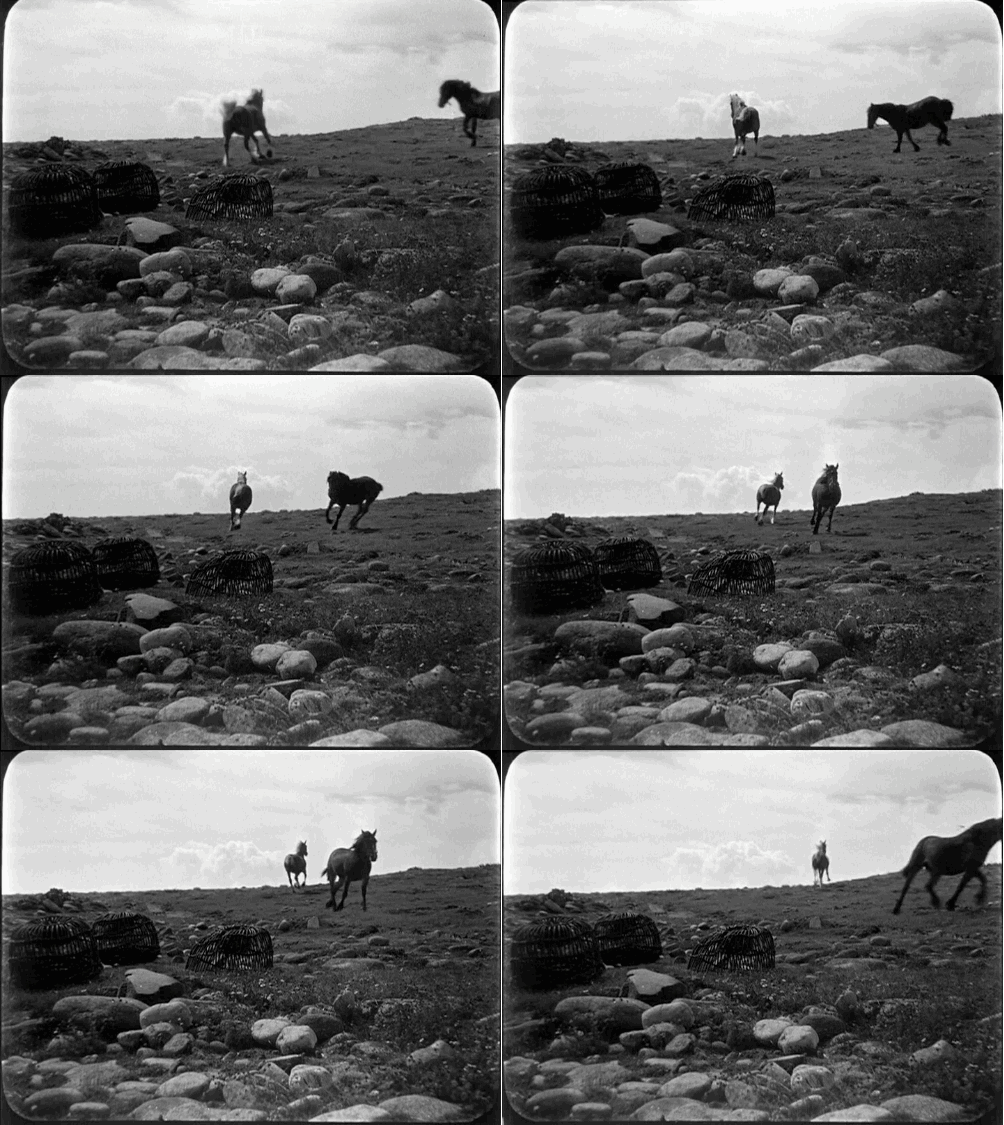
Although Epstein had long been fascinated by the sea, it was a grotesque fascination: half disgust and half attraction. Citing Edgar Allen Poe’s story The Imp of the Perverse, he described his consuming fear of the ocean, though a fear ‘that obliges us to do what we are afraid to do.’ Epstein made five films about the sea across two decades, starting with Finis Terrae in 1929. All but one is set on the Breton coast; like the rhythms of the tide that he placed so centrally in these films, his mind and travel plans kept pulling him back to the region.
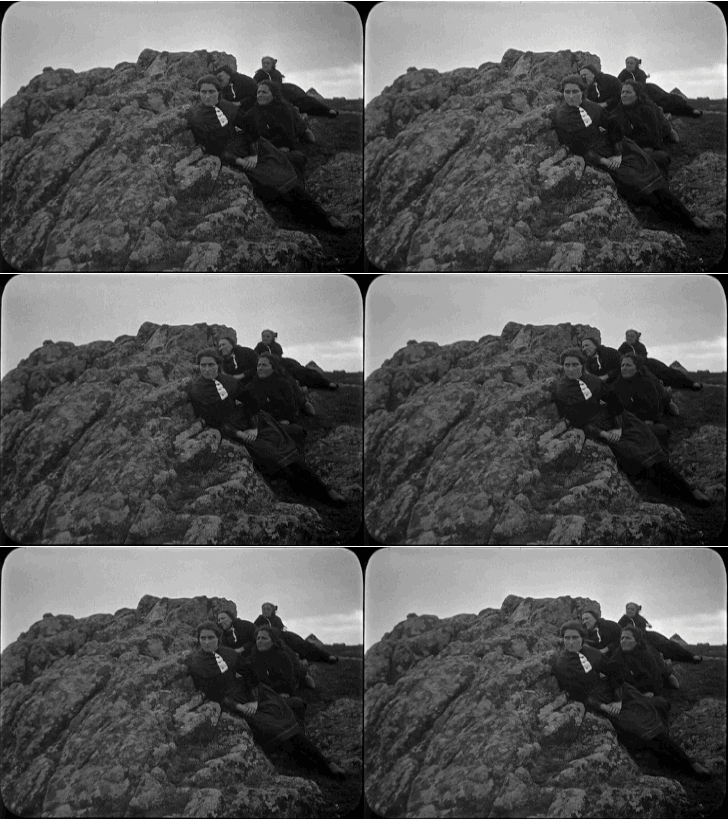
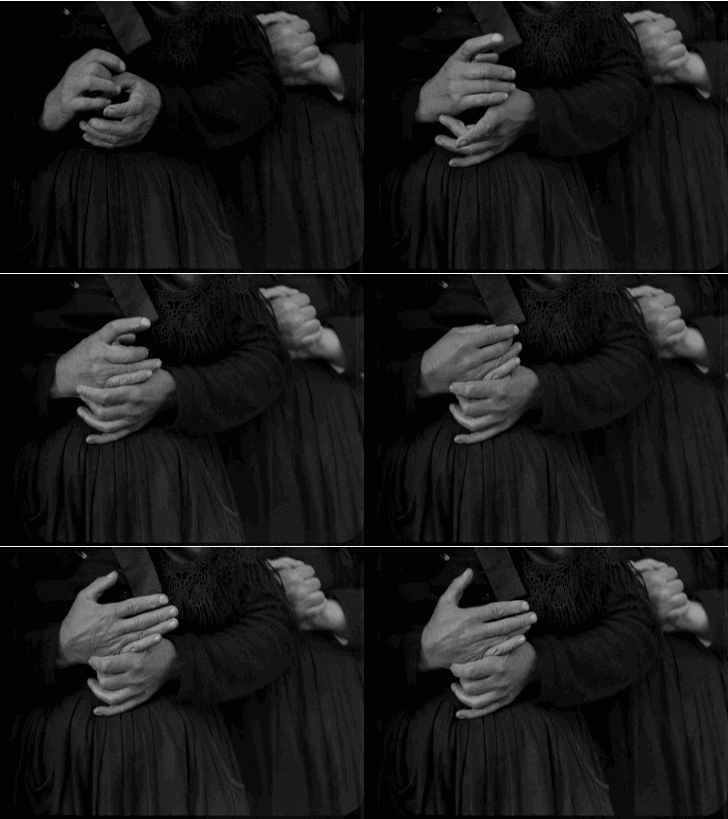
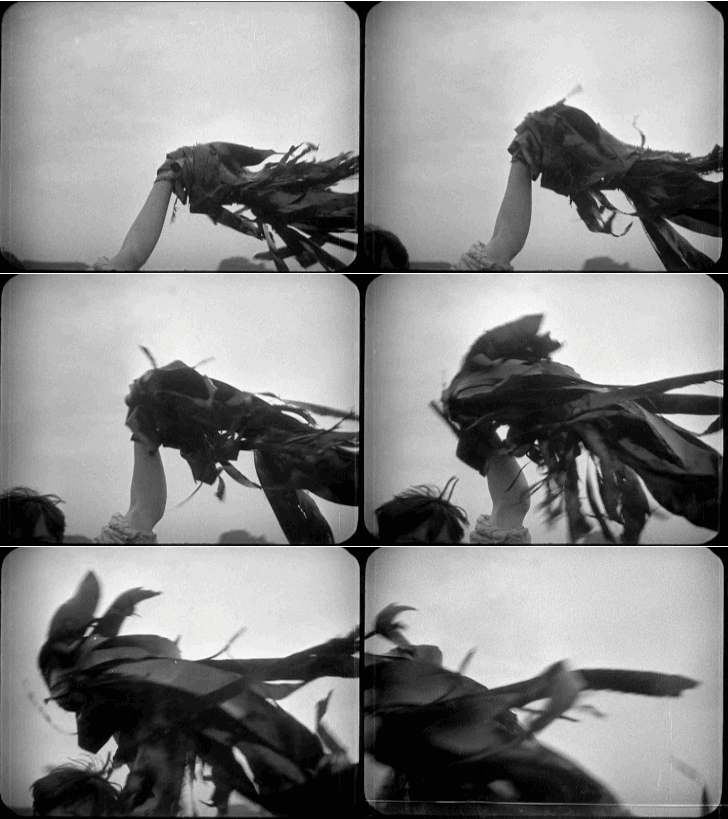
In Finis Terrae, the untouched quality of the Breton coastline allowed him to showcase seemingly simple elements to spectacular degree: the folding of a pair of arms, the fluttering of ribbons in a girl’s hair and, most persistently, the moods of the sea against the unchanging rocks. The space of Brittany gave him licence to completely renew his aesthetics, finding in the coastline the kind of natural photogénie that he had struggle to produce through artificial means in his earlier work:
Leaving the Ouessant archipelago, I felt I was taking with me not a film, but a fact and once this fact had been transported to Paris, something of the material and spiritual reality of the island life would henceforth be missing. An occult business.
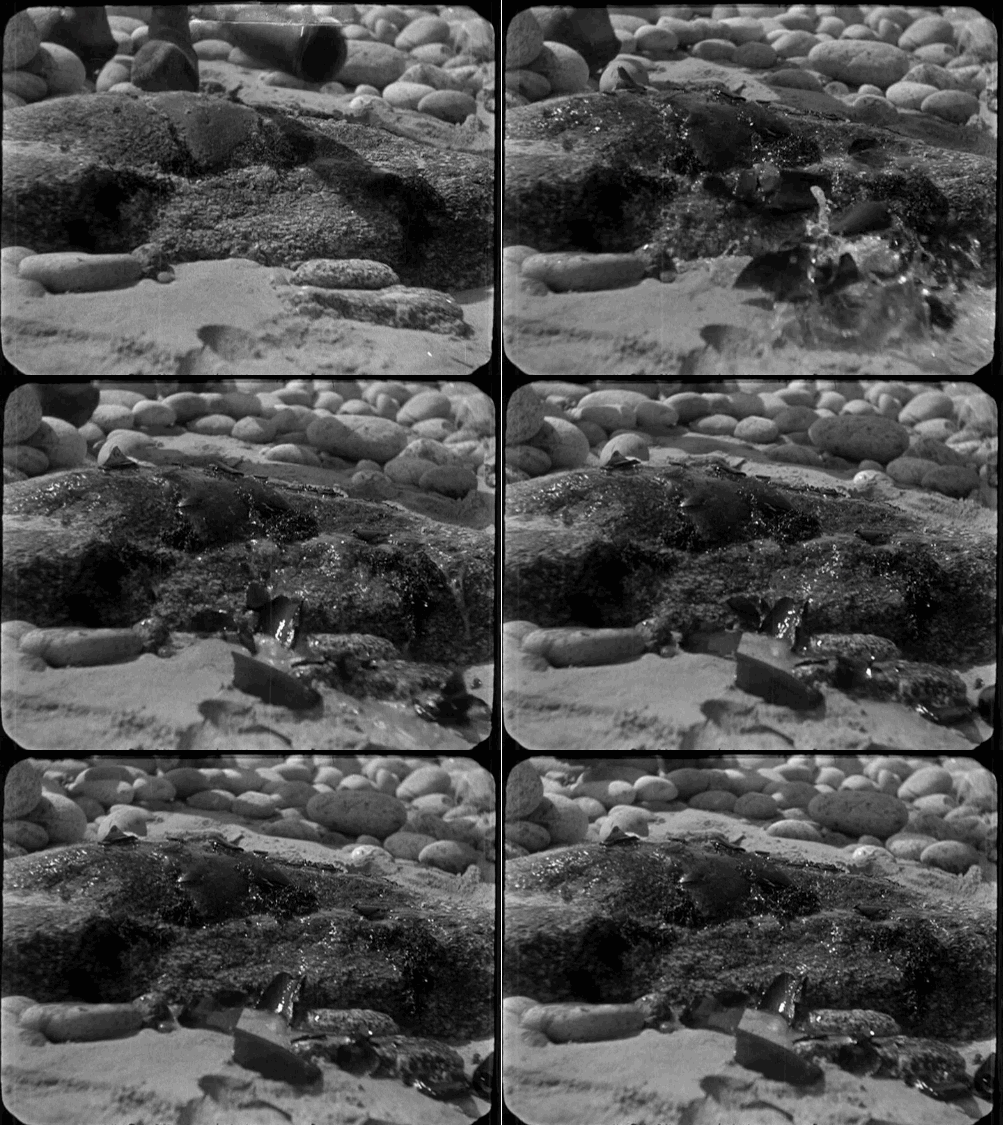
Epstein believed that cinema held the unique power to show us the fundamental objective truth that is usually shattered by subjectivity; he delighted in the French term for a camera lens, le objectif. Appropriately then, Finis Terrae’s plot was “torn from the headlines”, though markedly more sedate headlines than the cinema usually draws on. In the film, a seaweed gatherer on a remote coastal island accidentally cuts himself on a bottle, and the wound quickly becomes infected. Initially he is derided by the other seamen for his malingering, but soon they realise the mortal stakes and attempt the difficult sea crossing to the mainland.
As Epstein hoped, his mode of framing life in Ouessant acts as an “eye-freshener”: one comes away from the film brimming with cinema’s potential. Although Epstein exposes much that is exotic and novel in his docudrama, the film never patronises the Breton lifestyle. One thinks of Murnau and Flaherty’s Tabu: A Tale of the South Seas(1931), which, despite its beauty and “documentary” approach, has an outsider’s touch throughout, seeking to fillet the lives of the islanders for their “otherness”. Whether or not one can claim objectivity, Epstein was not simply another Paris intellectual seeking authenticity in the “naïve” life of the natives. Brittany represents a space of the uncanny for Epstein, where the smallest mistake can have life-threatening consequences:
In this place and people is resumed the mystery of men dedicated to land that is but rock, to sea that is but foam, to a hard and perilous trade suffering a meagre self-sufficiency.
Instead of “the other”, Epstein shows life in Brittany as a legitimate alternative to the alienation of modern life. He also had other reasons for seeking alternate lifestyles: as was uncovered when his full archives were made available, Epstein was gay and, under a pseudonym had written a pioneering treatise on Masculine Homosexual Ethics. With this information, the companionship between the younger seaweed gatherers takes on a new cast. Brittany at that time was heavily dominated by the Catholic church, but fishermen – unable to attend mass on a regular basis – were relatively exempt from their sway. In the male-only world of the archipelagos, a beautiful and separate world could flourish. The narrative trajectory of Finis Terrae can easily be read as a parable of two male lovers who come to realise their value to each other.
Epstein’s other works of the sea are equally compelling, but it is with this first work that he made his definitive statement about the power of the ocean. Coastal life is constantly in flux; for a filmmaker who believed that “still life is an abominable on screen … a sin against the very nature of cinema”, it allowed him the perfect location to capture the ecstatic essence of film.
This article is heavily indebted to Jean Epstein: Critical Essays and New Translations (Amsterdam University Press), which is available as a Creative Commons licenced free e-book here. Many thanks also to Bathysphere Productions for generously sharing a viewing copy of James June Schneider’s beautiful documentary Jean Epstein: Young Oceans of Cinema, which will be included in the upcoming (and much needed) box set of Jean Epstein’s works from Potemkine, due to be released in May 2014 to coincide with a retrospective of his works at the Cinemateque Française.
We’re an excitable bunch here at Silent London, which you have probably noticed by now. But a quiet announcement by Masters of Cinema recently caused even more whooping and merriment than usual. The classic movie imprint is releasing its gorgeous Lubitsch in Berlin box set, which had inexplicably fallen out of print. We’re big fans, big, big fans of this set, and so in a collective declaration of box set love, a group of us gathered together to review every movie in the box, one by one …
There are six films in the set, all made by the legendary Ernst Lubitsch in the earliest stages of his movie career, after he had been lured out of Max Reinhardt’s theatre company to the UFA studio. If these films are deemed less sophisticated than his later Hollywood work, then that is mostly because his subject matter is often more fanciful, his characters border on feral, and his sense of humour, at this time, in uninhibitedly mischievous. Or perhaps, because people are fools. The elusive “Lubitsch touch”, and his mastery of character, space and comedy is very much in evidence here – The Oyster Princess and Die Puppe in particular are perfectly pitched comic pantomimes. Three films in this box star the irrepressible German comic actress Ossi Oswalda – perpare to fall head over heels – a further two feature the wonderful Pola Negri and Emil Jannings makes an appearance too.
One of the films in this set, Anna Boleyn, was partially responsible for Lubitsch’s move west: it and Madame Du Barry (not in this set) found US distribution, and became unsettlingly successful on those shores. Lubitsch would bc the first established Hollywood talent to be snapped up by a Hollywood studio. Pola Negri would follow shortly after – they called it, sardonically, the “German Invasion”.
As well as the following six films, the set contains a feature-length documentary (Ernst Lubitsch in Berlin: From Schönhauser Allee to Hollywood) and some very sharply written essays. Don’t miss out.
The exclamatory title of this 40-minute adventure is a lesson hard won for its heroine. One might add, she hardly wants to be a woman either – at least not her fretful elders’ idea of how a young lady in her teens, and the century’s, should be. Delightfully, other people’s ideas hardly get a look in. I Don’t Want to be a Man is a taboo-thumping caper that plots its own course through conventional ideas about gender and romance. It was early days for Weimar Berlin when this film was made, but even in this short comedy, there is lechery, bisexuality, drunkenness and decadence in abundance. And when it comes to rebellious on-screen teens, Ossi Oswalda’s flirtatious, gender-bending minx feels decidedly modern.
Ossi is a smirking teenage nightmare, a spoilt brat who smokes and plays poker with men much older than her. Banished to her room, the flirting continues through her window as her suitors contort themselves on the pavement below. When he is called away overseas, her uncle hires a new, supposedly strict, young guardian to take her firmly in hand. That the appointed dragon is a handsome young man may seem to spell trouble, but Ossi’s next move takes the story to a whole new level of larkiness.
Outraged at being grounded, Ossi decides the only possible way to enjoy a night on the tiles is in drag, so she has herself fitted for top-hat-and-tails and sneaks out of the house. I won’t give away what happens in the nightclub, and the morning after, but suffice to say that lust and confusion bloom in equal measure.
A running gag here is that as a woman, Ossi can handle herself and manipulate the men who throng her, expertly. As a man she is clueless and not a little afraid. At the tailor’s, in feminine dress, she parcels her body out to the adoring assistants who clamour to measure her up: a left arm for one, the waist for another. In the club, she is near toppled over by the women who want to dance with her. Whether Lubitsch is saying that when it comes to sex women have the upper hand, or just poking fun at the whole business of romantic chivalry matters little. That Ossi finds herself a partner who likes her both in drag, and out of it, is the happy ending that even the most “retrosexual” audience could crave.
If it’s well-known that silent cinema is littered with heavily stylised classics, it’s perhaps also true that Die Puppe remains one of its most overlooked gems – a pre-Caligari classicof German artifice. Used here for comedic (rather than psychological) ends, the stylisation is no doubt employed in part to help make believable the film’s central premise: when a wealthy baron decides his nephew must marry, the local monks talk the nephew into marrying a lifelike doll so he can donate his dowry to their abbey. But what the nephew fails to realise is that the dollmaker’s puckish apprentice has broken the doll, and that his bride-to-be is in fact the dollmaker’s daughter herself, and not her mechanical counterpart …
If that all sounds rather silly … well, it is. But the nephew’s response to his uncle questioning the doll’s (literal) stiffness (“She’s from an old patrician family. They’re all very formal”) reminds us that this is as much social commentary as social comedy. The film is at its most pointed when representing the hypocrisy and greed of the monks, who gorge themselves on food and wine while claiming poverty (their response to the news of the 300,000 francs dowry: “Do you know how many pork knuckles you could eat for that!”).
The film was a vehicle for then-popular German actress Ossi Oswalda, who excels here in the dual role of the doll and the dollmaker’s daughter. But the film itself undoubtedly belongs to Lubitsch; he appears first onscreen, unpacking what is to become the scenery of the film’s opening scene. The film is subtitled “Four amusing acts from a toy chest”, and if the four acts never quite emerge in the print presented here, the rest of that description seems particularly accurate. Moving beyond stylisation-for-the-sake-of-it, Lubitsch seems to be delighting in the very medium of cinema and the possibilities inherent in the art form (lest the film’s exuberance make us forget, Die Puppe was made in 1919). Lubitsch is director as conjurer, and the film’s reflexive and playful edge exhibits all the purest joys of the silent era – a time in which cinematic conventions were yet to come along and ruin the experimental, stylised fun.
Alex Barrett is an independent filmmaker and critic. He is currently in development with his new film, London Symphony, a silent city symphony. You can follow the project’s progress on Facebook and Twitter.
Die Austernprinzessin (1919)
Reviewed by Ewan Munro
One of the wonderful things about silent cinema is that film techniques and technologies we nowadays take for granted were still evolving. This occasionally means we get stagy affairs with huge melodramatic emotions matched to over-the-top gestural acting and a sense of decorum a hundred years removed from our own sensibilities. Yet for every ten of those there’s a film like Die Austernprinzessin: constantly inventive, filled with laughs, and with a satirical sense that doesn’t feel hugely out of step with anything being made today. The director is Ernst Lubitsch, who at this point was still making his name. He even had a brand of sorts, the “Lubitsch touch”. Whatever that may be, he certainly does have a way with a film, no less in this early effort than in many of his “mature” works.
At the heart of The Oyster Princess is a pretty full-blooded critique of capitalism; there’s certainly no pulling punches here. The “oyster king”, Mr Quaker (Victor Janson), lives in a vast mansion attended by numerous servants and has a spoilt daughter, Ossi (Ossi Oswalda). Until the very end, all that either seems to care about is this privileged life they live. Quaker’s catchphrase, delivered at the end of each of the movie’s four acts, is “that doesn’t impress me”. Ossi, meanwhile, who kicks off the plot with her demand to marry a prince, susbequently pays only scant attention to either the man or the relationship. Hers is an entitled world of passing whims, and she soon decides that this prince she’s been given isn’t one she likes very much after all.
But this is a comedy of manners, and part of the joke is that Prince Nucki (Harry Liedtke) has fallen on hard times, and so has sent his valet Josef (Julius Falkenstein) to check out Mr Quaker’s offer. This somewhat inevitably leads to him being confused with the prince, and given the frivolous way the Quakers live, perhaps that’s little surprise. The opening shot shows Mr Quaker smoking an unreasonably large cigar, attended by a phalanx of obsequious black servants, while his every word is hung upon by an array of secretaries. This obscene overkill – Quaker doesn’t need so many women to transcribe his dictation, nor so many handservants, as most of them have nothing to do – quickly becomes a running joke. There are serried ranks of servants to help Ossi into and out of her bath, and serving a meal is like a military drill. This is obscenely gluttonous excess for its own sake – and for our amusement.
Although the technical limitations of the period mean the camera is still largely fixed, it’s hardly noticeable thanks to a lightness of touch in orchestrating the action. Characters move around incessantly. So vast is Quaker’s mansion that he, attended by his many servants, jogs from room to room. His daughter meanwhile is a whirligig of emotion, throwing everything around petulantly. At one point there’s even a dance sequence – “a foxtrot epidemic breaks out!” – allowing for various groupings around the mansion until eventually everyone, right down to the kitchen servants, is seen dancing.
It may not be surprising to devotees of Lubitsch’s work, but for one new to his cinema, what’s astonishing is that almost every moment in the film’s concise hour-long running time is filled with inventiveness and comic inspiration. Shots that just prosaically bridge a gap between two scenes are not for Lubitsch, and (as mentioned above) even moving between rooms is done with a humorous touch. The performances are also uniformly delightful, particularly Oswalda’s cheeky impishness and Janson’s amusingly affected stoicism.
Once again, this is another excellent Masters of Cinema release, with an exemplary transfer to DVD and a rather jaunty score perfectly matched to the action on screen. This isn’t just an excellent primer to Lubitsch’s cinema, or to silent screen comedy. It’s a marvel of a film and a joy to watch.
Of the silent genres which seem to have dissipated when sound came, the Sheikh & Sex desert romances can seem the most alien to us now. Not just for their broadly orientalist strokes, any silent film aficionado has to swallow to some degree the racial and jingoistic views of the time, but there is often a degree of exotic ethnography going on, from Valentino’s tea-towel headgear to the huge harems on display. In depicting a non-Christian world view, film companies could have their cake and eat it, tell highly sexualised stories without condoning them.
Sumurun, with all of its high melodrama, probably sits closer to Lubitsch’s sex comedies such as The Oyster Princess, but its source material and setting means that narratively at least there is a sense that the story is the most important thing. Whilst the film is invested in the capricious evil of its sheikh, and definitely leaning on the fetishisation of the harem and exotic dancing, Lubitsch does not seem to be moralising here. Instead he is using his setting as an alien world, building a blockbuster that throws all the spectacle it can muster on to the screen whilst trying to display humanity in all its characters.
This means that tonally, Sumurun is a bit of a mess. It lurches from slapstick to scenes of murder and ends with some high tragedy. This doesn’t really matter though, as the narrative thread is strong and like any blockbuster there is barely a moment where Lubitsch doesn’t put something funny, novel or just plain beautiful at the screen. Pola Negri is appropriately captivating as the travelling dancer who instigates the ruckus, but Jenny Hasselqvist’s Sumurun is suitably empathic in the title role as the seemingly doomed courtesan. The film, however, belongs to Lubitsch the actor, whose Hunchback both observes and drives the story but also holds the most significant emotional beats (and some of the broadest comedy). He does a lot of eyebrow acting, and is extremely watchable in the role. That said, by the time people are locked in trunks, and are being chased around the elaborate set like a Hanna-Barbera cartoon, the hand of Lubitsch the director is clearly more prominent.
Much like its source material, Sumurun is invested in entertaining a wide audience in the broadest way. It has a Shakespearean sweep in its tragedy, but is at its heart a comedy – and quite a silly one in places. That it works is due to Lubitsch taking rather broad archetypes, particularly his own, and breathing life into them, transforming them from comedy to tragedy. It feels apt that the last shot of the film is Lubitsch himself, in his final acting role, mournfully strumming a lute; he will go on to entertain behind the camera, but he gives himself a pretty meaty final role.
For the star of a story about a sexy tempter lady, Anne Boleyn (Henny Porten) doesn’t get to do a lot of tempting. The queens on either side of her have much more fun: her predecessor Catherine of Aragon (Hedwig Pauly-Winterstein) gets some spectacular eye rolls and glares in, and successor Jane Seymour (Aud Egede-Nissen) interestingly takes up the traditional “Anne Boleyn” role of the ambitious, flirtatious younger woman who lures away Henry VIII (Emil Jannings). Porten’s Anne is very Good and Virtuous and Tragic. Far from scheming to get Henry and the crown, she is pressured into the marriage by the king and her uncle Norfolk (Ludwig Hartau). The best shot of the film is of the two men exchanging glances over her head, then talking rapidly at her from both sides as she slips into a half-swoon between them.
The three leads are introduced with very successful contrasts: Anne’s energy as she runs across a courtyard to greet her fiancé Henry Norris (Paul Hartmann); Henry’s joie de vivre as he licks his fingers and drinks from a tankard bigger than his head; and Catherine’s ritual, stultified staging of monarchy in the court.
Lubitsch frames Anne in playful boxes throughout the film. The opening scene sees her in a rocking cabin on the sea from France, she kisses Norris over a half-door and meets Henry VIII when the train of her dress is caught in a door. The set traps her but the camera dangles the possibility of escape. After she is sentenced to death, she begins to stride toward the camera, nearly faces us head-on, but chickens out and ducks away down a side corridor.
As a little bonus, the new score has a few jokes for early modern music fans, as “Pastimes with good company” – a tune Henry VIII wrote himself – is heard at key moments: at the king’s introduction, sitting at a Round Table (do you see) with his knights, at a May fair and later in a minor key as things start to go wrong for Anne.
I suspect it’s a bit long and worthy for those who know Lubitsch for his comedies, but as a historical costume drama Anna Boleyn is a lot quicker and wittier than most contemporaneous films of that genre, and frankly most modern ones too.
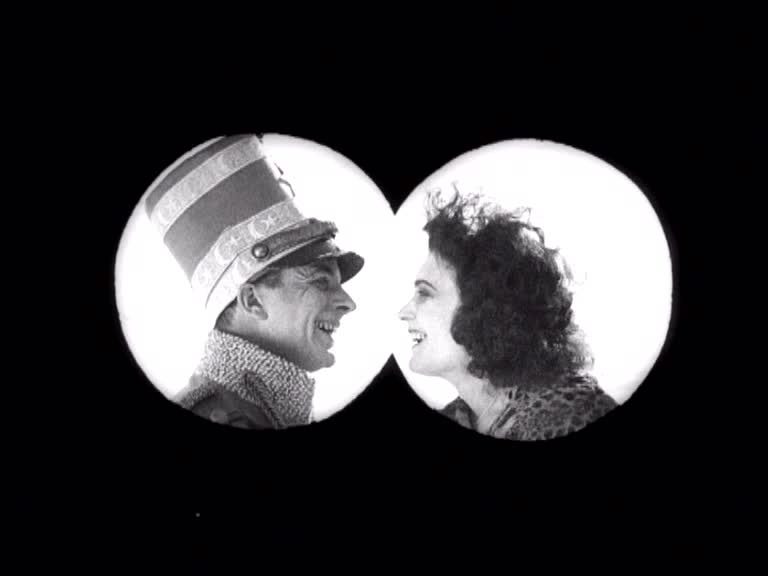
Ernst Lubitsch has referred to Die Bergkatze as his own personal favourite, and it’s easy to see why. This picture – which proudly proclaims itself as “A grotesque in four acts” – marks the peak of his silent era creativity. The film’s production design recalls The Cabinet of Dr Caligari with its spiral staircases and unusual angles, but filtered through the fantastic storybook style of Lubitsch’s Die Puppe, which he pushes to extremes here. We see the story unfold through a series of bizarre irises, from conventional circles to oblongs and squiggly outlines. Sometimes scenes are framed by an iris that suggests we’re viewing the action through a hole torn hastily in a sheet. It’s a suitably wild approach for the raucous tale Lubitsch wants to tell.
Die Bergkatze is the story of a soldier (Paul Heidemann) who finds himself caught between two women, one a captain’s eligible daughter (Edith Meller) and the other a gypsy girl – the “wildcat” of the title – who lives in the mountains with a gang of bandits. Her name is Rischka and she is played by Pola Negri, whose performance here almost matches the unrestrained exuberance of Ossi Oswalda in her collaborations with Lubitsch. Negri is lively and tough, manhandling and whipping the men around her into submission and stealing the leading man’s trousers within minutes of meeting him. While she takes steps towards a more feminine demeanour throughout the film, memorably trying on dresses and dousing herself in perfume, her more abrasive edges are never smoothed away – I loved the way she slapped away a proffered champagne glass before swigging straight from the bottle.
Lubitsch keeps undercutting convention in this manner. When we first see a crowd form to see off Heidemann’s Lieutenant Alexis, we might assume that it consists of people awed by his heroism in battle, but then we see that the throng is populated entirely by tearful women who want to thank “Alexis the Seducer” for the good times. Die Bergkatze is a gleefully entertaining romantic farce, with all of the wit and sauciness that characterises Lubitsch’s most distinctive comedies, but he also finds room for some unexpectedly touching interludes. A dream sequence that sees Rischka’s ghostly presence cavorting with Alexis is one of the loveliest scenes the director ever filmed.
Scotland’s only silent film festival returns to the glorious Hippodrome cinema in Bo’ness with another impressively wide-ranging programme. There are some real treasures to be unearthed here: rare screenings of little-seen but highly valued films, and innovative ways to share the magic of silent cinema with younger audiences. Gala screenings include the Dodge Brothers‘ Scottish debut, accompanying the Hollywood classic Beggars of Life, starring Louise Brooks; Jacques Feyder’s heartstopping Visages d’Enfants closes the festival, with music from Stephen Horne; Frank Borzage’s wartime weepy Lucky Star plays on the Friday night, with Neil Brand on the piano; and Jane Gardner will perform a specially commissioned new score for Ozu’s gangster drama Dragnet Girl. German group The Aljoscha Zimmermann Ensemble will provide a score for Murnau’s timeless The Last Laugh; Jason Singh will create his magical vocal soundscapes for Grierson’s landmark documentary Drifters, live at the Hippodrome.
This is a guest post for Silent London by Nina Giacomo from Brazil, who blogs at Primeiro Cinema. The Silents by Numbers strand celebrates some very personal top 10s by silent film enthusiasts and experts.
The great majority of the films made between the origins of cinema and the 1910s had colour in some way. People often don’t know that because a lot of films from the 1920s were actually released in black and white and so the evolutionary view of film history makes us think that silent cinema was deprived of colour. But, since the beginnings of cinema, a lot of research was done into colour film and two tendencies were explored: the colourisation after the film had been shot and the capture of “natural colours” while shooting.
This is not a “top 10” list … It is a selection of 10 films that show a variety of ways of giving colour to the moving image. It is my list of 10 must-watch silent colour films!
Annabelle Serpentine Dance (Edison, 1895)
The first of many films dedicated to the “serpentine dance” created by the american dancer Loïe Fuller in 1889. The hand colourisation, frame by frame, represents Fuller’s spectacular stage effects, which combined the constant flow of the dress’s movement with the projection of electrical lights.
Pierrette’s Escapades (Alice Guy-Blaché, 1900)
A vibrant example of hand-colouring made by Gaumont.
Untitled experiments (Edward Turner, 1901/02)
Theses pictures, recently discovered, are actually a series of tests for a new invention. They show how early the attempts to reproduce “natural colours” began.
A Trip to the Moon (Georges Méliès, 1902)
The colour version of this film was unknown until 1993, when it was found in Barcelona in a terrible condition. Not until 2010 could the restoration could be released and it transformed the image we have of this most iconic of all silent films.
The Lonedale Operator (DW Griffith, 1911)
Here we have an interesting use of colour in silent cinema. The young lady can only trick the bandits (making them believe that she has a gun, when actually it is a wrench) because the scene takes place at night. The blue tinting suggests the time of day.
This classic has just been restored and the new version will be shown in February at the Berlin International Film Festival with its original tinting and toning … I can’t wait to see it.
Virginian Types: Blue Ridge Mountaineers (1926)
An amazing example of Pathécolor, just recently discovered. It shows us a late use of this method that was pioneered by Pathé in France during 1905. Stencils were used to automate the hand-colouring of films.
Lonesome (Paul Fejos, 1928)
A hybrid in many ways: this is a silent, talkie, black-and-white and colour motion picture. The colour scenes are just marvellous.
The Love Charm (Howard Mitchell, 1928)
And here is a little known example of the two-colour Technicolor process. A weird love story in amazing colours.
Nina Giacomo
Do you agree with Nina’s choices? Share your suggestions below
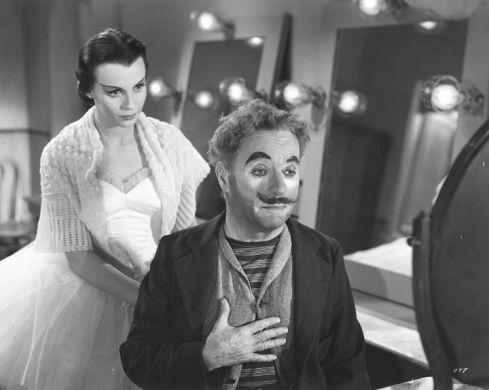
Claire Bloom and Charlie Chaplin in Limelight (1952)
Don’t tell me you missed the fact this year, this February in fact, we are celebrating 100 years of Charlie Chaplin’s Tramp. Kid Auto Races, Chaplin’s first screen appearance as the anarchic scruff, was released on 7 February 1914. It’s a cinematic centenary of the best kind – one that affords the opportunity for screenings of wonderful films and some clever-clever comment and analysis too. An event at the BFI Southbank on 4 February will add a little star power to proceedings, as well as some new insights into the Tramp and his creator.
At The Centenary of the Little Tramp David Robinson will be talking specifically about how Chaplin drew on the music hall tradition of his youth to create his signature character – and how those influences stayed with him and found a beautiful expression in the gorgeous 1952 film Limelight.
This special event marks the centenary of the birth of Charlie Chaplin’s ‘little tramp’. One hundred years ago this week the iconic character first stepped in front of the camera at the Keystone studios. David Robinson, Chaplin’s official biographer, presents his latest thoughts on Chaplin and the tramp and celebrates the launch of his new book ‘The World of Limelight,’ commissioned by the Cineteca di Bologna, which draws on previously unpublished material from the Chaplin Archive.
Robinson will be launching his book at the event and I think copies will be on sale after the talk with perhaps a booksigning too. A particularly well-informed little bird tells me that Chaplin’s co-star in Limelight, English actress Claire Bloom, will be in attendance also. In fact, Robinson’s book is dedicated to her. Here’s a little more about the book:
Limelight was first cast not as a film script, but as a long novella, Footlights, with the supplementary Calvero’s Story. Both are here published for the very first time – the ultimate raison d’être of this volume. Out of these Chaplin extracted a screenplay which passed through several drafts before being transferred to the screen.
The accompanying commentary in this volume explores the documentary reality of the world which Chaplin recreated from his memories and evoked for posterity – London, the music hall and ballet at the end of an era, the outbreak of the First World War. The book is illustrated with images from the author’s own collection, and reproductions of documents and photographs from the Chaplin archives, which clearly depict the development of the film LIMELIGHT that David Robinson so intricately describes.
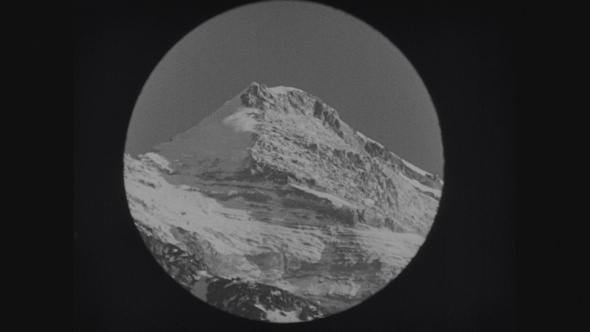
There has been plenty of chat on this blog, and elsewhere, about this fascinating, haunting documentary. Captain John Noel’s chilling film of the Mallory and Irvine’s doomed attempt to conquer the summit of Everest is a work of art, a testament to wild ambition, and a record of the prejudices and misconceptions of its era. For cinema audiences, the spectacle of the film – magnificent mountainscapes, drenched in red or blue tints – came first. Seen on the big screen, The Epic of Everest is utterly mesmerising.
So this home video release has to satisfy two camps. There will be those with deluxe home cinema setups who want to recreate the thrills of the cinema experience – and they will be happy with the high-definition transfer on the Blu-Ray disc here. The images are crisp and stable, with those beautifully rich tints adding real splendour to the scenery. But I suspect a more substantial group, knowing that The Epic will lose a little of its visual power on their TV screen, will want to go deeper into the film, will be looking for history rather than spectacle.
The Epic of Everest (1924)
Luckily the secound group is especially well-served by the presentation here. There are featurettes on the making and restoring of the film, as well as a thick booklet of essays, archive images and background information. You’ll remember that Simon Fisher Turner turned in another glacial score for The Epic – sleek, experimental themes comprising electronica and found sounds. There’s a documentary on his work here too, but just in case you’re about to slip out of the door in disgust – hold on.
The Epic of Everest (1924)
With this package, the BFI invites you to step back in time to 1924 and experience The Epic of Everest as its first audience did – well within reason. Those who buy the DVD version can download a PDF of the original programme from its premiere at the Scala, and – which may come as a surprise to a few people – you can watch the film with its original orchestral score here too. The score was recorded by the Cambridge University Chamber Orchestra and appears as an option alongside the new music, mixed in stereo. It’s less nuanced to 21st-century ears, perhaps, than the new music by Fisher Turner, but its lushness (it sounds almost like a ballet score) is totally immersive. There are some added musical snippets here too – all pieces that would have accompanied the first 1924 screening. If I had a pound coin for everyone who lamented to me that a new release of a silent had a modern score without a more “traditional” version as an audio option, I’d be able to buy a round of drinks for a full house at NFT2, so this is a welcome piece of news. Hats off to the BFI, and to Julie Brown who oversaw the reconstruction of the original music.
For more information, and to buy The Epic of Everest on DVD and Blu-Ray, please click here
This is a guest post for Silent London by noted silent cinema musicians Neil Brand and Philip Carli. The Silents by Numbers strand celebrates some very personal top 10s by silent film enthusiasts and experts.
There are more of these X-rated moments than you might think and people will have plenty of their own choices according to taste, shockability and squeamishness. By definition, all silent cinema is pre-Code and Will Hays was brought into the Hollywood fold as censor in the 1920s not just because of Hollywood’s own scandals, but because filmmakers were pursuing stronger, more adult storylines and nobody seemed to be taking the lead on what was acceptable. So, by way of giving the lie to the idea that silent cinema is somehow cinema in adolescence, here’s a list of some memorable times when the boundaries were pushed, in descending chronological order.
All Quiet on the Western Front (1930)
All Quiet on the Western Front (1930)
And yes it was also released as a silent! A soldier grips the barbed wire during an attack, a shell explodes and only his arms remain hanging from the wire. One of many unforgettably horrific images from this great film.
Diary of a Lost Girl (1929)
Diary of a Lost Girl (1929)
The brothel dance as the couples peel off to their various rooms is as easygoingly suggestive as you could want and easily more “real” than anything Von Stroheim could have dreamed of. Mind you, Louise Brooks would undoubtedly have made it into this list somewhere.
Joan Crawford and Norman Kerry in The Unknown (1927)
The Unknown (1927)
Having cut off his own arms for love of Joan Crawford (who can’t bear to be touched), murderer Alonzo (Lon Chaney) has to watch her responding sensually to the arms of a circus Strong Man (Norman Kerry) she has fallen in love with. Again, most Chaney films would qualify for this list, particularly the Tod Browning ones, for a whole different set of reasons. The Penalty, Victory, West of Zanzibar, all feature scenes or entire plotlines that would have trouble getting past the censor five years later. Meanwhile, Joan Crawford had already made at least one appearance in an extant pornographic film while still a struggling actress.
Captain Salvation (1927)
Captain Salvation (1927)
An X-certificate intertitle in which Pauline Starke screams at Lars Hanson “My step-pa ‘helped’ me once – a good thing the baby died!”
The Flame of the Yukon (1926)
The Flame of the Yukon (1926)
A fiery end for the villain in this movie (if memory serves) who is set alight by a kerosene lamp thrown at him, the flames only being quenched when he falls to his death.
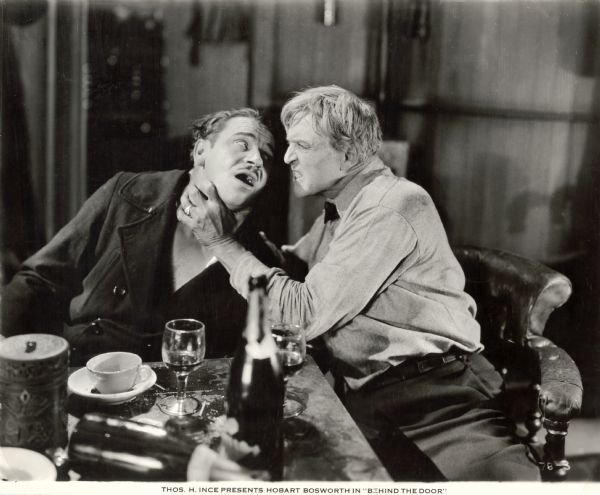
Behind the Door (1919)
Behind the Door (1919)
With memories of WW1 still fresh in the minds of audience and makers alike, this uncompromising tale of a husband’s bloodthirsty revenge on brutal German submariners who raped his wife ends with the title “I tried to skin him alive but the sonofabitch died on me!”
Intolerance (1916)
DW Griffith gave Babylon the full treatment, including a bathing orgy with lovingly shot nudes. Even more so than was the case with Cecil B De Mille and scantily clad classical maidens, Griffith seems to have demanded jaw-dropping realism and sensuality from his cast.
The Cheat (1915)
Sessue Hayakawa brands Fannie Ward in unflinching close-up, because as he puts it, he brands “all his property …”
Hypocrites (1913)
Lois Weber’s film has a quite gorgeous “Naked Truth” wandering through most of the four allegorical reels. Although this was obviously intended to edify rather than titillate, audiences were unlikely to have been as artistically mature about this as Weber might have hoped. Mayor James Curley of Boston supposedly insisted that clothing be painted on her in every frame in order to get the film past the city censors.
An Interesting Story (1904)
A man gets run over flat by a steamroller in James Williamson’s An Interesting Story – OK, two cyclists inflate him back to life again, but think what a shock it would have been to audiences of the time!
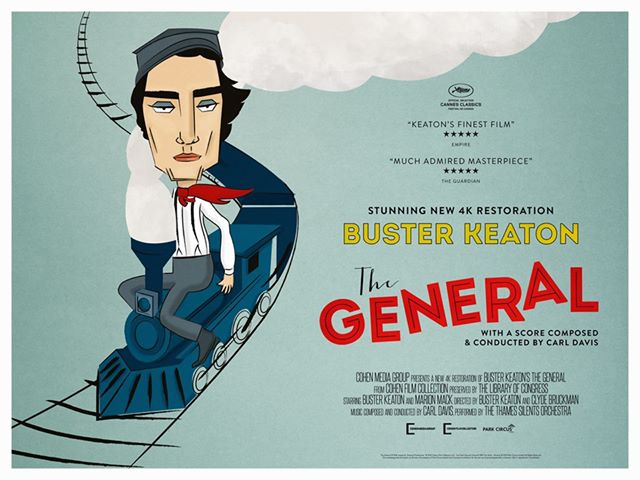
Buster Keaton’s The General (1927) goes on theatrical release this Friday – which should be cause for celebration and mass ticket-buying among all of you. However, if you are a regular reader of this blog, you have probably seen this classic, poll-bestriding Civil War caper before, very possibly in the dim and distant. What worries me, what keeps me up at night, is that if so, you may feel a bit “so-whattish” and “seen-it-all-beforeish” about Keaton’s masterpiece. That would be a tragedy, as The General is one of the funniest, most ingenious and gosh-darn exciting films you will ever see in your long and happy life. If familiarity has bred a touch of contempt, or just complacency, in your bosom, I would gladly bend your ear about the pin-sharp 4k transfer, and the booming rendition of Carl Davis’s nimble and turbo-charged score on this digital print. But that geeky stuff isn’t for everyone, so if that doesn’t tempt you, here are five more reasons to see The General … again.
The early, funny stuff
So we all know The General as a chase film, packed with stunts and crashing locomotives. Well, it actually starts in a very sedate fashion, as our hero Johnnie (Buster Keaton) goes to visit his girl Annabelle, who prompts him to enlist and fight for the South. Patience is a virtue – don’t be in a rush to get to the fast and furious business on the tracks. Johnnie’s pratfall as he leaves Annabelle’s house, the beautiful recruiting-office sequence and that wonderful selfie of Johnnie and his other beloved are all worth arriving at the cinema nice and early for. The scene-setting opening ends with one of the quietest, but most dangerous stunts in the whole movie, as Johnnie perches forlornly on the coupling rods of a locomotive that is picking up speed …
Annabelle Lee
The General‘s Southern belle is far more than a damsel in distress. To be frank, she’s a pain in the neck – watch her daintily selecting firewood and feel Johnnie’s pain. But to be fair, she takes more than her share of punishment too: kidnapped, soaked (twice), caught in a bear trap, stuffed into a sack and loaded as freight. Not only that, but consider this: to paraphrase Ginger Rogers, you try doing everything Buster Keaton does, but backwards and in a crinoline.
There is another reason to take note of Annabelle – she is played by a fascinating woman. Marion Mack knew more than most about the silent movie business. A former Mack Sennett Bathing Beauty, she later turned her hand to screenwriting, including a semi-autobiographical flick called Mary of the Movies, which she also acted in. In the the 30s, she even wrote a talkie short for Keaton. And when critical favour began to smile on The General in the 70s, she was on hand to speak at screenings and festivals, explaining what it was like to play one of Keaton’s not-so-straight women. We don’t have opportunities like that any more, so thank you Marion.
Yes, that is a real train
The one that falls through the burning Rock River Bridge? Yup. It’s not a model (you’re thinking of The Blacksmith). And if you thought it was CGI – shame on you. Famously, the destruction of the train in The General is the most expensive shot in silent movie history, and it’s a salient reminder that everything you see on screen here is real – including the danger that Keaton and Co frequently faced as they went about those wild stunts.
Those damn Yankees
Marion Mack isn’t the only thing here that gives us a flashback to Mack Sennett’s mid-teens romps. Those Yankee soldiers giving chase to Johnnie and Annabelle are enjoyably, hilariously inept. Hoot as a whole gaggle of them fail to fix the points our man has so thoroughly snookered, until their driver appears with a an axe and a shove; chortle as they topple like dominoes with every jolt of the engine. These buffoons are Keystone Kops in all but name. A guilty pleasure in a very sophisticated film.
War is hell
It’s not all larks and big kids playing with big train sets, of course. The General is a war movie, based on a true story – the hijacking of a train headed for Chattanooga, Tennessee. And it’s easy to forget that The General has a rather grim battle scene of its own, with swords and snipers and several deaths. Even the jokes fail to lighten the mood here. The flag gag, in which Johnnie grabs a confederate pennant from his falling comrade’s hand, and waves it in victory from a rocky outcrop, only to discover he has seriously misplaced his feet, is an unexpected splash of black humour. It’s a nifty moment that sharply undercuts any jingoistic vibes you may get from this story of a plucky underdog and his little engine that could.
Bonus reason
If you see The Generalon its extended run at BFI Southbank, it will accompanied by Keaton’s sublime early short One Week. If you were to ask me, right now, which of the two were the better film, I would have to say … “tough call”.
This is a guest post for Silent London by Alison Strauss, director of the Hippodrome Festival of Silent Cinema, Bo’ness. The Silents by Numbers strand celebrates some very personal top 10s by silent film enthusiasts and experts.
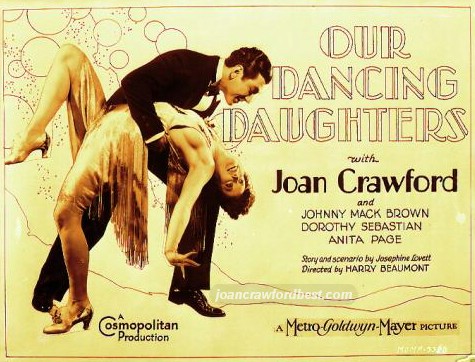
Our Dancing Daughters (1928)
Our Dancing Daughters (1928, Harry Beaumont)
The moment when fun-loving flapper Joan Crawford launches herself on to the dance floor and sets the party alight with a high-tempo Charleston, ripping her skirt to a more liberating length as she goes.
Danse Serpentine (1896, Auguste and Louis Lumiere)
The 45-second kaleidoscopic record of a vaudeville dance – created by pioneering dancer Loie Fuller – in which an anonymous performer elegantly whirls her arms in the long-flowing fabric of her costume to mesmerising effect, thanks to the immaculate hand-tinting work of the Lumiere Brothers’ army of finely skilled women behind the scenes.
Pandora’s Box (1929, Georg Wilhelm Pabst)
Trained dancer and former Ziegfeld Follies girl, Louise Brooks is electrifying as Lulu, especially when, with all eyes on her, she takes to the floor at her own wedding with yet another admirer – a female guest – and the pair dance in a sexually charged vertical embrace.
The Four Horsemen of the Apocalypse (1921, Rex Ingram)
Another raunchy tango, this time with Rudolph Valentino in a sequence that launched him as a legend. The woman in Julio’s arms submits to his overpowering masculinity in this iconic routine that set the standard for all subsequent movie tangos.
(Watch from 14 mins, 50 seconds)
That’s My Wife (1929, Lloyd French)
Stan Laurel is persuaded by Oliver Hardy to masquerade as his wife in order to secure the bequest of a rich uncle. In one of the funniest sequences Stan, looking lovely in an evening gown, dances the two-step with Ollie in an effort to shimmy a stolen necklace down through his undergarments!
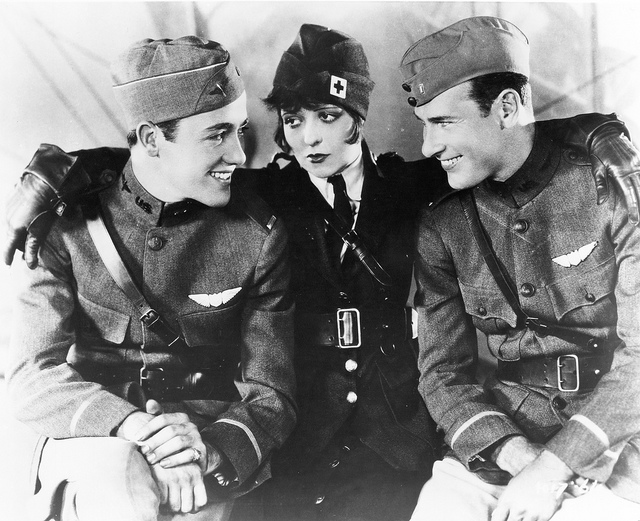
Richard Arlen, Clara Bow and Charles Rogers in Wings (1927)
This is a guest post for Silent London by Alex Barrett.
Long legendary as the first – and only – silent film to win an Academy Award for Best Picture (at the very first ceremony, back in 1927), Wings now comes to us in a stunning new restoration, courtesy of Eureka’s ever-dependable Masters of Cinema label. The film tells the story of Jack (Charles “Buddy” Rogers) and David (Richard Arlen), who compete for the affections of Sylvia (Jobyna Ralston), before becoming comrades in the airfields of World War I. Star power was added by the original “It girl”, Clara Bow, in the role of Jack’s neighbour, Mary – the pure-eyed girl next door with an undying love for our hero.
If this setup – minus the Mary strand – sounds familiar to silent film fans, it’s perhaps due to a striking similarity to the setup of Abel Gance’s J’accuse (1919), in which two rivals in love become comrades on the battlefields of World War I. However, if the overall plot of Wings at times resembles that of J’accuse, it does so without that film’s stringent anti-war message – and without its power.
Richard Arlen and Jobyna Ralston in Wings (1927)
In Wings, we are often told of the “horrors” of war in the title cards, but rarely do we see them. Even towards the end, when the body count begins to rise, it never feels as if we’re given a true sense of the barbarity of war. Compare, for instance, the lightness of the scenes detailing the cancellation of the soldier’s leave with the devastating impact of the equivalent scenes in Raymond Bernard’s Wooden Crosses, released just five years later. The closest Wings gets to touching upon this darkness is its final tragedy, but even there the film doesn’t quite hit home, despite the characters explicitly saying that the “war” is to blame. Wings was made with the assistance of a military in need of good PR, and perhaps it’s this that led to the film becoming a paean to the “young warriors of the sky” (as with J’accuse, real soldiers acted in the film, many of whom had seen service in the Great War). It’s a fine tribute to those who fought but, in being so, there remains a whiff of propaganda around the film’s portrayal of the chivalric life of these “knights of the air”.
This is a guest post for Silent London by Paul Joyce, who blogs about silent and classic cinema at Ithankyouarthur.blogspot.co.uk. The Silents by Numbers strand celebrates some very personal top 10s by silent film enthusiasts and experts.
Cinematic dreams are a staple of the silent era more than any other, possibly because much of what was on screen had only previously been experienced in dreams for contemporary audiences. Now our dreams are founded on over a century of cinema and we’re so much harder to impress but … we can still dream on. Here’s a top ten of silent dreams with a couple of runners up as a bonus.
The Astronomer’s Dream (1898)
A madly inventive three minutes from George Méliès in which an old astronomer is bothered by a hungry moon as the object of his observation makes a rude appearance in order to eat his telescope.
Dream of a Rarebit Fiend (1906)
A feast of special effects in Edwin S Porter’s cautionary tale on the matter of over-indulging in beer and cheese. Jack Brawn plays the titular fiend who suffers all manner of indignities once he staggers home to his bed, whereupon his sleep is interrupted by rarebit imps and his bed flies him high into the night sky … Proof that the whole cheese-and-dreams rumour is actually true.
Atlantis (1913)
Atlantis (1913)
In August Blom’s classic – the first Danish feature film – Olaf Fønss’ doctor dreams of walking through the sunken city of Atlantis with his dead friend, as the passenger ship he is on begins to sink. It’s either a premonition or recognition that his true feelings have been submerged … JG Ballard was obviously later inspired to write The Drowned World.
Poor Little Rich Girl (1917)
Poor Little Rich Girl (1917)
After being accidentally overdosed with sleeping draught by careless servants, Mary Pickford’s character falls into a deep and dangerous sleep … As she hovers on the edge of oblivion the story runs parallel between the doctor trying to save her and her dreams in which those she knows are transformed in her Oz-like reverie. Sirector Maurice Tourneur excels as “the hopes of dreamland lure the little soul from the Shadows of Death to the Joys of Life”.
When the Clouds Roll By (1919)
When the Clouds Roll By (1919)
Douglas Fairbanks is harassed by vengeful vegetables after being force-fed too many in an effort to drive him to suicide (yep, it’s a comedy). Directed by Victor Fleming, who later returned to dreams with Dorothy and that Wizard. Continue reading The top 10 silent film dream sequences→

















 Silent London