Just a short note to share some information about a conference I am looking forward to, so that you can also save the dates, and so that I can pass on the call for papers.
The twelfth Women and the Silent Screen conference will take place in Brussels and Antwerp next June. It will be hosted by Université libre de Bruxelles, University of Antwerp, and Cinematek, and will take place 11-14 June 2025. As Anke Brouwers, one of the organisers, Anke Brouwers, pointed out at the Women and Film History International meeting in Pordenone last week, just think of the waffles! And the chocolate, the beer, the frites…
It’s supposed to be big mystery: what do women want from a romantic partner? But there is no mystery at all. GSOH every time. That’s good sense of humour, of course. So if you’re in anyway romantically inclined, you’ll already be asking yourself: what is the FUNNIEST way I can celebrate Valentine’s Day next year.
If you know you know that Slapstick Festival celebrates visual comedy in all its forms. But that include silent cinema and there are especially strong offerings on that score this year, including lashings of Buster Keaton (with expert Polly Rose on hand to guide you through his work), including the gala screening of Steamboat Bill Jr. (1928), accompanied by the European Silent Screen Virtuosi, led by Günter A. Buchwald, on the Friday night at Bristol Beacon. Plus Harold Lloyd, Sarah Duhamel, Laurel and Hardy, Charlie Chaplin, WC Fields, and lots more.
A confession. I was conspiring over breakfast, and reader, this was a two-cappuccino problem. The upshot? I was a little late in getting started with the screenings today. But I certainly knew that I was going to be up late, with the gala… and the end-of-festival celebrations!
My sunny morning stroll to Cinemazero was rewarded with a simply terrific film from Uzbekistan. In Her Right (Grigorii Cherniak, 1930), a group of workers from the collective farm are sent to the factory to boost the workforce there, and to learn those valuable Soviet methods. One woman from the village defies her husband and sheds her burqa to join them. It’s a life-changing experience and not only does she gain independence through work, but she inspires others to do the same, through a filmed speech, that the workers clamour to watch, even after he enraged husband slashes the screen. Even with her “throat” cut, in a silent film, she continues to speak her truth. So you have noted already that this is once again pro-Soviet, anti-Islam propaganda in intent, but this is also a remarkable film in style and action. Our Hollywood friends would applaud the excellent, and indeed poignant, action sequence in which our heroine runs to jump on the train to the factory, is repeatedly shoved away by male guards and then, when it seems she has finally found a helping female hand, her husband leaps – for a second we think he has dragged her form the moving train, but no, he only has her coat in his hands. Nail-biting stuff. And the scene in which they watch the film is also very strong. Günter Buchwald at the keys for this one, keeping the energy at exactly the right pace.
Blood, sweat and tears on the screen today. And to cap it all off, prizes! That’s Friday in Pordenone, folks. Read all about it.
Your scribe is a little squeamish, I must confess, so this morning I had to resort to an old trick, and pop my glasses off during some of Arabi (Nadezhda Zubova, 1933), a drama about sheep farmers organising to form a collective and defeat the feudal powers that exploit their labour under the old system. That doesn’t make me squeamish, I’m all for it – it was the killing and skinning of lambs that turned my stomach. Still, I thought this was terrific, with some very sharp editing, especially in the opening sequence, and lovely low camerawork of the herd out in the field.
Wouldn’t you like to go Behind the Scenes with DW Griffith and Florence Lawrence? I sure would, that’s why I was bright and early at the Verdi this morning for the 1980 Biograph package. Behind the Scenes, per the catalogue is the “happy exception” among the 1908 output. Well it certainly had punch. A distraught mother must tear herself from her daughter’s sickbed to kick her heels and shake her hips on the vaudeville stage to earn a crust. But as the crowd roars out for an encore, her baby girl is slipping away from this life; Grandma rushes to the stage door… If “too late!” is the essence of the melodramatic narrative then this was a textbook case. We stayed to see Lawrence reappear as the titular character in The Red Girl, in which a collection of ethnic stereotypes conspire to rob a “girl miner” but Lawrence defies racist convention to lend a hand instead. Impressive to see Lawrence Harry Houdini her way free after being tied up and dangled over a precipice above the rushing river. Extra exciting with John Sweeney at the keys, of course.
Sometimes the old songs are the best, right? Familiarity can breed contentment. And nowhere will you find more consensus on that than here in Pordenone. So today I was happy to rewatch a couple of silent films I love, spend a little time with one of my all-time favourite silent stars. And then see something entirely new to me!
First, the old friends. This morning, we ventured back into the imaginations of Maurice Tourneur, and Ben Carré, with the 1918 adaptation of Maurice Maeterlinck’s The Blue Bird. Such a strange and beautiful, terrifying and wholesome journey into the shadow world of dreams, where bread and sugar and water have souls, the dogs and cats can talk, lost grandparents always have the table set for supper and babies wait impatiently to be born. If you have not seen this, you possibly can’t imagine quite how weirdly pretty it is. Variety’s critic wrote: “It is quite safe to assert that nothing quite like Director Tourneur’s work has ever been shown on the screen.” So hats off to Tourneur and Carré, and doubly so to Neil Brand and Elizabeth-Jane Baldry, who transported us to an enchanted realm with their music. I wrote about the film in more detail here, should you be interested.
And verily, on Tuesday, the fourth day of Le Giornate del Cinema Muto, the rains came down upon us. And things got quite soggy inside the theatre too, what with Mary Pickford nearly drowning in the hold of her own houseboat in Pride of the Clan, a parcel of wonderful underwater films in the early afternoon, and a wild ride to Neptune’s kingdom to close the day.
Before the rain began, I spent a couple of rapt hours in the Canon Revisited strand this morning. Carl Th Dreyer’s Leaves From Satan’s Book (1920) travels through the centuries with God’s Fallen Angel, who is doing his evil work among humans who prove reliably weak in the face of temptation. Surrendering one’s soul to sin is not to be advised, but surrendering oneself to cinematic greatness – that is a balm for the ills of the modern age. This is a film of deceptive subtlety, and slow-burning excitement. The camera stays still so long that when it moves, the moral universe tilts. The austerity of the first, biblical sequence gives way by degrees to a faster editing rhythm, and cutaways to sympathetic details, a flock of geese, a cat toying with a mouse, a baby in her crib. Soon we’re in action thriller territory as we finally wash up in Finland in 1918, via the Spanish Inquisition and the French Revolution. Dreyer, being Dreyer, the faces, not least of Helge Nissen as the shape-shifting Satanas, carry boundless weight. It’s a masterpiece, an early one, from a man who made much better films, even, but still. And yes I am smug about having watched it with John Sweeney’s soul-stirring accompaniment, which likewise knew when to hold back and when to rush forward through the ages.
I promise you, I really am in Pordenone, not in Paris. But honestly, the geography is becoming a little subjective. We seem unable to escape the Rive Gauche for long. This morning, a really quite exceptionally taut melodrama from Louiis Feuillade, with sets,of course, by Ben Carré, illustrated how the Latin Quarter exerts its own gravitational pull, morally, if not physically. In La Tare (1911), part of Feuillade’s “La Vie telle qu’elle est” (Life as It Is) series, Renée Carl gave a really beautiful performance as Anna, who works in the dance halls of the Latin Quarter, but given the chance, moves to the South of France and devotes herself to a new career caring for patients young and old in a nursing home. Ah, but cruel fate intervenes and a medical student who used to tap her for cash in the Paris days, takes it upon himself to inform the medical board that their “secular saint” is really a “girl of easy virtue”, sooner than you can say “Madonna-whore complex”. And so we are left with a tragic, yet ambiguous ending, following a rather harrowing scene in the unemployment office with a crowd of women, all of whom had remarkable faces (no, not Léontine, I don’t think, but maybe this is the kind of place where she might be found). A very special film, enhanced, naturally, by John Sweeney’s sensitive accompaniment.
“They’re eating the dogs. They’re eating the cats.” Proof, if proof were needed, that the American people saw through such anti-immigrant propaganda more than 100 years ago, comes in Dee-Dubya’s 1908 New York comedy Deceived Slumming Party – our first film of Sunday morning. Fraudulent tour guides promise show rich tourists the gritty realness of Chinatown and the Bowery, but the trick is, it’s all staged. Everyone in the opium den was upright and chatty before the tour group arrived, in fact, the barroom fights in the Bowery are choreographed by the bartender (DW Griffith himself) and the “meat grinder” in the Chinese restaurant kitchen, the one that the staff are “feeding” with cats and dogs and rats, is nothing but a sham.
Rich kids slumming it in Chinatown, you say? Hold that thought while we segue from comedy to melodrama, in the shape of Driven from Home (James Young, 1927), which yanked and yanked and yanked at the heartstrings with poor Virginia Lee Corbin disowned by her wealthy father after she married for love, although her devoted mother (Margaret Seddon) was on her deathbed and calling out to see her baby once more. Add to this a subway excavation accident, a scheming vamp housekeeper (Virginia Pearson), and you might not think there was room for an excursion to the Chinatown underworld but you would be wrong, as this film was playing in the Anna May Wong strand. So indeed here we witnessed a scant five minutes of Anna May Wong, as a Chinese restauranteur’s “legal wife and illegal accomplice” radiating more star power than the rest of the rest of the (perfectly good) cast could ever dream of. We understand this is a racist trope, yet it is quite nifty to think that on the evidence of this year’s Giornate, in any given situation, Anna May Wong can locate a secret door in seconds.
Grey skies clung to the Verdi this afternoon but you can’t put a dampener on a homecoming like this one. I’ve been to several festivals this year, but nothing really compares to the Giornate. And our hearts were warmed by festival director Jay Weissberg’s words of welcome, in which we pointed out how vital it is, these days more than ever, to cherish these events that bring people together in a shared endeavour.
Today was a day of varying shades and two colour schemes. We had a couple of stonking great classics. And also a slate of fragments, curios, oddities and ends – several of which had their merits, albeit in their own unconventional way. In fact, a certain aura of strangeness hung over the whole day, which you might attribute to the unseasonal weather, but I am partially putting down to the after-effects of watching Megalopolis last weekend.
This is an extended and adapted version of a contribution I made at the 2024 Domitor conference in Vienna. I spoke as part of a roundtable on Curating Early Cinema Today, chaired by Maggie Hennefeld. Full details of the roundtable are at the end of this post.
————-
Media history is doomed to repeat itself, first as travesty, then as art. I’m kidding, but only a little. Here are some thoughts on why early cinema is trending in the 21st century, why I am writing this blog, and perhaps, why you are reading it.
Since the digital transformation of the film industry at the turn of the 21st century brought with it a new surge of creativity and of anxiety, through the rise of audiovisual social media, from YouTube to TikTok and to the dawn of AI, we are living in an age of constant new-media excitement, and panic. These mew forms of communication belong to youth; to older eyes they appear baffling, and probably dangerous. In this state of anxiety and attraction, we have much in common with the spectators of early cinema in the years following the turn of the previous century. Our new platforms, expressly suited for exhibiting the “cinema of attractions”, have created their own stars, and genres. And just like our ancestors sharing in global astonishment at Charlie Chaplin, Asta Nielsen, or Max Linder, we experience anew the enhanced possibilities of mass communication, best expressed by the world-shrinking concept that is “going viral”.
Caroline Golum’s excellent article ‘Cinema Year Zero: Tik Tok and the Grammar of Silent Film’ (Mubi Notebook, 25 February 2021) aligns the fixed-camera, stop-and-start-editing and subject matter of TikTok with the mechanic and style of early cinema. I think her analysis is sharp, and I highly recommend the piece. It strikes me, though, that the best way to describe TikTok, or any new-media platform, from Medium to BlueSky, is to be alert to its specificities as much as to its similarities with other media.
Therefore we should say that while TikTok has much in common with early filmmaking, it is defined by its Chinese ownership, by the portrait-phone aspect-ratio, the placement of screen furniture, the captioning and comments functions, the use of memes and lip-sync comedy, the proliferation of shared music clips and the technique of stitching, an extension of the repost or quote function on other platforms. That it has become a natural home for both infuencers and brand promotion, so has a prominent place in the history of advertising media in particular. We can say that very much unlike early film it is tailored to a single spectator, handheld close to the eyes like a book, not aloft like a projection, and that the scrolling process, with its minimal interaction for maximum content, has more in common with the disaffected channel-hopping of the over-stimulated TV viewer than with cinema exhibition. That the algorithm that fuels the For You Page is similar to social feeds on eg Facebook, but has its own, sometimes, mysterious and ruthless methods[1]. That TikTok is TikTok, and also a collation of concepts from other media. Just as early film has its roots in optical toys, photography and the magic lantern, among other “pre-cinema” objects, and is also its own, glorious invention.
TikTok’s likeness to early film may not persist. Already it is facilitating longer videos, live streams and more complex editing. Time is ticking. And as is already apparent, these new-media platforms tend to drift from sanctuaries for short-form content to incentivising longer formats with advertising revenue. The most talked-about video on YouTube right now is a four-hour vlog about the ill-fated Star Wars hotel (currently on eight million views). At first populated by singular entrepreneurs and creative amateurs, the platforms tend to become colonised by companies who capitalise on the new media and align it with corporate structures. The new platform’s heyday is fleeting, the audience adjusts or moves on, and the cycle begins again.
Asta Nielsen in Hamlet (Svend Gade, Heinz Schall, 1921)
Which brings us here. In 2010, after the first social media revolution had taken place, I founded this website, a blog called Silent London. Its stated purpose was to collate listings for silent film screenings in London, its broader intent was to share the love of silent cinema, though this, it soon became apparent, was pushing at an open door. The modus operandi was not to copy out texts from history books, but to acknowledge that there is an audience for silent cinema right now, who may be new to the subject, whose reason for viewing is not research or scholarship, and may not be motivated by a film’s place within the canon, nor its relationship to canonical filmmakers. They enjoy early and silent cinema for its own sake. Silent cinema is, among many other things, an evening’s entertainment. Its importance does not only reside in its centrality to film studies textbooks.
The readers of Silent London, I have learned over the past decade and a half, encompass scholars, archivists, filmmakers and other practitioners in related fields. But primarily, this blog speaks to cinephiles: moving-image hedonists, who enjoy silent cinema as part of a varied filmic diet. Which is not to say that silent film screenings are not special. The collective frisson of silent cinema spectatorship, an audience’s imaginative leap towards the screen, the dynamic energy and emotional emphasis of live accompaniment – Silent London readers revel in these pleasures. While we respect the work of the archivists and scholars who facilitate these screenings, Silent London exists within the space of contemporary film culture. And so, increasingly, does silent cinema itself. More and more, we recognise the aesthetics and technique of early and silent film bleeding from the archive into freshly minted contemporary cinema. The connections between films of all eras crackle in our minds and in the imaginations of the filmmakers we love.
So I try to erase the time distance. I write about early films not because they are old, but because they are so young. I don’t talk about old movies, but young cinema, those films that were made when the medium was new and its possibilities had not been fully mapped out. Young films do not yet have histories, but are bursting with faith in the future of the medium[2]. They have this in common with the best of contemporary cinema.
I take this approach when writing elsewhere on early and silent film, and as a critic I am also witness to the prevalence of silent cinema aesthetics in new films. Increasingly this phenomenon is my pet subject, especially in my monthly column for Sight and Sound (The Long Take), and on the tab on this site labelled “At the Talkies”. Related but not quite the same: for a while, Pete Baran and I hosted The Sound Barrier, a podcast devoted to finding connections between new releases and the silent archive – it was vastly enjoyable to record.
Tabu (Miguel Gomes, 2012)
Visual storytelling abounds in cinema, but sometimes the references are more specific, the commitment to ditching dialogue firmer. You can take any one of a number of examples, from the Oscar-winning faux-silent The Artist (Michel Hazanavicius, 2011) to dialogue-free animations The Red Turtle (Michaël Dudok de Wit, 2016) and Robot Dreams (Pablo Berger, 2023), the elevated pastiches of Guy Maddin and the hands-on archival adventures of Bill Morrison, who takes silent cinema’s materiality as his central subject, to the traces of silent cinema style in the arthouse films of say, Miguel Gomes (Tabu, 2012, Grand Tour, 2024) and Alice Rohrwacher (Le Chimera, especially). Next week at Il Cinema Ritrovato in Bologna, Rohrwacher will be in dialogue with Juho Kuosmanen on the subject of The Future of Cinema (Silent) – and naturally, I have a ticket for that conversation. The best film of last year, Jonathan Glazer’s The Zone of Interest, was essentially a silent film and a sound film, playing at the same time. The director has said as much himself, and that he has harboured aspirations to make a full silent film. The Fall (2019), covered on this site, was one short-form venture into the form. Or something like it.
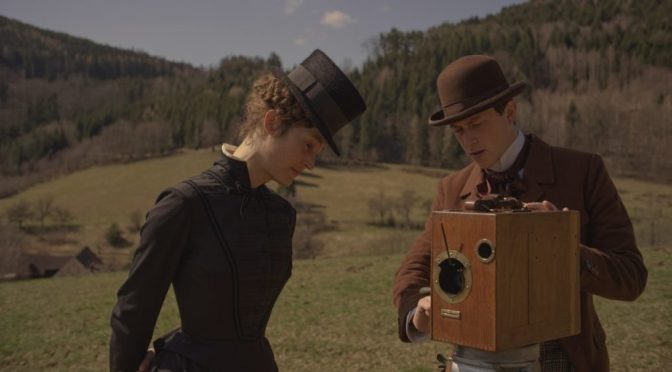
But is it really a silent film, quiz the sceptics? This question is mostly beside the point. The postmodern magpie impulse leads us away from purism and into remix culture. We recently welcomed the re-emergence of Musidora via the revival of Irma Vep on TV with Alicia Vikander, following Olivier Assayas’s 1996 film of the same name starring Maggie Cheung[3]. I would love to your draw your oversubscribed attention to the mischievous appearance of Louis Le Prince as a supporting character in Marie Kreutzer’s Corsage (2022, pictured above) – improbably wielding a reel of celluloid and giving the young Empress Sissi an opportunity to express herself in a medium of self-portraiture far removed from the formality of a court painting in oils. The mechanics of an early film apparatus in the service of the imperial selfie. Young cinema references live again in gleefully anachronistic contexts.
Irma Vep (Olivier Assayas, 1996)
As has been remarked before, this is happening alongside an explosion in the availability of early and silent film on DVD and Blu-ray, even on streaming platforms, and the growth in archive cinema festivals. These things are clearly related. We might trace this “silent film revival” back to the centenary of cinema celebrations in 1995, which reminded us all over again of cinema’s youth, the compelling beauty and strangeness of early film – the century looping back on itself like a reel.
So there are intellectual and practical reasons for the persistence of silent cinema style. But I would argue that there is also an emotional pull, drawing us back to the first decades of filmmaking. This is counter intuitive. When Billy Wilder made Sunset Boulevard (1950), and Stanley Donen made Singin’ in the Rain (1952), the memories of the silent era, and the fraught transition to sound, were still relatively fresh, barely a generation away. The filmmakers were excavating their own youth, their own back catalogues. Conversely, no one living today feels genuine nostalgia for the early film period. We don’t remember that far back.
However, I think there is a connection. We yearn for the new media excitement of ten or twenty years ago or more – the same sense of a moment captured in time emerges when we look at both. Whether the form in question is MySpace or Vine or YouTube vlogs, Facebook pokes, gifs, hashtags or Boomerangs. Ah, the days of landscape-oriented video. Or that particular format, the music video, corralled into an immersive exhibition practice called MTV and genuinely ubiquitous, now still as glamorous and sometimes expansively produced, but streamed singly online, or relegated to a “background screen” in a bar or hotel foyer. Who remembers renting a VHS, home-taping a movie off-air, or covertly watching a “video nasty”[4]? Laser discs, even. Or simply broadcast TV, in a choice of three or four channels. We have always been watching, and experiencing newness and loss.
Decasia (Bill Morrison, 2002)
Remember how we discovered, studied and adapted to the new forms, found ways to use them for our own amusement, our own conversations? We have become adept at learning to love and then learning to move on, from new media. The Artist, just like Sunset Boulevard, takes the loneliness of standing still while the world turns to a new novelty, as its central theme. Decasia, with its once carefully crafted images engulfed by decay, expresses this bereavement without saying a word. Sometimes, rarely, we find a form and stick to it, in defiance of fashion. Why is this blog still a blog, and a WordPress-hosted blog at that, when my peers have migrated to Substack, or pivoted to video? I must be old-fashioned, I guess, or simply nostalgic. Hands up if you remember when this site began, perversely on Tumblr? Or when Twitter – a platform that persists even now, but under a new name, with dangerous new rules, and diminished engagement – was integral to its growth?
When we look at early film we recall the ephemerality of once-new media: so many young cinemas, and one powerful pang. The joy of novelty and movement, experimentation and awkwardness, of discovery and reorientation and then the inevitable shock of absence. We understand the connection between our modern screen culture, and the early film period – but more importantly we feel it too. New media forms demand and swallow our attention, but their content is easily lost, and their existences short. This emotional link, as well as the artistic expressions that it provokes, is a rebuke to the idea of linear history. This is fine, because cinema time is always instantaneous. And cinema will always find a way to stay young. For a multitude of reasons, we are living in the silent film revival, and I find myself racing to document it.
Early cinema is trending in the 21st century, but how are we going to make the most of it?
Why “early cinema” in the twenty-first century? Over the past several decades, there has been a global revival of silent film culture—from international festivals and archival research collectives to popular podcasts, blogs, and social media fandoms. Passionate communities of students, scholars, archivists, curators, artists, and musicians have rallied around the resurrection of movies made over a century ago. But what is the specific appeal of “early” cinema—as an aesthetic form, experimental impulse, and historiographic gambit—toward bringing silent film culture into contact with the possibilities and crises of the present? New media pose irresistible parallels with early film exhibition practices, epitomized by the recurrence of viral temporal loops and attraction-based spectacles. Yet there are logistical challenges to curating early films (which are often very short) as opposed to feature-length works. Beyond material considerations, how do the uneven politics of visibility and representation in early filmmaking (its radicality and racism, for example) speak to feminist, queer, decolonial, anti-racist, and other social justice movements today? Digitization has made the early film archive widely accessible—but unmanageably plentiful. Its contents encompass 4k nitrate scans, physical media collections, curated streaming databases, and the unmoderated recesses of YouTube and TikTok. How best to give method to early cinema’s madness by concocting playful, new conceptual categories for thematic and speculative curating? Most importantly, who are the audiences for early cinema today (beyond the usual suspects) and how can we (early film evangelists) work together to identify, curate, and contextualize an evocative range of programming and syllabi that will bring new publics into the fold?
Silent London will always be free to all readers. If you enjoy checking in with the site, including reports from silent film festivals, features and reviews, please consider shouting me a coffee on my Ko-Fi page.
[1] For a commentary on the capitalist realities behind the apparently hobbyist jollity of TikTok comedians, see Maggie Hennefeld, Death by Laughter: Female Hysteria and Early Cinema (Columbia UP, 2024)
[3] This excellent film was my gateway into a lifetime of silent film fascination
[4] Film such as Prano Bailey-Bond’s Censor (2021) appeal to this nostalgic itch, just as clearly as The Artist appeals to those who admire the aesthetics of silent Hollywood.
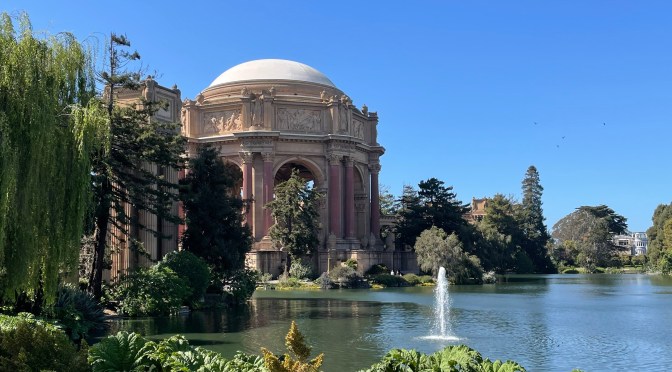
I was looking for Yoda when I bumped into Eadweard Muybridge. These are the circles film history moves in. This year’s San Francisco Silent Film Festival, the 27th, took place in the grandeur of the theatre of the Palace of Fine Arts, an elegant neo-classical folly of gigantic proportions, built as a temporary attraction for the 1915 Panama-Pacific Exposition and then rebuilt in more permanent form 50 years later. Here, time is a pretzel. Like the architecture, cinema becomes both ancient and the modern: live performances of century-old works.
Before the films began, I ventured just a few yards from the Palace for a guided tour of the LucasFilm building, home of some of the film industry’s most cutting-edge special effects and beloved animatronic characters. Case in point: our meeting point was at the Yoda Fountain, just in front of the of the offices, a thrilling rendez-vous for anyone’s inner child. That’s when my jet lag and a tendency to meander led me to take a wrong turn into the 19th century, and the statue of Muybridge, the photography pioneer who discovered the secrets of motion in a series of still frames – cinema in its simplest form. Born in Kingston, Surrey, Muybridge began his photography career in San Francisco, and the city is justifiably proud of his work and its legacy. Somehow, my sense of direction led me right back where I started from.
I may be a humble blogger typing at my desk, but just imagine I am a glamorous celebrity cracking first-rate jokes while wearing a designer ballgown. I have counted the votes, and I am ready to announce the winners of the Silent London Poll of 2023!
Congratulations to all the people mentioned below – as ever, these categories were bursting with great nominations. Thank you for all your votes, and your comments, which remind us all of the passion for silent film out there.
Without further ado, let me open this giant stack of golden envelopes. Here are your winners.
1. Best orchestral silent film screening of 2023
Your winner: Stella Dallas (Henry King, 1925), with a score composed by Stephen Horne, orchestrated by Ben Palmer and performed by Orchestra del Teatro Comunale directed by Timothy Brock, in the Piazza Maggiore Bologna, as part of Il Cinema Ritrovato
I said: “Before Monday night’s screening of the original 1925 adaptation of Olive Higgins Prouty’s weepie, some people in Bologna were still dropping the names of Barbara Stanwyck and King Vidor. After Monday, the talk of the town was only Belle Bennett, Henry King and Stephen Horne, whose marvellous score, alongside Bennett’s impeccable performance, left the piazza awash with tears. Horne has long championed this film, as have I, and the new restoration from MOMA is a very welcome, and beautiful thing. I really hope more people get to see this wonderful film now. Silent melodrama really can be the very finest melodrama.”
Honourable mention:Lady Windermere’s Fan (Ernst Lubitsch, 1925), at the same festival, with Timothy Brock’s new orchestral score.
The Crowd (King Vidor, 1928)
2. Best silent film screening with a solo musician or small ensemble of 2023
Season’s greetings Silent Londoners. It’s that time of year when we like to look back at the year, and especially at all the great silent movies we watched.
2023 was a busy year. We had in-person and online film festivals, seasons, screenings and conferences, some fabulous new restorations, discs and some big anniversaries. We had new books and DVDs to enjoy. I was a little distracted, but the silent film scene was booming.
Summer is here, and term is nearly out. For the readers of this blog I guess this means a few different things. Some of you are packing your bags for Bologna right this minute. Me too, as soon I finish writing this blogpost. Apart from that, the long summer days send a signal to your brain that in one scenario screams: holiday! Or in another, it whispers tactfully: time to get that project done.
Myself, I am very much in the second boat. I have a book to research and write BP (Before Pordenone). More on that anon. But the Silent London blog is about unity and harmony and what not, so I have a recommendation for all of you, whether your summer is all about reading on the beach or at a library desk.
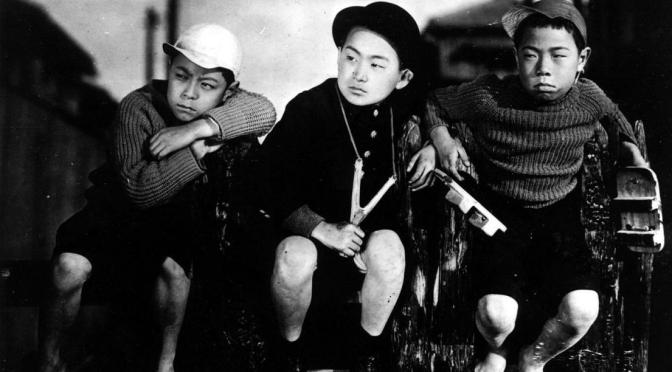
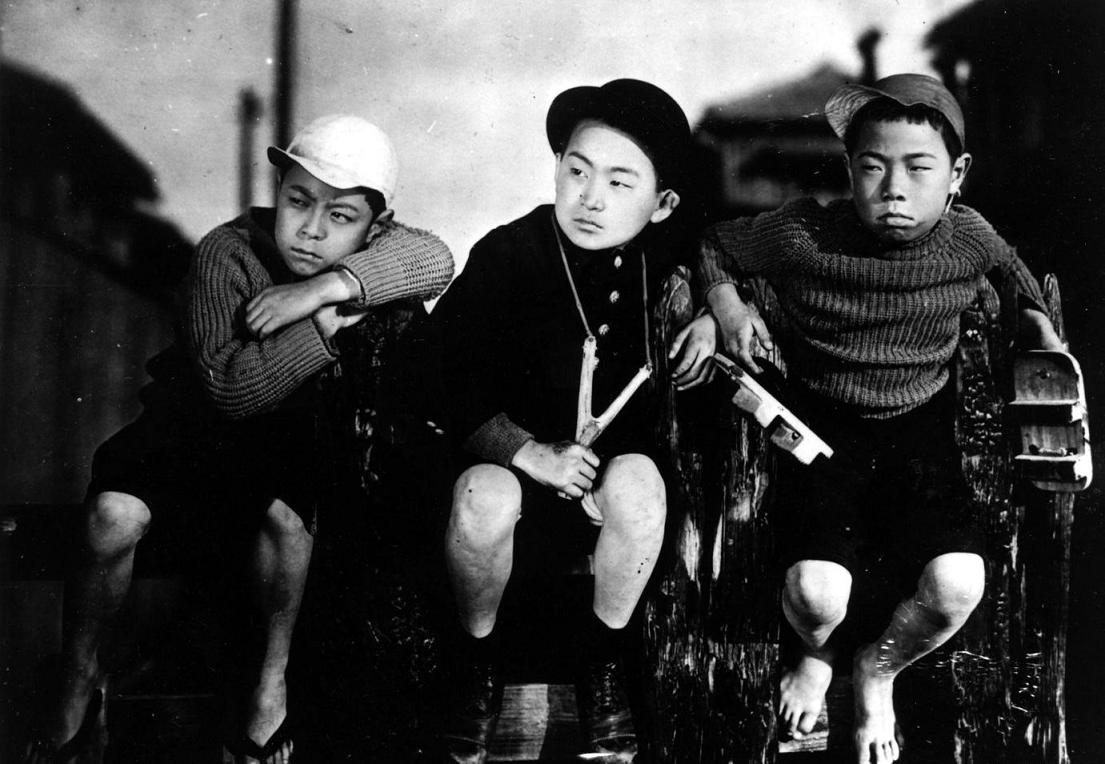
Fantastic news. Two events coming up in London explore the Japanese art of Benshi narration for silent film, both of them courtesy of the Japan Foundation. You may have already heard that there will a screening of the masterpiece I was Born, But … (Yasijuro Ozu, 1932) at the Barbican on 25 June with piano accompaniment and Benshi narration. Book your tickets here.
Before that, on Friday 23 June at Foyles on Charing Cross Road, you can learn more about Benshi itself, with Katsudo-Benshi Hideyuki Yamashiro and silent film pianist Mie Yanashita. There’ll be a talk, demonstration (with a scene from Orochi, 1925) and even the chance to have a go yourself. I’ll be there too, giving an introductory talk about silent cinema to set the scene and chairing the Q&A with Yamashiro. More details below – it’s free but you have to book your seat on Eventbrite.
In conjunction with the Barbican’s screening of Yasujiro Ozu’s I was Born, But… organised as part of The Japanese House exhibition, the Japan Foundation is delighted to present a special evening exploring the art of Benshi. Following an introductory talk by silent cinema specialist Pamela Hutchinson, Katsudo-Benshi Hideyuki Yamashiro and Silent Film Pianist Mie Yanashita will perform a clip from Orochi (1925) recreating an authentic Benshi experience. As part of his illustrated talk, Yamashiro will discuss Benshi as a contemporary occupation as well as the unique appeal of Japanese silent cinema.
This fascinating event will also offer a few audience members the chance to take to the stage and perform the role of Benshi under instruction from Yamashiro himself!
This event is free to attend but booking is essential. To book your place via Eventbrite, please click here
“I took one look at the script, and asked him if he ate welsh rarebit before going to bed at night.” Buster Keaton’s first impression of Samuel Beckett’s only foray into the cinema, Film, is entirely understandable. Although no one would wish its nightmarish scenario to appear in their own cheese dreams. This short, dialogue-free existential chase movie was made in 1966 starring a near-septuagenarian Keaton – and it remains one of the most intriguing corners of film history. The Nobel Laureate’s film might promise slapstick, but as Ross Lipman the director of a documentary on the work, NotFilm says: “It was at once an investigation of the cinematic medium, and of the human experience of consciousness.” Popcorn, anyone?
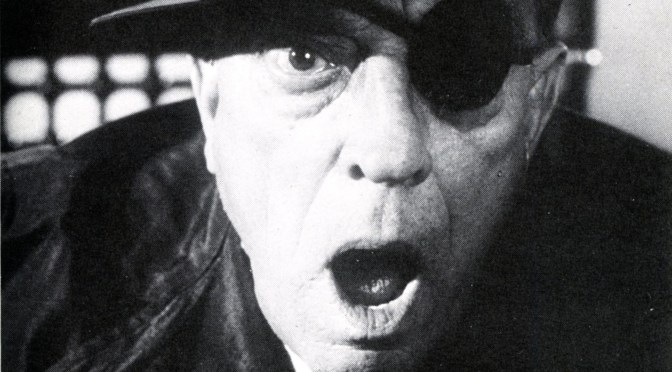
Keaton plays O, a man pursued by a camera, E. Object and Eye. O runs away from E, and when cornered in a room, goes to desperate lengths to avoid its piercing gaze. The reveal at the end of the movie is chillingly sinister, even if you see it coming. The film is shot in black and white, and although Keaton has aged, he is still recognisably the acrobatic star of the 20s – his pork-pie hat is worn at an angle, an eye-patch caps those famous cheekbones. The mood is bleak, paranoid, the camera is unsteady, Keaton shifty.
Samuel Beckett examines a film strip
Beckett was displeased with Film, despite conceding that it contained “the strangeness and beauty of pure image”. The critics were unimpressed at the time, but as is so often the way with these things, the reputation of Film has risen with time. This art film has become, in its own way, a cult movie: very hard to see, and referred to or homaged almost as often as it is screened. The theatrical release of Lipman’s brilliant “kino-essay” documentary was very welcome – offering historical background, cinematic context, and critical interpretation for Beckett’s movie. (I wrote about that last year for the Guardian.)
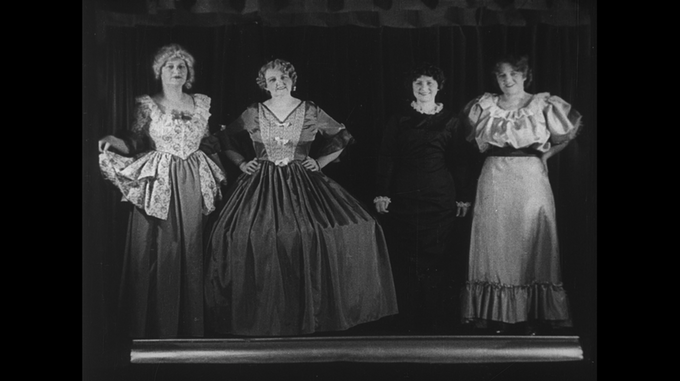
Not all of Silent London’s best-loved festivals are devoted solely to pre-sound film. A longstanding favourite here at Silent London HQ is the wonderfully glamorous Fashion in Film Festival. This event’s focus on cinematic design and unforgettable visuals, plus its enthusiasm for digging into the archives, means that silents often feature, of course, but it is always a wide-roaming affair. And this festival is a beautiful thing, a jewel in the London repertory film calendar.
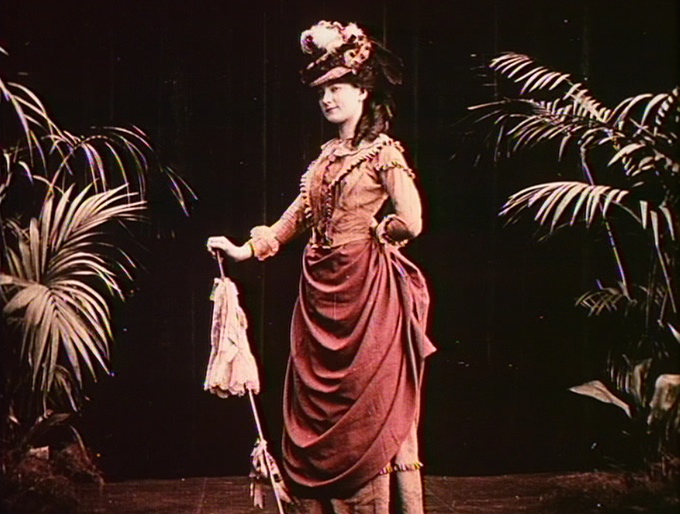
Le Costume à travers les âges – Reconstitué par le couturier Pascault, 1911
This year, the Fashion in Film Festival will take place in London venues from 19-26 March. The full programme has not been unleashed yet, but I do have reason to believe a silent or to may be on the cards. I’m posting today because the Fashion in Film Festival is asking for a little help this year. The organisers have launched a Kickstarter to raise £5,000 before the event begins. If you support them, rewards range from designer knick-knacks such as an Eley Kishimoto tote bag, a copy of the fantastic Birds of Paradise book and tickets and passes for the festival itself. Hurry, the festival passes are running out!
Here’s what the festival team have to say:
The festival celebrates our last ten years and EVERYONE who has been involved in making it a success, contributing or holding our hand. We have lined up an ambitious programme, co-curated with the wonderful Tom Gunning, including an exhibition and some 28 events, with fantastic speakers and some true archival gems we think everyone must see. But some of this is in danger due to a dire funding landscape in the UK. It has been a really tough year!
A Retrospective Look at Corsets, 1920s
And here’s a taste of this year’s programme:
Our programme features cinema’s well-loved as well as neglected masterpieces (Parajanov’s The Color of Pomegranates, Ophuls’ Lola Montes, Hitchcock’s Vertigo, Leisen’s Lady in the Dark, Protazanov’s Aelita), artist films (by Joseph Cornell, Jane and Louise Wilson, Cindy Sherman, Michelle Handelman, Jessica Mitrani), fashion films (by Nick Knight and Lernert & Sander), industry films and many archival gems. There will be talks, film introductions and panel discussions. As special highlights we are staging two film-based performances – with Rachel Owen (at Genesis Cinema) and with MUBI and Lobster Films (at the Barbican).
If you can spare a little money for the festival, I am sure it will be hugely appreciated. Just think of it as paying for your ticket in advance. I did!
When was the last time you enjoyed a moment of silence? Not a pause in conversation, a burst of concentration at your desk, or a moment of peace when your guests have gone, but a real, deep, out-in the-wilderness hour or two of pure aural emptiness?
You’ll rarely experience silence at the cinema – even the films this blog celebrates are mostly shown with music either live or recorded washing over them. But if you are very lucky, a trip to the cinema means a good hour and a half when you and your companions will hold your tongue, and instead of making noise, will enter a new sonic world, constructed on the screen.
In Pursuit of Silence (2015)
That’s what makes the reflective new documentary In Pursuit of Silence so powerful. In between experts discussing the value of escaping the distractions and hums of modern living, there are scenes of dialogue-free calm, from a rippling green field in Iowa to a Remembrance Day silence in the offices of Lloyd’s of London. These scenes are shot with fixed cameras, meaning there is no “visual noise” of pans or zooms to disturb the serenity, perfectly illustrating the meaning of quiet stillness. The peace is both beguiling and refreshing, offering space for the film’s argument to seep in: the idea that by seeking out silence, we will find greater intellectual capacity, better health, philosophical wisdom, a fuller awareness of our surroundings, even equality and an end to conflict.
London teems with cycles and cyclists. And though the sight of a pedal bike overtaking a double-decker always makes me chew my nails, this has got to be a good thing. While most of us are too sedentary, and too reliant on fossil fuels, cycling looks like a miracle cure for the whole human race. Heck, I have even been to a silent movie screening powered by stationary bikes hooked up to a generator. There may be something magical about these contraptions.
Which brings me to On Yer Bike, the BFI’s new archive compilation DVD of cycling throughout the years. Despite the exertions of Bradley Wiggins and co on their sleek carbon frames, cycling is decidedly retro. You couldn’t reach for a more solidly Edwardian image than a lady in a shirtwaist perched on a bone-shaker or a moustachioed gent atop a penny-farthing. And who doesn’t associate biking with their childhood? The pride when you lose your stabilisers; the terror when your parent lets go of the back of your tiny bike for the first time; a gleaming new cycle on your 11th birthday; or roaming around the local lanes with your best friends and a bag of sweaty sandwiches?









 Silent London