A short note from friend of Silent London, Maria Wyke, professor of Latin at University College London.
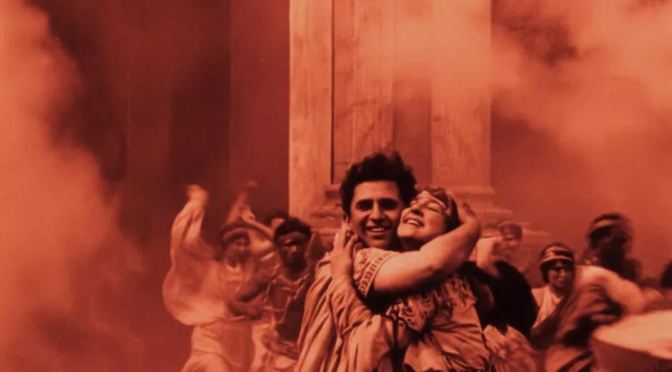
A one-off screening of the rarely seen silent epic film Jone o Gli ultimi giorni di Pompei (Jone or The Last Days of Pompeii, 1913, dir. Giovanni Enrico Vidali) will be held in the 500-seat Bloomsbury Theatre from 6 to 8.30 pm on Saturday 9 May 2026. Immerse yourself in the romance and menace of Pompeii’s last days, ending with the terror of its citizens as the volcano Vesuvius erupts and destroys their city in spectacular fashion. The screening will be accompanied by live piano and percussion performed by the professional silent film musicians John Sweeney and Jeff Davenport.
Tickets cost £12 and you can book HERE. This event is part of the activities of the Greek & Latin research project Museum of Dreamworlds as well as the bicentennial celebrations of UCL.
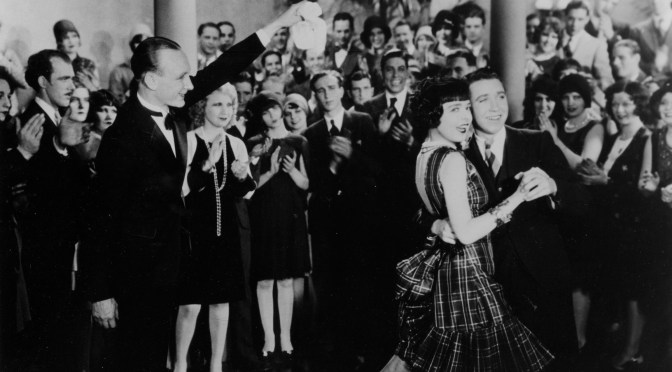
Great news from the north, as Hippfest today launches the lineup for its 16th festival, taking place next month: five days of silent film, live music, workshops, talks and a chance to do the Charleston. All in the vintage splendour of the beautiful Bo’ness Hippodrome.
I awoke with good intentions but encountered even better conversations. And thus, my film viewing on this, the final day of the 44th Giornate del Cinema Muto, began at midday, with Koko the Clown. Which is a wonderful way to begin. This cartoon, Ko-Ko at theCircus (Dave Fleischer, 1926), with our inky friend squaring off against a giant, had me in stitches – which is how I ended the day too. Apt, perhaps to start with animation when today was really all about the kiddywinks.
I have been a little slow to start up some mornings. But one thing you can guarantee that I will get out of bed for is Victor Sjöström. Victor Sjöström’s 1912 debut film no less, banned outright in Sweden, but available for us lucky degenerates on the capacious Verdi screen, with a truly wonderful accompaniment by Stephen Horne. Variously known as The Cruelty of the World, The Gardener or The Broken Spring Rose, this is a really special film and I do think the first title is the best one.
Feature films? What a concept. They don’t always seem to be the dominant form here at Pordenone. But this afternoon was an exception to that rule, with a triple-bill of four-to-six-reelers back to back. Welcome to a world of truly immersive narrative entertainment, It’s the future.
It may seem that the Giornate is in its own bubble, a hundred years or more removed from the real world, wrapped up in the fashions and the fads of the past. But we’re still looking out at the world every day, and no matter how the text on screen tries to guide us, we bring our 21st-century interpretation to everything that passes in front of our eyes. Sometimes the challenge is to wind back the clock, to see the past as our ancestors did when they were living through it. Sometimes we have no choice but to view images of the world as it was while burdened with the knowledge of our shared history, and of our violent present.
Last night I dreamt I went to East Lynne again… Ellen Wood is directing my subconscious now. I love this mini melodrama strand and I really enjoyed today’s instalment, which was the lavish 1925 Fox adaptation, East Lynne (Emmett Flynn), scripted by Lenore Coffee and starring Edmund Lowe as Carlyle and Alma Rubens as Lady Isabel – a very handsome pair and just right for this ill-starred pair.
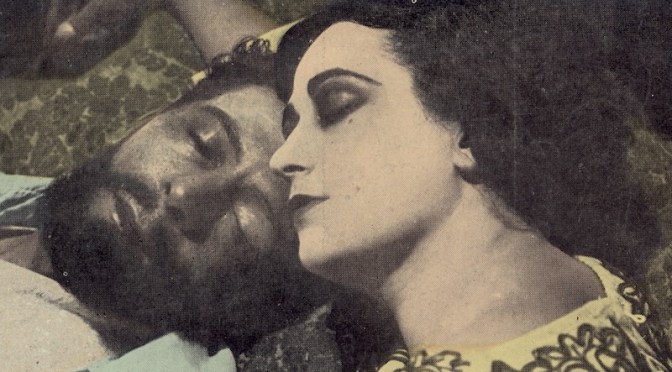
Monday finished with a zinger. I mean a Zingari. Italia Almirante Manzini wowed the Verdi as Wilejka, a heavy-lidded beauty with great hair, but in this case as a heavy-lidded beautiful Gypsy shepherdess with great hair. In Zingari (Mario Almirante, 1920) Wilejka falls in love with a man, Abaldo (Amleto Novelli, no less) that her father, the leader of the camp, forbids her to marry. There is many a consultation of the cards, a fireside dance, a storm, a threatening villain, a crushing pang of jealousy, an assassination and naturally, a barn on fire before this will all end happily ever after.
Is it still a pathetic fallacy even if the weather is true but the drama is not? As I set out to begin my day with some major melodrama, there was heavy weather in the skies above Pordenone also. We shook off the rain in the Verdi foyer, while we prepared to dampen our faces with tears during the first of this year’s adaptations of East Lynne.
The Giornate dawned with grey skies but good times, a respite from Storm Amy and all the rest of the week’s turbulence, a day of pretty views and outbreaks of mild escapism. Many of us were just grateful to be get here, let alone arrive on time, after the transport situation was especially complex this year. It was an especially mellow start to the festival for me. Blame it on the 3am alarm call, the cold medication or just the pleasurable daze of seeing so many familiar faces all at once. Will I sneeze or snooze my way through the first day of films? Who knows? And will my ears ever “unpop” from the plane? Join me now to find out.
As so often, I am going to have to ask a certain purist contingent to do their breathing exercises and locate the nearest fainting couch. Everyone else, buckle up!
I have not one but two cases of pop silents to report. And as ever, I remain optimistic for both. First up is one that may be familiar to many already. The Pet Shop Boys, one of the truly great pop bands of the 80s and 90s, wrote an electronic-orchestral score for Battleship Potemkin (Sergei Eisenstein, 1925) several years back. There was a special outdoor screening in Trafalgar Square, where the band performed the score with the Dresdner Sinfoniker, orchestrated by Torsten Rasch, back in 2004. I missed that occasion, but I heard that it was pretty epic, despite the rain. Talk about Eastern Bloc sailors and West End, um, squares.
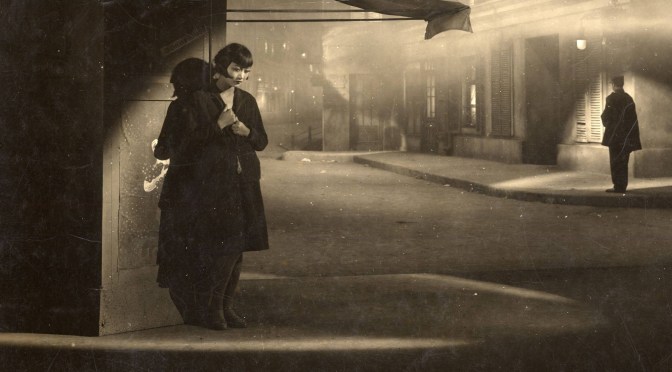
On Sunday I had the very great pleasure of introducing a double-bill of Anna May Wong silents: the UK premieres of new restorations of Song (Richard Eichberg, 1928, restored by Filmmuseum Düsseldorf) and Pavement Butterfly (Richard Eichberg, 1929, restored by DFF) at Cinema Rediscovered in Bristol. Beautiful films, a beautiful audience and simply gorgeous musical accompaniment by Stephen Horne. Wish you could have been there – maybe you were?
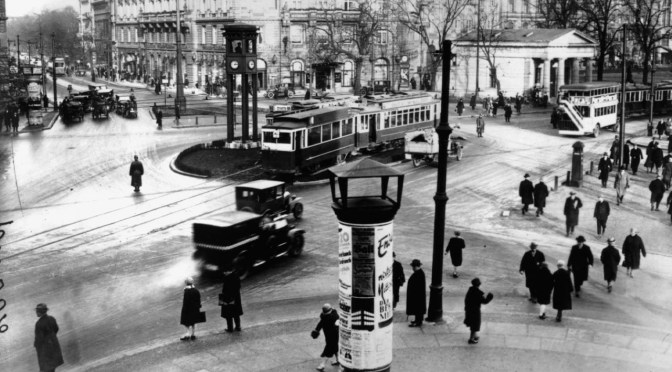
I may live in the 21st century on the south coast of England, but here on my desk it often looks like I am somewhere else entirely. Weimar-era Berlin, to be precise. It is the epicentre of some truly great silent filmmaking, such as the works I often share on this blog, it is the setting and source for the first film book I wrote (Pandora’s Box, as you asked), and it is here that we find the origins of much of the Golden Age of Hollywood cinema that I write about elsewhere.
It also sometimes looks this way when I am reading the news, but that, perhaps, is another matter.
This is a guest blog for Silent London by Maria Wyke, professor of Latin at University College London.
Worn out from watching Paul Mescal battle with CGI baboons, rhinos and sharks in the Roman arena? Or trying to avoid the Marvel-style struggle for the future of the Roman empire playing out in a cinema near you? Then you might be interested in these two screenings coming up at the end of November of very different antiquity films from 100 years ago or more. Gladiator II explicitly presents itself as a sequel to Gladiator (2000). That hugely successful film drew on the Hollywood blockbusters of the Cold War era and they in turn built on the global success of antiquity films already established at the start of the 20th century. Those early films, however, often reconstructed the ancient world in ways never taken up by later cinema. These upcoming screenings bring back to us that otherwise lost innovation, vibrantly supported by the live accompaniment of professional musicians.
The Odyssey (1911, dirs. F. Bertolini, A. Padovan and Giuseppe de Liguoro)
Entering the Ancient World through Silent Cinema
Saturday 30 November 2024, 16:45-17:45 at the Morecambe Winter Gardens
As part of a Northern Silents event, this variety programme begins with a British travelogue, Visit to Pompeii (1901, dirs. George A. Smith and Charles Urban), that takes elegant tourists on a journey around the excavated city and up to the crater of Vesuvius. An Italian historical drama, Nero, or the Burning of Rome (1909, dirs. Luigi Maggi and Arturo Ambrosio)shows the emperor repudiating his wife and driving her to suicide at the command of his beautiful mistress. The people rebel, Rome burns, the emperor plays his lyre. Through cinematic superimposition, a terrified Nero sees a nightmare vision of the Christians suffering for his crimes. His own suicide soon follows.
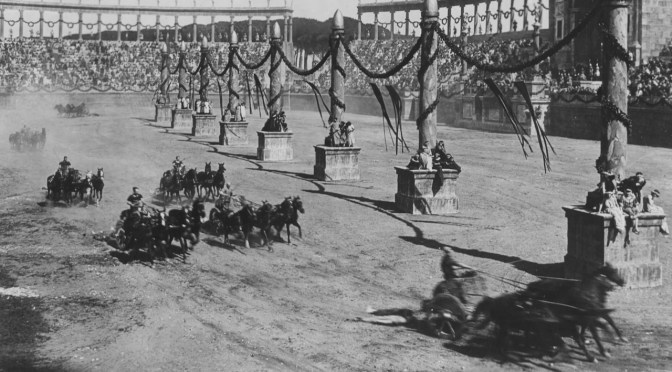
Similarly, The Odyssey (1911, dirs. F. Bertolini, A. Padovan and Giuseppe de Liguoro) uses special effects imaginatively to present the daring escape of Odysseus and his crew from a monstrous giant, the apparition to him of his protective goddess, and his miraculous transformations to hide his true self from the suitors who hound his wife back at home. The climactic finale is an American animation, A Roman Scandal (1926, dirs. Charles R. Bowers and Bud Fisher), based on the newspaper comic strip adventures of Mutt and Jeff. Magically transported back to ancient Rome, little Jeff finds himself racing a chariot before the beady eyes of emperor Mutt. In a parody of the great race sequence in Fred Niblo’s Ben-Hur (1925), cunning is the winner.
Quo vadis? (1924, dirs. Gabriellino D’Annunzio and George Jacoby)
Quo vadis? (1924, dirs. Gabriellino D’Annunzio and George Jacoby)
Sunday 1 December 2024, 14:15 at BFI Southbank NFT1, London
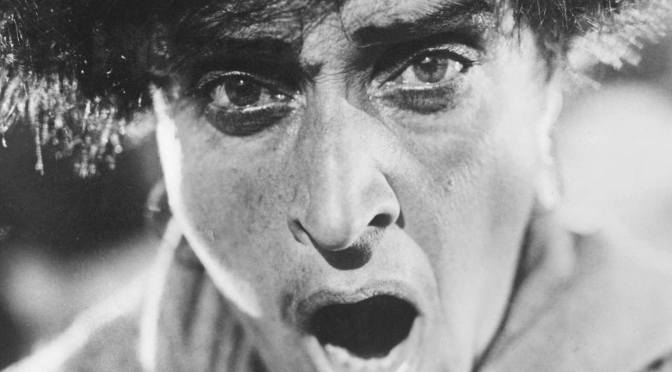
Magnificent and disturbing, this epic film revels in the debauchery often associated with ancient Rome. The emperor Nero is played as a satanic grotesque by the star Emil Jannings. At the opening of the film, we see him lie resplendent on a couch in the grounds of his ornate palace. He peers with sadistic amusement at a series of female victims being thrown into the fountain to fatten his fish.
The Latin title of the film or ‘Where are you going?’ refers to the question that the apostle Peter was supposed to have asked when he saw Christ coming to save the Christians in Rome. It also refers to a celebrated nineteenth-century novel that told the story of a fictional girl, Lygia, who turns the Roman soldier Vinicius toward God despite Nero’s attempts to stop her. The first half of the film ends with the camera focussing in on a hand gripping a cross. It is a sign that the soldier’s conversion is underway.
The second half of the film puts that story in the broader context of the burning of the city and the subsequent persecution of the Christian community. Here red tinting marks out the danger for Rome and the excitement for viewers. A cast of thousands charges the imperial palace. Christians are arrested and Christ himself makes two appearances. Eventually Nero commits suicide, and the Cross is declared victorious. But not before we are offered a range of extraordinary spectacles: extravagant banquets; beatings and murder; thwarted rapes; a city on fire; a strongman wrestling a bull, lurid martyrdoms and soldiers from the provinces riding to the rescue.
Both screenings are being run in association with the AHRC-funded research project Museum of Dream Worlds based at University College London and led by myself, Maria Wyke. The project (drawing on the surviving films in the BFI National Archive) asks how did early cinema design its Greek and Roman dreamworlds? What did cinema gain from recreating the distant past? What did that past gain from being recreated in moving images? The project also considers how these films were once used as instruments of education and what educative potential they might have today.
Ivo Blom is offering a free download of his recent book Quo vadis?, Cabiria and the ‘Archaeologists’: Early Italian Cinema’s Appropriation of Art and Archaeology (Kaplan, 2023) over on his site, as well as the link to buy a paper copy.
Stand outside Alexandra Palace on a clear evening with a full moon, as I did last night, and you can take in the whole city. London may be as silent as it gets from this vantage point, but the landscape is loud in its own way. The glittering towers that dominate the skyline were all built in the last 50, probably 20 years. The red lights dotted in among them are all cranes, standing by to change the shape of the city once again. Scan the horizon, and you’ll be reassured perhaps to see the dome of St Paul’s – a symbol of continuity, a connection between modern times and the age of Christopher Wren, going back to 1710.
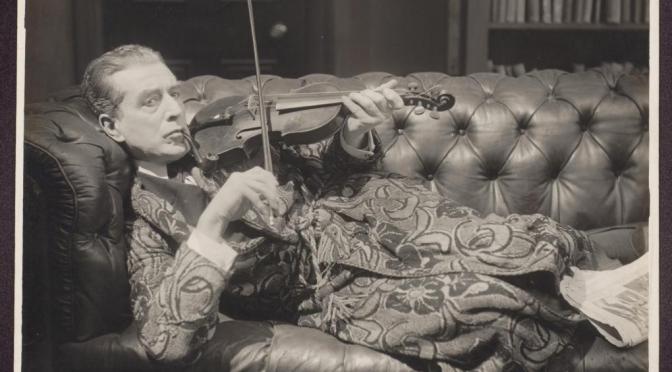
Swivel on your heel, and pivot to 1873 or thereabouts, when Ally Pally itself, the “People’s Palace” first opened. I had a date to keep at the theatre, recently restored to what the owners call a state of “arrested decay” and reopened to the public. We were there to travel back to a fuzzy combination of the 1880s and the 1920s, to revel in the BFI London Film Festival’s latest archive presentation: Silent Sherlock.
It’s supposed to be big mystery: what do women want from a romantic partner? But there is no mystery at all. GSOH every time. That’s good sense of humour, of course. So if you’re in anyway romantically inclined, you’ll already be asking yourself: what is the FUNNIEST way I can celebrate Valentine’s Day next year.
If you know you know that Slapstick Festival celebrates visual comedy in all its forms. But that include silent cinema and there are especially strong offerings on that score this year, including lashings of Buster Keaton (with expert Polly Rose on hand to guide you through his work), including the gala screening of Steamboat Bill Jr. (1928), accompanied by the European Silent Screen Virtuosi, led by Günter A. Buchwald, on the Friday night at Bristol Beacon. Plus Harold Lloyd, Sarah Duhamel, Laurel and Hardy, Charlie Chaplin, WC Fields, and lots more.
A confession. I was conspiring over breakfast, and reader, this was a two-cappuccino problem. The upshot? I was a little late in getting started with the screenings today. But I certainly knew that I was going to be up late, with the gala… and the end-of-festival celebrations!
My sunny morning stroll to Cinemazero was rewarded with a simply terrific film from Uzbekistan. In Her Right (Grigorii Cherniak, 1930), a group of workers from the collective farm are sent to the factory to boost the workforce there, and to learn those valuable Soviet methods. One woman from the village defies her husband and sheds her burqa to join them. It’s a life-changing experience and not only does she gain independence through work, but she inspires others to do the same, through a filmed speech, that the workers clamour to watch, even after he enraged husband slashes the screen. Even with her “throat” cut, in a silent film, she continues to speak her truth. So you have noted already that this is once again pro-Soviet, anti-Islam propaganda in intent, but this is also a remarkable film in style and action. Our Hollywood friends would applaud the excellent, and indeed poignant, action sequence in which our heroine runs to jump on the train to the factory, is repeatedly shoved away by male guards and then, when it seems she has finally found a helping female hand, her husband leaps – for a second we think he has dragged her form the moving train, but no, he only has her coat in his hands. Nail-biting stuff. And the scene in which they watch the film is also very strong. Günter Buchwald at the keys for this one, keeping the energy at exactly the right pace.
Blood, sweat and tears on the screen today. And to cap it all off, prizes! That’s Friday in Pordenone, folks. Read all about it.
Your scribe is a little squeamish, I must confess, so this morning I had to resort to an old trick, and pop my glasses off during some of Arabi (Nadezhda Zubova, 1933), a drama about sheep farmers organising to form a collective and defeat the feudal powers that exploit their labour under the old system. That doesn’t make me squeamish, I’m all for it – it was the killing and skinning of lambs that turned my stomach. Still, I thought this was terrific, with some very sharp editing, especially in the opening sequence, and lovely low camerawork of the herd out in the field.
Wouldn’t you like to go Behind the Scenes with DW Griffith and Florence Lawrence? I sure would, that’s why I was bright and early at the Verdi this morning for the 1980 Biograph package. Behind the Scenes, per the catalogue is the “happy exception” among the 1908 output. Well it certainly had punch. A distraught mother must tear herself from her daughter’s sickbed to kick her heels and shake her hips on the vaudeville stage to earn a crust. But as the crowd roars out for an encore, her baby girl is slipping away from this life; Grandma rushes to the stage door… If “too late!” is the essence of the melodramatic narrative then this was a textbook case. We stayed to see Lawrence reappear as the titular character in The Red Girl, in which a collection of ethnic stereotypes conspire to rob a “girl miner” but Lawrence defies racist convention to lend a hand instead. Impressive to see Lawrence Harry Houdini her way free after being tied up and dangled over a precipice above the rushing river. Extra exciting with John Sweeney at the keys, of course.
Sometimes the old songs are the best, right? Familiarity can breed contentment. And nowhere will you find more consensus on that than here in Pordenone. So today I was happy to rewatch a couple of silent films I love, spend a little time with one of my all-time favourite silent stars. And then see something entirely new to me!
First, the old friends. This morning, we ventured back into the imaginations of Maurice Tourneur, and Ben Carré, with the 1918 adaptation of Maurice Maeterlinck’s The Blue Bird. Such a strange and beautiful, terrifying and wholesome journey into the shadow world of dreams, where bread and sugar and water have souls, the dogs and cats can talk, lost grandparents always have the table set for supper and babies wait impatiently to be born. If you have not seen this, you possibly can’t imagine quite how weirdly pretty it is. Variety’s critic wrote: “It is quite safe to assert that nothing quite like Director Tourneur’s work has ever been shown on the screen.” So hats off to Tourneur and Carré, and doubly so to Neil Brand and Elizabeth-Jane Baldry, who transported us to an enchanted realm with their music. I wrote about the film in more detail here, should you be interested.



 Silent London