Tag Archives: Buster Keaton

A Taste of Silents, and more, by HippFest

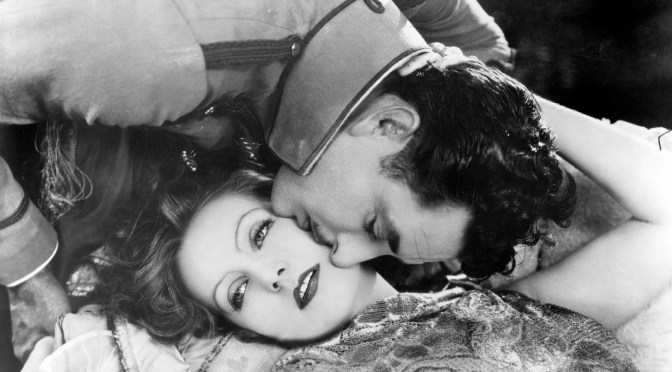
Is it a little hot in here… or is it just me? Outside the weather is turning autumnal, inside here I am contemplating the sizzling lineup for HippFest’s Taste of Silents season, which opens next month. Complete with Greta Garbo and John Gilbert sharing a cigarette, and much more, in Flesh and the Devil (Clarence Brown, 1926).

Stephen Horne will accompany Flesh and the Devil on piano and flute at the beautiful Hippodrome Cinema in Bo’ness, Falkirk on 20 September. This event will open the programme, which has been curated by the Hippodrome Silent Film  Festival’s Young Programmers: an educational programme to support future cinema programmers and film exhibitors.

Continue reading A Taste of Silents, and more, by HippFest

Silent films go pop

As so often, I am going to have to ask a certain purist contingent to do their breathing exercises and locate the nearest fainting couch. Everyone else, buckle up!

I have not one but two cases of pop silents to report. And as ever, I remain optimistic for both. First up is one that may be familiar to many already. The Pet Shop Boys, one of the truly great pop bands of the 80s and 90s, wrote an electronic-orchestral score for Battleship Potemkin (Sergei Eisenstein, 1925) several years back. There was a special outdoor screening in Trafalgar Square, where the band performed the score with the Dresdner Sinfoniker, orchestrated by Torsten Rasch, back in 2004. I missed that occasion, but I heard that it was pretty epic, despite the rain. Talk about Eastern Bloc sailors and West End, um, squares.

Continue reading Silent films go pop

Silent reading: Spring 2025 book reviews

This is a long overdue post, but perhaps I was simply enjoying the research too much. Picking up an occasional series on this site, here are some short reviews of new books on silent film that have passed across my desk recently. Yes, I am a lucky duck.

Silent to Sound: British Cinema in Transition, by Geoff Brown

John Libbey, 2024, $45.00

If a story is worth telling, and this one certainly is, then it is worth telling with style. In this case, Geoff Brown relates the story of the arrival of sound in the British film business with an eye for the eccentricities and absurdities that make it not just a pivotal moment in the medium, but a good yarn, and one that is revelatory about the national industry. Geoff Brown, journalist and researcher, has been studying the arrival of sound in Britain for years now as part of an AHRC-funded project and the result is this deeply enjoyable and admirably detailed book about a long and strange process, which when told with Brown’s light touch and quick humour is as diverting as it is informative. The serious point is that Brown’s emphasis, where he has access, is always on the films themselves. And that, along with the quotations from the critical discourse that I particularly cherish, is what really gives this book its colour.

Continue reading Silent reading: Spring 2025 book reviews

Slapstick 2025: for the love of silent comedy

It’s supposed to be big mystery: what do women want from a romantic partner? But there is no mystery at all. GSOH every time. That’s good sense of humour, of course. So if you’re in anyway romantically inclined, you’ll already be asking yourself: what is the FUNNIEST way I can celebrate Valentine’s Day next year.

Not to brag, but I do have the solution. Bristol’s Slapstick Festival runs 12-16 February at venues across the city centre. It’s the perfect romantic getaway for you and your lighthearted lover. Or for you and your love of silent film.

If you know you know that Slapstick Festival celebrates visual comedy in all its forms. But that include silent cinema and there are especially strong offerings on that score this year, including lashings of Buster Keaton (with expert Polly Rose on hand to guide you through his work), including the gala screening of Steamboat Bill Jr. (1928), accompanied by the European Silent Screen Virtuosi, led by Günter A. Buchwald, on the Friday night at Bristol Beacon. Plus Harold Lloyd, Sarah Duhamel, Laurel and Hardy, Charlie Chaplin, WC Fields, and lots more.

Continue reading Slapstick 2025: for the love of silent comedy

Season’s greetings, Silent Londoners

I am just about to sign off for the year, so I wanted to take a moment to thank you for reading, and supporting, this blog in 2023. This year has been another very challenging one, on the world stage, and in the arts, but I continue to be impressed by the resilience, energy and imagination of people in the silent film world. So much work going on, so many opportunities to share great films and music with each other.

Continue reading Season’s greetings, Silent Londoners

Buster goes to the seaside: Kent MOMI relaunches this week

I first visited Kent Museum of the Moving Image back in 2019. This museum in Deal has a fascinating, and extensive, collection of material relating to the moving image. I remember I was particularly struck by a beautifully detailed reconstruction of Googie Withers’ dressing table as well as a gorgeous set of magic lanterns, dioramas and other pre-cinema treasures. Now, the big news is that Kent MOMI is about to relaunch in grand style, this week.

Continue reading Buster goes to the seaside: Kent MOMI relaunches this week

Shhh… Chichester International Film Festival celebrates the silents

This August, silent film fans in search of a summer holiday should take trip to sunny West Sussex, and the Chichester International Film Festival. The festival is now in its 31st year, and in 2023 Roger Gibson steps down as Artistic Director and Programmer of the festival, a post he has held for many years. It’s no coincidence that there are a few of his favourite films in the programme, including some of the silent classics.

In fact, there is an especially strong lineup of silent cinema with live music at the festival this year, which runs 4-27 August. The silent film programme comprises Neil Brand’s acclaimed Laurel and Hardy show, John Sweeney playing for Gibson’s choice The Italian Straw Hat, Ben Hall accompanying The Phantom of the Opera on the St John’s Chapel organ, and the Buster Plays Buster show featuring Steamboat Bill, Jr. There’s also a screening of Harold Lloyd’s jaw-dropping stunt comedy Safety Last!.

The Phantom of the Opera

Here is the full silent lineup, and links for booking tickets, which will be on sale on Friday 21 July.

  • 13 & 26 August Safety Last!, New Park Cinema, Chichester – book here.
  • 15 August The Italian Straw Hat with John Sweeney, Guildhall, Priory Park, Chichester – book here.
  • 16 August Buster Plays Buster, Guildhall, Priory Park, Chichester – book here.
  • 22 August Neil Brand Presents Laurel and Hardy, New Park Cinema, Chichester – book here.
  • 25 August The Phantom of the Opera, St John’s Chapel, Chichester – book here.
Harold Lloyd in Safety Last (1923)
  • Explore the full lineup of the 2023 Chichester International Film Festival here, and the Special Events in particular here.
  • I am also giving a talk at the festival, on the career of Cate Blanchett, who is the subject of a retrospective strand, and strikes permitting, Roger and I will be leading a Q&A with the actress after a screening of the fabulous Tár. Both of these events are on 21 August.
  • Silent London will always be free to all readers. If you enjoy checking in with the site, including reports from silent film festivals, features and reviews, please consider shouting me a coffee on my Ko-Fi page.

The mechanics of Mission: Impossible

Spoiler alert: this post is mostly about the very end of the new Mission: Impossible film, Dead Reckoning: Part one. Don’t read on until you have seen that, or you will be very angry with me.

I have written here before about how the stunt movie and the art of silent slapstick intersect – the inspiration that time was John Wick, with its old-school fight choreography. New in the cinemas this week is the latest film in the Mission: Impossible franchise, starring Tom Cruise, a man who has long insisted that he does all his own stunts, just like a latterday silent star.

Continue reading The mechanics of Mission: Impossible

The Silent London Poll of 2022: And the winners are …

Well done everyone! The Silent London Poll of 2022 had a record-breaking number of votes, and the winners reflect a thriving, international silent film scene. Congratulations to all the people mentioned below, some of these categories were bursting with great nominations. Thank you for all your votes. And for making me blub a little when I was typing this up.

Without further ado, let me open this giant stack of golden envelopes. Here are your winners!

The Manxman (Alfred Hitchcock, 1929)

1. Best orchestral silent film screening of 2022

Your winner: The Manxman (Alfred Hitchcock, 1929), with a score composed by Stephen Horne, orchestrated and conducted by Ben Palmer and played by Orchestra San Marco di Pordenone, with soloists Louise Hayter and Jeff Moore, at Le Giornate del Cinema Muto, Pordenone.

I said: “Horne’s music is as deft as Hitch’s camera: always gorgeous, but sometimes delicate and other times thick with portents of doom… Needless to say, Hitch and Horne brought the Verdi to its feet once more.

Honorable mention: The Unknown (Tod Browning, 1927) with a score conducted and composed by José María Serralde Ruiz, performed by Orchestra San Marco di Pordenone, , at Le Giornate del Cinema Muto, Pordenone.

La Dixième symphonie (Abel Gance, 1918)

2. Best silent film screening with a solo musician or small ensemble of 2022

Continue reading The Silent London Poll of 2022: And the winners are …

Funny Valentines: Silent comedy at Slapstick 2023

This February, comedy fans will head west to Bristol, Unesco City of Film for the annual Slapstick Festival. As usual, there is plenty for fans of silent cinema in the programme, with stars from Charley Bowers to Harold Lloyd, Charlie Chaplin to Marlene Dietrich. Presenters include Kevin Brownlow, Steve Massa and Polly Rose, as well as the marvellous Ayşe Behçet, whose Charlie’s London posts you may remember from this very site, back in the day.

The 2023 Slapstick festival runs from 14-19 February this year, and here’s what’s coming up silent in the programme.

WEDNESDAY 15 FEBRUARY

2pm: The Cigarette Girl Of Mosselprom [1924]

Hosted by Lucy Porter

Watershed  £8.50/£5.00

Dir: Yuri Zhelyabuzhsky, Soviet Union, 78 mins, cert TBA

In stark contrast to most films made immediately after the Russian Revolution, this is an endearing rom-com filled with likeable characters and some self-effacing insights into the filmmaking process. At the centre of it all is cigarette seller Zina (played by the future Cannes award-winning director Yuliya Solntseva) and the love tangles that surround her when she is talent-spotted to become an actress. With an introduction from stand-up comedian and actor Lucy Porter and live piano accompaniment by John Sweeney. 

Continue reading Funny Valentines: Silent comedy at Slapstick 2023

Carl Davis on composing for Buster Keaton: ‘the hardest challenge’

This is a guest post for Silent London by the composer and author Carl Davis. Today is his 85th  birthday, and his new album Buster Keaton: The Carl Davis Soundtracks is released next week, 5 November. The two-disc set comprises highlights from the Carl Davis soundtracks composed for the Buster Keaton movies commissioned for Thames Silents and The Cohen Film Collection. The music is composed and conducted by Carl Davis and performed by the Thames Silents Orchestra, the Chamber Orchestra of London and the Czech National Symphony Orchestra. recorded between 1984 and 2020.

What makes Buster Keaton different from his two great rivals, Charles Chaplin and Harold Lloyd in the Hollywood of the 1920s? These three artists played very defined and different characters and supporting them in their differences is the role of the music.

Charlie’s Tramp evolved from 1914 and he played him until 1936 when the character made his final appearance in Modern Times. Chaplin was himself a gifted composer. As soon as sound film became the standard he completed and recorded his score for City Lights (1931) and did so for the rest of his career. Chaplin’s scores evolved out of the pre-1914 world of Victorian Music Halls: sentimental ballads, waltzes and polkas as well as melodramatic underscoring.

Continue reading Carl Davis on composing for Buster Keaton: ‘the hardest challenge’

Hollywood history: Chaplin-Keaton-Lloyd Alley

Quick question. Can you remember March 2020? Me neither. Far too long ago.

So, a few things have happened since then, but at the beginning of March I reported for the Guardian on film historian John Bengtson’s campaign to have one alley in Hollywood renamed in honour of Chaplin, Keaton and Lloyd, who all shot famous scenes there. When I wrote the piece, I hoped to be visiting the alley to see it for myself quite soon. Now there’s a bad joke.

The point is, that the campaign continues, and gathers support. Also, I wanted to share this video John has made that sums up the importance of the alley rather smartly. Why share, give it a thumbs-up, or just enjoy the gags?


  • Find out more about John’s campaign here.
  • On a not-entirely-related topic, did you know that you can watch Il Cinema Ritrovato from home this year? Sign up here for a streaming pass.
  • Eureka releases another great Buster Keaton box set next week, comprising College, Our Hospitality and Go West.
  • Silent London will always be free to all readers. If you enjoy checking in with the site, including reports from silent film festivals, features and reviews, please consider shouting me a coffee on my Ko-Fi page.


Buster Keaton: 3 Films review: discs the doctors would order

How are you doing? You can be honest here, you’re among pals. It’s a bit difficult out there these days isn’t it? Whether you’re out on the front line (thank you, THANK YOU), out-of-work, homeworking or home-schooling, life is stressful at the moment. Apparently we’re all either filling our time or switching off at night by streaming more than ever. Why not? There are some great resources out there for watching silents online (and more from me on this anon), but streaming is not the only fruit.

If you still have some pennies to spare in the age of lockdown, don’t forget that physical media is your best friend. Silents on Blu-ray (or DVD) won’t disappear at the whim of the rights-holder, or glitch or go lo-res every time your bandwidth gets overloaded by your flatmate’s Zoom cocktails or your kids’ homework chats. Not only that, but the best discs coming out these days are packed with commentaries and extras that celebrate the film and will expand your knowledge in the most entertaining way. Continue reading Buster Keaton: 3 Films review: discs the doctors would order

Buster, Denny and Dutch: all in a day at the Slapstick Festival

A little of what you fancy does you good. Right? I think so, and with that in mind I treated myself to a day of giggles at Bristol’s Slapstick Festival. My seventh visit, and suitably, I saw some heavenly sight gags.
giphy (1).gif
Buster Keaton, who made his first appearance on film 100 years ago, was the special focus of the festival’s silent offering this year. So it’s no surprise that I had two dates with Mr Keaton in one day. First, an energetic, and thought-provoking lecture on the Great Stoneface’s masterpiece The General (1927), by Peter Kramer, author of the recent BFI Film Classic monograph on the film. I really liked what he had to say about the film’s depiction of the Old South, and the punishment meted out to Annabelle Lee as the film continues. Plenty to consider, and I think he’s exactly right about Lee. What’s great about her character is that she behaves badly, gets punished and then grows a little. A carefully drawn female character, capable of personal development, in a silent comedy? Cheers to that.
giphy (2)
Dorothy Sebastian’s Trilby Drew in Keaton’s MGM silent Spite Marriage (1929) also faces a bruising punishment for her sins – hilariously so, in the sequence when Buster manhandles her passed-out body into bed – but I don’t buy into her transformation as much as I do Annabelle’s. Anyway, this film is frequently hilarious, while being more of a series of sketches forced into a feature than a narrative flick, and it was an excellent way to end my day at the festival. Not least because of sublime accompaniment from the European Silent Screen Virtuosi, AKA Gunter Buchwald, Romano Tadesco, and Frank Bockius, who made a late but welcome appearance after the film had begun. We were fed some line about Bockius being caught up in traffic, but I have read enough rock biogs to know what drummers get up to. Even Trilby Drew would blush, I’m sure.

Continue reading Buster, Denny and Dutch: all in a day at the Slapstick Festival

Buster and beyond: silent comedy at the 2018 Slapstick Festival

More silent film goodness to look forward to in 2018, and this time a little closer to home.

The 2018 edition of Bristol’s Slapstick festival takes place at venues across the city centre from 25-28 January and tickets are on sale now. If you’re not familiar with this event let me tell you how it breaks down. Funny films. Funny people. That’s it, really. The Slapstick Festival celebrates the tradition of visual comedy on screen, beginning in the silent era. And it invites famous comedians to present and share their favourites, as well as a host of experts and the best silent movie musicians in the business.

So next year, silent comedy fans can look forward to:

Betty Balfour in The Vagabond Queen (1929)

  • The Silent Comedy Gala at Colston Hall on Friday night will be hosted by Tim Vine. The headline film is the superlative Sherlock, Jr, accompanied by Charlie Chaplin’s A Dog’s Life and Angora Love, starring Laurel and Hardy. The Buster Keaton feature will be accompanied by the world premiere of a new, semi-improvised score composed by Günter Buchwald and performed by the renowned European Silent Screen Virtuosi and members of Bristol Ensemble. A Dog’s Life features Chaplin’s own composition for the film and will be performed by a 15-piece Bristol Ensemble conducted by Buchwald.
  • Comedian Lucy Porter introduces two screenings of female-led silent comedies at the Watershed Cinema: Betty Balfour in The Vagabond Queen, and Constance Talmadge in Her Night of Romance. Porter is great at these intros, both knowledgeable and passionate, so don’t miss these. Music by John Sweeney too.

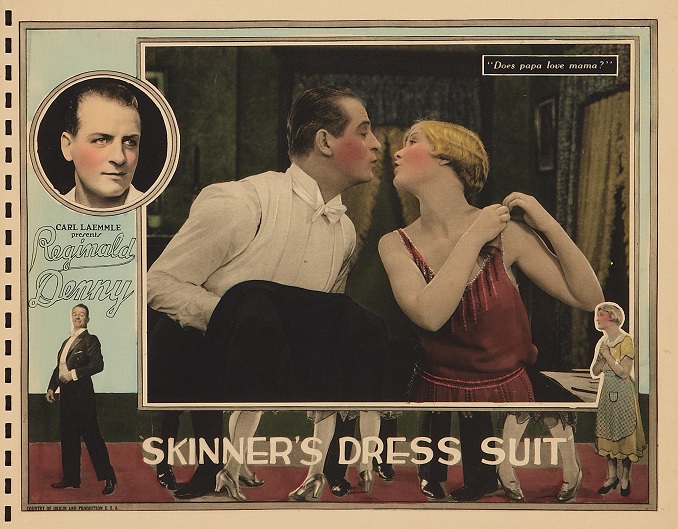
Skinner's Dress Suit (1926)

  • Someone else who is rather good at introducing silent movies is Kevin Brownlow, who will introduce a lesser-known film, Skinner’s Dress Suit, starring the brilliant Laura La Plante and Reginald Denny. Piano accompaniment by Daan Van den Hurk.
  • Meet the Austrian answer to Laurel and Hardy, Cocl and Seff, with a screening of some of their rarely seen work at the Watershed, with music by Stephen Horne and Elizabeth-Jane Baldry.
  • And there will be a chance to see even more rare films at a screening called Lost and Found, in which collector Anthony Saffrey and historian David Robinson will present some recently rediscovered silent comedies, from André Deed (AKA Foolshead) Marcel Perez, Max Linder, Karl Valentin and more. Music will be provided by Elizabeth-Jane Baldry and Daan Ven den Hurk.

Continue reading Buster and beyond: silent comedy at the 2018 Slapstick Festival

The truth about Charlie Chaplin and Universal

There is little so dispiriting as a joke that has to be explained. I don’t pretend to speak for Charlie Chaplin as a rule, but I am fairly sure he would agree with me on that one.

A joke that takes people in, that fools them into swallowing impossible truths? Well that can be funny, but dangerous too – we tend to hope national newspapers won’t fall for them.

A week or so ago I posted about a story in the Mail on Sunday that didn’t add up. The newspaper claimed that Chaplin had been offered, rather grudgingly, a screentest by Universal in 1912, to replace the misbehaving Buster Keaton, but having seen him in action, decided he wouldn’t do, certainly not with that hat, that moustache, that silly walk and that name. If it quacks like a duck and all that – the story sounded like nonsense, and it was, too. Almost.

Continue reading The truth about Charlie Chaplin and Universal

Film and Notfilm review: when Buster Keaton met Samuel Beckett

“I took one look at the script, and asked him if he ate welsh rarebit before going to bed at night.” Buster Keaton’s first impression of Samuel Beckett’s only foray into the cinema, Film, is entirely understandable. Although no one would wish its nightmarish scenario to appear in their own cheese dreams. This short, dialogue-free existential chase movie was made in 1966 starring a near-septuagenarian Keaton – and it remains one of the most intriguing corners of film history. The Nobel Laureate’s film might promise slapstick, but as Ross Lipman the director of a documentary on the work, NotFilm says: “It was at once an investigation of the cinematic medium, and of the human experience of consciousness.” Popcorn, anyone?

Keaton plays O, a man pursued by a camera, E. Object and Eye. O runs away from E, and when cornered in a room, goes to desperate lengths to avoid its piercing gaze. The reveal at the end of the movie is chillingly sinister, even if you see it coming. The film is shot in black and white, and although Keaton has aged, he is still recognisably the acrobatic star of the 20s – his pork-pie hat is worn at an angle, an eye-patch caps those famous cheekbones. The mood is bleak, paranoid, the camera is unsteady, Keaton shifty.

beckett-with-film-strip-copy
Samuel Beckett examines a film strip

Beckett was displeased with Film, despite conceding that it contained “the strangeness and beauty of pure image”. The critics were unimpressed at the time, but as is so often the way with these things, the reputation of Film has risen with time. This art film has become, in its own way, a cult movie: very hard to see, and referred to or homaged almost as often as it is screened. The theatrical release of Lipman’s brilliant “kino-essay” documentary was very welcome – offering historical background, cinematic context, and critical interpretation for Beckett’s movie. (I wrote about that last year for the Guardian.)

Continue reading Film and Notfilm review: when Buster Keaton met Samuel Beckett

Fact-checking a story about Charlie Chaplin, Universal and Buster Keaton

Update: Mystery solved! The truth about Charlie Chaplin and Universal

The Mail on Sunday ran a news story about Charlie Chaplin last weekend. I missed it at the time, but the story came to my attention when it was featured on Have I Got News For You (for non-Brits, that’s a satirical news quiz on the BBC). Panellist Paul Merton, who knows a thing or two about Chaplin, pulled quite a face when he heard it. You may too, when you read on.
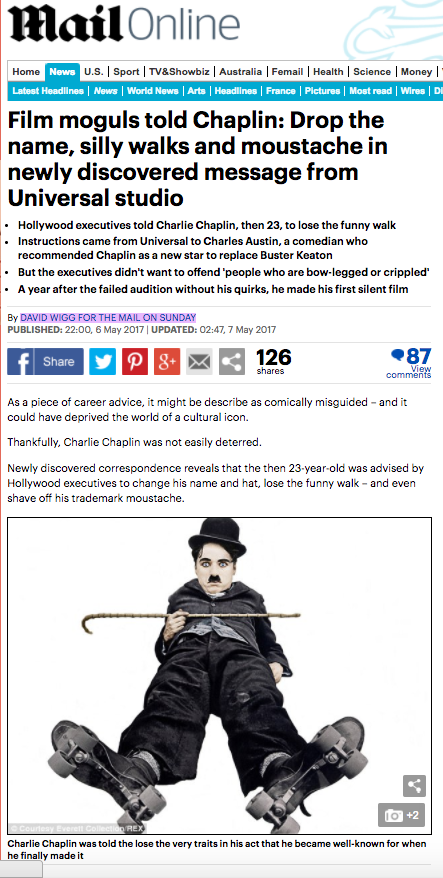
The story, written by David Wigg, who seems to be an occasional correspondent for the Daily Mail and Mail on Sunday, mostly on showbiz stories, is about a set of correspondence from 1912. The papers were discovered in the archive of the Grand Order of Water Rats, and concern one of the society’s most famous members, Charlie Chaplin.

The story goes, and please put down your tea before continuing, that Charlie Austin of the Water Rats, well-connected in London theatre circles, had recommended Chaplin to the Universal film studio in America. The executives there wanted to replace Buster Keaton, as he had become far too demanding. A reply from Universal voices several concerns about Austin’s suggestion of Chaplin as a potential film star. He would, the letter says, have to change his appearance, his act and his name. The year, I remind you, is 1912.

The studio wrote: ‘The moustache must go and Chaplin will have to change name. Too easily confused with another comic Charlie Chase. Also Chaplin sounds Jewish.’

The memo added: ‘Please send in new ideas and new name in case tests are successful. Also, do not allow Chaplin to walk comically. This may look alright on English Music Hall stages but for mass audience we must try to avoid offending people who are bow- legged or cripples. DO NOT let him over-act. Try other hats and caps, possibly even beret.’

Hold up. Yes, I know.

In a further letter, Austin says that Chaplin “strongly objects” to changing his makeup and style (as if he has discussed the offer with the actor). Undeterred, Universal pays for Chaplin to travel to the US for a screen test in January 1913, but finds him to be unsuitable for screen work even though he apparently changed his “act” for the occasion:

Universal’s verdict was scathing: ‘Test unsatisfactory. Very bland style, no personality and too short. Please keep looking for comics. Keaton becoming impossible.’

It’s a classic story of the star who got away, like Dick Rowe turning down the Beatles, or that possibly apocryphal MGM screen test for Fred Astaire, which summarised: “Can’t act. Can’t sing. Slightly bald. Can dance a little.” It also paints an unattractive picture of Hollywood types as both absurdly politically correct (concerns about mocking “cripples”) and either anti-Semitic or at least worried about pandering to that prejudice. It’s fun to look back with hindsight at fools in days gone by who couldn’t appreciate the talent that is clear to us now.

But if you have any knowledge of the facts of Chaplin’s life or of early Hollywood, this story is pretty much bilge from beginning to end – with just a smear of truth to make it believable. It’s almost impossible to know where to start with this nonsense. But let’s begin with this:

Continue reading Fact-checking a story about Charlie Chaplin, Universal and Buster Keaton

John Wick: Chapter 2, Buster Keaton and silent comedy

If you want to see Buster Keaton on the big screen next weekend, go see John Wick 2 – but be careful not to blink. The action sequel opens in New York, with a Buster Keaton movie being projected on the external wall of a building. Why? “We want to let you know we’re having fun and we stole this all from silent movie people,” says director Chad Stahelski.

As soon as you have clocked, and cheered, the reference, the action has begun, down on the streets with a blistering collision between a motorcycle and a car. The movie’s opening sequence is very funny, hugely violent, and actually a pretty clever example of how to cover a lot of exposition (for those like me who hadn’t seen the first film) with a minimum of dialogue. All you need to know about the plot, and all I can really tell you, having seen the film, is that John Wick (played by Keanu Reeves) is a hitman, with a revenge motive. The film takes him from New York to Rome and back again – and en route, he kills a hell of a lot of people.

The nods to silent cinema don’t stop with the Keaton film, though*. One of the movie’s key shootouts takes place in a hall of mirrors. Very Enter the Dragon (1973), a little The Lady from Shanghai (1947). But surely Chaplin got there first with The Circus in 1928. Despite his smart suit, John Wick is essentially a tramp like Charlie – homeless and friendless, he’s a hired hand for a shadowy and moneyed elite, and he’s happiest trudging about with his dog by his side. The film reveals a fearsome network of derelicts, in fact, assassins just like Wick who pass through the city unseen. When Wick puts on his fancy togs and goes to a party his presence is disquieting – he’s not one of the in-crowd, but someone they have hired to do their dirty work. That tension is the source of many of Chaplin’s best gags.

Continue reading John Wick: Chapter 2, Buster Keaton and silent comedy

The Gag Man review: a brutal insight into the silent comedy business

The consensus view on Clyde Bruckman was summed up by Tom Dardis, biographer of Harold Lloyd and Buster Keaton: “he was not very funny, and he drank too much”. Matthew Dessem’s The Gag Man, an entertaining and revelatory study of the writer-director, does little to erase that image, but does examine how he came to “direct” some of silent cinema’s greatest comedies, and tells one heck of a Hollywood yarn.

Bruckman was a journalist who entered the film industry as an intertitle writer, before becoming a “gagster”. The “gag men” would conceive visual jokes for silent comedies, working in groups, throwing ideas around, so it’s tricky to say who did what. However, Bruckman is credited with the brilliant concept for  Buster Keaton’s The Playhouse (1921). The star had a broken ankle, which limited his usual acrobatic display. Bruckman sketched out an idea for creating laughs out of camera trickery instead of physical exertion. Thanks to deadly timing on behalf of cameraman and star, the multiple exposures work perfectly, including a triumphant sequence in which nine Keatons dance together.

ClydeBruckman
Clyde Bruckman

Continue reading The Gag Man review: a brutal insight into the silent comedy business