I awoke with good intentions but encountered even better conversations. And thus, my film viewing on this, the final day of the 44th Giornate del Cinema Muto, began at midday, with Koko the Clown. Which is a wonderful way to begin. This cartoon, Ko-Ko at the Circus (Dave Fleischer, 1926), with our inky friend squaring off against a giant, had me in stitches – which is how I ended the day too. Apt, perhaps to start with animation when today was really all about the kiddywinks.
Continue reading Le Giornate del Cinema Muto 2025: Pordenone Post No 8Tag Archives: Stephen Horne
Le Giornate del Cinema Muto 2025: Pordenone Post No 7
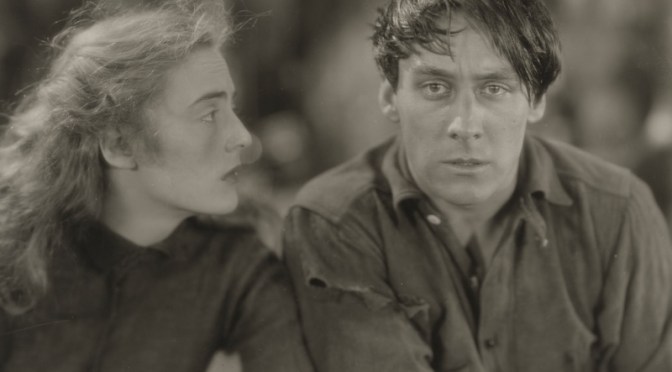
I have been a little slow to start up some mornings. But one thing you can guarantee that I will get out of bed for is Victor Sjöström. Victor Sjöström’s 1912 debut film no less, banned outright in Sweden, but available for us lucky degenerates on the capacious Verdi screen, with a truly wonderful accompaniment by Stephen Horne. Variously known as The Cruelty of the World, The Gardener or The Broken Spring Rose, this is a really special film and I do think the first title is the best one.
Continue reading Le Giornate del Cinema Muto 2025: Pordenone Post No 7
Le Giornate del Cinema Muto 2025: Pordenone Post No 2
Is it still a pathetic fallacy even if the weather is true but the drama is not? As I set out to begin my day with some major melodrama, there was heavy weather in the skies above Pordenone also. We shook off the rain in the Verdi foyer, while we prepared to dampen our faces with tears during the first of this year’s adaptations of East Lynne.
Continue reading Le Giornate del Cinema Muto 2025: Pordenone Post No 2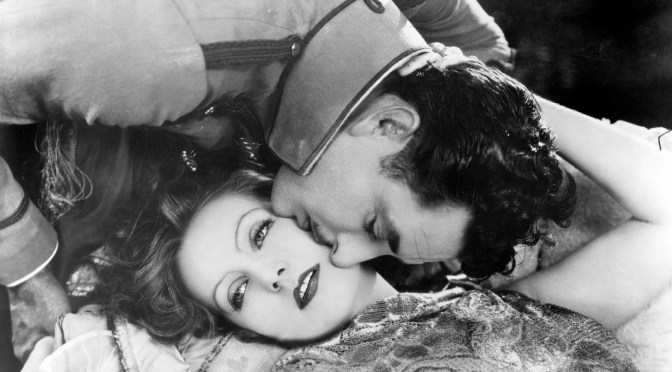
A Taste of Silents, and more, by HippFest
Is it a little hot in here… or is it just me? Outside the weather is turning autumnal, inside here I am contemplating the sizzling lineup for HippFest’s Taste of Silents season, which opens next month. Complete with Greta Garbo and John Gilbert sharing a cigarette, and much more, in Flesh and the Devil (Clarence Brown, 1926).
Stephen Horne will accompany Flesh and the Devil on piano and flute at the beautiful Hippodrome Cinema in Bo’ness, Falkirk on 20 September. This event will open the programme, which has been curated by the Hippodrome Silent Film Festival’s Young Programmers: an educational programme to support future cinema programmers and film exhibitors.
Continue reading A Taste of Silents, and more, by HippFest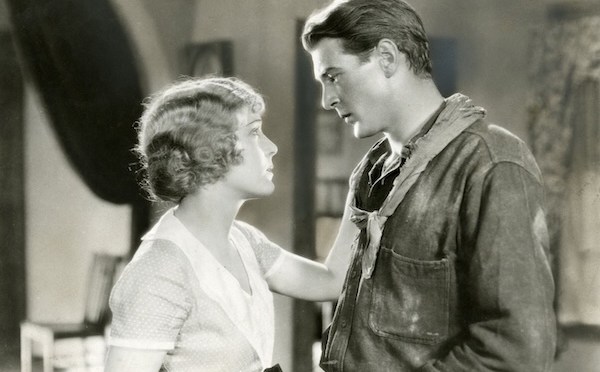
The Silent London Poll of 2024: And the winners are …
Thank you for bearing wth me during a few several technical glitches related to this year’s poll. Relax, enjoy your glass of wine-flavoured carbonated beverage, and welcome to our glittering award ceremony. I have counted the votes, and I am ready to announce the winners of the Silent London Poll of 2024!
Congratulations to all the people mentioned below – as ever, these categories were bursting at the seams with excellent, worthy nominations and a great reminder of how exciting the global silent film scene is. Thank you for all your votes, and your comments, especially.
Without further ado, let me open this giant stack of golden envelopes. Here are your winners.
1. Best orchestral silent film screening of 2024
Your winner: The Winning of Barbara Worth (Henry King, 1926), with a score composed by Neil Brand, arranged by George Morton, conducted by Ben Palmer, performed live by the Orchestra da Camera di Pordneone, at Giornate del Cinema Muto, Pordenone
I said: “t’s a big, big movie, with the youthful star trio of Ronald Colman (on $1,750 a week), Vilma Banky (on $1,000 a week) and Gary Cooper (on $50 a week!) in a desert love triangle, and a tremendously terrifying climax, as the townsfolk run for their lives when the river bursts its manmade bounds. Plus we were to enjoy the world premiere of a wondrous new score composed by Neil Brand, arranged by George Morton, conducted by Ben Palmer, and performed live tonight by the Orchestra da Camera di Pordenone. If you know the film you will know that it is celebrated for its scale, but also that this is a Frances Marion script, with a touch of melodrama (Vilma overhearing Ronald’s confession that he won’t propose to her, but not the reason why), her pet subject of adopted children, and her love of a grand theme – here the pioneers’ battle for mastery over the elements, and capitalism’s battle for mastery over the populace. You’ll also know that between the big action scenes there are several more sedate moments, discussions of policy and payroll. As, quite frankly, we have come to expect, Brand’s score was buoyant and nimble, keeping the film on its toes, teasing out the romance and flooding (yes, I went there) the auditorium with sound during those blockbuster setpieces, starting with a sandstorm in the first reel and the deluge in the last. Timed to a T, so that image and sound met in perfect harmony, and just a joy to listen to – for what it’s worth, I think it’s a winner. Geddit?”

2. Best silent film screening with a solo musician or small ensemble of 2024
Continue reading The Silent London Poll of 2024: And the winners are …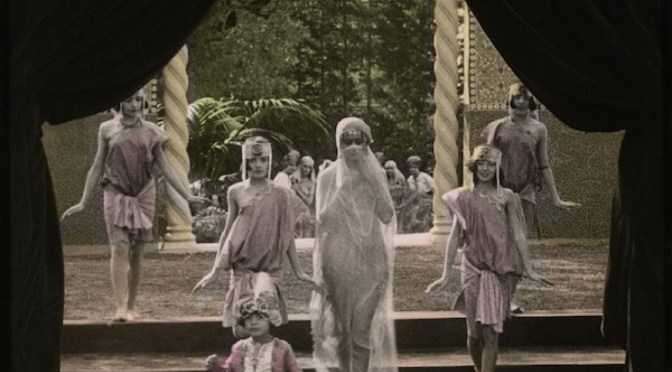
Le Giornate del Cinema Muto 2024: Pordenone Post No 5
Sometimes the old songs are the best, right? Familiarity can breed contentment. And nowhere will you find more consensus on that than here in Pordenone. So today I was happy to rewatch a couple of silent films I love, spend a little time with one of my all-time favourite silent stars. And then see something entirely new to me!
First, the old friends. This morning, we ventured back into the imaginations of Maurice Tourneur, and Ben Carré, with the 1918 adaptation of Maurice Maeterlinck’s The Blue Bird. Such a strange and beautiful, terrifying and wholesome journey into the shadow world of dreams, where bread and sugar and water have souls, the dogs and cats can talk, lost grandparents always have the table set for supper and babies wait impatiently to be born. If you have not seen this, you possibly can’t imagine quite how weirdly pretty it is. Variety’s critic wrote: “It is quite safe to assert that nothing quite like Director Tourneur’s work has ever been shown on the screen.” So hats off to Tourneur and Carré, and doubly so to Neil Brand and Elizabeth-Jane Baldry, who transported us to an enchanted realm with their music. I wrote about the film in more detail here, should you be interested.
Continue reading Le Giornate del Cinema Muto 2024: Pordenone Post No 5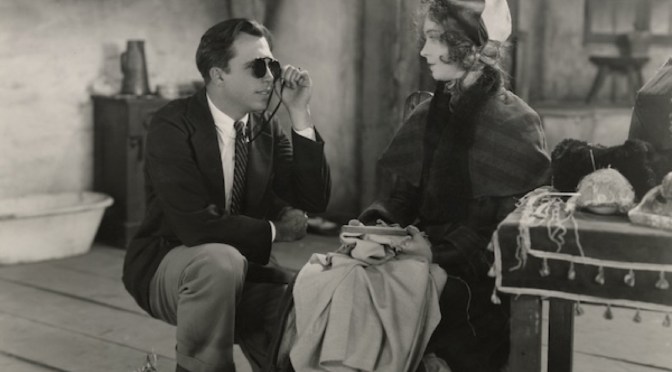
Le Giornate del Cinema Muto 2024: Pordenone Post No 2
“They’re eating the dogs. They’re eating the cats.” Proof, if proof were needed, that the American people saw through such anti-immigrant propaganda more than 100 years ago, comes in Dee-Dubya’s 1908 New York comedy Deceived Slumming Party – our first film of Sunday morning. Fraudulent tour guides promise show rich tourists the gritty realness of Chinatown and the Bowery, but the trick is, it’s all staged. Everyone in the opium den was upright and chatty before the tour group arrived, in fact, the barroom fights in the Bowery are choreographed by the bartender (DW Griffith himself) and the “meat grinder” in the Chinese restaurant kitchen, the one that the staff are “feeding” with cats and dogs and rats, is nothing but a sham.
Rich kids slumming it in Chinatown, you say? Hold that thought while we segue from comedy to melodrama, in the shape of Driven from Home (James Young, 1927), which yanked and yanked and yanked at the heartstrings with poor Virginia Lee Corbin disowned by her wealthy father after she married for love, although her devoted mother (Margaret Seddon) was on her deathbed and calling out to see her baby once more. Add to this a subway excavation accident, a scheming vamp housekeeper (Virginia Pearson), and you might not think there was room for an excursion to the Chinatown underworld but you would be wrong, as this film was playing in the Anna May Wong strand. So indeed here we witnessed a scant five minutes of Anna May Wong, as a Chinese restauranteur’s “legal wife and illegal accomplice” radiating more star power than the rest of the rest of the (perfectly good) cast could ever dream of. We understand this is a racist trope, yet it is quite nifty to think that on the evidence of this year’s Giornate, in any given situation, Anna May Wong can locate a secret door in seconds.
Continue reading Le Giornate del Cinema Muto 2024: Pordenone Post No 2
Stephen Horne’s score for The Manxman: album news
As you should know by now, this blog does indeed play favourites. And Stephen Horne’s score for Hitchcock’s The Manxman (Alfred Hitchcock, 1928) is one of my all-time favourites. I loved it at the London Film Festival in 2012, and again with the orchestra in Pordenone inn 2022. Beautiful music, flavoured with folk and nourished by emotion. The film’s not bad, either.
So I am thrilled, honestly, that this wonderful score by the award-winning Stephen Horne is going to be released as an album, via Ulysses Arts. The digital version (which may include a few extras) will be released on 10 January 2025, so bookmark this link to find out full details about digital downloads, including advance singles and pre-orders.

However, for us physical-media fans, limited copies of the CD version are available now. Rumour has it that Horne may have a few of said CDs to sell in Pordenone next week. So if you’re lucky, you can stop him and buy one.
Also next week, the first digital single will be released. I listened to it while writing this post, which is probably why there are tears on my keyboard. I have no higher recommendation…
- Pre-order The Manxman by Stephen Horne from Ulysses Arts.
- Stephen Horne will be accompanying The Manxman at Polperro Village Hall, right where the film was shot, on 19 October, a screening curated by South West Silents.
- The Manxman will be screened with Stephen Horne’s orchestral score by the 2025 San Francisco Silent Film Festival on 11 January 2025 at Grace Cathedral. I think I wrote the screening notes for this – hope I did the film justice.
Poil de Carotte (1925): a young boy’s living hell
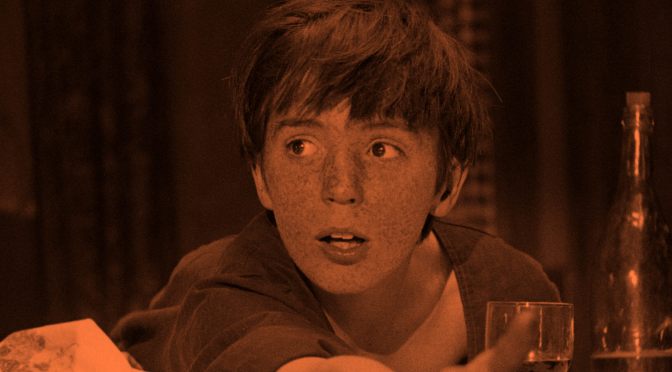
Julien Duvivier, the great French director of films including 1937’s Pépé Le Moko, was very clear which was his favourite out of his many beautiful silent films. “Poil de Carotte: without hesitation,” he said. “Of all the films I have made, this is closest to my heart.” Made, and remade. Duvivier directed this silent Poil de Carotte in 1925, and then remade it as a sound film in 1932. He later began work on a third, colour version, but this was never realised.
Poil de Carotte, or Carrot Top or Red Hair, is based on an 1894 novella by Jules Renard, the autobiographical tale of an abused, redheaded child, driven right to the edge. Duvivier had been hired to write the screenplay for a proposed adaptation of the book, to be shot by the director Jacques Feyder.
Continue reading Poil de Carotte (1925): a young boy’s living hell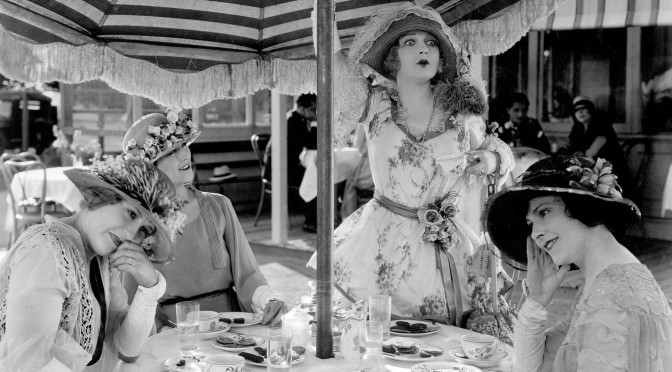
The Silent London Poll of 2023: And the winners are …
I may be a humble blogger typing at my desk, but just imagine I am a glamorous celebrity cracking first-rate jokes while wearing a designer ballgown. I have counted the votes, and I am ready to announce the winners of the Silent London Poll of 2023!
Congratulations to all the people mentioned below – as ever, these categories were bursting with great nominations. Thank you for all your votes, and your comments, which remind us all of the passion for silent film out there.
Without further ado, let me open this giant stack of golden envelopes. Here are your winners.
1. Best orchestral silent film screening of 2023
Your winner: Stella Dallas (Henry King, 1925), with a score composed by Stephen Horne, orchestrated by Ben Palmer and performed by Orchestra del Teatro Comunale directed by Timothy Brock, in the Piazza Maggiore Bologna, as part of Il Cinema Ritrovato
I said: “Before Monday night’s screening of the original 1925 adaptation of Olive Higgins Prouty’s weepie, some people in Bologna were still dropping the names of Barbara Stanwyck and King Vidor. After Monday, the talk of the town was only Belle Bennett, Henry King and Stephen Horne, whose marvellous score, alongside Bennett’s impeccable performance, left the piazza awash with tears. Horne has long championed this film, as have I, and the new restoration from MOMA is a very welcome, and beautiful thing. I really hope more people get to see this wonderful film now. Silent melodrama really can be the very finest melodrama.”
Honourable mention: Lady Windermere’s Fan (Ernst Lubitsch, 1925), at the same festival, with Timothy Brock’s new orchestral score.

2. Best silent film screening with a solo musician or small ensemble of 2023
Continue reading The Silent London Poll of 2023: And the winners are …
The Magician (1926): Rex Ingram, Michael Powell and the French Riviera
Michael Powell made films in the south of France. Before that one. His first job in the film industry was working at the Victorine studios of Rex Ingram, just outside Nice, in the mid-1920s. He was 19 and he took on pretty much any job he could on set, trying to learn the business from the ground up. It worked, didn’t it? He even appeared in front of the camera a few times, often playing a sappy creation called Cicero Simp in the Riviera Revels comic shorts.
Continue reading The Magician (1926): Rex Ingram, Michael Powell and the French Riviera
Le Giornate del Cinema Muto 2023: Pordenone Post No 2
Pordenone eh? It’s like Christmas for silent film fans. Quite literally tonight at the breathtaking conclusion of tonight’s headline film. The title was Hell’s Heroes, and we were watching the silent version of William Wyler’s 1929 sound adaptation of the story better known as Three Godfathers.
Continue reading Le Giornate del Cinema Muto 2023: Pordenone Post No 2
The Signal Tower (Clarence Brown, 1924): the romance of the rails
I originally wrote this piece for Sight and Sound in 2019, after seeing The Signal Tower at the San Francisco Silent Film Festival. I am sharing it here because the festival is making the film available to stream for 24 hours to celebrate Silent Movie Day.
On a remote stretch of American railroad, a hard-working signal operator and his family are terrorised by a snarling villain. While his pretty young wife defends her virtue against the intruder’s threats, our hero engages in a thrilling race to the rescue to save a runaway train. It could easily be the plot of one of D.W. Griffith’s early short melodramas, but this is Clarence Brown’s The Signal Tower, a fully fledged feature film from 1924, adapted from a short story by Wadsworth Camp.
Continue reading The Signal Tower (Clarence Brown, 1924): the romance of the railsIl Cinema Ritrovato 2023: women who worry and men who don’t
Someone just asked me if I were back from Bologna yet. Oops. I have been back home for over a week now, but I haven’t written anything about the festival. So here I am, to tell you what rocked my world at Il Cinema Ritrovato. This year I enjoyed a truly excellent programme, and some even more excellent company. Here are some of my highlights, of the silent variety.

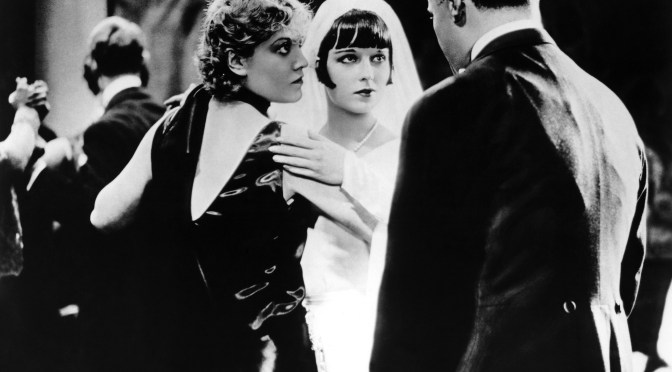
Silent dispatches Spring 2023: essays, films and festivals
Film on Film Festival
Lots to enjoy at the BFI Film on Film festival this summer (8-10 June) but now the lineup is out we can confirm that there are silents to be savoured among the banquet. British silents in fact: The First Born (Miles Mander, 1928), and two Manning Haynes films: Sam’s Boy (1922) and The Boatswain’s Mate (1924). All three films with be screened on vintage prints with live piano accompaniment, naturally. And I am also intrigued by a programme of dialogue-free “visual documentaries” dating from 1947-71 with live musical accompaniment.

Stella Dallas
Register now at the Film Foundation Screening Room for access to a stream of Henry King’s sublime Stella Dallas (1925), starring Belle Bennett. This is the new, MOMA restoration of the film, and it will screen with a recording of Stephen Horne’s gorgeous score. Don’t miss out.
Weimar Cinema Spring 2023
Remember I told you about the fabulous resource that is WeimarCinema.org? This comprehensive website is also a journal, and the Spring 2023 edition has just been published. Contents include a dossier by Oksana Bulgakova on the difficult reception of Eisenstein’s Battleship Potemkin in Berlin in 1926, as well as essays by Tom Gunning, So Mayer, Tatjana Hramova, Leonard Quaresima, Michael Cowan and Anton Kaes. Oh, and, um, me on Pabst. I especially enjoyed reading Mayer on Queer Weimar Cinema Across Borders, ahead of tomorrow’s Gender Rebels event in Bristol.
Continue reading Silent dispatches Spring 2023: essays, films and festivals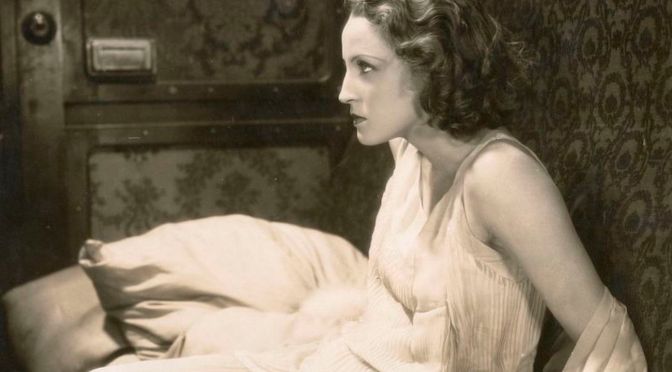
The Silent London Poll of 2022: And the winners are …
Well done everyone! The Silent London Poll of 2022 had a record-breaking number of votes, and the winners reflect a thriving, international silent film scene. Congratulations to all the people mentioned below, some of these categories were bursting with great nominations. Thank you for all your votes. And for making me blub a little when I was typing this up.
Without further ado, let me open this giant stack of golden envelopes. Here are your winners!

1. Best orchestral silent film screening of 2022
Your winner: The Manxman (Alfred Hitchcock, 1929), with a score composed by Stephen Horne, orchestrated and conducted by Ben Palmer and played by Orchestra San Marco di Pordenone, with soloists Louise Hayter and Jeff Moore, at Le Giornate del Cinema Muto, Pordenone.
I said: “Horne’s music is as deft as Hitch’s camera: always gorgeous, but sometimes delicate and other times thick with portents of doom… Needless to say, Hitch and Horne brought the Verdi to its feet once more.
Honorable mention: The Unknown (Tod Browning, 1927) with a score conducted and composed by José María Serralde Ruiz, performed by Orchestra San Marco di Pordenone, , at Le Giornate del Cinema Muto, Pordenone.

2. Best silent film screening with a solo musician or small ensemble of 2022
Continue reading The Silent London Poll of 2022: And the winners are …
Le Giornate del Cinema Muto 2022: Pordenone Post No 8
So the 41st Giornate del Cinema Muto, and my personal 11th, draws to a close with two British silent films. What is that they say about saving the best for last?
I was certainly in Italy this morning, with the Italian drama Profanazione (Eugenio Pergeo, 1924-6) – a tale of adultery, corruption, suspicious, lost pets and automobile accidents. This was spirited drama, if very heavy on the intertitles, with Leda Gys as a woman who strays and yet is more sinned against than sinning. That title translates into English as “defilement”, which gives you a sense of the subject matter, I think, and why censorship delayed the film’s release for so long. Gys is every inch the star, though notably more restrained than the diva mode, and she is the heart of this film that despite its twists and turns, is very much a serious film for grownups.
Continue reading Le Giornate del Cinema Muto 2022: Pordenone Post No 8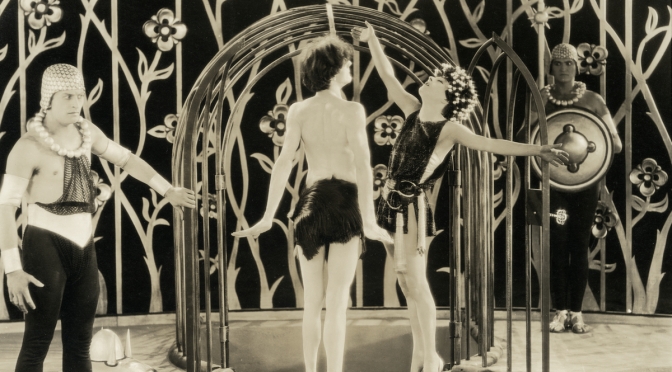
Il Cinema Ritrovato: a week in 1922
Three little words of Italian you need to learn if you attend Il Cinema Ritrovato: Cento Anni Fa. This must-see strand of the festival, curated by Bologna’s silent cinema supremos Mariann Lewinsky and Karl Wratschko, dials back the programming clock by a century. The name means simply: a hundred years ago.
So it was that this week, in between blasts of restorative Italian sunshine and shots of iced coffee, I spent a week in the 1922 cinematic universe: a world of gorgeous location photography, penetrating psychodrama, impeccable slapstick and to generalise, a healthy number of female-led films (including a handful of nasty women). It was clearly a good year for the movies, so much so that even though I skipped some of the Cento Anni Fa screenings as they were already familiar to me (or outside my days at the festival), that left plenty of room to explore some less well-trod pathways through the year, one massive restoration project and at least one cult classic that I had been saving up for a big-screen viewing. Here are some of those highlights.
Continue reading Il Cinema Ritrovato: a week in 1922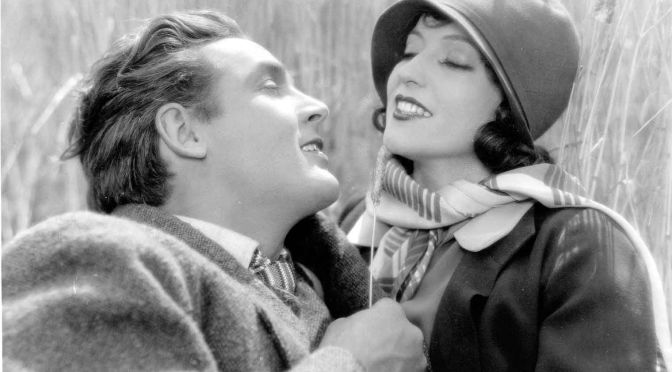
Thinking Aloud about Hippfest
You know how much I love the Bo’ness bonanza that is the Hippodrome Silent Film Festival. So this week I was honoured to appear with José Arroyo and Richard Hayne on their fantastic podcast Thinking Aloud About Film for a special episode dedicated to all things Hippfest 2022.
• You can find out more about the podcast and this episode here on José Arroyo’s marvellous First Impressions: Notes on Film and Culture blog.
Or proceed directly to the Soundcloud here:
• The podcast can also be listened to on Spotify here and on iTunes here.
• Hang out on the Hippfest website and find out more, here.
• Might be sharing another guest podcast appearance here soon, maybe… watch this space.

The Silent London Poll of 2021: And the winners are …
It may already feel like a long time ago, but 2021 was one heck of a year. We were online, we were in-venue, sometimes we were both. But we were all grateful for the films, and the music. Below, it gives me great pleasure to reveal your chosen favourites, and a selection of your insightful and amusing comments too.
Thank you for your votes. Here are your winners!
- Best real-world silent film screening of 2021
Your winner: Casanova (1927), accompanied by the Orchestra San Marco, conducted by Günter Buchwald, playing his new orchestral score
You said:
“Casanova at Teatro Verdi, by Gunther Buchwald. But I also want to mention: Shoes at the Frankfurt Schauspiele with Maud Nelissen trio and also Bett und Sofa at open-air Beykoz Kundura Istanbul with Korhan Futaci and his band.”
“I only saw one (down from pre-pandemic 30 or 40 a year). So that one wins! It was a goodie though. Pandora’s Box, 35mm, Hebden Bridge, with Darius Battiwalla. Well worth the terrifying road trip over icy moors!”
2. Best online silent film screening of 2021
 Silent London