Scotland’s only silent film festival returns to the glorious Hippodrome cinema in Bo’ness with another impressively wide-ranging programme. There are some real treasures to be unearthed here: rare screenings of little-seen but highly valued films, and innovative ways to share the magic of silent cinema with younger audiences. Gala screenings include the Dodge Brothers‘ Scottish debut, accompanying the Hollywood classic Beggars of Life, starring Louise Brooks; Jacques Feyder’s heartstopping Visages d’Enfants closes the festival, with music from Stephen Horne; Frank Borzage’s wartime weepy Lucky Star plays on the Friday night, with Neil Brand on the piano; and Jane Gardner will perform a specially commissioned new score for Ozu’s gangster drama Dragnet Girl. German group The Aljoscha Zimmermann Ensemble will provide a score for Murnau’s timeless The Last Laugh; Jason Singh will create his magical vocal soundscapes for Grierson’s landmark documentary Drifters, live at the Hippodrome.
This is a guest post for Silent London by Nina Giacomo from Brazil, who blogs at Primeiro Cinema. The Silents by Numbers strand celebrates some very personal top 10s by silent film enthusiasts and experts.
The great majority of the films made between the origins of cinema and the 1910s had colour in some way. People often don’t know that because a lot of films from the 1920s were actually released in black and white and so the evolutionary view of film history makes us think that silent cinema was deprived of colour. But, since the beginnings of cinema, a lot of research was done into colour film and two tendencies were explored: the colourisation after the film had been shot and the capture of “natural colours” while shooting.
This is not a “top 10” list … It is a selection of 10 films that show a variety of ways of giving colour to the moving image. It is my list of 10 must-watch silent colour films!
Annabelle Serpentine Dance (Edison, 1895)
The first of many films dedicated to the “serpentine dance” created by the american dancer Loïe Fuller in 1889. The hand colourisation, frame by frame, represents Fuller’s spectacular stage effects, which combined the constant flow of the dress’s movement with the projection of electrical lights.
Pierrette’s Escapades (Alice Guy-Blaché, 1900)
A vibrant example of hand-colouring made by Gaumont.
Untitled experiments (Edward Turner, 1901/02)
Theses pictures, recently discovered, are actually a series of tests for a new invention. They show how early the attempts to reproduce “natural colours” began.
A Trip to the Moon (Georges Méliès, 1902)
The colour version of this film was unknown until 1993, when it was found in Barcelona in a terrible condition. Not until 2010 could the restoration could be released and it transformed the image we have of this most iconic of all silent films.
The Lonedale Operator (DW Griffith, 1911)
Here we have an interesting use of colour in silent cinema. The young lady can only trick the bandits (making them believe that she has a gun, when actually it is a wrench) because the scene takes place at night. The blue tinting suggests the time of day.
This classic has just been restored and the new version will be shown in February at the Berlin International Film Festival with its original tinting and toning … I can’t wait to see it.
Virginian Types: Blue Ridge Mountaineers (1926)
An amazing example of Pathécolor, just recently discovered. It shows us a late use of this method that was pioneered by Pathé in France during 1905. Stencils were used to automate the hand-colouring of films.
Lonesome (Paul Fejos, 1928)
A hybrid in many ways: this is a silent, talkie, black-and-white and colour motion picture. The colour scenes are just marvellous.
The Love Charm (Howard Mitchell, 1928)
And here is a little known example of the two-colour Technicolor process. A weird love story in amazing colours.
Nina Giacomo
Do you agree with Nina’s choices? Share your suggestions below
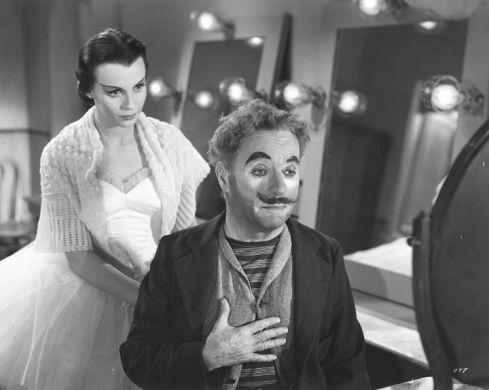
Claire Bloom and Charlie Chaplin in Limelight (1952)
Don’t tell me you missed the fact this year, this February in fact, we are celebrating 100 years of Charlie Chaplin’s Tramp. Kid Auto Races, Chaplin’s first screen appearance as the anarchic scruff, was released on 7 February 1914. It’s a cinematic centenary of the best kind – one that affords the opportunity for screenings of wonderful films and some clever-clever comment and analysis too. An event at the BFI Southbank on 4 February will add a little star power to proceedings, as well as some new insights into the Tramp and his creator.
At The Centenary of the Little Tramp David Robinson will be talking specifically about how Chaplin drew on the music hall tradition of his youth to create his signature character – and how those influences stayed with him and found a beautiful expression in the gorgeous 1952 film Limelight.
This special event marks the centenary of the birth of Charlie Chaplin’s ‘little tramp’. One hundred years ago this week the iconic character first stepped in front of the camera at the Keystone studios. David Robinson, Chaplin’s official biographer, presents his latest thoughts on Chaplin and the tramp and celebrates the launch of his new book ‘The World of Limelight,’ commissioned by the Cineteca di Bologna, which draws on previously unpublished material from the Chaplin Archive.
Robinson will be launching his book at the event and I think copies will be on sale after the talk with perhaps a booksigning too. A particularly well-informed little bird tells me that Chaplin’s co-star in Limelight, English actress Claire Bloom, will be in attendance also. In fact, Robinson’s book is dedicated to her. Here’s a little more about the book:
Limelight was first cast not as a film script, but as a long novella, Footlights, with the supplementary Calvero’s Story. Both are here published for the very first time – the ultimate raison d’être of this volume. Out of these Chaplin extracted a screenplay which passed through several drafts before being transferred to the screen.
The accompanying commentary in this volume explores the documentary reality of the world which Chaplin recreated from his memories and evoked for posterity – London, the music hall and ballet at the end of an era, the outbreak of the First World War. The book is illustrated with images from the author’s own collection, and reproductions of documents and photographs from the Chaplin archives, which clearly depict the development of the film LIMELIGHT that David Robinson so intricately describes.
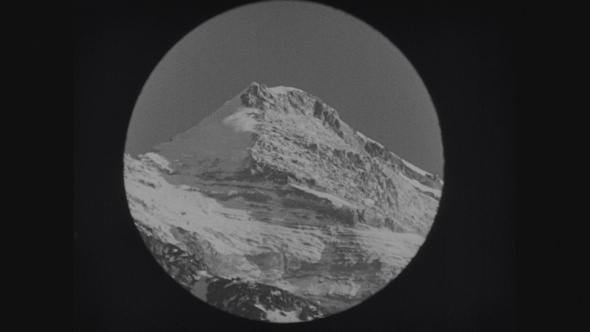
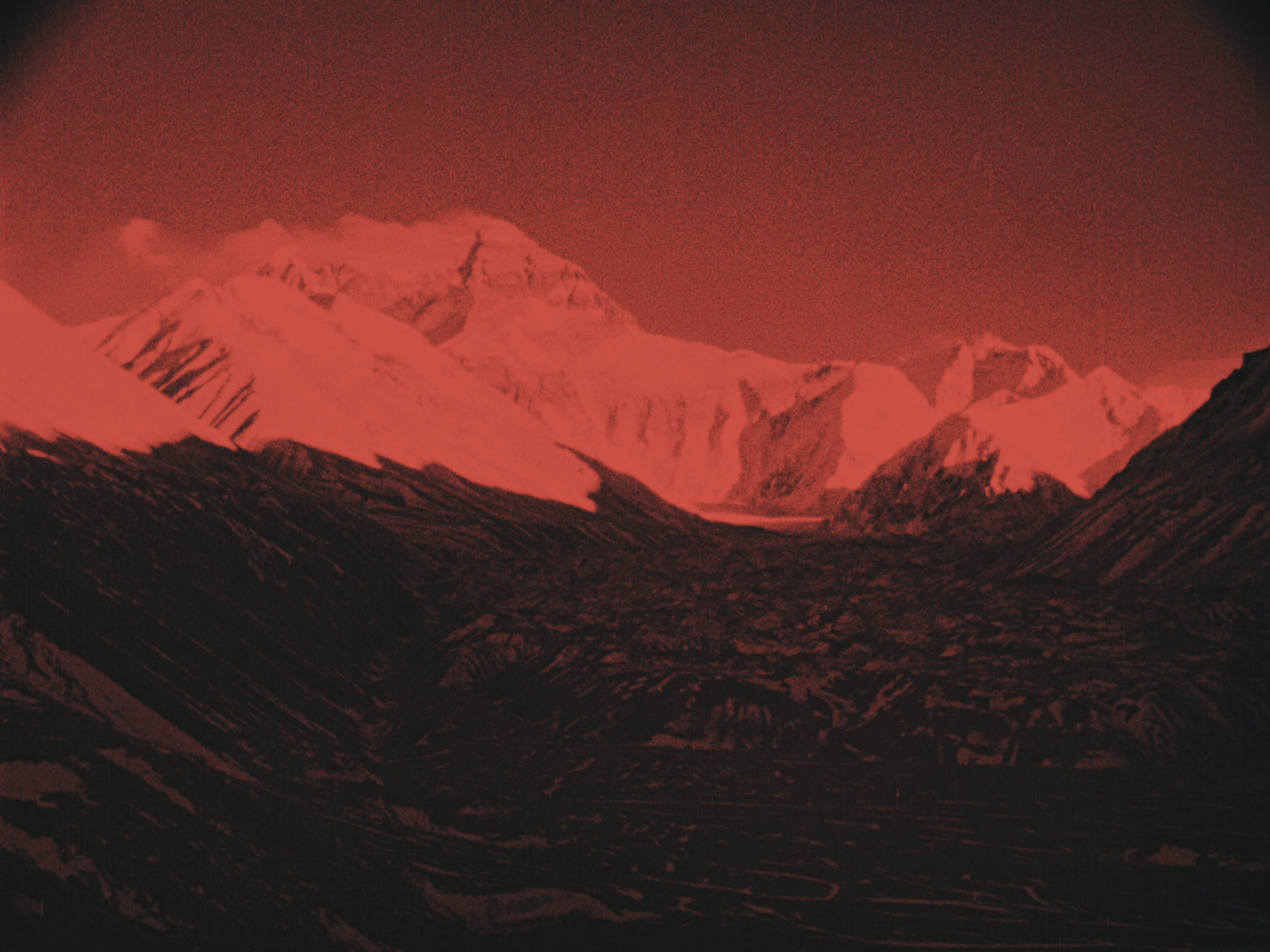
There has been plenty of chat on this blog, and elsewhere, about this fascinating, haunting documentary. Captain John Noel’s chilling film of the Mallory and Irvine’s doomed attempt to conquer the summit of Everest is a work of art, a testament to wild ambition, and a record of the prejudices and misconceptions of its era. For cinema audiences, the spectacle of the film – magnificent mountainscapes, drenched in red or blue tints – came first. Seen on the big screen, The Epic of Everest is utterly mesmerising.
So this home video release has to satisfy two camps. There will be those with deluxe home cinema setups who want to recreate the thrills of the cinema experience – and they will be happy with the high-definition transfer on the Blu-Ray disc here. The images are crisp and stable, with those beautifully rich tints adding real splendour to the scenery. But I suspect a more substantial group, knowing that The Epic will lose a little of its visual power on their TV screen, will want to go deeper into the film, will be looking for history rather than spectacle.
The Epic of Everest (1924)
Luckily the secound group is especially well-served by the presentation here. There are featurettes on the making and restoring of the film, as well as a thick booklet of essays, archive images and background information. You’ll remember that Simon Fisher Turner turned in another glacial score for The Epic – sleek, experimental themes comprising electronica and found sounds. There’s a documentary on his work here too, but just in case you’re about to slip out of the door in disgust – hold on.
The Epic of Everest (1924)
With this package, the BFI invites you to step back in time to 1924 and experience The Epic of Everest as its first audience did – well within reason. Those who buy the DVD version can download a PDF of the original programme from its premiere at the Scala, and – which may come as a surprise to a few people – you can watch the film with its original orchestral score here too. The score was recorded by the Cambridge University Chamber Orchestra and appears as an option alongside the new music, mixed in stereo. It’s less nuanced to 21st-century ears, perhaps, than the new music by Fisher Turner, but its lushness (it sounds almost like a ballet score) is totally immersive. There are some added musical snippets here too – all pieces that would have accompanied the first 1924 screening. If I had a pound coin for everyone who lamented to me that a new release of a silent had a modern score without a more “traditional” version as an audio option, I’d be able to buy a round of drinks for a full house at NFT2, so this is a welcome piece of news. Hats off to the BFI, and to Julie Brown who oversaw the reconstruction of the original music.
For more information, and to buy The Epic of Everest on DVD and Blu-Ray, please click here
This is a guest post for Silent London by noted silent cinema musicians Neil Brand and Philip Carli. The Silents by Numbers strand celebrates some very personal top 10s by silent film enthusiasts and experts.
There are more of these X-rated moments than you might think and people will have plenty of their own choices according to taste, shockability and squeamishness. By definition, all silent cinema is pre-Code and Will Hays was brought into the Hollywood fold as censor in the 1920s not just because of Hollywood’s own scandals, but because filmmakers were pursuing stronger, more adult storylines and nobody seemed to be taking the lead on what was acceptable. So, by way of giving the lie to the idea that silent cinema is somehow cinema in adolescence, here’s a list of some memorable times when the boundaries were pushed, in descending chronological order.
All Quiet on the Western Front (1930)
All Quiet on the Western Front (1930)
And yes it was also released as a silent! A soldier grips the barbed wire during an attack, a shell explodes and only his arms remain hanging from the wire. One of many unforgettably horrific images from this great film.
Diary of a Lost Girl (1929)
Diary of a Lost Girl (1929)
The brothel dance as the couples peel off to their various rooms is as easygoingly suggestive as you could want and easily more “real” than anything Von Stroheim could have dreamed of. Mind you, Louise Brooks would undoubtedly have made it into this list somewhere.
Joan Crawford and Norman Kerry in The Unknown (1927)
The Unknown (1927)
Having cut off his own arms for love of Joan Crawford (who can’t bear to be touched), murderer Alonzo (Lon Chaney) has to watch her responding sensually to the arms of a circus Strong Man (Norman Kerry) she has fallen in love with. Again, most Chaney films would qualify for this list, particularly the Tod Browning ones, for a whole different set of reasons. The Penalty, Victory, West of Zanzibar, all feature scenes or entire plotlines that would have trouble getting past the censor five years later. Meanwhile, Joan Crawford had already made at least one appearance in an extant pornographic film while still a struggling actress.
Captain Salvation (1927)
Captain Salvation (1927)
An X-certificate intertitle in which Pauline Starke screams at Lars Hanson “My step-pa ‘helped’ me once – a good thing the baby died!”
The Flame of the Yukon (1926)
The Flame of the Yukon (1926)
A fiery end for the villain in this movie (if memory serves) who is set alight by a kerosene lamp thrown at him, the flames only being quenched when he falls to his death.
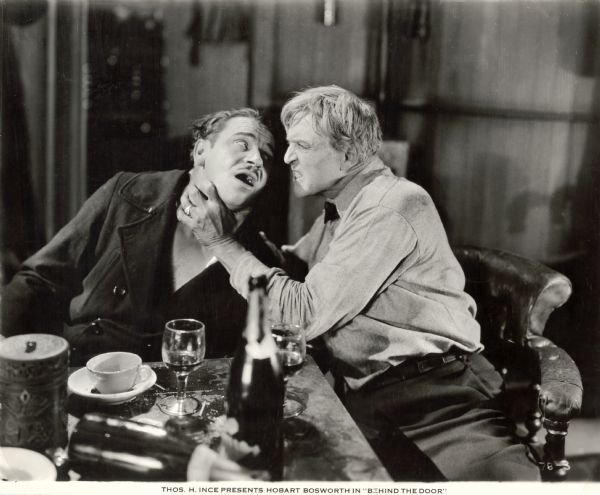
Behind the Door (1919)
Behind the Door (1919)
With memories of WW1 still fresh in the minds of audience and makers alike, this uncompromising tale of a husband’s bloodthirsty revenge on brutal German submariners who raped his wife ends with the title “I tried to skin him alive but the sonofabitch died on me!”
Intolerance (1916)
DW Griffith gave Babylon the full treatment, including a bathing orgy with lovingly shot nudes. Even more so than was the case with Cecil B De Mille and scantily clad classical maidens, Griffith seems to have demanded jaw-dropping realism and sensuality from his cast.
The Cheat (1915)
Sessue Hayakawa brands Fannie Ward in unflinching close-up, because as he puts it, he brands “all his property …”
Hypocrites (1913)
Lois Weber’s film has a quite gorgeous “Naked Truth” wandering through most of the four allegorical reels. Although this was obviously intended to edify rather than titillate, audiences were unlikely to have been as artistically mature about this as Weber might have hoped. Mayor James Curley of Boston supposedly insisted that clothing be painted on her in every frame in order to get the film past the city censors.
An Interesting Story (1904)
A man gets run over flat by a steamroller in James Williamson’s An Interesting Story – OK, two cyclists inflate him back to life again, but think what a shock it would have been to audiences of the time!
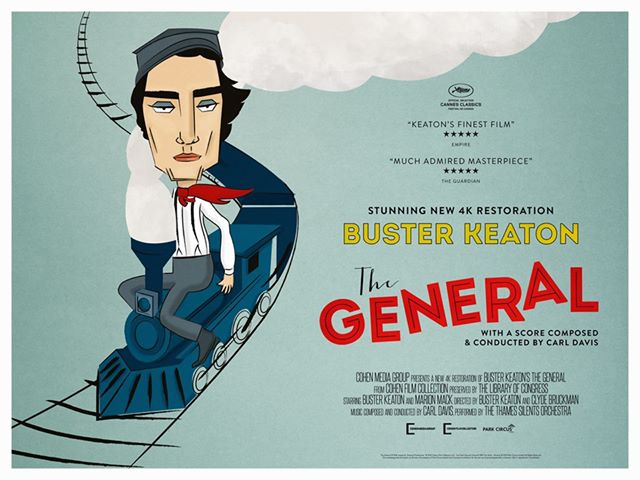
Buster Keaton’s The General (1927) goes on theatrical release this Friday – which should be cause for celebration and mass ticket-buying among all of you. However, if you are a regular reader of this blog, you have probably seen this classic, poll-bestriding Civil War caper before, very possibly in the dim and distant. What worries me, what keeps me up at night, is that if so, you may feel a bit “so-whattish” and “seen-it-all-beforeish” about Keaton’s masterpiece. That would be a tragedy, as The General is one of the funniest, most ingenious and gosh-darn exciting films you will ever see in your long and happy life. If familiarity has bred a touch of contempt, or just complacency, in your bosom, I would gladly bend your ear about the pin-sharp 4k transfer, and the booming rendition of Carl Davis’s nimble and turbo-charged score on this digital print. But that geeky stuff isn’t for everyone, so if that doesn’t tempt you, here are five more reasons to see The General … again.
The early, funny stuff
So we all know The General as a chase film, packed with stunts and crashing locomotives. Well, it actually starts in a very sedate fashion, as our hero Johnnie (Buster Keaton) goes to visit his girl Annabelle, who prompts him to enlist and fight for the South. Patience is a virtue – don’t be in a rush to get to the fast and furious business on the tracks. Johnnie’s pratfall as he leaves Annabelle’s house, the beautiful recruiting-office sequence and that wonderful selfie of Johnnie and his other beloved are all worth arriving at the cinema nice and early for. The scene-setting opening ends with one of the quietest, but most dangerous stunts in the whole movie, as Johnnie perches forlornly on the coupling rods of a locomotive that is picking up speed …
Annabelle Lee
The General‘s Southern belle is far more than a damsel in distress. To be frank, she’s a pain in the neck – watch her daintily selecting firewood and feel Johnnie’s pain. But to be fair, she takes more than her share of punishment too: kidnapped, soaked (twice), caught in a bear trap, stuffed into a sack and loaded as freight. Not only that, but consider this: to paraphrase Ginger Rogers, you try doing everything Buster Keaton does, but backwards and in a crinoline.
There is another reason to take note of Annabelle – she is played by a fascinating woman. Marion Mack knew more than most about the silent movie business. A former Mack Sennett Bathing Beauty, she later turned her hand to screenwriting, including a semi-autobiographical flick called Mary of the Movies, which she also acted in. In the the 30s, she even wrote a talkie short for Keaton. And when critical favour began to smile on The General in the 70s, she was on hand to speak at screenings and festivals, explaining what it was like to play one of Keaton’s not-so-straight women. We don’t have opportunities like that any more, so thank you Marion.
Yes, that is a real train
The one that falls through the burning Rock River Bridge? Yup. It’s not a model (you’re thinking of The Blacksmith). And if you thought it was CGI – shame on you. Famously, the destruction of the train in The General is the most expensive shot in silent movie history, and it’s a salient reminder that everything you see on screen here is real – including the danger that Keaton and Co frequently faced as they went about those wild stunts.
Those damn Yankees
Marion Mack isn’t the only thing here that gives us a flashback to Mack Sennett’s mid-teens romps. Those Yankee soldiers giving chase to Johnnie and Annabelle are enjoyably, hilariously inept. Hoot as a whole gaggle of them fail to fix the points our man has so thoroughly snookered, until their driver appears with a an axe and a shove; chortle as they topple like dominoes with every jolt of the engine. These buffoons are Keystone Kops in all but name. A guilty pleasure in a very sophisticated film.
War is hell
It’s not all larks and big kids playing with big train sets, of course. The General is a war movie, based on a true story – the hijacking of a train headed for Chattanooga, Tennessee. And it’s easy to forget that The General has a rather grim battle scene of its own, with swords and snipers and several deaths. Even the jokes fail to lighten the mood here. The flag gag, in which Johnnie grabs a confederate pennant from his falling comrade’s hand, and waves it in victory from a rocky outcrop, only to discover he has seriously misplaced his feet, is an unexpected splash of black humour. It’s a nifty moment that sharply undercuts any jingoistic vibes you may get from this story of a plucky underdog and his little engine that could.
Bonus reason
If you see The Generalon its extended run at BFI Southbank, it will accompanied by Keaton’s sublime early short One Week. If you were to ask me, right now, which of the two were the better film, I would have to say … “tough call”.
This is a guest post for Silent London by Alison Strauss, director of the Hippodrome Festival of Silent Cinema, Bo’ness. The Silents by Numbers strand celebrates some very personal top 10s by silent film enthusiasts and experts.
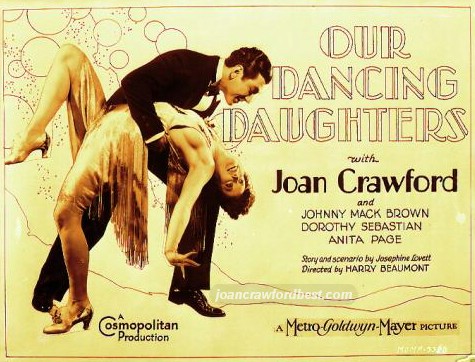
Our Dancing Daughters (1928)
Our Dancing Daughters (1928, Harry Beaumont)
The moment when fun-loving flapper Joan Crawford launches herself on to the dance floor and sets the party alight with a high-tempo Charleston, ripping her skirt to a more liberating length as she goes.
Danse Serpentine (1896, Auguste and Louis Lumiere)
The 45-second kaleidoscopic record of a vaudeville dance – created by pioneering dancer Loie Fuller – in which an anonymous performer elegantly whirls her arms in the long-flowing fabric of her costume to mesmerising effect, thanks to the immaculate hand-tinting work of the Lumiere Brothers’ army of finely skilled women behind the scenes.
Pandora’s Box (1929, Georg Wilhelm Pabst)
Trained dancer and former Ziegfeld Follies girl, Louise Brooks is electrifying as Lulu, especially when, with all eyes on her, she takes to the floor at her own wedding with yet another admirer – a female guest – and the pair dance in a sexually charged vertical embrace.
The Four Horsemen of the Apocalypse (1921, Rex Ingram)
Another raunchy tango, this time with Rudolph Valentino in a sequence that launched him as a legend. The woman in Julio’s arms submits to his overpowering masculinity in this iconic routine that set the standard for all subsequent movie tangos.
(Watch from 14 mins, 50 seconds)
That’s My Wife (1929, Lloyd French)
Stan Laurel is persuaded by Oliver Hardy to masquerade as his wife in order to secure the bequest of a rich uncle. In one of the funniest sequences Stan, looking lovely in an evening gown, dances the two-step with Ollie in an effort to shimmy a stolen necklace down through his undergarments!
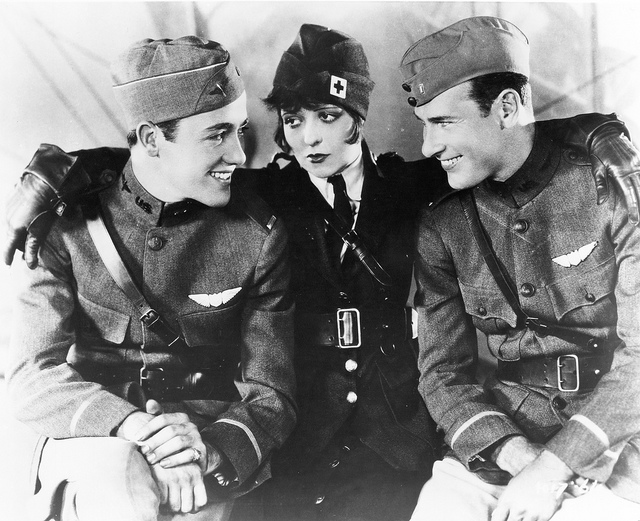
Richard Arlen, Clara Bow and Charles Rogers in Wings (1927)
This is a guest post for Silent London by Alex Barrett.
Long legendary as the first – and only – silent film to win an Academy Award for Best Picture (at the very first ceremony, back in 1927), Wings now comes to us in a stunning new restoration, courtesy of Eureka’s ever-dependable Masters of Cinema label. The film tells the story of Jack (Charles “Buddy” Rogers) and David (Richard Arlen), who compete for the affections of Sylvia (Jobyna Ralston), before becoming comrades in the airfields of World War I. Star power was added by the original “It girl”, Clara Bow, in the role of Jack’s neighbour, Mary – the pure-eyed girl next door with an undying love for our hero.
If this setup – minus the Mary strand – sounds familiar to silent film fans, it’s perhaps due to a striking similarity to the setup of Abel Gance’s J’accuse (1919), in which two rivals in love become comrades on the battlefields of World War I. However, if the overall plot of Wings at times resembles that of J’accuse, it does so without that film’s stringent anti-war message – and without its power.
Richard Arlen and Jobyna Ralston in Wings (1927)
In Wings, we are often told of the “horrors” of war in the title cards, but rarely do we see them. Even towards the end, when the body count begins to rise, it never feels as if we’re given a true sense of the barbarity of war. Compare, for instance, the lightness of the scenes detailing the cancellation of the soldier’s leave with the devastating impact of the equivalent scenes in Raymond Bernard’s Wooden Crosses, released just five years later. The closest Wings gets to touching upon this darkness is its final tragedy, but even there the film doesn’t quite hit home, despite the characters explicitly saying that the “war” is to blame. Wings was made with the assistance of a military in need of good PR, and perhaps it’s this that led to the film becoming a paean to the “young warriors of the sky” (as with J’accuse, real soldiers acted in the film, many of whom had seen service in the Great War). It’s a fine tribute to those who fought but, in being so, there remains a whiff of propaganda around the film’s portrayal of the chivalric life of these “knights of the air”.
This is a guest post for Silent London by Paul Joyce, who blogs about silent and classic cinema at Ithankyouarthur.blogspot.co.uk. The Silents by Numbers strand celebrates some very personal top 10s by silent film enthusiasts and experts.
Cinematic dreams are a staple of the silent era more than any other, possibly because much of what was on screen had only previously been experienced in dreams for contemporary audiences. Now our dreams are founded on over a century of cinema and we’re so much harder to impress but … we can still dream on. Here’s a top ten of silent dreams with a couple of runners up as a bonus.
The Astronomer’s Dream (1898)
A madly inventive three minutes from George Méliès in which an old astronomer is bothered by a hungry moon as the object of his observation makes a rude appearance in order to eat his telescope.
Dream of a Rarebit Fiend (1906)
A feast of special effects in Edwin S Porter’s cautionary tale on the matter of over-indulging in beer and cheese. Jack Brawn plays the titular fiend who suffers all manner of indignities once he staggers home to his bed, whereupon his sleep is interrupted by rarebit imps and his bed flies him high into the night sky … Proof that the whole cheese-and-dreams rumour is actually true.
Atlantis (1913)
Atlantis (1913)
In August Blom’s classic – the first Danish feature film – Olaf Fønss’ doctor dreams of walking through the sunken city of Atlantis with his dead friend, as the passenger ship he is on begins to sink. It’s either a premonition or recognition that his true feelings have been submerged … JG Ballard was obviously later inspired to write The Drowned World.
Poor Little Rich Girl (1917)
Poor Little Rich Girl (1917)
After being accidentally overdosed with sleeping draught by careless servants, Mary Pickford’s character falls into a deep and dangerous sleep … As she hovers on the edge of oblivion the story runs parallel between the doctor trying to save her and her dreams in which those she knows are transformed in her Oz-like reverie. Sirector Maurice Tourneur excels as “the hopes of dreamland lure the little soul from the Shadows of Death to the Joys of Life”.
When the Clouds Roll By (1919)
When the Clouds Roll By (1919)
Douglas Fairbanks is harassed by vengeful vegetables after being force-fed too many in an effort to drive him to suicide (yep, it’s a comedy). Directed by Victor Fleming, who later returned to dreams with Dorothy and that Wizard. Continue reading The top 10 silent film dream sequences→
This is a guest post for Silent London by Kelly Robinson, and the first in a new series of posts bringing you very personal top 10s from silent cinema experts and enthusiasts.
From a programming point of view, it’s always good to have a few shorts up your sleeve: either to accompany a feature or to make up a shorts programme, which are always a good way to introduce new audiences to silent film. I’m trying to write short screenplays at the moment and I’m inspired by these film-makers, several of whom spent the majority of their careers working on shorts.
How to be an American Citizen (Alice Guy-Blaché, 1912)
Made in the US by Solax, film pioneer Alice Guy-Blaché’s production company, this is such a brilliant darkly anarchic comedy. View the version on the Retour de Flamme (06) disc by Lobster Films for one of the most inspired accompaniments to a silent film.
Ménilmontant (Dimitri Kirsanoff, 1926)
Breathtakingly stylish (talk about Eisenstein’s “kino fist”!) but also heartbreakingly moving, this is avant-garde cinema of the 1920s at its most profound. The scene on the bench is as poignant as anything by Chaplin or more recent master Krzysztof Kieslowski. Unforgettable.
Charlie Chaplin in Kid Auto Races (1914)
Kid Auto Races (Henry Lehrman, 1914)
Chaplin’s Keystone films are sometimes written off as unsophisticated fare, preceding a more nuanced approach to style and content at later studios. However, Chaplin’s performance here is pure clown, and shows why contemporary audiences immediately wanted more, more, more of “The Little Fellow”.
Leave ’em Laughing (1928)
Leave ’em Laughing (Clyde Bruckman, 1928)
I just have to think about the final sequence of the Laurel and Hardy classic and I start chuckling madly to myself.
Daisy Doodad’s Dial (Florence Turner, 1914)
“The Vitagraph Girl” pulls a face at being one of the first screen stars.
The Battles of the Coronel and Falkand Islands (Walter Summers, 1927)
This is a guest post for Silent London by Jo Pugh, based on hitherto unpublished information about the military record of British film director Walter Summers.
“I did fairly well in the war – not that it would interest you very much.” – Walter Summers, interviewed by Garth Pedler in 1972
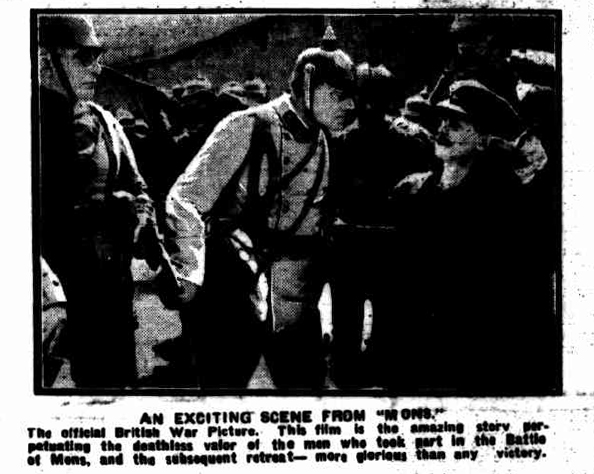
In 1924, Metro-Goldwyn-Mayer went to town on the international distribution of the British war film Mons, from the British director Walter Summers. Chronicling the 1914 defeat of the British Expeditionary Force in France (but a defeat as great as any victory – to paraphrase a classic Summers intertitle) Mons was promoted alongside Ben-Hur and its director “Captain Walter Summers, D.S.O., M.C.” praised for his wartime experience. One newspaper went further, asserting that Mons had “a genuineness and a reality that could only have been achieved by a director who had actually lived and fought during the immortal retreat.”[1]
Mons
History written by the victors is one thing, but history written by movie studio advertising executives may not meet the highest standards of evidence: Walter Summers did not fight at Mons, Walter Summers was not a Captain in the Great War, Walter Summers was not the recipient of a DSO. But the truth is not any less interesting. Walter Summers was a highly decorated war veteran but the precise details of his early life and military career have become a little mangled through a combination of hazy memory and the application of a bit of stardust. Surviving records allow us access to a little understood side of Summers and seem to place his film career in a slightly different light.
Walter Summers’ birth certificate
Walter George Thomas Summers was born on 2 September 1892 in the West Derby district of Liverpool. This date has become confused, probably because Summers seems so confused about it himself, writing conflicting ages on just about every official form going. His mother and father were both actors, his father (also Walter) a member of one of D’Oyly Carte’s touring companies who had a close association with Liverpool’s Royal Court Theatre. He died when Summers was quite young, leaving his mother, Mary Ann, to bring up Walter and his three sisters, Mary, Beatrice and Irene in Liverpool. In the 1911 census, Walter gives his occupation as “Theatrical Property Maker” – his association with the theatre began very early. On his application to become an officer, Arthur Lawrence, manager of the Royal Court Theatre, Liverpool, testifies as to Walter’s good character for the period 1903-6[2], in other words from the age of about 11 to 14. In their haste to join up in 1914, many young men lied about their age. Summers was a more seasoned 22 (though, characteristically, he wrote 21 on his form) and unlike many of his compatriots was not contemplating leaving England for the first time: he had already travelled to Australia and South Africa with Thomas Quinlan’s opera company, prior to his first film work with London Film Productions. This latter role probably culminated in work on George Loane Tucker’s version of The Prisoner of Zenda[3], in which a certain amount of armed European conflict is treated with all the seriousness of a works outing.
A thorougly Prussian baddie: Arthur Holmes-Gore as Duke Michael of Strelsau in The Prisoner of Zenda (1915). Holmes-Gore was killed at Gallipoli
London Film’s studio was a former skating rink at St Margaret’s, just over Richmond Bridge, which explains why Summers, the Liverpool boy, joined the army at Kingston. He joined up in October 1914, less than two months after the defeat at Mons. In retrospect, MGM’s claim that he fought at the battle is not very plausible: only members of the British Expeditionary Force, regular soldiers who had joined up before the war started, fought at Mons. Summers was a member of Kitchener’s volunteer army and would have been among the first significant wave of recruits to reach France. Even so, he didn’t leave England until the autumn of 1915, almost exactly a year after he had joined up. Joining as a private, Summers quite quickly rose to the rank of Sergeant in the 9th battalion of the East Surrey Regiment. This battalion is most closely associated with the playwright RC Sherriff, who used his experiences serving within it as the basis for his most famous play Journey’s End, subsequently directed on stage and then in 1930 on screen by James Whale, who had himself served in the Worcestershire Regiment. Summers and Sherriff knew each other but seemingly as comrades, not friends. Summers arrived in France a year before Sherriff and shortly after the battalion had suffered appalling losses at the battle of Loos. Subsequently, the 9th East Surrey fought at Ypres and the Somme. At the latter in July 1916, Summers was awarded the Distinguished Conduct Medal for his service at the Battle of Delville Wood. “A nightmare that men will dream again,” wrote the journalist Philip Gibbs, of the month-long conflict over the small piece of woodland believed to offer some tactical advantage. By the end of it, thousands had been killed and barely a tree was left standing.
Military Artist drawing of the Battle of Delville Wood, The Somme. July 1916. First published in “The Great War” Ed. H.W. Wilson, 1917
Summers won his Military Medal for leading a fighting squad of eight men from the battalion in a risky daylight raid on 25 January 1917 near Hulluch, in the Pas de Calais. One of six such squads, with orders to identify the unit opposite, “inflict losses” and obtain a sample of German bread, the small force ran across no man’s land under the cover of somewhat tardy smoke bombs and a smattering of “wild and erratic” machine gun fire.[4] With the element of surprise, the British killed a number of Germans (Summers shot at least one) before meeting “hostile resistance”. Summers’ group were among the last to withdraw from the German trenches. The force returned with three prisoners and the bread sample. By its own account it had suffered seven casualties and inflicted around 21. German records in contrast put their losses at eight.[5] Summers was personally commended for “the determined and fearless leading of his fighting squad”. Reading the description of the attack in the unit’s war diary, it is impossible not to be reminded of the raid depicted in Journey’s End. This is because it was indeed Sherriff’s inspiration for the attack that preoccupies his characters in the second half of the play.[6]
Mark Kermode’s passion for the silent film and live music scene, expressed here in a video interview with the utterly brilliant New Empress team, is always heartening. I wish he would talk about a wider selection of movies though. Keep up to date with when Mark’s band the Dodge Brothers are accompanying silent films on their website here.
You can watch Mark talking some more about silents here, from the Kermode Uncut video blog in 2009:
And here he is at the Cinema Museum talking about silent movie accompaniment with Neil Brand:
Janet Gaynor and her Christmas tree, via the Toronto Silent Film Festival
Merry Christmas and a happy new year to all our readers!
It has been a very busy year – in the best kind of way. We witnessed the long-awaited return of Napoléon to the capital, a short but fascinating British Silent Film Festival – and the birth of a new intimate screening series, the Kennington Bioscope at the Cinema Museum.
There have been some wonderful screenings at our favourite venues – from the Gothic silents at the BFI Southbank to a range of international films at the Barbican cinema. Retrospectives of Marcel L’Herbier and Jean Grémillon at both venues introduced many of us to the further reaches of French silent cinema. Theatrical releases of Underground, Nosferatu and The Epic of Everest boosted silent movie awareness hugely. Blancanieves proved that the art is not lost.
On a personal note, I was lucky enough to visit the festivals at Bologna and Pordenone, and I have enjoyed another year of blogging, writing and speaking about the silent cinema I love.
Next year, we’re anticipating a Buster Keaton season at the BFI Southbank, the 10th Slapstick festival and several events to mark the centenary both of the Little Tramp and the onset of the first world war. For more details, of course, you can check the ever-expanding listings.
But before we get too ahead of ourselves, let me know below what your highlights and yes, maybe lowlights, of 2013 were silent-film wise. Was it a good year for the silents?
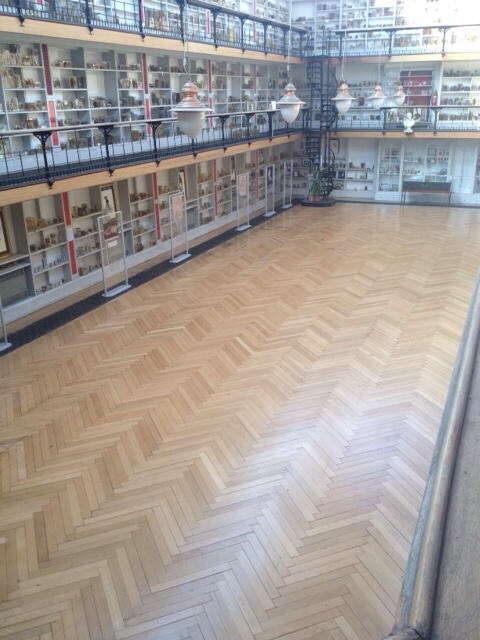
A drink, a snack and a temptingly toothsome silent movie? Perhaps with some live music too? And all in one of the coolest venues in London? I am super-excited to announce that Barts Pathology Museum (as promised, here on these very pages) is hosting a short silent film season in January. The films have been chosen because we think they are fabulous, and because they also have some relation to the research and study that goes on at Barts.
First, a recap. If you don’t know Barts Pathology Museum, that is because it is one of the capital’s best-kept secrets – a stunning Grade II listed 19th-century hall where quirky medical specimens are displayed. The hall has a glass roof, because once upon a time medical students would dissect cadavers there. You can read more about the history of the museum and its many fascinating artefacts on the museum blog, here. Entry to the museum is by appointment only, but the doors are open on selected evenings for a series of lectures and events on subjects ranging from film noir to taxidermy to dentistry. Your humble scribe was there last November, giving an illustrated talk on silent cinema.
The January screenings are supported by Hendrick’s Gin, and entry to each film includes a G&T and some delicious, freshly popped popcorn as well as the film. I will be there to introduce the screenings and the the first movie in the series features live musical accompaniment, too. Here’s what’s coming up in the new year.
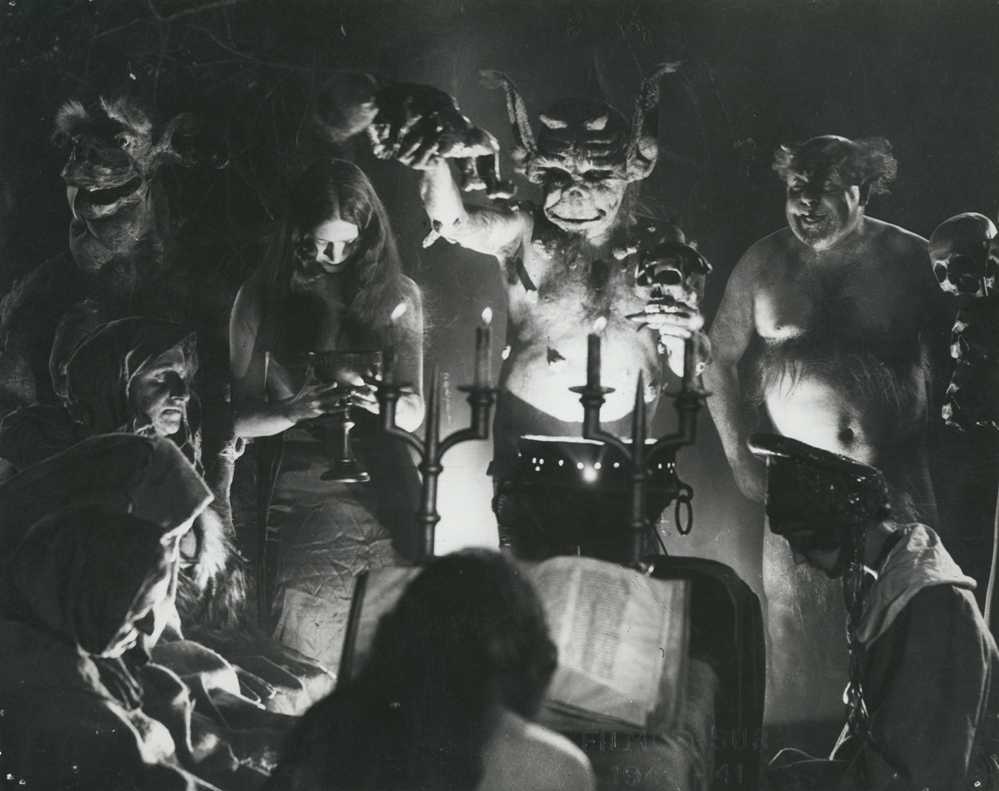
Next weekend is spookier than most at BFI Southbank – which is saying something, since the BFI Gothic season rolled into town. The Hauntology weekend takes over, with a screening of the majorly creepy drama-documentary Häxan on Friday 13 December, and on Saturday night, a collection of gothic treasures soundtracked by a group of seriously talented musicians – Sarah Angliss and the Spacedog ensemble. Here’s a little more about what you can expect from the shows – scroll down for a chance to win tickets to see Häxan.
The ensemble was put together by Sarah Angliss, a composer, automatist and theremin player, whose singularly unsettling music was recently heard at the National Theatre as a tense underscore to Lucy Prebble’s The Effect. Angliss’ music for Gothic film will be performed by her band: recent Ghost Box guests Spacedog. They’ll be joined byExotic Pylon’s Time Attendant (Paul Snowdon) who will be supplying a new work on simmering, tabletop electronics. There will also be some extemporisations from Bela Emerson, a soloist who works with cello and electronics. Fellow Ghost Box associate Jon Brooks, composer of the haunting Music for Thomas Carnacki (2011), will also be creating a studio piece for the event.
Sourced by Bryony Dixon, the BFI’s curator of silent film, many of the short films inspiring these musicians were made in the opening years of the twentieth century. The Legende du fantôme (1908) and early split screen experiment Skulls Take Over (1901) are on the bill, along with the silent cubist masterpiece The Fall of the House of Usher (US version, 1928) and more.
“There is undoubtedly something uncanny about the earliest of these films”, said Angliss. “Many are stencil-coloured in vibrant hues, adding to that sense of the familiar taking on a strange cast. They seem to demand music that suggests rather than points up the horror, a motif that discomforts as it soothes, or a sweet sound that is somehow sickly, as though heard in a fever.”
Brooks added “the visuals suggest aural textures reminiscent of painted glass, to strange derivatives of stringed instruments. Hopefully I’ve conjured some playfulness amongst the macabre too.”
Adding to the strangeness are Angliss’ automata, who will also be performing live. These include a polyphonic, robotic carillon (bell playing machine) and Hugo, the roboticised head of a ventriloquist’s dummy who is of the same vintage as some of the films. The event will be directed by Emma Kilbey. After the BFI Southbank performance there are plans to take Vault to Gothic revivalist buildings around the UK.
Sarah Angliss is grateful to PRS for Music for financially supporting her new work. Vault: Music for Silent Gothic Treasures is part of the BFI’s Hauntology Weekend, in association with The Wire magazine (Fri 13 Dec – Sat 14 Dec)
To book tickets for Vault: Music for Silent Gothic Treasures, click here http://bit.ly/bfivault. The screening takes places a 8:45pm NTF1, BFI Southbank, Saturday 14 December.
Häxan (1922)
On the Friday night, the Häxan screening will also be accompanied by live music: a specially commissioned score from Demdike Stare.
This 1922 documentary-horror masterpiece explores the effect of superstition on the collective medieval consciousness. Presented for the first time with a BFI-commissioned score by electronic artists Demdike Stare. The duo base their music on samples from old recordings, twisted into new sonic shapes. The blend of Demdike Stare’s resurrected aural phantoms and Christensen’s Satanic horror promises to be a singularly modern yet arcane live experience.
Häxan is a thrilling movie, and an amazing thing to experience on the big screen – an effect that will surely only be enhanced by those “aural phantoms”.
To book tickets for Häxan with Demdike Stare, in association with Wire Magazine, click here. The screening takes place at 7pm in NTF1, BFI Southbank, Friday 13 December. Tickets cost £15 full price – concessions are available.
Win! Win! Win!
To win a pair of tickets to Häxan with Demdike Stare, email the correct answer to this question to silentlondontickets@gmail.com with “Haxan” in the subject line by noon on Wednesday 11 December 2013.
Which American writer provided the voiceover for Häxan’s jazzy 1968 re-release?
The winner will be chosen at random and notified by email. Good luck!
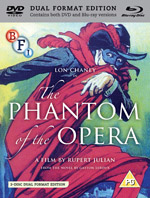
Three discs, two formats, both existing versions of the movie, the Carl Davis score, snippets of previously unseen footage including a reel from the the lost talkie adaptation, trailers, essays and the comprehensive documentary Lon Chaney: Man of a Thousand Faces … yes, this is a pretty fabulous Phantom.
But first things first … the movie. Well sit comfortably, because this gets a little complicated. The Phantom of the Opera is a 1925 Hollywood adaptation of the Gaston Leroux novel, starring the unforgettably versatile Lon Chaney as the malignant spectre who stalks the vaults beneath the Paris Opera House, and falls catastrophically in love with one of the sopranos who appears on the stage above him. Rupert Julian’s The Phantom of the Opera was booed by the audience at its first test showing, so had many scenes reshot by Edward Sedgwick, failed yet again to impress at screenings and was so handed over to Maurice Pivar and Lois Weber, who reconfigured and edited it down – this version, finally, was a hit, with the punters if not the critics. When talkies arrived, Universal reissued the movie with a score and effects track, plus newly filmed dialogue sequences, in 1929. We have only the soundtrack for this version, but the existing later version of the movie, presented on this dual format disc, is probably the silent version of the sound re-release. You follow?
The Phantom of the Opera
Here’s what’s clear: Chaney is astounding in this film. His famous makeup skills are responsible for his hideously twisted face, with bulging eyes, no nose and leathery skin. His physical prowess is even more powerful, however. This Phantom is elegantly sinister, a ghost fit for a grand opera house. And even through those grotesque features, his heartsickness for the unattainable Christine, played rather flatly by Mary Philbin, is plain.
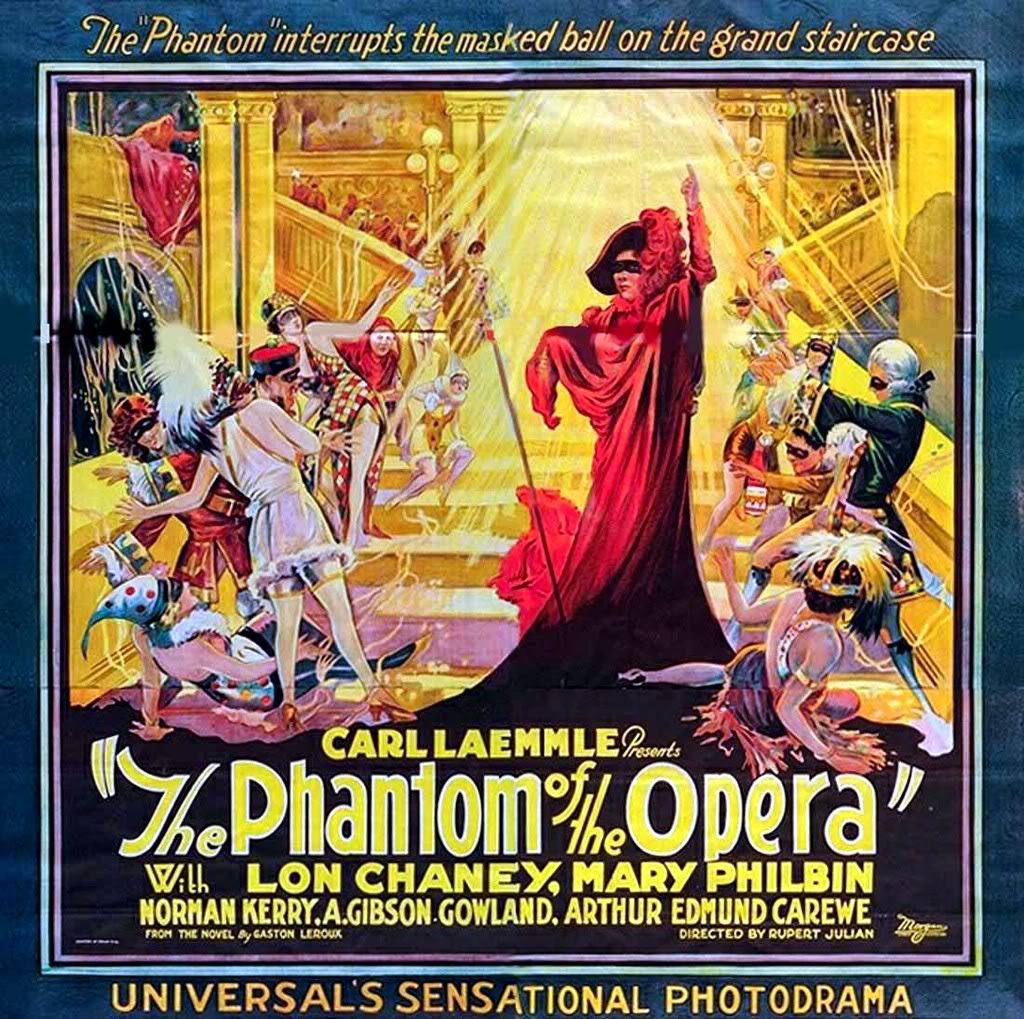
What supports Chaney’s performance is the glorious gothic beauty of the thing. The Phantom of the Opera is art directed splendidly, lending due grandeur to the set pieces, such as the chandelier falling on the Opera audience, and adding luscious detail to the glamorous settings. Tinting adds texture to the film: warmth to the brightly lit theatre, a lurid violet for the spooky cellars. The apogee of Phantom’s grand design is the Bal Masqué sequence – a burst of searing two-strip Technicolor, in which Chaney, dressed in a skull mask and rich red satin cloak, stalks into the party, scattering guests and disrupting the festivities to declare a hex.
This is high-camp Hollywood hokum to be sure, but hokum dressed up to the nines. And arguably the sheer gorgeousness of the film, as well as Chaney’s chill portrayal of the spectre, lend the entire endeavour an unexpected gravitas. And there is so much here that repays not just the care taken in the Photoplay restoration, and in the composition of Carl Davis’s thrilling score, but the high-def Blu-Ray treatment too. That spectacularly crashing chandelier; the creepy shadows in the vault; the heartbroken unmasked Phantom, lurking on the Opera House roof, scarlet cape fluttering in the blue tinted night ; the horror of the first moment that Christine sees her pursuer’s terrifying face; the brutality of the mob at the movie’s close.
The Phantom of the Opera
It should be no surprise that the success of The Phantom of the Opera spurred Universal on to create its famous string of horror movies in the 1930s. If you’re a horror fan yourself, you can’t miss this film which is both a fascinating predecessor to the genre, and also, courtesy of Chaney, a masterclass in acting for scary films. After all, what terrifies us most about the Phantom is not his unnatural powers, but that his very human vulnerabilities prompt him to use them.
The Phantom of the Opera Dual-format edition is available on 2 December from the BFI, rrp £22.99. Extras on the 3-disc set include 1925 and 1929 trailers, a reel from the lost talkie version, the mysterious “Man With a Lantern footage, the 1925 version of the film with a piano score by Ed Bussey, the Lon Chaney documentary, and a booklet of images and essays by Kevin Brownlow and Patrick Stanbury as well as a 1975 Monthly FIlm Bulletin review by Geoff Brown. Order a copy for £16.99 from MovieMail here.
I’m proud to be bringing people back to the cinema, in an age when people will happily watch Lawrence of Arabia on their mobile phones. Napoleon is pure cinema, and cinema was designed for sharing. There’s something about the way it was shot that makes it like no other. I can’t tell you how many people, having seen our restoration, have said: “That was the greatest experience I have ever had in a motion picture theatre.” Kevin Brownlow, How we made – Napoleon, theguardian.com
My eyes and ears are still adjusting back to normality. Yesterday’s screening of Abel Gance’s Napoléon at the Royal Festival bombarded the senses and befuddled the brain. It was not, as you may have been warned, a marathon. The five-hours-forty-minutes running time appears to go by in a flash, powered along by Carl Davis’s invigorating orchestral score. I would happily watch it all again tomorrow and the next day, and for as many times as it took to get to the bottom of its many mysteries.
Right then, six hours of Abel Gance's Napoleon with live orchestra, Here I Come.
Because despite the pleasures it offers, this is not an easily digestible film. Napoléon’s open-ended structure, which closes just as Bonaparte’s career takes flight, doesn’t help. It’s also a film of unexpected variety, and yes, unevenness, if only because its very best sequences are impossible to match. Immense but not immaculate, Napoléon is at times a masterpiece and at others a sketchbook of enthralling, intricate designs. The magic is that Gance’s ambition is every bit as exciting as his achievements. After just one, eagerly anticipated screening, I may be addicted.
I’m not going to attempt to write a review proper this morning, but I did want to give a flavour of the film, the event and the audience’s reaction to it.
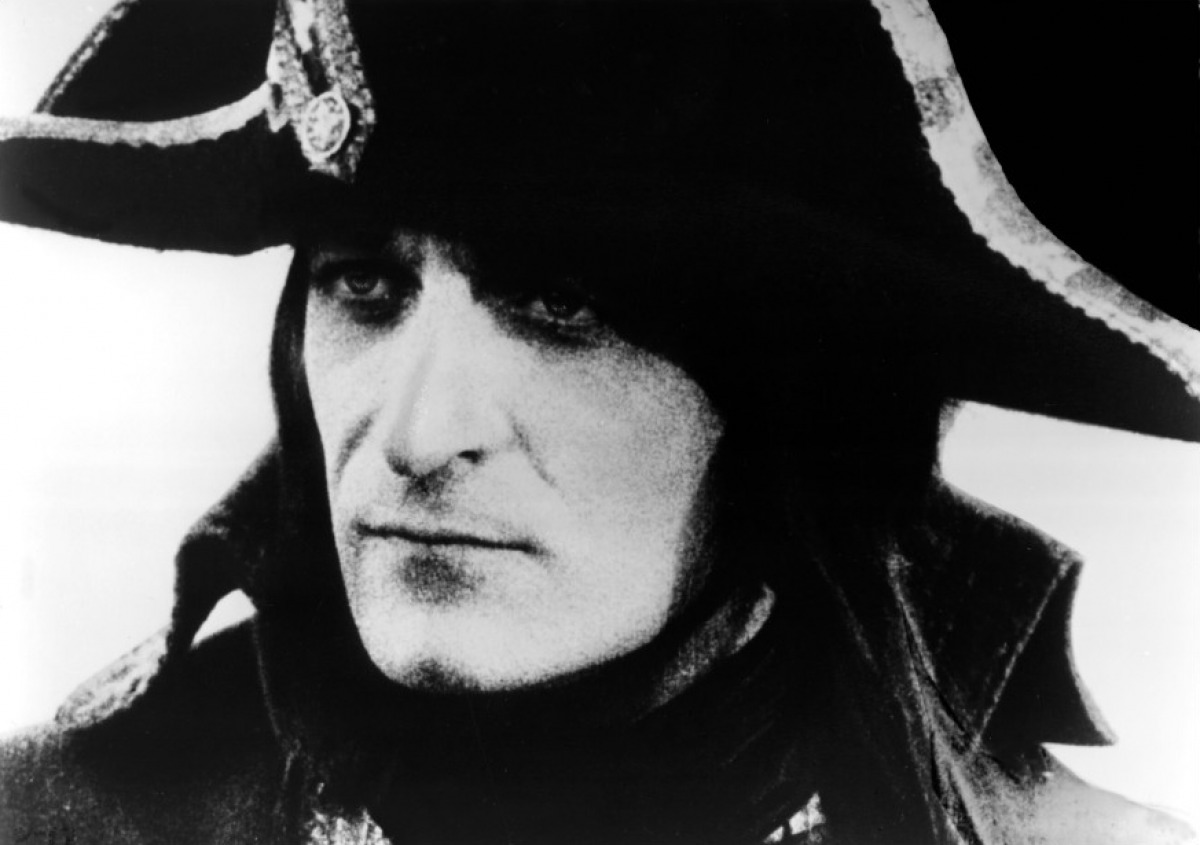
Napoléon is a biopic that pairs the grandeur of its subject’s work and vision with its own cinematic innovations. You will have read about the triptychs that close the movie (more of which later) but perhaps you’ve also heard about the flash cuts, superimpositions, multiple exposures and the cameras thrown, whirled, mounted on horseback. The first act of the film, in this restoration by Kevin Brownlow, contains much of its experimentation and bravado. It follows Napoléon as an unhappy alienated schoolboy, and his disastrous return as a young man to his native Corsica. The snowball fight that opens the film, in which Bonaparte and nine chums strategise their way to a crucial victory over 40 of their peers, led by a particularly unscrupulous pair of urchin villains, is a beauty – staged as if were the culmination of a bloody war. Likewise the frenzy of a pillow fight in the dorm. Vladimir Roudenko as the young Bonaparte is marvellous too – showing far more pluck and passion than Albert Dieudonné in the adult role. There is pathos and humour here, as throughout the film, but Napoléon excels at bombast, exemplified by the sequence that closes the act: Bonaparte, lost at sea in a boat with a Tricolour sail, thrillingly cross-cut with uprisings at the Paris Convention.
So far, so much like what I expected from Napoléon, although more exhilarating that I hoped it could be. What I wasn’t prepared for was a sudden shift in tone, as the second act lingered on the battlefield – crowded, red-tinted frames of bloody combat. Memorable details: a drowning man’s hand thrashing the in the mud, a cannon-cart rolling over a fallen soldier’s ankle. This typifies the movie’s take on history: grim faces, skewiff hairdos, grit and squalor. The film punctuates Bonaparte’s moody middle-distance staring and eloquent intertitle speeches with a mode one might call grotesque realism – whether it’s the exposed flesh of dancers at a ball, the tattered foot bindings of the Italian army or Napoleon’s cardboard boots disintegrating in the gutter, this is visceral stuff. And a note on realism: Napoléon footnotes all bona fide incidents and quotations with a “(Historical)” label on the relevant title. Not quite as clunky as it sounds, several “based on a true story” films would benefit from a similar device. Who knew that a clerk ate Josephine’s accusatory dossier to save her from the guillotine? Or that Nelson wanted to sink Napoléon’s “suspicious” boat on his return from Corsica, decades before Trafalgar?
Napoléon (Abel Gance, 1927)
After the long dinner interval, and much inevitable analysis and debate, the third act proved the most controversial. While the sequences exploring the Reign of Terror, from the ructions in the Convention, to brutality of the authorities (including Gance himself as a rather glamorous Saint-Just) were universally admired, many audience members I spoke to were of the “Not tonight, Josephine” persuasion. The courtship between Bonaparte and Josephine is strange, truncated and slightly unsettling. An impressionistic montage of their previous meetings suggest Napoléon’s passion for his lady, but a queasy sequence in which he embraces a globe superimposed with her face shows that his motivations may not be entirely romantic, with Josephine just another territory to be conquered as he builds his empire. The shadow of this bizarre love story is Violine, the young girl infatuated with Napoléon, who insinuates her way into Josephine’s household, imitates her dress and keeps a shrine to the General above her bed. Hardly edifying, but I found these glimpses of the warrior’s homelife fascinating, and enjoyed the tension between these awkward scenes and the single-mindedness of his military strategies.
The morning after #Napoleon. Really, everything pales after seeing Brits weep openly during the finale last night.
Seven hours after first taking our seats, we assembled for the finale. I freely admit that my lower lip had already wobbled as the titles rolled at the start of the film (“This is it! I’m watching Napoléon!”) but according to my sources, Napoléon was at its most most Napoléon in its last 20 minutes. Not long to wait. In fact, the final hour breezes by, as Napoléon sets out to conquer Italy (writing passionate love letters to the missus in his carriage even while he dispatches orders to his riders). The troops are dilapidated, and morale is as low as funds, but the mountain landscapes are incredible. So, as Napoléon rallies his men with more fine words, it’s just a matter of time before the screen grows, the orchestra soars and Gance’s Polyvision finale kicks in. The panorama shots, after five and a half hours of Academy Ratio, are enough to send anyone into a spin, but when Gance designs each frame individually, multiplying his montage techniques, using colour and superimposition and animation, the the effect is truly astonishing. And at the centre of it all, Dieudonné’s graven face, beneath that famous hat, surveying his own triumph. It’s a monument to patriotism of course, but in the RFH last night, our awe at the work of Gance, of Brownlow and of Davis, rekindled our devotion not to a country but to the cinematic arts. A magnificent monstrosity, Napoléon offers refined beauty, raw thrills and a thousand and one reasons to adore the cinema.
“There’s nothing that matches the experience of going along to see it. It’s incredible. Word has gotten round: this is fun, this is extraordinary.” Carl Davis, How we made – Napoleon, theguardian.com
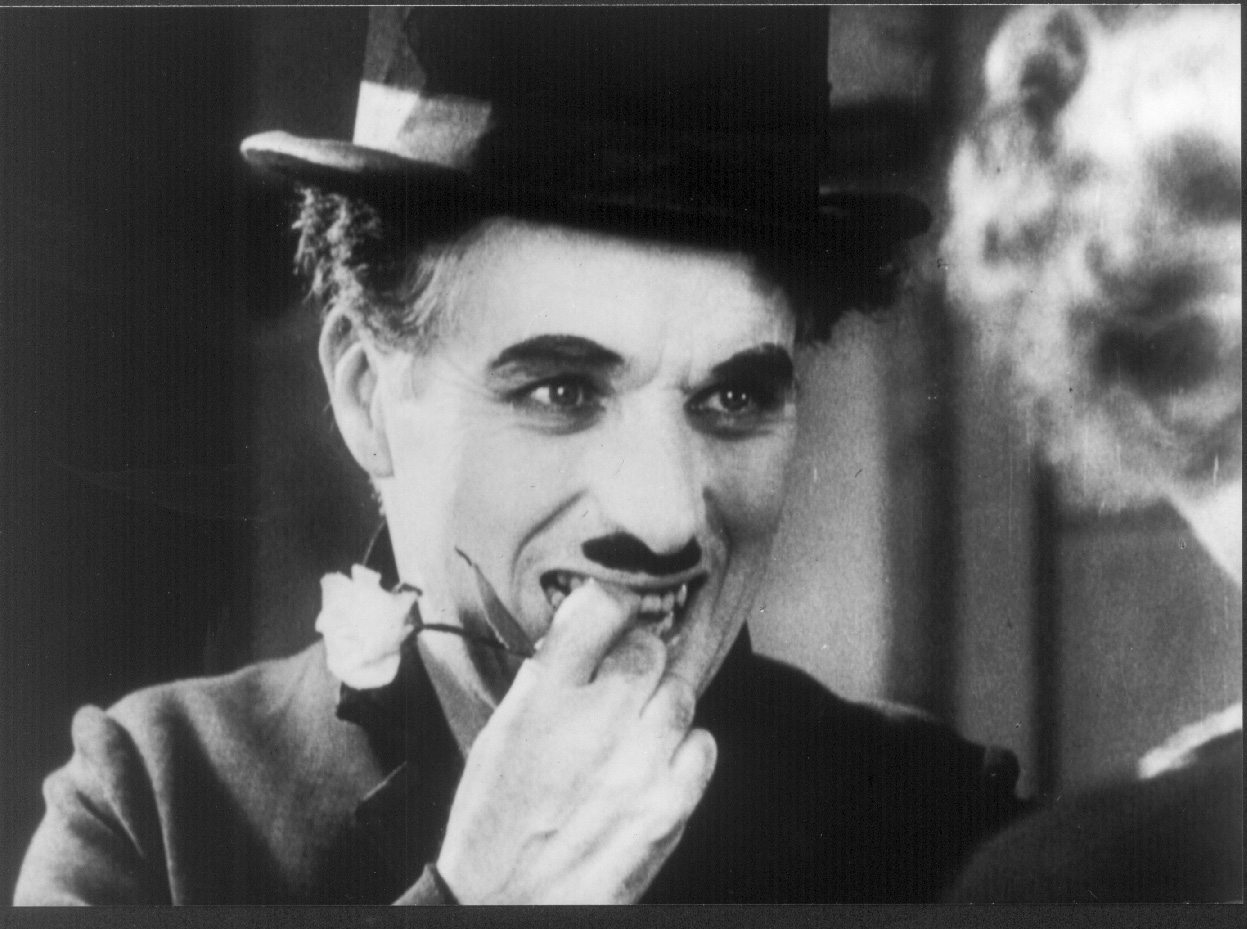
The funniest weekend of the year is back: Bristol’s own rib-tickling Slapstick Festival. This year marks not only the 10th year of the festival but, as you all very well know, the 100th anniversary of Chaplin’s iconic Little Tramp. The Slapstick Festival will be celebrating the tramp in fine style with an orchestral gala screening of the the wonderful City Lights (1931), recently voted into the Top 10 Silent Movies by the Guardian and Observer. The screening will be introduced by comedian Omid Djalili and music will be provided by the 39-piece Bristol Ensemble.
There’s a full weekend of funny films beyond the Chaplin too. Check the listings below for details. Notable screenings inlcude the Societ laugh-riot The Extraordinary Adventures of Mister West in the Land of the Bolsheviks (1924), the rarely shown Raymond Grifffith romp Hands Up! (1926) and a chance to see Constance Talmadge in Her Sister From Paris (1925). And don’t miss Harold’s Lloyd’s classic Safety Last! (1923) with Radio 4’s Colin Sell on the piano.
Max Davidson
More treasures are to be found in the talks and lecture events: David Robinson on the Tramp, Kevin Brownlow on Chaplin and the Great War, all three Goodies on Buster Keaton and Graeme Garden delving into the work of German Jewish comic Max Davidson.
There will be some modern work featured too: from Wallace & Gromit (naturally) to The Meaning of Life and Withnail & I. Yes, Tim Vine will be offering a tribute to Benny Hill too!
The 10th Slapstick Festival will be held at various venues across Bristol from 24-26 January 2014. Visit the website for more details, or read on for full listings and ticket information.
I know, we don’t look our age, but yes, Silent London has been keeping movie fans updated on silent film news, reviews and events for three whole years now. Thanks to everyone who reads this site, for your support, enthusiasm and intelligent comments. It has been, and continues to be, the cat’s particulars, and never a gimlet.
In the interview, Chandler asks Stephen about how he started out playing for silent films, and Stephen reveals that The Passion of Joan of Arc was the intimidating first film he ever accompanied. They also discuss the differences between composition and improvisation, and in more detail, the music that Stephen has played and written for Stella Dallas, The Manxman, Prix de Beauté and The First Born. Thanks to Chandler and Stephen for allowing me to post this fascinating conversation here on Silent London.


















 Silent London